23 November 2012

A few books recalled

Some of you will remember that a short time ago I bought a book simply because the subtitle made me laugh: The Hobbit and Philosophy: For When You've Lost Your Dwarves, Your Wizard, and Your Way.

Despite a promising - and enjoyable - introduction cleverly peppered with many allusions and puns,  the rest of the book really has very little to do with such situations as when you've lost your dwarves, your wizard, or your way.

The book is written by a number of philosophers, nearly all of whom somehow seem not to have noticed that Tolkien's was not only Catholic, but that his faith very much shaped his conception of Middle Earth.  Too much of the book focuses on Taoism and not on Catholicism and so misses the real insights contained with Tolkien's subcreation.

Frankly, I don't really recommend this book to anyone seeking to delve more deeply into Middle Earth.

While I'm reviewing books, let me make a brief mention of two books that the Chancellor, knowing of my love of The Hobbit and The Lord of the Rings, kindly gave to me recently.

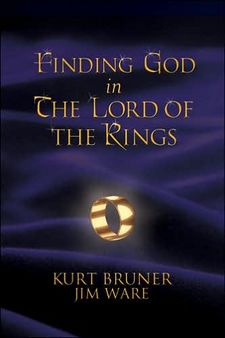
The first is Finding God in the Hobbit by Jim Ware and the second is Finding God in The Lord of the Rings by Kurt Bruner and Jim Ware.

While these took books deal with Christian themes, they also seem to have missed - or perhaps chose to ignore - Tolkien's Catholic faith one.  Bruner and Ware are Christian, but to which they denomination they adhere they give little indication, except for one reference to "Jehovah".

These short books can each be read in the space of an hour.  In both books, the chapters form reflections on a line or two from Tolkien's work.  Beginning first with a recap of the situation surrounding the brief quotation, Bruner and Ware follow the recap with a sort of mini homily and conclude with a "reflection" fit a church marquee.

These two books are not bad, but they are very simple and won't really help anyone delve more deeply in the many insights Tolkien offers us.

Better, I suggest, to stick with Matthew Dickerson's A Hobbit Journey: Discovering the Enchantment of J.R.R. Tolkien's Middle-earth.  Of the books I have read looking at the Christian and philosophical underpinnings of Tolkien's work, it is the best and more insightful.

22 November 2012

Thanksgiving and the Year of Faith

During this Year of Faith, Pope Benedict XVI has called us "to rediscover the content of the faith that is professed, celebrated, lived and prayed."  This, he says, "is a task that every believer must make his own" (Porta Fidei, 9).

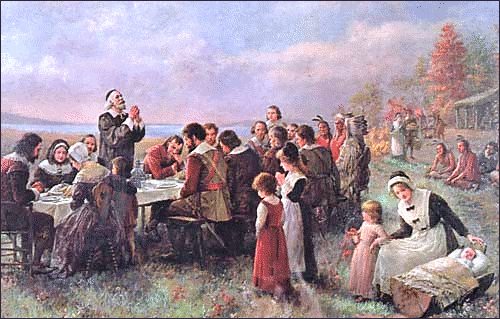
One important way we can rediscover the faith that is celebrated is to reflect on the liturgical texts of the Church found in the Roman Missal.  Doing so as we in these United States of America celebrate Thanksgiving Day can offer us a profound insight into what it means to give thanks.

We should never forget the ancient maxim lex orandi, lex credendi, which roughly means "the law of prayer is the law of belief."  In this principle we remember that our worship of God is the foundation of all that we are.

There is a common thread uniting the prayers Holy Mother Church has given us to use on Thanksgiving Day.


The Collect - which gathers our various individual prayers together at the beginning of the Mass and presents them to the Father - recalls that the Father's "gifts of love are countless" and asks the Lord to "open our hearts to have concern for every man, woman, and child, so that we may share your gifts in loving service."  The Prayer Over the Offerings similarly asks the Father that "we might learn to share your blessings in gratitude" while the Prayer after Communion asks that we will be helped "to reach out in love to all your people, so that we may share with them the good things of time and eternity."'

The common thread uniting the prayers together is the recognition that gratitude for God's copious blessings must lead to a willingness to share these gifts with others, with friends and families, with enemies and strangers.  The preface makes this common thread more explicit when it recalls that the gift of freedom is "a gift that calls forth responsibility and commitment to the truth that all have a fundamental dignity before you."

The gifts that we have received from God are not simply ours to keep, but are given to us to be shared freely, with loving and joyful hearts.

Here we remember the words of the Lord Jesus, "Truly, I say to you, as you did it to one of the least of these my brethren, you did it to me," and, "Truly, I say to you, as you did it not to one of the least of these my brethren, you did it not to me" (Matthew 25:40, 45).

This is why the Holy Father reminds us that "confessing with the lips indicates in turn that faith implies public testimony and commitment.  A Christian may never think of belief as a private act.  Faith is choosing to stand with the Lord so as to live with him" (Porta Fidei, 10).  This is why to the maxim lex orandi, lex credendi is often added the phrase lex vivendi: the law of prayer is the law of belief is the law of life.  What the Church prayers is the faith of the Church we should direct the way we live.

As we give thanks today for the many gifts with which the Lord has blessed us - among which we should especially recall the gifts of faith and of freedom - let us ask above all for hearts as generous as his that we imitate him in all things.  Let us beg the grace to give generously and never count the cost because, as Pope Benedict XVI reminds us, "Faith without charity bears no fruit, while charity without faith would be a sentiment constantly at the mercy of doubt.  Faith and charity each require the other" (Porta Fidei, 14).

To you and to yours, I wish a very happy and blessed Thanksgiving!

21 November 2012

If only I were free tonight!

At long last, after many years of waiting, the "antechamber" of Pope Benedict's monumental work, Jesus of Nazareth, is finally in my hands.  Deo gratias!

Opening the little book subtitled The Infancy Narratives at random - it is only 132 pages - I found this insightful passage:

Mary wrapped the child in swaddling clothes.  Without yielding to sentimentality, we may imagine with what great love Mary approached her hour and prepared for the birth of her child.  Iconographic tradition has theologically interpreted the manger and swaddling clothes in terms of the theology of the Fathers.  The child stiffly wrapped in bandages is seen as prefiguring the hour of his death: from the onset, he is the sacrificial victim, as we shall see more closely when we examine the reference to the first-born.  The manger, then, was seen as a kind of altar (68).

I can't wait to read it and wish I didn't have any plans this evening!

Even in fog, the Cross stands clear

The weather here in central Illinois has been a bit odd lately, with highs in the lower 60s and lows in the lower 30s.  That temperatre isn't particularly unusal in these parts, but what is is that the temperature doesn't start falling until after 9:00 p.m. (and that's been a bit early).  The late and sudden drop in temperatures has resulted in a heavy fog settling over the plains each morning for about the last week and a half or so.

This morning, though, the fog is unusally heavy and thick.  Even in downtown Springfield, the fog is only now beginning to lift and it isn't expected to dissipate until sometime in the early afternoon.

At any rate, earlier this morning a friend posted a picture of Father Tolton's grave to Facebook, which he kindly has allowed me to share with you:


What I particularly like about it is the prominence of the cross, even in the dense fog.  Let this image serve as a visual reminder for each of us that in the fog and mists of life that cloud our vision and confuse our thinking, let us remember that the Cross of our Lord is always present immediately in front of us, and that so long as we hold fast to it our vision and thinking will both be cleared.

17 November 2012

Mass for the New Evangelization

As you know, we are presently in the midst of the Year of Faith, proclaimed by the Holy Father Pope Benedict XVI "to arouse in every believer the aspiration to profess the faith in fullness and with renewed conviction, with confidence and hope" (Porta Fidei, 9).  (If you haven't yet read Porta Fidei, hop to it!)

Prior to the beginning of this Year of Faith - on 18 June 2012 - the Congregation for Divine Worship and the Discipline of the Sacraments approved the Mass for the New Evangelization (I missed it, too), which is not found in the current edition of the Roman Missal.

Last month, the same Congregation released the Latin and the vernacular translations of the prayers and the readings from the Sacred Scriptures so that this Mass may be celebrated through the Year of Faith.

My brother priests, let's make good and frequent use of this Mass for the New Evangelization that the efforts of this Year of Faith will bear great fruit!

My Brother the Redneck

One of the things I most enjoy about the Middle Ages is their sheer honesty often used when describing their leaders, an honesty that by today's standards of political correctness would, at the very least, border on the offensive (in a time without surnames you had to distinguish people somehow).

Some simply stated the obvious, as with King William the Bastard or Geoffrey the Bearded or Wilfred the Hairy or Fortun the One-Eyed or King Canute the Tall.

Some of the epithets attached to the names of their kings recognized their good qualities, as in the case of King Richard the Lion-hearted (couer de lion) or King Sancho the Wise.

Other epithets, however, were less flattering, as in the case of King Edward the Confessor - so-named because he frequently made use of the sacrament of confession, which is, in part, why is also a Saint - or King Louis the Pious, both titles that could be both a word of praise or a jab.  There is also King Henry the Fowler, who was fixing his nets when he received word he was to be king.  And I cannot forget my favorite epithet, that given to King Peter the Ceremonious.

Still other epithets were much less ambiguous and rather pointed.  Consider, for instance, Pepin the Short or King Charles the Bald or King Aethelred the Unready or Fulk the Quarreler.

By now you're probably wondering why I've brought any of this up.

After my day of Q&A at Quincy Notre Day High School I had supper with my brother, to whom I often refer as "my brother the redneck," an epithet he rather enjoys.

When we finished our meal he insisted I swing by his house to see the Christmas light display he has prepared in his yard this year (he had to put them up already, he explained, because a neighbor already had his lights up and on).

When my brother turned on his lights (to his credit he largely leaves them off until Thanksgiving night) I beheld this sight:


There is no need to rub your eyes, they do not deceive you; that is a pink flamingo on the left (wearing, I'm assured, a Santa hat).

He has the lights on some sort of a musical timer with the lights going on and off according to the music, so snapping a picture of all of the lights was a bit of a trick.

After watching the display for a short time (it was cold outside), I suggested he needed more wildlife or snowmen.  To my well-meaning suggesting, he replied with a happy smile, "I can get a pig!"

And that, my friends, is why I refer to him as, "My Brother the Redneck."

"If I forget you, O Jerusalem, let my right hand wither" (Psalm 137:5)

As violence intensifies in the Holy Land and the threat of total war looms heavy on the horizon, we do well to turn to Our Lady, Queen of Palestine - the Patroness of the Equestrian Order of the Holy Sepulchre of Jerusalem - to implore her intercession for peace.

Devotion to the Blessed Virgin Mary under her title as Queen of Palestine took on greater focus when Patriarch Louis Barlassina established the shrine of Our Lady, Queen of Palestine at Deir Rafat in 1927; at the time, all of the Middle East was commonly referred to as Palestine.

The Holy See approved the liturgical celebration of this feast in 1933 to, as Patriach Michel Sabah once noted, "ask the protection from God through the intercession of our Lady daughter of this Holy Land, and who was chosen to become the mother of his eternal word incarnated, who took a body like ours in order to redeem us, and became man like us in everything not in sin."

As we watch with trepidation to violence in the land where the Prince of Peace walked among us, let us sing with King David:
Pray for the peace of Jerusalem!
May they prosper those who love you!
Peace be within your walls,
and security within your towers!
For my brethren and companions' sake
I will say, "Peace be within you!"
For the sake of the house of the LORD our God
I will seek your good (Psalm 122:6-9).
Let us then turn to the Queen of Palestine, Mary, the Queen of the Middle East, and implore her intercession:
O Mary Immaculate, gracious Queen of Heaven and of Earth, behold us prostrate before thy exalted throne. Full of confidence in thy goodness and in thy boundless power, we beseech thee to turn a pitying glance upon Palestine, which more than any other country belongs to thee, since thou hast graced it with thy birth, thy virtues and thy sorrows, and from there hast given the Redeemer to the world. 
Remember that there especially thou wert constituted our tender Mother, the dispenser of graces. Watch, therefore, with special protection over thy native country, scatter from it the shades of error, for it was there the Sun of Eternal Justice shone. Bring about the speedy fulfilment of the promise, which issued from the lips of Thy Divine Son, that there should be one fold and one Shepherd. 
Obtain for us all that we may serve the Lord in sanctity and justice during the days of our life, so that, by the merits of Jesus and with thy motherly aid, we may pass at last from this earthly Jerusalem to the splendours of the heavenly one. 
Amen.
Our Lady, Queen of Palestine, pray for us all and all the peoples of the lands made sacred by your Son's Life, Death, and Resurrection.  Amen.

16 November 2012

Paprocki writes on sports and faith

This coming February Ave Maria Press will release a new book by   His Excellency the Most Reverend Thomas John Paprocki, Bishop of Springfield in Illinois, that he co-wrote with his brother Joe.

A long-time hockey goalie and marathon runner, Bishop Paprocki has titled the book Holy Goals for Body and Soul: Eight Steps to Connect Sports with God and Faith.

You can pre-order the 160 page book through Amazon.com (curiously, it isn't yet on AMP's web site).

15 November 2012

Staples beat me to it

When I was at Quincy Notre Dame High School to celebrate Mass for the Solemnity of All Saints, I had the great pleasure of taking a teacher's classes for the day.

Knowing that his students have questions and that I have answers, he asked - when he learned I would be there for Mass - if I would have a go at their questions.

I've never been one to shy away from Q&A - in fact, I positively enjoy it and find it invigorating - and gladly accepted his invitation.

Now, such a session with high school students can be a bit of a challenge, not because of a fear of being stumped - which hasn't happened yet - but a fear of running out of questions.  I'm happy to say that each of the four questions asked insightful and intelligent questions, and had more questions than I had time to answer.

When I left for the day, the teacher - who is also a friend of mine - invited me to come back anytime.  When I saw him this past weekend in conjunction with a high school retreat I helped with, he told me his students insisted I needed to come back - apparently they thoroughly enjoyed my time with them - and said when I do come back I need to stay for a week (that might be hard to pull off).

At any rate, tomorrow I'll be back for a second go at their questions and I'm very much looking forward to it.

As invigorating as Q&A is, four hours of it is also exhausting.  If you happen to see me tomorrow in the late afternoon or throughout the evening and I don't make a great deal of sense (or, at least, less sense than usual), you now know the cause.

08 November 2012

A nation of fools is surely doomed...

Wake up, people!


Unexpected words

Earlier this week the Diocese of Springfield in Illinois held its 16th biennial Diocesan Adult Enrichment Conference with the theme "Living Faith Fully, Sharing Faith Freely" at which Father Robert Barron gave two excellent keynote addresses.

The first morning of the two-day event, Bishop Paprocki and I were waiting in a hallway before the beginning of Morning Prayer as the conference attendees were filing into the appropriate room.

As one young man walked by, he pointed towards me and said, "I've you've seen you on New Advent."  It was, I think, a compliment.

His unexpected words caught me quite by surprise; no one had ever said that to me before.  I'm not sure why, but his words still stick with me these five days later.

07 November 2012

How fitting

I saw this cartoon a few moments on Facebook:


It is sad, but very true.

Disappointment

This morning I find myself marked by a certain sorrow; the weather mirrors my mood well.  I had hoped - rather uncharacteristically - this nation would prove itself to be an enlightened one, but half of our fellow citizens have shown that they live in darkness with their vote against life and religious liberty.

Edmund Burke (d. 1797) wisely said, "Those who do not know history are doomed to repeat it."  Last night we saw the truth of his words lived out in the American people, a people who largely do not know the present, let alone the past.  As proof, consider this staggering fact: The most Googled question yesterday was, "Who is running for President?"

One of my professors in college correctly told us, on numerous occasions  that historians are the best people to indicate what the future holds, not in the sense of fortune-telling but in the sense of reading the signs of the times.  Because historians study the events of the past - including the circumstances and motives involved - they can become, if they are astute, "experts" on the human person and what motivates him on a collective basis.

Let me be clear: I do not believe President Obama is The Anti-Christ, nor I do believe the arrival of the End Times are heralded by his election.  I do believe, however, that his election - and particularly his re-election - will mark the beginning of the end of the Republic.

Five years ago I began warning my students and others who would listen where the election of Barack Obama as President of the United States of America would lead.  History has seen political leaders arise through sheer force of charisma before, and it has never ended well.

At the time, many of my students and their parents laughed at me and mocked me.  Last night their Facebook posts and Twitter feeds indicate they now see the truth of my words and, with me, now fear for the future of the Republic.

For some hours now I have been struggling to put my thoughts into words and still cannot do so.  Father John Trigilio, however, has written an excellent post that echoes my very thoughts.

As a student of history, what do I see as I look to the coming months and years?

"Gay marriage" is now legal in nine of the fifty States.  The push for its legalization in other States and on a federal level will not end or slow down.

Here in Illinois, we have seen the effects not of legalized "gay marriage," but of civil unions.  After legalizing same-sex civil unions, the State forced Catholic Charities out of foster care and adoptions.  The same has happened in Boston and will continue to happen with increasing speed in other cities and States.

Laws were enacted some years ago to classify certain attacks as "hate crimes," many of which include attacks on those who take part of the gay subculture.  Though such laws have unfortunately not included attacks against people of faith as hate crimes, I do not deny or dispute the good such laws can do.

New laws, however, will soon be enacted that will classify the teachings of the Church on homosexuality, contraception, abortion, and marriage as "hate speech."  Such laws will be the beginning of a concerted and purposed persecution of the Church; the government will seek to silence the Church by removing her pastors.

Once her pastors are silenced or removed, the rights of the Church and of the faithful will be increasingly curtailed and taken away.  Once the freedom of religion is taken away, every other freedom will also be removed.

I know that, because of these words, some will accuse me of inciting hate.  Such is not my intent and I have written nothing hateful.  Such laws have already been passed in Canada and in Great Britain, and the consequences have not always been pleasant.

I hope very much that I am wrong, but looking at past events and the present threats to religious liberty in these United States, this trajectory seems clear.

Writing this morning to President Obama, Timothy Cardinal Dolan, Archbishop of New York and President of the United States Conference of Catholic Bishops, congratulated the President and offered assurances of his prayers, and of those of his brother Bishops:
In particular, we pray that you will exercise your office to pursue the common good, especially in care of the most vulnerable among us, including the unborn, the poor, and the immigrant.We will continue to stand in defense of life, marriage, and our first, most cherished liberty, religious freedom.We pray, too, that you will help restore a sense of civility to the public order, so our public conversations may be imbued with respect and charity toward everyone.
I pray for the same and every day I remember the President in my prayers.

Let us pray for those elected to public office in this country and in every country:
Almighty ever-living God,in whose hand lies every human heart and the rights of peoples,look with favor, we pray,on those who govern with authority over us,that throughout the whole worldthe prosperity of peoples,the assurance of peace,and freedom of religionmay through your gift be made secure.Through our Lord Jesus Christ, your Son,who lives and reigns with you in the unity of the Holy Spirit,one God, for ever and ever.Amen.
- Roman Missal 

Saint Thomas More, pray for us!

Update: Simply Fulfilled follows up on this post with a good list of prayer needs for the nation and an encouragement not to lose hope.

06 November 2012

Vote for principle

The statue is of John Wood (1798-1880),
founder of Quincy and second governor of Illinois.
What was once the principle square in my beloved Gem City (a.k.a. Hobbiton) originally was named John Park (today it is called Washington Square/Park).

It was the main square of downtown Quincy, which was - and remains - the seat of Adams County.

As you have likely deduced - and rightly so - Quincy, Illinois was named in 1825 after the sixth President of these United States of America, John Quincy Adams.

It was in this very park that Stephen Douglas and Abraham Lincoln held their sixth of seven debates, a moment that Quincians have not forgotten, but that's a story perhaps for another day.
At any rate, it was the namesake of my hometown who said (as Bishop Coyne reminds us today):
Always vote for principle, though you may vote alone, and you may cherish the sweetest reflection that your vote is never lost.
This nation was founded on the principles of life, liberty, and the pursuit of happiness.  These three are very much intertwined and are presently being threatened from numerous sides as both the dignity of human life and the freedom of religion are slowly and purposefully being curtailed.

As we cast our ballots today, let us do so for these principles that have made our nation great, and not for partisan politics.  We must remember that we are not Republicans or Democrats or Independents, but Catholics.

May God bless us, one and all.

02 November 2012

Effective marketing

I'm not ashamed to admit that I just bought this book because the subtitle had me buckled over in laughter: The Hobbit and Philosophy: For When You've Lost Your Dwarves, Your Wizard, and Your Way.

Once I've finished reading it, I'll let you know what I think of it.

We have loved them in life, let us not forget them in death

It is a pity that we, in our enlightened day, generally only allow a few days of the year to remember - in a deliberate and purposeful way - our beloved dead.  As a society we typically allow Memorial Day, Veterans Day, and today, the Commemoration of the Faithful Departed.

As we become materially comfortable, we grow afraid of death.  It sometimes seems that the more comfortable we are the more afraid of death we are.  Why?

We have largely forgotten God and we live as if this life alone mattered.  This is the great tragedy of our time.

Reflecting on the death of his brother Satyrus, Saint Ambrose of Milan said that "we should have a daily familiarity with death, a daily desire for death" because "our soul must learn to free itself from the desires of the body."  If we lived each day with the recognition that one day - perhaps today - we will die, how different our lives would be!

Saint Damien of Moloka'i once wrote to his brother, saying, "the cemetery and the hut of the dying are my best meditation books, as well as for the benefit of my own soul as in view of preparing my instructions."

Too often we forget that death is, as Saint Ambrose says, "no cause for mourning, something to be avoided, for the Son of God did not think it beneath his dignity, nor did he seek to escape it."

This is not to suggest that we should not grieve the deaths of our loved ones; it highlights, rather, the destiny of those who have died in Christ.  Love does not end in death, whether it be our love of the love of the Lord for us.

He died so that we might be with him for ever and so "the soul has to turn away from the aimless paths of this life," says Saint Ambrose, "from the defilement of an earthly body; it must reach out to those assemblies in heaven."

We come, then, to the doctrine of Purgatory, that process by which souls are cleansed of their impurities and are made holy to stand before the throne of God.

In his second encyclical letter Spe salvi (Saved by hope), Pope Benedict XVI beautifully described Purgatory (it's a little lengthy but well worth a read), with my emphases:

With death, our life-choice becomes definitive—our life stands before the judge. Our choice, which in the course of an entire life takes on a certain shape, can have a variety of forms. There can be people who have totally destroyed their desire for truth and readiness to love, people for whom everything has become a lie, people who have lived for hatred and have suppressed all love within themselves. This is a terrifying thought, but alarming profiles of this type can be seen in certain figures of our own history. In such people all would be beyond remedy and the destruction of good would be irrevocable: this is what we mean by the word Hell[37]. On the other hand there can be people who are utterly pure, completely permeated by God, and thus fully open to their neighbours—people for whom communion with God even now gives direction to their entire being and whose journey towards God only brings to fulfilment what they already are[38]. 
Yet we know from experience that neither case is normal in human life. For the great majority of people—we may suppose—there remains in the depths of their being an ultimate interior openness to truth, to love, to God. In the concrete choices of life, however, it is covered over by ever new compromises with evil—much filth covers purity, but the thirst for purity remains and it still constantly re-emerges from all that is base and remains present in the soul. What happens to such individuals when they appear before the Judge? Will all the impurity they have amassed through life suddenly cease to matter? What else might occur? Saint Paul, in his First Letter to the Corinthians, gives us an idea of the differing impact of God's judgement according to each person's particular circumstances. He does this using images which in some way try to express the invisible, without it being possible for us to conceptualize these images—simply because we can neither see into the world beyond death nor do we have any experience of it. Paul begins by saying that Christian life is built upon a common foundation: Jesus Christ. This foundation endures. If we have stood firm on this foundation and built our life upon it, we know that it cannot be taken away from us even in death. Then Paul continues: “Now if any one builds on the foundation with gold, silver, precious stones, wood, hay, straw—each man's work will become manifest; for the Day will disclose it, because it will be revealed with fire, and the fire will test what sort of work each one has done. If the work which any man has built on the foundation survives, he will receive a reward. If any man's work is burned up, he will suffer loss, though he himself will be saved, but only as through fire” (1 Cor 3:12-15). In this text, it is in any case evident that our salvation can take different forms, that some of what is built may be burned down, that in order to be saved we personally have to pass through “fire” so as to become fully open to receiving God and able to take our place at the table of the eternal marriage-feast.
Some recent theologians are of the opinion that the fire which both burns and saves is Christ himself, the Judge and Saviour. The encounter with him is the decisive act of judgement. Before his gaze all falsehood melts away. This encounter with him, as it burns us, transforms and frees us, allowing us to become truly ourselves. All that we build during our lives can prove to be mere straw, pure bluster, and it collapses. Yet in the pain of this encounter, when the impurity and sickness of our lives become evident to us, there lies salvation. His gaze, the touch of his heart heals us through an undeniably painful transformation “as through fire”. But it is a blessed pain, in which the holy power of his love sears through us like a flame, enabling us to become totally ourselves and thus totally of God. In this way the inter-relation between justice and grace also becomes clear: the way we live our lives is not immaterial, but our defilement does not stain us for ever if we have at least continued to reach out towards Christ, towards truth and towards love. Indeed, it has already been burned away through Christ's Passion. At the moment of judgement we experience and we absorb the overwhelming power of his love over all the evil in the world and in ourselves. The pain of love becomes our salvation and our joy. It is clear that we cannot calculate the “duration” of this transforming burning in terms of the chronological measurements of this world. The transforming “moment” of this encounter eludes earthly time-reckoning—it is the heart's time, it is the time of “passage” to communion with God in the Body of Christ[39]. The judgement of God is hope, both because it is justice and because it is grace. If it were merely grace, making all earthly things cease to matter, God would still owe us an answer to the question about justice—the crucial question that we ask of history and of God. If it were merely justice, in the end it could bring only fear to us all. The incarnation of God in Christ has so closely linked the two together—judgement and grace—that justice is firmly established: we all work out our salvation “with fear and trembling” (Phil 2:12). Nevertheless grace allows us all to hope, and to go trustfully to meet the Judge whom we know as our “advocate”, or parakletos (cf. 1 Jn 2:1).
And so we pray this day, and every day:
Eternal rest grant unto them, O Lord, and let perpetual light shine upon them.  May they rest in peace.  Amen.

01 November 2012

Homily - 1 November 2012


The Solemnity of All Saints
Quincy Notre Dame High School

Mr. McDowell, teachers and staff, honored visitors, my dear young friends: it is indeed a great pleasure to celebrate this Solemnity of All Saints with you here in the Gem City! 

Today the Apostle John offers what may well be the best answer to any question posed by a teacher: “My lord, you are the one who knows” (Revelation 7:14).  Your teachers may not give you full credit for the answer, but they may at least give you extra credit for being clever.

There are some people who seem to skate through life, as it were, on extra credit, without ever really investing themselves fully into their projects and duties.  They count on their charm, charisma, or cleverness, but do not know the satisfaction of an honest attempt or the growth that comes from failure.

In his vision of the heavenly court, Saint John the Beloved certainly does not find himself in the presence of those who merely ambled their way into heaven.  No, these men and women “wearing white robes and holding palm branches in their hands” are those who “have survived the time of great distress” (Revelation 7:9, 14).  It is no accident that they are standing before the throne of God.

As we contemplate the lives of the Saints, of those who have made themselves pure out of love for God (cf. I John 3:3), we often wonder how they did so.  How did they keep their hands sinless and their hearts clean (cf. Psalm 24:4)?

We are told that the seal of the servants of God was placed on their foreheads (cf. Revelation 7:3).  Elsewhere we are told that this seal is the sign of the tau, the Greek letter T; the seal of the servants of God is the Cross (cf. Ezekiel 9:4).

On the day of our Baptisms, a priest traced the Sign of the Cross on our foreheads and as he did so, he said, “I now claim you for Christ our Savior by the Sign of his Cross.”  When the Bishop confirmed us with the Sacred Chrism, he again traced the Sign of the Cross on our foreheads, saying, “Be sealed with the gift of the Holy Spirit.”  The Saints, too, have been sealed in the same way.  What is it, then, that differentiates us from them?

Throughout their lives – or at least toward the end of their lives – they longed to ascend the mountain of the Lord and to stand in his holy place (cf. Psalm 24:3).  Put perhaps more simply, they wanted – more than anything else – to be with God, to look upon the beauty of his face (cf. Psalm 24:6).  Each of the Saints recognized the truth of Saint Augustine’s words: “You stir man to pleasure in praising you, because you have made us for yourself, and our heart is restless until it rests in you.”[1]  Do you not know this to be true?

All of the Saints survived the time of great distress by remaining near the Cross of the Lord.  They heard Jesus’ invitation: “If anyone wishes to come after me, he must deny himself and take up his cross daily and follow me” (Luke 9:23); they heard these words and they did not shy away.  They remembered that they were sealed with this very sign, that they were claimed for Christ, that they were not their own because they were purchased at the price of the Blood of the Son of God (cf. I Corinthians 6:20).

Each of them encountered their own time of great distress.  For some, it was religious persecution and martyrdom; for others, rejection by their family and friends; for some, the renunciation of wealth; still for others, a battle with pride or a period of spiritual dryness.  In all of this, they clung to Jesus Christ and to his Cross.

How many forms the time of great distress has taken in our own day!  There is the great distress of divorce and abortion; of unreturned love and feelings of inadequacy.  There is the distress of economic ruin and the destruction of powerful storms.  And with these distresses, the distresses of the Saints’ remain.  Yet even so, hope resounds: “These are the ones who have survived the time of great distress; they have washed their robes and made them white in the Blood of the Lamb” (Revelation 7:14).  In the lives of the Saints, we learn, as J.R.R. Tolkien said, “The Christian still has to work, with mind as well as body, to suffer, hope, and die; but he may now perceive that all his bents and faculties have a purpose, which can be redeemed.”[2]

Looking upon the glory of the Saints, we see our own weakness.  Saint John the Baptist and Saint Thomas More gave up their lives in defense of the sanctity of marriage.  Saint Gianna Molla gave up her life to give birth to her child.  Saint Damien de Vuester and Saint Marianne Cope risked their health to care for the lepers on Moloka’i.  Saint Clare followed Saint Francis and renounced her social status to gain a life of poverty.  Saint Thomas Aquinas put his great intellect at the service of the Church and Saint Therese of Lisieux showed us the Little Way of love.

There are a great many other Saints, of course, each of whom who has given something unique to the Church.  Looking upon the Saints, we wonder: Can I really be like them?  Can I be holy?  Can I really be a Saint?  The answer is, quite simply and honestly, yes.  Yes, I can be a Saint, and so can each of you.  What is necessary for us to be holy is to remember that the seal of the servants of God has been placed on our foreheads.  In their personalities and dispositions and in the circumstances of their lives, the Saints are just like us.

We think ourselves unworthy of being admitted to their great company, but that decision is not up to us.  We have to remember, as Tolkien said: “But in God’s kingdom the presence of the greatest does not depress the small.  Redeemed Man is still man.”[3]  The Lord Jesus calls us his friends and wants us to be with him; who are we to refuse his friendship (cf. John 15:15)?

The Saints knew that friends become like their friends.  So it was that they looked to the Cross to learn the hidden beauty of the Beatitudes.  In the Eucharist, Saint Damien recognized the “one and only companion who will never leave me,” the one who is the “most tender of friends with souls who seek to please him.”  He encourages us, as do all of the Saints:

His goodness knows how to proportion itself to the smallest of His creatures as to the greatest of them. Be not afraid then in your solitary conversations, to tell Him of your miseries, your fears, your worries, of those who are dear to you, of your projects, and of your hopes. Do so with confidence and with an open heart.

This familiarity with the Lord is the key to the holiness of the Saints; it is the key to our holiness, as well.

The Saints, each in their own way, sought to imitate him who gave his life for us.  These men and women became his presence in the world; they became wells of love and beacons of hope.

When he announced this Year of Faith, the Holy Father Pope Benedict XVI said, “What the world is in particular need of today is the credible witness of people enlightened in mind and heart by the word of the Lord, and capable of opening the hearts and minds of many who desire for true life, life without end.”[4]

If you, my brothers and sisters, remain close to the Cross of our Lord; if you do not flee from it but instead embrace it; if you let your heart rest in God; then you will be such a credible witness and you will be holy.  To be sure, this is not an easy task, but it is a worthy one and to this you are called.  You have been made for greatness; do not shy away from it!

As you strive for holiness, be not concerned with the opinions of your peers or of society, but keep in mind the wisdom of Gandalf the Grey: “All we have to decide is what to do with the time that is given us.”[5]  What will you do with the time that is given you?  Will you seek to ascend the mountain of the Lord?  Will you seek his face?  He is calling you; do not stay away from him.  Be a saint!  What else is there?


[1] Saint Augustine of Hippo, Confessions, 1.1, Henry Chadwick, trans. (Oxford: Oxford University Press, 1998), 3.
[2] J.R.R. Tolkien, “On Fairy Stories,” in Tales from the Perilous Realm (Boston: Houghton Mifflin Harcourt, 2008), 389.
[3] J.R.R. Tolkien, “On Fairy Stories,” in Tales from the Perilous Realm (Boston: Houghton Mifflin Harcourt, 2008), 389.
[4] Pope Benedict XVI, Porta Fidei, 15.
[5] J.R.R. Tolkien, The Fellowship of the Ring: Being the First Part of The Lord of the Rings (Boston: Houghton Mifflin Company, 1994), 50.

31 October 2012

An excellent Halloween FAQ

Word on Fire today has what is perhaps the best and most thorough explanation of the origins of Halloween that I have ever seen.

This is a must-read post that should also be filed away for future reference.

30 October 2012

Mary is always near us

Saint Anthony of Padua described the name of Mary as "a strong tower.  The sinner who flees to her," he said, "will be safe.  It is a name sweet name, a name to comfort sinners, a name of blessed hope."

The great Wonder Worker of Padua maintained a great devotion to Our Lady throughout his life and died singing her praises.

In our modern times we have often neglected a devotion to the Blessed Virgin Mary because we have forgotten that she is always with us.  We become most aware of her presence during the storms of life when we call upon her as children call upon their mother.  It is right that we do so because Our Savior has entrusted us to her.

In the aftermath of Hurricane Sandy, the Associated Press captured this truth of Our Lady in a powerful photograph:


The image of the Blessed Virgin Mary stands unharmed in the midst of the devastation wrought by a fire that destroyed some fifty homes in the Bronx Queens.

Let us pray for those whose lives have been so quickly and tragically affected by this massive storm:
Remember, O most gracious Virgin Mary, that never was it known that anyone who fled to thy protection, implored they help, or sought thy intercession was left unaided. 
Inspired by this confidence, I fly unto thee, O Virgin of virgins, my mother.  To thee do I come, before thee I stand, sinful and sorrowful.  O Mother of the Word Incarnate, despise not my petitions, but in your mercy hear and answer me. 
Amen.

Two books on The Hobbit

J.R.R. Tolkien's dislike of allegory is legendary.  In his foreword to the second edition of The Fellowship of the Ring: Being the First Part of the Lord of the Rings, Tolkien wrote:
But I cordially dislike allegory in all its manifestations, and always have done so since I grew old and wary enough to detect its presence.  I much prefer history, true or feigned, with its varied applicability to the thought and experience of readers.
He wrote these words after a great many people were trying to make a one-to-one connection between the reality of our physical world and the world of Middle-earth, making such claims as "the ring is the nuclear bomb" or "the anger of the Ents is against industrialization."

These many years later, some wonder what the difficulty is with such claims.  To these questions, Tolkien responds:
I think that many confuse 'applicability' with 'allegory'; but the one resides in the freedom of the reader, and the other in the purposed domination of the author.
What is more, Tolkien rather bluntly states, "As for any inner meaning or 'message', it has in the intention of the author none.  It is neither allegorical nor topical.  As the story grew it put down roots (into the past) and threw out unexpected branches."  He did not write an allegory, but a feigned history.

Nevertheless, every reader is naturally drawn to connect to the world of Middle-earth and the adventures of hobbits, wizards, men, elves, and dwarfs.  This one Tolkien means by "applicability"; each reader is free to apply the tales to his own day and to read out of them - or into them - what he wishes.

This week I have happily read two new books exploring Middle-earth, both of which seek to apply the lessons of The Hobbit and The Lord of the Rings to our own day.

In a letter written to Father Robert Murray, S.J., who noted a "positive compatibility with the order of Grace" in The Lord of the Rings, Tolkien wrote that "The Lord of the Rings is of course a fundamentally religious and Catholic work; unconsciously so at first, but consciously so in the revision."

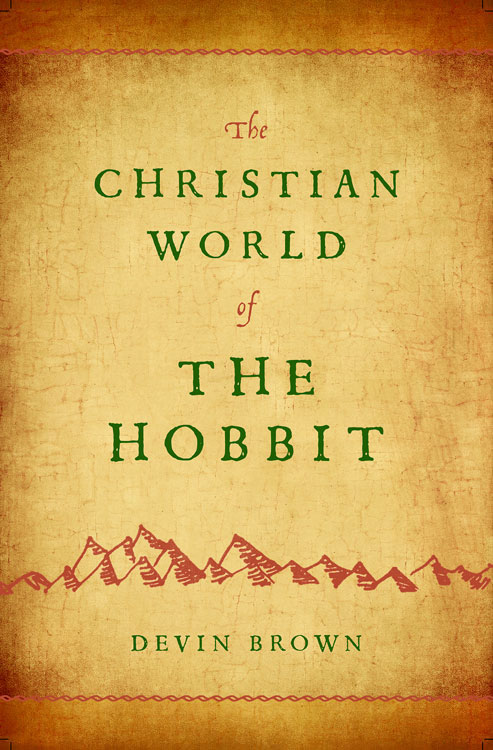
Though he spent only a small amount of time writing about Tolkien's Catholic faith, Devin Brown took this simple statement as the launching point of his The Christian World of The Hobbit.  The book itself is easily suited to a popular audience, even to those who - for whatever unfathomable reason - have not yet read The Hobbit.

In five chapters, Brown leads his readers in a consideration of the workings of grace and morality in The Hobbit, with a particular - and intriguing - focus on the growth of Bilbo Baggins from the moment he left his comfortable Hobbit hole to the moment he returned.

Brown summarizes his thesis in the final chapter of the book, saying,
The Hobbit is both a children's tale and something more.  The Providence, purpose, and morality in The Hobbit go against the grain of the modern mind-set.  In The Hobbit, Tolkien brings his readers into a world filled with meaning and purpose where they find stark contrasts between right and wrong.  The same audience who might scoff at the Christian worldview in a different context find themselves embracing it in The Hobbit.
I suspect he is quite right.

For those looking for a more scholarly exploration of The Hobbit, Matthew Dickerson's A Hobbit Journey: Discovering the Enchantment of J.R.R. Tolkien's Middle-earth provides a great deal of food for thought.

Both books are good, but I enjoyed Dickerson's much more, in no small part because it delves deeper into the morality of Middle-earth.  Exploring such important - and timely - issues as torture and war, freedom and responsibility, Dickerson's oft-repeated refrain is that for Tolkien, a military victory is less important than a moral victory.

In his introduction, Dickerson writes,
This book explores some of those truths that can be glimpsed in Tolkien's very successful works of fantasy literature.  They are truths that are as applicable today as when Tolkien lived and wrote.  The central question this book addresses is, What can we learn from hobbits and from their vision of the Good Life, and how does that apply to our own present situation?  In particular, we will look at the hobbitish pursuit and practice of peace, even in the midst of a world at war.  And we will start with the question of what actions war does or does not justify.
I had a difficult time putting this book down and recommend it highly.

22 October 2012

Tolton's grave in the fall

This past Friday I attended a Gala Fundraiser for the Cause of Sainthood of Father Augustus Tolton with three other priests of the Diocese of Springfield in Illinois and Bishop Paprocki.  All told, some three hundred people were present for the enjoyable evening.

I took a few pictures from the evening, but none of them turned out too well.  His Eminence Francis Cardinal George, O.M.I., Archbishop of Chicago, stopped in for a moments and addressed us.  I was glad to see he looked well as he continues his chemotherapy treatments.

On Saturday evening I returned to Quincy to help with Quincy Notre Dame's sophomore retreat.  As I always do when I return to the Gem City, I stopped by the grave of Father Tolton, which was particularly beautiful and draped in the colors of autumn:


20 October 2012

A Life of Pono: The Mother of Outcasts

In just a few hours' time, His Holiness Pope Benedict XVI will canonize seven Saints for the Universal Church, two of whom are Americans.

Over the past several months the Catholic press has rightly given great attention to one of these: Blessed Kateri Tekakwitha, the Lily of the Mohawks.  Her cause has had great popular support and appeal over the years because of her status as the first Native American to be declared Blessed, and tomorrow the first to be declared a Saint.

But of the other American soon-to-be-saint the Catholic press - and even the blogosphere - has given precious little attention.  Perhaps this is best since it was this courageous woman who said, "I do not think of reward; I am working for God and do so cheerfully."  Though much of the world has either forgotten or largely ignored the merits of this faithful soul, God has not forgotten her efforts and her cooperation with his grace.

Born 23 January 1838 in Heppenheim, Germany, Barbara Cope immigrated with her family to Uttica, New York.  She entered the Franciscan Sisters of Syracuse in 1862 and received the name Marianne.  Recognizing her skillful administration, her Sisters elected her as superior general in 1877.

It was to her that Father Leonor Fouesnel, SS.CC, Provincial of the Congregation of the Sacred Hearts of Jesus and Mary, to whom mission of the Sandwich Islands (now known as Hawaii) had been entrusted, wrote in June of 1883.  For years, Saint Damien de Vuester, the Leper Priest, requested Sisters who would not only work with him in the care of the lepers, but who would also continue his ministry after him.

Mother Marianne was the only religious superior to respond to Father Leonor's request for a group of Sisters to serve the lepers and run the Kaka'ako Branch Hospital on Oahu.  It was from Kaka'ako that the lepers were sent to the settlement at Kalaupapa.  Writing to Father Leonor, Mother Marianne wrote:
I am hungry for the work and I wish with all my heart to be one of the chosen ones, whose privilege it will be to sacrifice themselves for the salvation of the souls of the poor Islanders...  I am not afraid of any disease; hence it would be my greatest delight even to minister to the abandoned "lepers."
She arrived in Honolulu with six Sisters in November of 1883 and diligently saw to the needs of the patients, placing a particular emphasis of cleanliness.

After Father Damien was diagnosed with leprosy in 1886, Mother Marianne said, "We are not only willing but anxious to go and care for the poor outcasts" at Kalaupapa, which she did extremely well.

After the Sisters arrived at Moloka'i, Father Damien said, "I can die now.  You will continue to carry on the work even better than I could do."  Such was his confidence in Mother Marianne.


Several days before his death, Father Damien said to Father Conrardy, "How good God is to have made me live long enough to see at this moment two priests at my side and the Franciscan Sisters at the Settlement!  I can sing Nunc Dimittis, the work for the lepers is in good hands; and I, I am no longer necessary; I am going to Heaven."

After his death, Mother Marianne carried on his work with great skill and love, reminding her Sisters, "What little good we can do in this world to help and comfort the suffering, we wish to do it quietly and so far as possible unnoticed and unknown."  Hers truly was a life of pono, a life of righteousness.

Mother Marianne died on 9 August 1918 and is now buried in Syracuse, New York.


Mother Marianne, pray for us!

18 October 2012

I'm a happy nerd

...because I just picked up these:


I swear bookstores see me coming.

Do Democrats reduce the number of abortions?

In an intriguing post, John-Paul seeks to answer the important and timely question, "Should Catholics vote Democrat to reduce abortions?"

It's a claim we've all heard, but is it true?  As John-Paul notes, "It should be quite easy to prove this preist right or wrong since we have statistics on abortion since before Roe. So, we should be able to match those stats up with the years of Democrat presidents and Republican presidents and see pretty clearly which ruling party has fewer abortions on their watch."

Looking at the data, John-Paul found that
It turns out that Republican presidents average lower abortion numbers and lower abortion rates than Democrat presidents. On average, under Democrat leadership, there were 70,172 MORE abortions per year than under Republican leadership. According to this data, a Democrat president leads to an average increase in the abortion rate of 5.29% more than a Republican.
The answer, then, to the above question is patently, "No."

It turns out that a great many people have been misled by the fact the they were fewer abortions during the term of President Clinton than that of President Bush (the first).  However, it is also true that there fewer abortions during the term of President Bush (the second) than under President Clinton.

John-Paul, though, doesn't stop there.  He goes on to suggest additional reasons why we should not vote Democrat to reduce abortions, not only the USA, but throughout the world.


17 October 2012

Call PP to Schedule Your Imaginary Mammogram Day

During last night's Presidential Debate, President Obama once again claimed that Planned Parenthood provides mammograms, which it, in fact, does not.

To help illustrate the point, Abby Johnson has designated tomorrow, October 18, 2012, "Call Planned Parenthood to Schedule Your Imaginary Mammogram Day."  The number to call is 1-800-230-PLAN.

Abby imagines your conversation will go something like this:
PP: "Thank you for calling Planned Parenthood, how can I help you?"Caller: "I'd like to come in to your clinic for a mammogram."PP: "We do perform clinical breast exams, and we refer out for mammograms, but we don't perform them in the clinic."Caller: "What? But Barack Obama said you guys provide mammograms!"PP: "We don't. We refer out for them."
TRUTH BOMB: Planned Parenthood is a level-one breast service provider. This means they are not only unequipped to perform mammography... it is ILLEGAL for them to do so. The extent of their breast health services are manual breast exams. They refer out for mammograms, but they DO NOT PROVIDE THEM.

Ladies, you know what to do.  Call Planned Parenthood and when they tell you they don't in fact provide mammograms, write to President Obama and gently correct him.

16 October 2012

At long last!

This December - after many years of expectation, longing, and waiting - the final volume of Pope Benedict XVI/Joseph Ratzinger's trilogy on the life of the Savior will finally be published: Jesus of Nazareth: His Infancy and Childhood.

For a short time you can pre-order the book through Ignatius Press for only $16.00 (regularly $20.00).

I ordered a copy; you should do the same.

If you haven't yet read the first two volumes (Jesus of Nazareth: From the Baptism in the Jordan to the Transfiguration and Jesus of Nazareth: Holy Week: From the Entrance into Jerusalem to the Resurrection, you really should read them.  You will not only learn a great deal about the life of our Master and Teacher, but you will be inspired and drawn closer to the Lord with the passing of each chapter.  You can even order the 3-volume set.

Honestly, what are you waiting for?

George: Mary will be there

Throughout the month of October, Holy Mother Church urges us to give special consideration to the Rosary of Our Lady.

As we pray the rosary, through its various repetitions, we are asked, as Pope Benedict XVI reminds us, to "be guided by Mary in this prayer, ancient and ever new, which is especially dear to her because it leads us directly to Jesus, contemplated in his Mysteries of salvation: joyful, luminous, sorrowful and glorious."

Yesterday His Eminence Francis Cardinal George, O.M.I., Archbishop of Chicago e-mailed a brief reflection on the rosary.  He concluded, saying, "So many private apparitions of the Blessed Virgin over the centuries have given us messages about this help, and it is a great comfort to believe that Mary will be there when the soul, the source of life for our body, struggles toward a different form of living.  Mothers give birth; Mary will be there, no matter when or how death comes to each of us."

Cardinal George is presently undergoing chemotherapy treatment for his second bout with cancer.  I ask you, then, remembering his words, to pray the rosary for him.  Ask the Lord to sustain him in his ministry and ask Our Lady to wrap him in her mantle.

15 October 2012

Random melodies

In former years I was a bit of a video game nerd.  In fact, I found my first job simply because I played video games.

This morning as I sat tiredly at my desk in my sitting room, I was working on something when I became aware that my feet were tapping a melody.  As I paid more attention - I was exhausted this morning - I realized I was tapping - and mentally humming - the theme music from Super Mario World from the Super Nintendo.  Admittedly, it's a great game!

Being amused at the situation - and, no doubt, pleased - a friend posted the music to my Facebook timeline (I want the old wall back), so I thought I'd share it with you:

Enjoy!

Paprocki running for vocations

On Sunday Bishop Paprocki will run his nineteenth marathon - this year in St. Louis - to help raise funds for charitable causes.  Since 1995, His Excellency has raised more than $330,000 for a variety of causes, including Pro-Life organizations and the Chicago Legal Clinic.  This year, he will be running for vocations.


Writing in the Catholic Times, Bishop Paprocki explained the need the Diocese of Springfield in Illinois has for additional funds for the formation of seminarians:

Since my installation as your bishop on June 22, 2010, I have spoken frequently in our parishes and on various other occasions about the need to pray for and promote increased vocations to the priesthood and religious life. God has so far answered our prayers with an increase from 11 seminarians in 2010 to our current number of 25. 
While the growing number of candidates for the priesthood is most welcome and needed for the future of the diocese, it also comes with a cost. At the college level the diocese splits the costs of tuition, room and board with the seminarians and their families, giving loans, if needed, that the diocese assumes if the men are ordained priests. At the level of the major seminary, the diocese pays the full tuition, room and board of the seminarians, plus health insurance and a monthly stipend. If you have ever sent a son or daughter to college, you know how expensive higher education is. We are sending 25 of our diocese's sons to college and major seminaries, so you can see that training our future priests needs more than prayers, but some real revenue as well!
Bishop Paprocki invites those who are able and willing to "consider donating a dollar or more per mile to support my 26.2 mile Run for Vocations. If you are able to 'go the extra mile' and underwrite the full cost of one year's education for one of our seminarians, please contact me or our director of vocations, Father Christopher House, by telephone at (217) 698-8500 or by e-mail at vocations@dio.org."
If you are able to make a donation, you do so online or mail in your pledge.  Any gift you can give will very much be appreciated!
Please, pray for our seminarians every day, that will be formed after the heart of Jesus Christ.


In honor of the day

Give me death, give me life.
Give me sickness, give me health.
Give me honor, give me shame.
Give me weakness, give me strength.
I will have whatever you give. Amen.


- Saint Teresa of Avila