Showing posts with label Tolkien. Show all posts

02 September 2023

Tolkien the Eutrapelos: Thoughts on the Fiftieth Anniversary of His Death

The ancient Greek philosophers spoke of the virtue of eutrapelia, which Hugo Rahner, S.J., describes as “the virtue practised by the eutrapelos, the man who has the wit and the wisdom to be the mean between the boor (the agroikos) and the buffoon (the bomoclochos).” It is a virtue regrettably little practiced today, but J.R.R. Tolkien, who departed the circles of this world on September 2, 1973, was just such a man. Through his playful seriousness, Tolkien is able to achieve in the hearts of his readers that rare combination of stirring their hearts to ponder the great mysteries of life while at the same time moving them to laughter.

This fiftieth anniversary of his death has – much to my surprise – affected me rather deeply. Being emotionally affected by the anniversary of someone’s death is not particularly unusual for me, but to be so affected by the anniversary of someone I never met in person is striking. However, having read so many of his writings time and again, it does seem – in a certain sense – that I do know Tolkien; to know someone’s thought is, in many ways, to know the person. His writings, saturated as they are with the desire for what he calls deathlessness, strikes right to the core of my being, expressing thoughts and sentiments I cannot express adequately myself and in ways that no other author has done.

Tolkien once said “the chief purpose of life, for any one of us, is to increase according to our capacity our knowledge of God by all the means we have, and to be moved by it to praise and thanks” (Letter 310 to Camilla Unwin, 20 May 1969). While a growing number of his readers today lamentably and wrongly seek to downplay the role Tolkien’s faith played in his writings, they were very much part of his striving to increase his knowledge. In his essay “On Fairy Stories,” he said,

The Christian still has to work, with mind as well as body, to suffer, hope, and die; but he may now perceive that all his bents and faculties have a purpose, which can be redeemed. So great is the bounty with which he has been treated that he may now, perhaps, fairly dare to guess that in Fantasy he may actually assist in the effoliation and multiple enrichment of creation.

The playfulness with which Tolkien created his secondary world was no mere frivolity; it was his attempt to participate in the work of creation. Through his great legendarium, he sought to express the deepest yearnings in the heart of every man and in so doing to contemplate the Creator who placed those yearnings within humanity. This what made Tolkien the eutrapelos par excellence.


It may seem strange to say to, but my first visit to the professor’s grave remains one of the happiest moments of my life. A few days after that little pilgrimage, I wrote,

As I expressed my gratitude to Tolkien as best I could, my heart was filled with so great a joy that tears flowed uncontrollably down my cheeks; I was easily as happy as a boy on Christmas morning because one of my greatest hopes had been achieved. As I wept tears of joy, I remembered the words Tolkien gave to Gandalf: "I will not say: do not weep; for not all tears are an evil" (The Lord of the Rings, 6.VIII). I prayed that [the] two of us may meet merrily in heaven where, as Tolkien said, "the presence of the great [him] does not depress the small [me]" (On Fairy Stories).

Today is a day for sorrow, yes, but it is also a day for rejoicing in the gift that Tolkien has been and continues to be for so many of us. Today is a day to strive to become, like him, the eutrapelos thereby increasing in our knowledge of God. Today I will raise another Dr Pepper in his honor and pray for the blessed repose of his soul:

O God of all forgiveness, grant to the soul of your servant John Ronald Reuel Tolkien, whose anniversary we celebrate, a place of refreshment, of blessed rest and resplendent light. Through our Lord Jesus Christ,  your Son, who lives and reigns with you in the unity of the Holy Spirit, God for ever and ever.

05 April 2018

Coming Soon: A Documentary on Friendship in the Life and Writings of J.R.R. Tolkien

Reese Parquette is a young filmmaker in Springfield. His documentary, Mercy: Discovering God's Loverecently aired at EWTN.

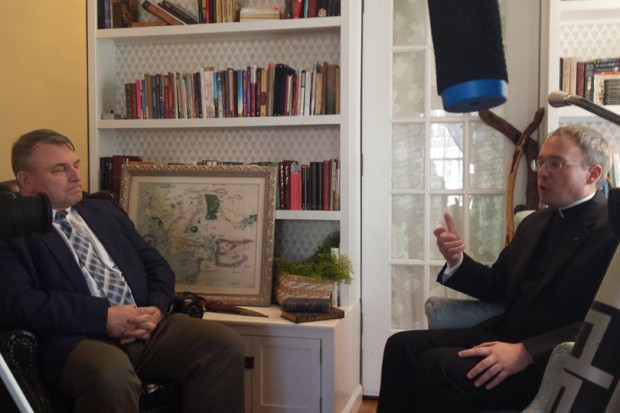
At Reese's request, I recently sat down with Joseph Pearce, author of - among other titles - Tolkien: Man and Myth (San Francisco: Ignatius Press, 1998), to talk about friendship in the life and writings of J.R.R. Tolkien.


It was a very enjoyable conversation and those who were present to watch us talk commented on how natural it all seemed. Joseph and I had not met previously, but a devotion to The Professor has a way of establishing a friendship between strangers rather easily. When the final edits are completed, the conversation will become a documentary titled, An Unexpected Friendship.

Though it was not planned so at first, this will actually become the first of a two-part documentary on friendship in the life and writings of Tolkien. The second part will be filmed in a few weeks on location in Oxford.

Reese's plan is to follow me around Oxford as I visit and talk about the sites important in the Professor's life in and around the famous medieval university city, culminating with a pilgrimage to his grave at Wolvercote Cemetery. It is a project about which I am rather excited, and for which Reese and I could use your assistance.

We are currently looking for donors willing to help fund the costs of our travel and of production of the documentary (with a total goal of $3,000). Any help you can provide - however large or small - will be greatly appreciated.

We are still working on the title for part two, though we might borrow a phrase Tolkien used to describe husbands and wives, "companions in shipwreck."

The 405 kindly offered to interview Reese and I concerning this project and has published an article about it titled, "J.R.R. Tolkien & 'something of the truth of human existence' - Meet filmmaker Reese Parquette & Fr. Daren Zehnle of An Unexpected Friendship".

17 January 2018

Joy Like Swords: The video of my lecture

When I was studying in Rome, something came across my Facebook feed claiming the desk at which J.R.R. Tolkien wrote and illustrated all of The Hobbit and some of The Lord of the Rings was in Illinois. I am not in the habit of taking click bait, but this was one I could not pass up, a click that introduced me to the Marion E. Wade Center in Wheaton, Illinois.

Yesterday afternoon, I had the great and distinct privilege to present a lecture at the Wade Center, a research library dedicated to the writings of J.R.R. Tolkien, C.S. Lewis, and the other Inklings with whom they wrote. The title of my lecture was ""Joy Like Swords': Hobbits, Franciscans, and the Crucifix," the video of which I am happy to share with you today:


I am delighted to say it was well received by the audience in Wheaton, and I hope you will enjoy it, too.

05 January 2018

A Lecture at the Wade Center

Click on the photo to enlarge it
One of Illinois' unsung treasures is the Marion E. Wade Center at Wheaton College, a research library devoted to the Inklings, whose members included the great J.R.R. Tolkien. The library houses original manuscripts, translations of the authors' works into various languages, and books and articles about the writings and lives of the Inklings. Among its treasures is the desk at which the Professor wrote The Hobbit and most of the Lord of the Rings.
 
When I first visited the Wade Center after returning from my studies in Rome, I mentioned that I was about to give a Theology on Tap lecture on the subject of Tolkien's faith. The archivist quickly asked for a copy of my text for the library and asked if I might be interested in giving the lecture at the Wade Center. Naturally, I was very open to doing so and am happy to say I will give the lecture at 4:00 p.m. on Tuesday, January 16th. The lecture will be free and open to the public.
 
In advance of the lecture, the Marion E. Wade Center sent out the following press release to publicize it:
 

Joy Like Swords : Hobbits, Franciscans, and the Crucifix
 4:00pm | January 16, 2018
 
The Marion E. Wade Center and the Wheaton College Tolkien Society present a lecture on the work of J. R. R. Tolkien by Rev. Daren J. Zehnle on Tuesday, January 16, 2018 at 4pm in Bakke Auditorium.

After Frodo Baggins and Samwise Gamgee heard a minstrel sing of the deeds of the Fellowship of the Ring, J. R. R. Tolkien wrote that “their joy was like swords, and they passed in thought out to regions where pain and delight flow together and tears are the very wine of blessedness.” By exploring the phrase, “their joy was like swords,” we learn to understand the reality of joy mingled with sorrow and experience God’s merciful love as we embrace the Cross.

Father Daren J. Zehnle is a priest of the Diocese of Springfield in Illinois where, in addition to other duties he performs for the diocese, he serves as Pastor of St. Augustine Parish in Ashland, Illinois. He is a Knight of the Equestrian Order of the Holy Sepulchre, a member of The Tolkien Society, and holds a B.A. from Quincy University, a S.T.B. and a M.Div. from the University of St. Mary of the Lake/Mundelein Seminary, and a J.C.L. from the Pontifical Gregorian University.

This lecture will take place in the Wade Center’s Bakke Auditorium and is free and open to the public. The Wade Center is located at 351 Lincoln Ave. on the northwest corner of campus at the intersection of Washington St. and Lincoln Ave. For more information, contact the Wade Center at 630.752.5908 or
wade@wheaton.edu.


26 October 2017

Fr. Mike Schmitz on Tolkien's Leaf By Niggle

As the daylight continues to lessen, the leaves continue to fall, and the temperatures continue to drop, our thoughts naturally turn to death and what comes afterward, which is why next Mother Church will observe the Commemoration of the Faithful Departed on November 2nd, more commonly known as All Souls' Day.

This autumnal season is always a good time for us to delve again into the Church's teaching on Purgatory and to its reality. Pope Benedict XVI spoke eloquently on Purgatory in his encyclical Spe salvi (see especially numbers 45-48), to which I frequently return. Great theologians, though, are not the only ones who can contribute to our understanding of Purgatory.

My favorite story to help illustrate the reality of Purgatory is the great J.R.R. Tolkien's short story, Leaf By Niggle, about which, Father Mike Schmitz recently make a short video (though he, sadly, doesn't directly connect it to Purgatory, the implication is there):


If you haven't yet read Leaf By Niggle, I highly recommend you find a copy of it. It's only a few pages long, but there is much to ponder in just a few words.

17 July 2017

Should Tolkien's faith be discussed?

Being an avid reader of the writings of J.R.R. Tolkien and various commentaries upon his writings, I have been a member of The Tolkien Society for a few years now. I enjoy both its print publications and its page on Facebook, where a great many things are shared, from a wide variety of questions to news articles to artworks inspired by his legendarium to Tolkien-related events.
 
As a sort of security measure, the Facebook page of The Tolkien Society is a "closed" page with moderation, meaning that requests to join the page and posts to the page must all be approved by an administrator.
 
Yesterday, I submitted Mike Aquilina's "Chord of the Rings," which someone passed on to me the other day. It is an older reflection on Tolkien's creation myth in relation to the hymning of creation spoken of by Fathers of the Church. I received a disappointing response from one of the admins:
Thanks for wanting to share that post from the Eighth Day institute. It is an interesting article, but reading it carefully reveals that it has a rather strong religious message. Unfortunately, we've often found that religious posts often lead to unnecessary and unpleasant arguments, so we won't be putting it through to the group.
Being, as I said, rather disappointed with this response, I asked if it wouldn't be better instead to call for civility and respect for those who oppose Tolkien's faith, which was undeniably central both to his life and to his writings. I also asked the administrators of the group page to reconsider this decision. The response was again disappointing but understandable: "[T]he current rules have grown up from years of experience of moderating a FB group with thousands of members."

Have we in the West really fallen so low that we cannot allow devotees of an author to discuss every aspect of an author's life? Tolkien himself said his The Lord of the Rings "is of course a fundamentally religious and Catholic work" (Letter to Robert Murray, 2 December 1953); how much of an integral conversation can actually be had, then, if this foundation is not allowed to be discussed?

I understand the difficulty the administrators have in keeping on an eye on the page. They are all volunteers and have their families to attend to, and rightly so. But what does it say about us if we cannot allow a discussion of the role of faith in the lives of various people? I, as a man of faith, do not go around causing a ruckus on the Internet whenever I see a post by an atheist; why do they feel the need to stir up trouble when they see a post about Tolkien's faith? If the read his letters, they'd know how central it was to him and to his works.

It seems we need a new lesson in decency, respect, and civility.

03 January 2017

A book you should read: The Proverbs of Middle-earth

The best commentators on the great J.R.R. Tolkien's legendarium of Middle-earth cause you to return to The Hobbit and The Lord of the Rings with a newfound ability to detect something you had previously overlooked and in this way help you find greater enjoyment in Tolkien's works. David Rowe is just such a commentator.

Clearly the fruit of a great erudition and of a devoted love, Rowe's recently released The Proverbs of Middle-earth (Oloris Publishing, 2016 [$18.00, 234 pages]), masterfully explores the "more than four hundred proverbial sayings" placed on the lips of the peoples of Middle-earth by the Professor (63). By deeply delving into the profundity of dwarves, elves, ents, men, and hobbits, Rowe uncovers for us a great treasure, helps us understand each of these races from within, as it were, and in the process helps us understand ourselves in a clearer light.

In his brief forward to this book, Dr. Peter Kreeft says he is "as pleased as a pickle that I was sent this wonderfully Socratic book" (v), a book that "is really an act of anthropology" (iv). Whenever you find an enthusiastic endorsement from Dr. Kreeft, you know you are in for a treat, and this book is no exception!

Rowe begins his exploration of the proverbs of Middle-earth with a rather scholarly - though still readable - consideration of what a proverb is and is not. "Proverbs," he says, "are vessels of transmission, the ships in which wisdom sails" (ix). Because Middle-earth is filled with proverbs, Rowe rightly suggests that
What we quickly discover is that Tolkien did not merely create hundreds of erudite, apposite, and funny sayings - however great an artistic achievement that is - he also invented entire wisdom traditions in which these sayings belong. Just as different contemporary nations often have contrasting perspectives, so each civilisation of Middle-earth has a distinct worldview or philosophical culture. Each of these becomes apparent when we look through the lens of their proverbs: the national character and philosophy of each of Tolkien's cultures - from the small-minded pragmatism of rustic Hobbits tot he disciplined dignity of Gondor - has been written into their wisdom traditions. Tolkien's legendarium is founded on details such as these; its world created from the bottom-up, and therefore richly rewarding to those who take the time to dive in and investigate the depths (xiii). 
Of particular delight, are two of Rowe's three appendices in which he lists the proverbs (and those who speak them) in The Hobbit, The Lord of the Rings, and the appendices to The Lord of the Rings, first in chronological order and second by the peoples of Middle-earth.

I would provide you with summaries of his explorations of the proverbs of each of the peoples of Middle-earth, but I do not wish to rob you of the joy of discovery that comes with the reading the chapters without quite knowing what to expect.

Let me simply say that in The Proverbs of Middle-earth, Rowe brilliantly shines a light on an important aspect of Tolkien's writings hitherto largely unexplored. He helps us to see that "in the well-feigned history of Middle-earth, what is offered to us is wisdom and truth: not a simple lesson to learn, but over seven thousand years' worth of learned lessons to apply" (174). 

As he leads us through these learned lessons, Rowe takes us by the hand and guides us along the paths of wisdom and truth and opens for us a new and unexpected adventure.

03 November 2016

Another of Tolkien's works is published again

Originally published in 1945 in The Welsh Review, the great J.R.R. Tolkien's The Lay of Aotrou and Itroun was released again today by HarperCollins. Here follows the blurb from the publisher:
Set in Britain’s land beyond the seas’ during the Age of Chivalry, The Lay of Aotrou and Itroun tells of a childless Breton Lord and Lady (the ‘Aotrou’ and ‘Itroun’ of the title) and the tragedy that befalls them when Aotrou seeks to remedy their situation with the aid of a magic potion obtained from a corrigan, or malevolent fairy. When the potion succeeds and Itroun bears twins, the corrigan returns seeking her fee, and Aotrou is forced to choose between betraying his marriage and losing his life.

Coming from the darker side of J.R.R. Tolkien’s imagination, The Lay of Aotrou and Itroun, together with the two shorter ‘Corrigan’ poems that lead up to it and which are also included, was the outcome of a comparatively short but intense period in Tolkien’s life when he was deeply engaged with Celtic, and particularly Breton, myth and legend.

Originally written in 1930 and long out of print, this early but seminal work is an important addition to the non-Middle-earth portion of his canon and should be set alongside Tolkien’s other retellings of myth and legend, The Legend of Sigurd and Gudrún, The Fall of Arthur and The Story of Kullervo. Like these works, it belongs to a small but important corpus of his ventures into real-world’ mythologies, each of which in its own way would be a formative influence on his own legendarium.
And now I wait for it to arrive.

28 October 2016

Hobbits, Franciscans, and the Crucifix

One of our seminarians at Bishop Simon Bruté College Seminary recently invited me to give a talk for the Theology of Tap program at Marian University in Indianapolis. The talk, he suggested, should focus on something regarding J.R.R. Tolkien and Catholicism.

After soliciting suggestions from members of The Tolkien Society, I have decided to title my talk (which is still percolating in my mind), "'Joy Like Swords'": Hobbits, Franciscans, & the Crucifix."

To help with the advertising of the event, I sent this brief sketch of the talk, which should match up with my final text:

After Frodo Baggins and Samwise Gamgee listened to a minstrel sing of the deeds of the Fellowship of the Ring, J.R.R. Tolkien explains that “their joy was like swords, and they passed in thought out to regions where pain and delight flow together and tears are the very wine of blessedness.” These words often strike the reader as something of great profundity, even if they do not quite understand their full meaning.

Thomas of Celano wrote that “joy and sorrow were intermingled” in Saint Francis of Assisi. By exploring the Professors’ phrase “joy like swords” in light of the stigmatization of the Seraphic Father, we can approach the reality of joy and sorrow even as God’s merciful love floods our wounds when we embrace the Cross.
The talk will be given on November 10, 2016 at 7:00 p.m. in Alumni Hall on the campus of Marian University. It is open to the public and there is, as I understand it, a small admission fee depending on your choice of beverage (something like $5 with alcohol or $2 without).

28 August 2016

Is it terrible being a priest?

Holy Mother Church places before us today the virtue of humility. In the first reading, she has hear these words from one of the wisdom books: "My child, conduct your affairs with humility" (Sirach 3:17).

In the second reading, we hear not of entering into the presence of the Lord, but of approaching (cf. Hebrews 12:18, 22). It is the humble man who approaches the presence of one greater than himself and the proud man who simply walks into the presence of another.

In the verse accompanying the Alleluia, Jesus tells us, "take my yoke upon you and learn from me, for I am meek and humble of heart" (Matthew 11:29). In the Gospel, Jesus warns us that "everyone who exalts himself will be humbled" (Luke 14:11).

To live in humility is really quite simple; all one must do is look honestly at one's life and at the course of human history. Such an honest assessment cannot but remind us of our sinfulness and our failures. With such a knowledge, one cannot think too highly of oneself. This is why the confessional is the best teacher of humility, both for the penitent who confesses his or sins and for the priest who hears and absolves the sins confessed.

A good many people do not yet fully understand this and so think the confession of sins is something to be dreaded and even avoided. Even the great J.R.R. Tolkien, himself a devout Catholic, thought "it must be terrible to be a priest!" In one of his letters to his son, he wrote these words:
A small knowledge of history depresses one with the sense of the everlasting mass and weight of human iniquity: old, old, dreary, endless repetitive unchanging incurable wickedness. All towns, all villages, all habitations of men - sinks! And at the same time one knows that there is always good: much more hidden, much less clearly discerned, seldom breaking out into recognizable, visible, beauties of word or deed or face - not even when in fact sanctity, far greater than the visible advertised wickedness, is really there. But I fear in the individual lives of all but a few, the balance is debit - we do so little that is positive good, even if we negatively avoid what is actively evil. It must be terrible to be a priest! (Letter to Christopher Tolkien, 14 May 1944).
Let me say here that it is far from terrible being a priest! Listening to the confession of sins, even of sins confessed by the same penitent over and over again again is not dreary; rather, it is a sign of great humility and of a desire for holiness.

When he spoke with a group of First Communicants some years ago, His Holiness Pope-emeritus Benedict XVI answered a question from the children about the confession of repetitive sins:
It is true: our sins are always the same, but we clean our homes, our rooms, at least once a week, even if the dirt is always the same; in order to live in cleanliness, in order to start again. Otherwise, the dirt might not be seen but it builds up. Something similar can be said about the soul, for me myself: if I never go to confession, my soul is neglected and in the end I am always pleased with myself and no longer understand that I must always work hard to improve, that I must make progress. And this cleansing of the soul which Jesus gives us in the Sacrament of Confession helps us to make our consciences more alert, more open, and hence, it also helps us to mature spiritually and as human persons.
Whenever a penitent enters the confessional and confesses his or her sins with humility, he or she leaves the confessional exalted by the Lord and filled with his joy and peace. When a priest hears confessions conscious of his configuration to Christ Jesus, our humble and eternal High Priest, who, too, leaves the confessional exalted by the same Lord and filled with his joy and peace.

Since my return to these United States of America on 21 June 2016 (since which date no one has walked into me or even come close to walking into me), I have had the great privilege of hearing confessions in a number of different circumstances, from retreats for high school students and married couples (two separate retreats) to the course of ordinary parish ministry.

While studying in Rome, I only the opportunity to hear confessions on a very occasional basis and it is good to hear them again. I have always found absolving the sins of Christ's faithful to be not a terrible experience as The Professor supposed, but one that fills me with humble gratitude for being used by the Lord Jesus as an instrument of his merciful love.

Whenever we receive absolution for our sins after a humble and sincere confession, we "rejoice and exult before God" and are "glad and rejoice" (Psalm 68:4). When we humble ourselves, the Lord exalts us; I therefore encourage you not to let your pride keep you from confessing yours sins.

06 April 2016

A pilgrimage to Tolkien's grave

When I left Rome to spend Holy Week in Scotland, I intended to return to Rome on Easter Monday to finish working on my thesis. I had just submitted what I hoped was a nearly final draft of the thesis - with the title of "Order and Age: Confirmation in the Present Legislation of the Latin Church" - to my director and expected him to have many corrections, changes, and recommendations. To my delight, he made only a couple of grammatical corrections, offered two suggestions I was free to incorporate or not, and told me it was ready for submission without his further review.

To celebrate the completion of my thesis, I changed my travel plans and took the train from Edinburgh to London with the sole purpose of visiting the grave of the man Tom Shippey calls "the Chrétien de Troyes of the twentieth century," J.R.R. Tolkien.


Eight days ago I boarded the train from London to Oxford, but not before buying a bouquet of flowers to lay at his grave:


After the train pulled into the station, I spent some time wandering about the famous university city, making good use of The Tolkien Society's helpful guide, "Tolkien in Oxford" to find a couple of the houses in which the Tolkiens lived and to visit the Bodleian Library, which houses some of Tolkien's original art.

Because I wanted this to be a real pilgrimage, I set out on foot from the center of Oxford and made my way past The Eagle and Child out to Wolvercote Cemetery, some three miles from city center.

Google maps told me that after I turned left at the intersection where the cemetery began, I would find the entrance to the cemetery on the right. When I arrived at the gate, I saw this sign:


If you can't make out the altered closing time for Monday - Thursday, it has been changed to 2:00. I stood before the sign at about 3:30 p.m. and my heart sank; I had arrived too late and wouldn't be able to visit the grave of the man I revere so highly. But then I read the sign more closely and realized there must be another gate that was still open.

As I made my way back towards the intersection, I asked a woman who appeared to be a local where the main entrance to the cemetery was. She directed me to return to the intersection where I turned left and to make a left turn; the entrance would immediately be on the left. She was right:


My heart rose as I passed through the gate and I chuckled a bit when I saw the first sign pointing the way to the grave of Professor and Mrs. Tolkien:


The cemetery itself was smaller than I expected it would be and was rather charming, as far as cemeteries go:


My happiness deepened as I passed one sign after another for the Tolkiens' grave (nine in total, if I counted correctly until I passed the last sign which, for an unknown reason, was on the opposite side of the footpath as the other signs:


At long last, I reached the goal of my pilgrimage, a pilgrimage I had wanted to make for many years:


Many tokens of affection had been left for The Professor, from marbles to coins to flowers. There was a receipt from The Eagle and Child and a letter written by an American student studying at Oxford. In the letter (which was not in an envelope) was written on my birthday, the author expressed well the sentiments of my heart:
...I wish I could have known you. I wish I could have shook your hand and told you how much your writing has meant to me. And how it breaks my heart to know that this is as close to you as I will ever come in this life. For death is not the end, but only a beginning.

As strange as it might be, I feel somehow like I know you. Your stories of Middle-earth have broken and mended my heart.... I look forward to the day when I can meet you in glory and tell you just how much you've changed the world you left behind.
After placing my small token of affection at his grave, I told The Professor how has writings have affected me, especially his letters.


As I expressed my gratitude to Tolkien as best I could, my heart was filled with so great a joy that tears flowed uncontrollably down my cheeks; I was easily as happy as a boy on Christmas morning because one of my greatest hopes had been achieved. As I wept tears of joy, I remembered the words Tolkien gave to Gandalf: "I will not say: do not weep; for not all tears are an evil" (The Lord of the Rings, 6.VIII). I prayed that two of us may meet merrily in heaven where, as Tolkien said, "the presence of the great [him] does not depress the small [me]" (On Fairy Stories).

Having brought my favorite beverage with me on my little pilgrimage (all the way from London), I raised a toast to "The Professor" as some of us do on Tolkien's birthday.


I stayed at his grave for about forty-five minutes and the thought arose in my heart that I did not want to leave without having my picture taken at the grave. At about this same moment, a man who had been meticulously cleaning a nearby grave appeared ready to leave the cemetery. I approached him and asked apologetically if he would be willing to take my picture at nearby grave. He kindly agreed to do so (I suspect he'd been asked many times over the years):


I didn't catch his name before he left, but I went over to look at the headstone to which he gave such loving care:


I can only presume that Miss Druce is his sister. Please, out of gratitude for the simple kindness he showed me, please remember him and Miss Druce in your prayers.

As I made my way from the Tolkiens' grave to cemetery entrance, a man asked me if I knew where Tolkien's grave us. He was asking for a husband and wife and their daughter. I assured them they were very close and took them to the grave. As Providence would have it, they were Americans and Tolkien's grave was their last stop on their vacation in England before they returned to the U.S. the next day. I bumped into them a couple more times in Oxford later that evening.

Because by that time my feet were growing sore, I took the bus from the cemetery back to Oxford where I had an early dinner of fish and chips at The Eagle and Child, where Tolkien, C.S. Lewis, and the Inklings met so frequently:


All in all, it was a day I won't soon forget and I'm very grateful for having been allowed to visit the grave of the man whose writings have so deeply touched my heart.