Showing posts with label The Lord of the Rings. Show all posts

24 October 2015

Why is Tolkien's Middle-earth so popular?

The Telegraph recently republished what the editors call an interview with Professor J.R.R. Tolkien first published 22 March 1968. Though it reads more like a news story than an interview, the piece makes for fascinating reading not only because of what Tolkien himself says in it, but because of the way in which the interviewer describes the professor and his literary work. Among the many things we learn is that Elvish should be sung "like Gregorian chants."

Consider, as just one example among many reasons why you should read this interview, this description of Tolkien:
Tolkien, who describes himself as "tubby", has grey eyes, firm tanned skin, silvery hair and quick decisive speech. He might have been, 50 year ago, the model of the kindly country squire. Any hobbit would trust this man, any dragon would quail before him, any elf name him friend. Effortlessly, he compels you to admire him as much as  – and herein lies his charm  – he clearly admires himself.

To the small but bitter anti-Ring coterie – some of whom profess to see sinister meanings in the text – his very ebullience would presumably constitute an irritant. But to devotees, all this adds up to the perfect cult-hero.
Though I was, of course, never able to meet Tolkien (he died five years before I was born), I certainly count him among my heroes, both because of the brilliance of his legendarium and because of the exemplary character we find in his letters. I hope someday that it might also be said of me that "any hobbit would trust this man, any dragon would quail before him, any elf name him friend." Not bad praise, that.

In a passing description of The Lord of the Rings, the interviewer seems to implicitly ask why Tolkien's great work is so popular, both among academics and non-academics alike:
Despite the fact that his books lack perversion, four-letter words, homosexuality and sadism – virtually everything that makes 20th-century fiction so commercially desirable – the Professor and those connected with his publications have found the streets of Middle-earth paved with gold.
Curiously, the interviewer doesn't delve into this any deeper than to say that Tolkien "never expected a money success" from the book, which begs the question as to why his works were and remain so popular. The answer is very simple and cuts straight to the heart of his life's work:
But I should say, if asked, the tale is not really about Power and Dominion: that only sets the wheels going; it is about Death and the desire for deathlessness. Which is hardly more than to say it is a tale written by a Man (Letter to Herbert Schiro, 17 November 1957)!
A few months later, Tolkien briefly explained what he meant by this desire for deathlessness:
Though it is only in reading the work myself (with criticisms in mind) that I became aware of the dominance of the theme of Death. (Not that there is any original 'message' in that: most of human art & thought is similarly preoccupied.) But certainly Death is not the Enemy! I said, or meant to say, that the 'message' was the hideous peril of confusing true 'immortality' with limitless serial longevity. Freedom from Time, and clinging to Time. The confusion is the work of the Enemy, and one of the chief causes of human disaster. Compare the death of Aragorn with a Ringwraith. The Elves call 'death' the Gift of God (to Men). Their temptation is different: towards a faineant melancholy, burdened with memory, leading to an attempt to halt time (Letter to C. Ouboter, 10 April 1958).
Everything that makes Tolkien's work so beloved to his fans and readers - friendship, fidelity, courage, charity, in effect, everything of virtue and heroism - is found in his characters' desire for deathlessness, a desire which we all share, whether we recognize it or not. In his own way, Tolkien shows us this desire, warns us of its dangers, and shows us the way to its fulfillment. This is what makes his life's work so popular, in the past, today, and for years to come.

20 October 2015

On the 60th anniversary of the publication of The Return of the King

Sixty years ago today Books 5 and 6 of J.R.R. Tolkien's The Lord of the Rings were published as The Return of the King.

Tolkien was from the beginning against the splitting of The Lord of the Rings, but his publisher insisted upon it due to the cost of such a lengthy work and the uncertainty of its popularity (the world had not yet seen anything quite like Tolkien's story). What is more, Tolkien was not fond of the title chosen for the third volume. He said titling volume one as The Fellowship of the Ring "will do" and title volume two as The Two Towers "gets as near as possible to finding a title to cover the widely divergent Books 3 and 4." He preferred, however, to call the final volume The War of the Ring because "it gets in the Ring again; and also is more non-committal, and gives less hint about the turn of the story" (Letter 140 to Rayner Unwin, 17 August 1953). Not a bad point, that.

I am tempted today to try and pinpoint a favorite passage from The Return of the King, but, as I flip through its pages trying to find one, I realize that there are simply too many passages and lines which resound deep in my heart. I have utilized many of these lines and passages in homilies to good effect; others have provided not only good entertainment but also rich food for thought. For these gifts, I can only say, "Thank you, Professor Tolkien!"

10 June 2014

Middle-earth in medieval illumination?

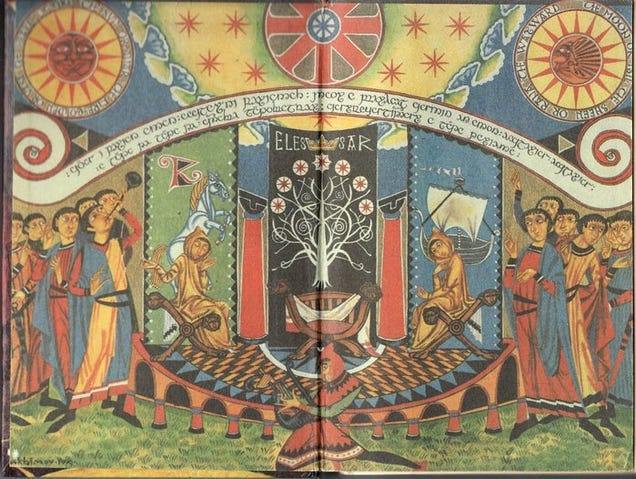
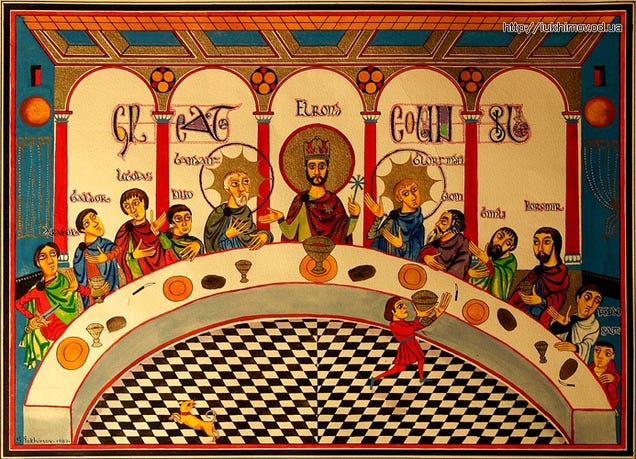
A few days ago a friend shared with me a link to an intriguing collection of images of medieval-style Tolkien illustrations painted by an iconographer.

As I first looked at the images, I was not certain what to make of them. It seemed to me that the first couple were painted in rather an exaggerated medieval style, especially the death of Boromir, the more images I saw, the more I enjoyed them.

Of all of the images, I have difficulty in choosing a favorite, going back and forth between a depiction of a bard signing the tale of Frodo of the Nine Fingers and the Ring of Doom in the hall of King Elessar:


and a depiction of the Council of Elrond:


Go have a look. Which paintings do you most enjoy?

23 November 2012

A few books recalled

Some of you will remember that a short time ago I bought a book simply because the subtitle made me laugh: The Hobbit and Philosophy: For When You've Lost Your Dwarves, Your Wizard, and Your Way.

Despite a promising - and enjoyable - introduction cleverly peppered with many allusions and puns,  the rest of the book really has very little to do with such situations as when you've lost your dwarves, your wizard, or your way.

The book is written by a number of philosophers, nearly all of whom somehow seem not to have noticed that Tolkien's was not only Catholic, but that his faith very much shaped his conception of Middle Earth.  Too much of the book focuses on Taoism and not on Catholicism and so misses the real insights contained with Tolkien's subcreation.

Frankly, I don't really recommend this book to anyone seeking to delve more deeply into Middle Earth.

While I'm reviewing books, let me make a brief mention of two books that the Chancellor, knowing of my love of The Hobbit and The Lord of the Rings, kindly gave to me recently.

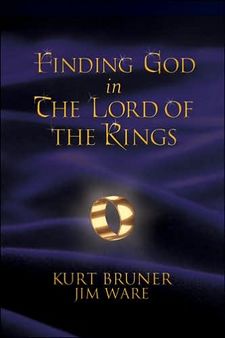
The first is Finding God in the Hobbit by Jim Ware and the second is Finding God in The Lord of the Rings by Kurt Bruner and Jim Ware.

While these took books deal with Christian themes, they also seem to have missed - or perhaps chose to ignore - Tolkien's Catholic faith one.  Bruner and Ware are Christian, but to which they denomination they adhere they give little indication, except for one reference to "Jehovah".

These short books can each be read in the space of an hour.  In both books, the chapters form reflections on a line or two from Tolkien's work.  Beginning first with a recap of the situation surrounding the brief quotation, Bruner and Ware follow the recap with a sort of mini homily and conclude with a "reflection" fit a church marquee.

These two books are not bad, but they are very simple and won't really help anyone delve more deeply in the many insights Tolkien offers us.

Better, I suggest, to stick with Matthew Dickerson's A Hobbit Journey: Discovering the Enchantment of J.R.R. Tolkien's Middle-earth.  Of the books I have read looking at the Christian and philosophical underpinnings of Tolkien's work, it is the best and more insightful.

12 April 2012

Gandalf and Priests: Servants of the Secret Fire

Prior to the Easter Vigil Saturday night, the deacon, the pastor, and I went out to where the fire would late be lit in the courtyard between the Cathedral and the school.  It is a perfect space for the fire and for the congregation to gather around it, but it was rather windy at the time.
We still had just over an hour before the beginning of the mother of all holy vigils, but I wanted to be sure we could move the Paschal Candle into the Cathedral without the blessed flame being blown out by the wind.  I suggested that we could have the Bishop lightt the Paschal Candle and then light a small votive candle that could be shielded more easily and snuck into the vestibule of the Cathedral before the Paschal Candle, just in case we should need it.  My idea was nixed.
As I returned to the sacristy pondering the situation and still envisioning the sneaking of a holy flame into the Cathedral, these words ran repeatedly through my mind:
I am a servant of the Secret Fire, wielder of the flame of Anor.

Neither the deacon nor the pastor knew the reference, but the servers did and so did the Bishop (who enjoyed it).
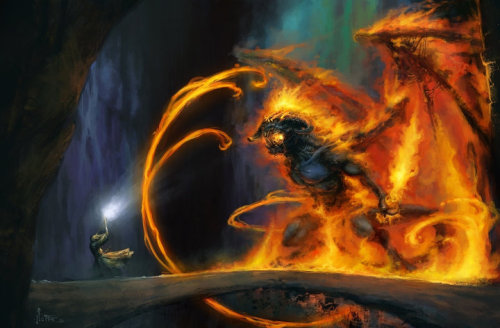
The words come, of course, from Gandalf the Grey in J. R. R. Tolkien's great trilogy, The Lord of the Rings.  Gandalf speaks the words on the bridge of Khazad-Dûm to the Balrog.  He contines, saying to the "dark figure streaming with fire," "You cannot pass.  The dark fire will not avail you, flame of Udûn.  Go back to the Shadow!  You cannot pass."
As the lines ran through my mind again and again, I wondered if some connection might be made with the Easter Vigil, so I pulled out my Tolkien books to have a look.

The Secret Fire: The Flame of Anor

"Anor" is a Sindarin word for the Quenya word for "sun," coming from "Anar."  The "Secret Fire" of which Gandalf speaks is the Flame of Anor, which is also called the "Flame Imperishable," the divine life-force of the world and of the universe.

In The Silmarillion, Tolkien describes the coming of the light of Anor:
Then Anar arose in glory, and the first dawn of the sun was like a great fire upon the towers of the Pelóri: the clouds of Middle-earth were kindled, and there was heard the sound of many waterfalls.  Then indeed Morgoth was dismayed, and he descended into the uttermost dephs of Angband, and withdrew his servants, sending forth great reek and dark cloud to hide his land from the daystar ([New York: Ballantine Books, 2001], 112).
In Part One of The Book of Lost Tales, we learn that Melko "fared often alone into the dark places and the voids seeking the Secret Fire that giveth Life and Reality (for he had a very hot desire to bring things into being of his own)" ([Boston: Houghton Mifflin Company, 1984], 53).  It is this Secret Fire that burns "at the heart of the world" (The Silmarillion, 55).

It is to this Secret Fire that the Order of the Istari (the wizards) gave their obedience and it is this Secret Fire they wield.

The Secret Fire: The Light of Christ

Tolkien was, as we know well, a devout Catholic, and his Catholic faith lies as something of a hidden foundation supporting the world of Middle-earth.  Consequently, it is right for us to examine the Flame of Anor and to look for possible connections to Christianity.

During the great night of Easter, our attention focuses upon Jesus Christ, who referred to himself as the "light of the world" (John 8:12) and who is symbolized by the light of the Paschal Candle.


Lit from the newly blessed fire which we pray will bestow "upon the faithful the fire of [God's] glory" and incised with the Cross, the Alpha and the Omega, and the calendrical year, and marked by grains of incense symbolic of the stigmata, it is held aloft in procession to "dispel the darkness of our hearts and minds" (Roman Missal, The Easter Vigil in the Holy Night, 10-14).

As he sings the Exultet, the Deacon praises "the power of this night" that "dispels wickedness, washes faults away, restores innocense to the fallen, and joy to mourners, drives out hatred, fosters concord, and brings down the mighty."

This night is embued with such power because it is the night during which Christ rose from the dead and salvation history is brought to its fulfillment.  On this night, the Lord Jesus, whom the Exultet calls "the Morning Star who never sets," shows himself to be "the light [that] shines in the darkness, and the darkness has not overcome it" (John 1:5).  Christ is the Flame Imperishable.

What is more, "all things came to be through him, and without him nothing came to be.  What came to be through him was life, and this life was the light of the human race" (John 1:3-4).  Not only is the Flame Imperishable; Jesus also gives life and reality to the world.

When at last he came into the world and took on our human flesh, "he came to what was his own, but his own people did not accept him" (John 1:11).  His identity was made secret and not everyone recognized his light.

A Servant of the Secret Fire
The connections between Jesus and the Secret Fire are easy enough to make, but what of a possible connection between Gandalf - and, through him, the Order of the Istari - and priests?

Writing to the Corinthians, Saint Paul said, "Thus should one regard us: as servants of Christ and stewards of the mysteries of God" (II Corinthians 4:5).  A servant must pledge obedience to his master and a steward safeguards what is entrusted to him.

We saw above that Gandalf and the Istari pledged their obedience to the Flame of Anor; before their ordination, priests promise obedience to their Bishop and his successors.  At the same time, they promise to be faithful to the teachings and discipline of the Church, which is the Body of Christ.  As Saint Paul says, priests are "servants" of the Light of the World.

At the same time Gandalf serves the Secret Fire, he also wields it.  The same can be said of priests.

Jesus said, "I have come to set the earth on fire, and how I wish it were already blazing" (Luke 12:49)!  When he wrote to Saint Timothy, Saint Paul urged him, saying, "I remind you to stir into flame the gift of God that you have through the imposition of my hands" (II Timothy 1:6).  It is this flame that a priest wields, the Light of Christ himself, which is entrusted to priests at their ordination when the Holy Spirit is called down upon them, the same Spirit who descended upon the Apostles in "tongues as of fire" (Acts 2:3).

Priests wield this gift, this flame, through the Sacraments.  Priests are principally ordained to celebrate the Eucharist and to hear confessions and absolve sins.  These two Sacraments of Eucharist and Penance each "dispels darkness, washes faults away, restores innocence to the fallen, and joy to mourners, drives out hatred, fosters concord, and brings down the mighty," as the Exultet sings of the Light of Christ.

Through his priests, his servants, Christ the Lord "shed[s] his peaceful light on humanity" (Exultet) and those who follow him "will not walk in darkness, but will have the light of life" (John 8:12).

It seems, then, that when the words of Gandalf came to me quite randomly - "I am a servant of the Secret Fire, wielder of the flame of Anor" - I wasn't too far off.