Showing posts with label Thanksgiving. Show all posts

25 November 2018

Homily - 22 November 2018 - Thanksgiving Day


Thanksgiving Day


Dear brothers and sisters,


We Americans like our holidays, and we have distinctly American ways of observing them. Like most other peoples, our holiday celebrations often center around food, but, of course, we give our own flair even to this. As but one example, most non-Americans are baffled by our near religious custom of the cook-out on Memorial Day; they do not understand what it has to do with remembering our fallen dead. To be fair, most of us cannot explain the connection, either, and this shows something of a certain American disconnect in the observance of our holidays.


Nearly all of our American holidays are civic affairs: Independence Day, President’s Day, Labor Day, etc. Today, though, Thanksgiving Day, is different; it is our most religious holiday. Now, I know that some may object, asking, “What about Christmas and Easter, Father?” This is a fair objection, but, strictly speaking, these are not so much American holidays as much as they are universal holidays.


It is a curious thing that this most religious of American holidays has now become – against all reason and logic – almost devoid of religion, as if it were possible to give some form of generic thanks to the universe. Simply consider this statement written to me yesterday: “I like the point that Thanksgiving isn't a religious holiday (other than a possible prayer before the meal).” It is a comment that demonstrates both a historical ignorance and a complete lack of understanding of what it means to be grateful.


As Americans, we lost the religiousness of Sunday when, some decades ago, we abandoned the divinely revealed purpose of the Lord’s Day in favor of sports, shopping, and profits. How many Americans purposefully arrange their Sundays around these events and fit prayer in only as an afterthought instead of making the worship of God the center of Sunday? We likewise largely gave up the focus on the Resurrection of the Lord Jesus as the centrality of Easter in favor of new outfits to impress others and we tossed aside the poverty of the Child Jesus at Christmas in favor of a growing materialistic greed. To anyone then paying attention, these were distressing signs of a declining culture. Today, a recovery seems all but impossible.


Up until a few years ago, it seemed the simple purity of Thanksgiving Day had been preserved and kept safe from the heavy-footed encroachment of a cruel secularism. Eight years ago, the owner of a bed and breakfast in Pennsylvania said, “Thanksgiving is fairly quiet in the consumer-driven market of ghouls, glitz, and over-the-top commercialism.”[1] Today, it is clear that the same can no longer be said. How quickly we have abandoned even gratitude itself! Is this not why Jesus asks today, “Ten were cleansed, were they not? Where are the other nine” (Luke 17:17)? Still, we are not without hope.


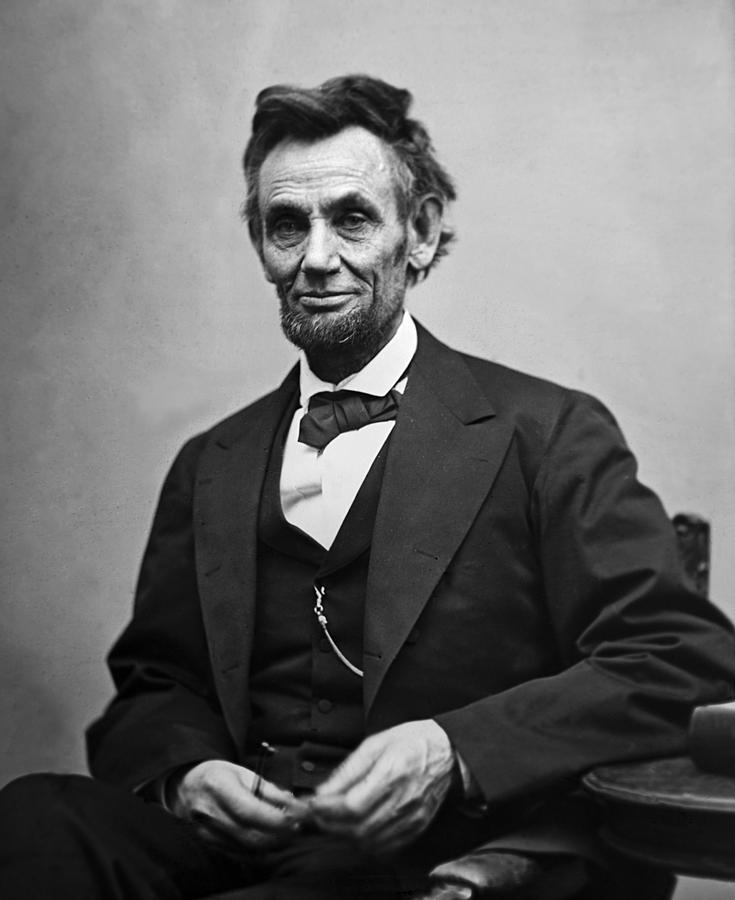
When Mr. Lincoln issued his Proclamation of Thanksgiving on October 3, 1863, he did so in the midst of the Civil War.  He knew, the traumatic destruction of life and property wrought by the war, but he also saw the bounty of the harvest and the prosperity of the nation, which led him to say, in part,


The year that is drawing towards its close, has been filled with the blessings of fruitful fields and healthful skies. To these bounties, which are so constantly enjoyed that we are prone to forget the source from which they come, others have been added, which are of so extraordinary a nature, that they cannot fail to penetrate and soften even the heart which is habitually insensible to the ever watchful providence of Almighty God. … They are the gracious gifts of the Most High God, who, while dealing with us in anger for our sins, hath nevertheless remembered mercy. It has seemed to me fit and proper that they should be solemnly, reverently and gratefully acknowledged as with one heart and one voice by the whole American People. I do therefore invite my fellow citizens in every part of the United States, and also those who are at sea and those who are sojourning in foreign lands, to set apart and observe the last Thursday of November next, as a day of Thanksgiving and Praise to our beneficent Father who dwelleth in the Heavens. And I recommend to them that while offering up the ascriptions justly due to Him for such singular deliverances and blessings, they do also, with humble penitence for our national perverseness and disobedience, commend to His tender care all those who have become widows, orphans, mourners or sufferers in the lamentable civil strife in which we are unavoidably engaged, and fervently implore the interposition of the Almighty Hand to heal the wounds of the nation and to restore it as soon as may be consistent with the Divine purposes to the full enjoyment of peace, harmony, tranquility and Union.[2]


Historically, then, it is quite false to say this quintessential American holiday of Thanksgiving is not a religious occasion; it has, as its foundation, a communal act of gratitude to God which is, by its very nature, religious.


Nor is it possible to give thanks simply to one another on this day on which we gather around our tables to share a feast. We may have purchased the food prepared, but we did not create it, this nation, or even ourselves. There is no one on earth whom we can thank for these gifts, because no one on earth has given them; nor is it possible to give thanks to no one; such an act would be senseless and devoid of meaning. The fundamental act of gratitude must above all be ascribed to God, the Creator of all that exists, “who fosters people’s growth from their mother’s womb” (Sirach 50:22).


While a great many Americans fail to grasp the essential quality of Thanksgiving Day, we ought not only give thanks for God’s many mercies toward us, but we ought also do penance as President Lincoln urged us to do. Our country remains greatly divided and a profound healing is needed in our land, both between fellow citizens and between citizens and the Lord. Such a healing can come about through acts of gratitude, through acts which recognize that I deserve nothing, but that everything is a gift from God.


Before we gather around our family tables, we have gathered at the altar of the Lord where the


Mass invites us to discern what, in ourselves, is obedient to the Spirit of God and what, in ourselves, is attuned to the spirit of evil. In the Mass, we want to belong only to Christ and we take up with gratitude – with thanksgiving – the cry of the psalmist: ‘How shall I repay the Lord for his goodness to me’ (Ps 116:12)?[3]


For whatever within us is attuned to the Spirit of God, let us give humble thanks; for whatever within us is not attuned to God, let us give thanks for the gift of his mercy that can heal this discord within us and bring us into “fellowship with his Son, Jesus Christ our Lord” (I Corinthians 1:9). Amen.


[1]Thanksgiving – The Last Pure andSimple Holiday in America,” The Artist’s Inn & Gallery, 18 November 2010.
[2] Abraham Lincoln, Proclamation of Thanksgiving, 3 October 1863.
[3] Pope Benedict XVI, Homily, 13 September 2008.

26 November 2015

Thoughts on that First Thanksgiving

The only surviving account of what we call that first Thanksgiving celebration comes to us from the quill of one Edward Winslow, Jr. Born in 1595, Winslow was a printer by trade and among the company of the Separatists - known to us as the Pilgrims - who thought the Church of England too much resembled the Catholic Church and left Plymouth, England aboard the Mayflower in September of 1620 to establish the Puritan way of life in the New World.

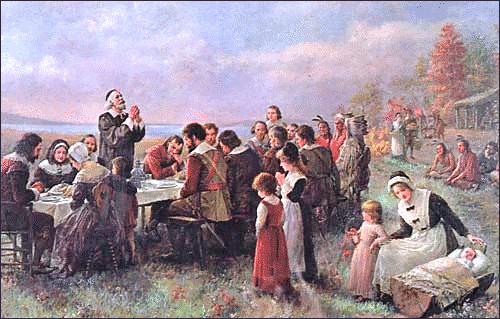
Though the exact dates are unknown to us, the feast that we call the First Thanksgiving took place over three days sometime between September 21 and November 11, 1621, most likely at the end of September. Those who enjoyed the feast included the fifty remaining Separatists (the other fifty Pilgrims had already died) and some 90 members of the Wampanoag tribe who happened upon the celebrations of the Separatists and joined them.

Writing from Plymouth on 11 December 1621 to a "loving, and old friend," Edward Winslow, Jr. described the festivities accompanying that First Thanksgiving:
...our harvest being gotten in, our governor sent four men on fowling, that so we might after a more special manner rejoice together, after we had gathered the fruit of our labors; they four in one day killed as much fowl, as with a little help beside, served the company almost a week, at which time amongst other recreations, we exercised our arms, many of the Indians coming amongst us, and among the rest their greatest King Massasoit [whom Winslow had earlier befriended], with some ninety men, whom for three days we entertained and feasted, and they went out and killed five deer, which they brought to the plantation and bestowed on our governor, and upon the captain, and others.
It might seem striking that so very little is known about an event that plays such a central role in the imagination of the American people and how we think of ourselves, but this is often the way with such foundational stories. If more were known about that First Thanksiving, so many of our mythic stories purporting to express the core values of what would become the United States of America - freely sharing our bounty with others, being but one of them - could not have been added to those three days of feasting.

It is not hard to see that many Americans today are turning in on themselves and openly expressing a desire to keep others out, as we see particularly with the plight of the Syrian refugees. The forebears of our Founding Fathers freely shared their food and benefits with the Wampanoag who came as invited guests. Nevertheless, the Separatists welcomed them and feasted with them.

The United States of America has always claimed to be a safe haven for those suffering injustice and whose liberty was threatened. We have not always lived up to this ideal, but we have also never relinquished this ideal. Today we have a momentous opportunity to live up to this ideal or to reject. If we are truly thankful, we will embrace it.

26 November 2014

President Lincoln's Thanksgiving Proclamation of 1863

From President Abraham Lincoln, with my emphases:
By the President of the United States of America

A Proclamation

The year that is drawing towards its close, has been filled with the blessings of fruitful fields and healthful skies. To these bounties, which are so constantly enjoyed that we are prone to forget the source from which they come, others have been added, which are of so extraordinary a nature, that they cannot fail to penetrate and soften even the heart which is habitually insensible to the ever watchful providence of Almighty God. In the midst of a civil war of unequaled magnitude and severity, which has sometimes seemed to foreign States to invite and to provoke their aggression, peace has been preserved with all nations, order has been maintained, the laws have been respected and obeyed, and harmony has prevailed everywhere except in the theatre of military conflict; while that theatre has been greatly contracted by the advancing armies and navies of the Union. Needful diversions of wealth and of strength from the fields of peaceful industry to the national defence, have not arrested the plough, the shuttle or the ship; the axe has enlarged the borders of our settlements, and the mines, as well of iron and coal as of the precious metals, have yielded even more abundantly than heretofore. Population has steadily increased, notwithstanding the waste that has been made in the camp, the siege and the battle-field; and the country, rejoicing in the consiousness of augmented strength and vigor, is permitted to expect continuance of years with large increase of freedom. No human counsel hath devised nor hath any mortal hand worked out these great things. They are the gracious gifts of the Most High God, who, while dealing with us in anger for our sins, hath nevertheless remembered mercy. It has seemed to me fit and proper that they should be solemnly, reverently and gratefully acknowledged as with one heart and one voice by the whole American People. I do therefore invite my fellow citizens in every part of the United States, and also those who are at sea and those who are sojourning in foreign lands, to set apart and observe the last Thursday of November next, as a day of Thanksgiving and Praise to our beneficent Father who dwelleth in the Heavens. And I recommend to them that while offering up the ascriptions justly due to Him for such singular deliverances and blessings, they do also, with humble penitence for our national perverseness and disobedience, commend to His tender care all those who have become widows, orphans, mourners or sufferers in the lamentable civil strife in which we are unavoidably engaged, and fervently implore the interposition of the Almighty Hand to heal the wounds of the nation and to restore it as soon as may be consistent with the Divine purposes to the full enjoyment of peace, harmony, tranquillity and Union.

In testimony whereof, I have hereunto set my hand and caused the Seal of the United States to be affixed.

Done at the City of Washington, this Third day of October, in the year of our Lord one thousand eight hundred and sixty-three, and of the Independence of the United States the Eighty-eighth.

By the President: Abraham Lincoln

William H. Seward
Secretary of State

22 November 2012

Thanksgiving and the Year of Faith

During this Year of Faith, Pope Benedict XVI has called us "to rediscover the content of the faith that is professed, celebrated, lived and prayed."  This, he says, "is a task that every believer must make his own" (Porta Fidei, 9).

One important way we can rediscover the faith that is celebrated is to reflect on the liturgical texts of the Church found in the Roman Missal.  Doing so as we in these United States of America celebrate Thanksgiving Day can offer us a profound insight into what it means to give thanks.

We should never forget the ancient maxim lex orandi, lex credendi, which roughly means "the law of prayer is the law of belief."  In this principle we remember that our worship of God is the foundation of all that we are.

There is a common thread uniting the prayers Holy Mother Church has given us to use on Thanksgiving Day.


The Collect - which gathers our various individual prayers together at the beginning of the Mass and presents them to the Father - recalls that the Father's "gifts of love are countless" and asks the Lord to "open our hearts to have concern for every man, woman, and child, so that we may share your gifts in loving service."  The Prayer Over the Offerings similarly asks the Father that "we might learn to share your blessings in gratitude" while the Prayer after Communion asks that we will be helped "to reach out in love to all your people, so that we may share with them the good things of time and eternity."'

The common thread uniting the prayers together is the recognition that gratitude for God's copious blessings must lead to a willingness to share these gifts with others, with friends and families, with enemies and strangers.  The preface makes this common thread more explicit when it recalls that the gift of freedom is "a gift that calls forth responsibility and commitment to the truth that all have a fundamental dignity before you."

The gifts that we have received from God are not simply ours to keep, but are given to us to be shared freely, with loving and joyful hearts.

Here we remember the words of the Lord Jesus, "Truly, I say to you, as you did it to one of the least of these my brethren, you did it to me," and, "Truly, I say to you, as you did it not to one of the least of these my brethren, you did it not to me" (Matthew 25:40, 45).

This is why the Holy Father reminds us that "confessing with the lips indicates in turn that faith implies public testimony and commitment.  A Christian may never think of belief as a private act.  Faith is choosing to stand with the Lord so as to live with him" (Porta Fidei, 10).  This is why to the maxim lex orandi, lex credendi is often added the phrase lex vivendi: the law of prayer is the law of belief is the law of life.  What the Church prayers is the faith of the Church we should direct the way we live.

As we give thanks today for the many gifts with which the Lord has blessed us - among which we should especially recall the gifts of faith and of freedom - let us ask above all for hearts as generous as his that we imitate him in all things.  Let us beg the grace to give generously and never count the cost because, as Pope Benedict XVI reminds us, "Faith without charity bears no fruit, while charity without faith would be a sentiment constantly at the mercy of doubt.  Faith and charity each require the other" (Porta Fidei, 14).

To you and to yours, I wish a very happy and blessed Thanksgiving!

23 November 2011

A thanksgiving round up

As the nation's Thanksgiving holiday quickly approaches, it is good to spend a bit of time considering what is to be thankful (otherwise tomorrow's festivities are just about good food).

Writing on his blog, Shepherd of Fort Worth, His Excellency Bishop Kevin Vann - a priest of the Diocese of Springfield in Illinois - calls all Christians to, in the words of Pope St. Gregory the Great, "remember your dignity" and to act as leaven in the world because "Thanksgiving is a time for us to reflect seriously and joyfully on God's grace."

Thanksgiving, says His Excellency Archbishop Dolan, "is bittersweet—especially this year. The need for an annual distribution of meals at Thanksgiving reminds us that all is not right with our nation—and world."

And in Crisis magazine, Father Dwight Longenecker explores the theology of thanksgiving, both in the Old Testament and in the Eucharist.

22 November 2010

President Washington's Thanksgiving Proclamation

From President George Washington, with my emphases:

By the President of the United States of America, a Proclamation.

Whereas it is the duty of all Nations to acknowledge the providence of Almighty God, to obey his will, to be grateful for his benefits, and humbly to implore his protection and favor-- and whereas both Houses of Congress have by their joint Committee requested me to recommend to the People of the United States a day of public thanksgiving and prayer to be observed by acknowledging with grateful hearts the many signal favors of Almighty God especially by affording them an opportunity peaceably to establish a form of government for their safety and happiness.

Now therefore I do recommend and assign Thursday the 26th day of November next to be devoted by the People of these States to the service of that great and glorious Being, who is the beneficent Author of all the good that was, that is, or that will be-- That we may then all unite in rendering unto him our sincere and humble thanks--for his kind care and protection of the People of this Country previous to their becoming a Nation--for the signal and manifold mercies, and the favorable interpositions of his Providence which we experienced in the course and conclusion of the late war--for the great degree of tranquility, union, and plenty, which we have since enjoyed--for the peaceable and rational manner, in which we have been enabled to establish constitutions of government for our safety and happiness, and particularly the national One now lately instituted--for the civil and religious liberty with which we are blessed; and the means we have of acquiring and diffusing useful knowledge; and in general for all the great and various favors which he hath been pleased to confer upon us.

and also that we may then unite in most humbly offering our prayers and supplications to the great Lord and Ruler of Nations and beseech him to pardon our national and other transgressions-- to enable us all, whether in public or private stations, to perform our several and relative duties properly and punctually--to render our national government a blessing to all the people, by constantly being a Government of wise, just, and constitutional laws, discreetly and faithfully executed and obeyed--to protect and guide all Sovereigns and Nations (especially such as have shewn kindness unto us) and to bless them with good government, peace, and concord--To promote the knowledge and practice of true religion and virtue, and the encrease of science among them and us--and generally to grant unto all Mankind such a degree of temporal prosperity as he alone knows to be best.

Given under my hand at the City of New York the third day of October in the year of our Lord 1789.
You can see the original document here.
Now, what of that supposed separation of Church and State?

26 November 2009

The Establishment of Thanksgiving

The year that is drawing towards its close, has been filled with the blessings of fruitful fields and healthful skies. To these bounties, which are so constantly enjoyed that we are prone to forget the source from which they come, others have been added, which are of so extraordinary a nature, that they cannot fail to penetrate and soften even the heart which is habitually insensible to the ever watchful providence of Almighty God.

In the midst of a civil war of unequalled magnitude and severity, which has sometimes seemed to foreign States to invite and to provoke their aggression, peace has been preserved with all nations, order has been maintained, the laws have been respected and obeyed, and harmony has prevailed everywhere except in the theatre of military conflict; while that theatre has been greatly contracted by the advancing armies and navies of the Union. Needful diversions of wealth and of strength from the fields of peaceful industry to the national defence, have not arrested the plough, the shuttle, or the ship; the axe had enlarged the borders of our settlements, and the mines, as well of iron and coal as of the precious metals, have yielded even more abundantly than heretofore. Population has steadily increased, notwithstanding the waste that has been made in the camp, the siege and the battle-field; and the country, rejoicing in the consciousness of augmented strength and vigor, is permitted to expect continuance of years, with large increase of freedom.

No human counsel hath devised nor hath any mortal hand worked out these great things. They are the gracious gifts of the Most High God, who, while dealing with us in anger for our sins, hath nevertheless remembered mercy.

It has seemed to me fit and proper that they should be solemnly, reverently and gratefully acknowledged as with one heart and voice by the whole American people. I do therefore invite my fellow citizens in every part of the United States, and also those who are at sea and those who are sojourning in foreign lands, to set apart and observe the last Thursday of November next, as a day of Thanksgiving and Praise to our beneficent Father who dwelleth in the Heavens. And I recommend to them that while offering up the ascriptions justly due to Him for such singular deliverances and blessings, they do also, with humble penitence for our national perverseness and disobedience, commend to his tender care all those who have become widows, orphans, mourners or sufferers in the lamentable civil strife in which we are unavoidably engaged, and fervently implore the interposition of the Almighty Hand to heal the wounds of the nation and to restore it as soon as may be consistent with the Divine purposes to the full enjoyment of peace, harmony, tranquillity and Union.

In testimony whereof, I have hereunto set my hand, and caused the seal of the United States to be affixed.

Done at the city of Washington, this third day of October, in the year of our Lord one thousand eight hundred and sixty-three, and of the independence of the United States the eighty-eighth.

- Abraham Lincoln
Capello tip to The Crescat.

22 November 2009

An evening with the Baptists

This evening the First Baptist Church in Virden hosted the annual Thanksgiving Service sponsored by the North Macoupin County Ministerial Association. Pastor Philips invited me to preach the sermon and I happily accepted his invitation.

My words were very well received and the Baptists were gracious hosts. I'm pleased to say that the local Catholics were also very well represented.

What follows is the sermon I preached for the occasion:

Dear Pastors and Ministers,
Dear brothers and sisters in Christ,

May the Lord give you peace!

I am grateful to Pastor Philips and to my fellow members of the Virden-Girard Ministerial Association for their kind invitation to preach this evening. They have welcomed me warmly and have been very supportive of my ministry here among you, and I thank them. I thank, too, the members of First Baptist Church who are graciously hosting us this evening; may the Lord reward you for their kindness.

Some four hundred years ago, in 1621 a great feast was held between Puritans Separatists and local Indians to give thanks at Plymouth for the recent harvest in the midst of great hardship. This week families will gather across this land to commemorate this event, though the current difficulties are not so severe, the harvest is not yet finished and our own menus will be very much unlike that of the first Thanksgiving on this nation’s soil.

There is something within us, a certain desire and longing, a certain necessity, if you will, to give thanks. Man must give thanks, for he is not his own, in and of himself. Saint Paul puts it this way: “What have you that you did not receive” (I Corinthians 4:7)? All that we have is gift, whether we recognize it or not.

This need to express gratitude has given rise to rituals and traditions in every culture of the world, in every age and place, from the simplest peasant to the most noble of kings. Although much has changed, this desire to offer thanks remains, even, curiously enough, among atheists.

The greater man advances technologically, the greater his need to give thanks lest he become lost in himself, lest he become ill at ease and unable to rest.

In every corner of the world we discover certain truths. Among them is this: the more a person gives thanks, both to his Creator and to his fellow man, he greater his happiness will be.

Here in the civilized West we have come to the notion that life is meant to be happy and that if, for one reason or another, it is not, something must be amiss. But, my brothers and sisters, is this, in fact, the reality of our human existence?

If we think back to that first celebration of Thanksgiving, can we really say that life was happy for the Europeans or for the Indians as we think a happy life should be today? Of the original number who set sail from England, half died of malnutrition, disease and the elements before the celebration of that first Thanksgiving. Twenty years later, they still had only one plow among them.

The hardships they endured, we, with our indoor plumbing and electricity, computers and supermarkets, can scarcely imagine. Theirs was a life few of us could have lived and in this regard they are not very different from the major course of human history.

This certainly could not have been what we mean by a happy life, but it may well have been a contented life. Would any one of the pilgrims have expected anything less? Of course not; difficulty and hardship was part of everyday life. Why should we expect it to be any different for us, here at the beginning of the twenty-first century?

This gives us cause to consider for what we are grateful. Do we give thanks for the ease with which we have our food, for our trusty air conditioners in the summer and heaters in the winter, for our vehicles which make travel so fast and simple and for the other technological advancements of our age? Of course we do, but we should not stop there.

Those first pilgrims rendered thanks to Almighty God who saw them through that first difficult winter. They did “not forget all the gifts of God,” simple as these gifts may appear to us (Psalm 103:2). They were well aware that, as King David sang, it is the Lord “who pardons all your sins, heals all your ills, delivers your life from the pit, surrounds you with love and compassion, fills your days with good things” (Psalm 103:3-5).

The Lord does all of these things through the Cross of our Lord Jesus Christ. It is this very cross of which the Redeemer says, “If anyone wishes to come after me, he must deny himself and take up his cross daily and follow me. For whoever wishes to save his life will lose it, but whoever loses his life for my sake will save it” (Luke 9:23-24).

The Church – and each of her members – must always give thanks to God for so great a gift through which all good things come to us. For without the Cross of Jesus Christ, what do we have? As Saint Peter says, “By his wounds, you have been healed” (I Peter 2:24).

So often we seek to flee from the Cross, to avoid what is difficult and seek only what is easy. But, my friends, the Lord Jesus did not promise us a rosy and happy life; he promised us persecution and rejection and division; he promised us the Cross. It is only through his Cross that we know his peace, his joy and his love. Why, then, do we run from it? Why do we not instead run toward the Cross whenever it is presented to us?

We are often afraid of the Cross because it requires us to change our lives, our manner of thinking and doing. It requires us to renounce ourselves more and more until we can say with the Apostle, “It is no longer I who live, but Christ who lives in me” (Galatians 2:20).

The Cross of our Lord is not simply his; each of us is called to share in it and share in it we must, if we wish to be his disciple. The Cross will come in different forms for each us because the Lord knows how we will best grow in holiness and grace. He knows best how to complete the good work he has begun in us (cf. Philippians 1:6).

Whereas the Cross was once the symbol of death, now it is the symbol of live, the symbol of victory. Christ reigns now from the throne of his Cross, offering each of us a share in his victory. This is why Saint Paul says we are to “give thanks in all circumstances; for this is the will of God in Christ Jesus for you” (I Thessalonians 5:18). Are we grateful for the Cross as it comes to us?

Saint Paul was certainly grateful for the Cross of Christ, even if he asked for it to be taken from him. When it was not, he accepted it as a faithful disciple and through it came to rely on the grace of Christ in all things, finding in it the cause of his joy (cf. II Corinthians 12:7-8). Christ Jesus said to him, “My grace is sufficient for you, for power is made perfect in weakness,” which lead Saint Paul to say, “Therefore, I am content with weaknesses, insults, hardships, persecutions, and constraints, for the sake of Christ; for when I am weak, then I am strong” (II Corinthians 12:9). This is the mark of one who has accepted his share in the Cross.

Writing to the Church of Colossae, he says, “Now I rejoice in my sufferings for your sake, and in my flesh I am filling up what is lacking in the afflictions of Christ on behalf of his body, which is the Church” (Colossians 1:24). How can he rejoice in his sufferings? Because he is thankful for them, because he recognizes the grace given him through them.

Saint James, too, recognized this grace, and so he wrote, “Consider it all joy, my brothers, when you encounter various trials, for you know that the testing of your faith produces perseverance” (James 1:2-3).

Likewise did Saint Peter know the beauty of the Cross. “In this you rejoice,” he says, “although now for a little while you may have to suffer through various trials, so that the genuineness of your faith, more precious than gold that is perishable even though tested by fire, may prove to be for praise, glory, and honor at the revelation of Jesus Christ” (I Peter 1:6-7).

Dear brothers and sisters, let us never seek to shy away from the Cross, but let us welcome it gladly, with rejoicing and much thanksgiving. This seems contrary to our natural inclinations. We willing give thanks for the blessings we receive, those things we ordinarily consider good, but to give thanks for difficulties and hardships seems almost insane to our modern sensibilities.

Consider the following reflection of a soldier from the Civil War:

I asked God for strength, that I might achieve; I was made weak, that I might learn humbly to obey.

I asked for health, that I might do greater things; I was given infirmity, that I might do better things.

I asked for riches, that I might be happy; I was given poverty, that I might be wise.

I asked for power, that I might have the praise of others; I was given weakness, that I might feel the need of God.

I asked for all things, that I might enjoy life; I was given life, that I might enjoy all things.

I got nothing I asked for – but everything I had hoped for.

Almost despite myself, my unspoken prayers were answered.

I am, among all people, most richly blessed!

This is the reflection of one who knows the beauty of the Cross, of one who is thankful for it.

As we gather this week with family and friends around our tables, we will rightly recall with gratitude that first Thanksgiving at Plymouth. We will rightly recall with gratitude the many material blessings the Lord has given us, both in this nation and in this time. But let us not forget to render thanks to the Father Almighty for the gift of his Son, for the gift of his Cross, for our sharing in his sufferings.

21 November 2008

Thanksgiving prep

With Thanksgiving Day not too far away, many people are busying themselves today and the next few days with the many preparations for the celebration, most notably the purchasing and preparation of food.

As important as these preparations are, we ought not neglect to prepare ourselves spiritually for the civic holiday. We are Catholic, after all, and our faith is to shape and inform everything we do. Even eating turkey or, my personal favorite, noodles. I'm also a big fan of homemade biscuits. And pie, but not pumpkin. And creamed turkey sandwiches the next day, but I digress.

Bishop William Lori of Bridgeport offers several questions for our consideration to help us prepare for Thanksgiving.

In these next few days as we ask the intercession of Saint Martha for help in seeing to the needs of hospitality, let us not forget that it was Saint Mary who chose "the good portion, which shall not be taken away from her" (Luke 10:42).

22 November 2007

Washington's Thanksgiving Proclamation

Whereas it is the duty of all nations to acknowledge the providence of Almighty God, to obey His will, to be grateful for His benefits, and humbly to implore His protection and favor; and

Whereas both Houses of Congress have, by their joint committee, requested me "to recommend to the people of the United States a day of public thanksgiving and prayer, to be observed by acknowledging with grateful hearts the many and signal favors of Almighty God, especially by affording them an opportunity peaceably to establish a form of government for their safety and happiness":

Now, therefore, I do recommend and assign Thursday, the 26th day of November next, to be devoted by the people of these States to the service of that great and glorious Being who is the Beneficent Author of all the good that was, that is, or that will be; that we may then all unite in rendering unto Him our sincere and humble thanks for His kind care and protection of the people of this country previous to their becoming a nation; for the signal and manifold mercies and the favorable interpositions of His providence in the course and conclusion of the late war; for the great degree of tranquillity, union, and plenty which we have since enjoyed; for the peaceable and rational manner in which we have enabled to establish constitutions of government for our safety and happiness, and particularly the national one now lately instituted; for the civil and religious liberty with which we are blessed, and the means we have of acquiring and diffusing useful knowledge; and, in general, for the great and various favors which He has been pleased to confer upon us.

And also that we may then unite in most humbly offering our prayers and supplications to the great Lord and Ruler of Nations, and beseech Him to pardon our national and other transgressions; to enable us all, whether in public or private stations, to perform our several and relative duties properly and punctually; to render our national government a blessing to all the people by constantly being a government of wise, just, and constitutional laws, discreetly and faithfully executed and obeyed; to protect and guide all sovereigns and nations (especially such as have shown kindness to us), and to bless them with good governments, peace, and concord; to promote the knowledge and practice of true religion and virtue, and the increase of science among them and us; and, generally, to grant unto all mankind such a degree of temporal prosperity as He alone knows to be best.

Given under my hand, at the city of New York,
the 3d day of October, AD 1789
George Washington

On Thanksgiving

It takes no more than just a few minutes of watching the "news" on television - or reading it in the papers, for that mater - to notice that what is called "news" is not much more than commentary and editorializing.

As I readied for the day this morning I was listening to the news on a couple of different channels in an attempt to ascertain if anything of note occured throughout the world during the night (it appears not).

I stopped one station to listen to a bit of discussion about thanskgiving, not so much the day but the act of giving thanks.

One of the guests - an "expert", no doubt - said that thanksiging was a very "life-affirming" activity. She never quite said just what she meant by that.

The second of the guests tried to help us realize for what we might be thankful if, say, we were suffering some disease or a family member lay dying. He suggested we be thankful that we have people who love and care for us.

What struck me first about these two guests and their comments was that in discussing thanksgiving, neither of the two mentioned anything about God, or even a "Supreme Being" (the host said nothing to that end, either).

If there be not God, to whom are we to be thankful? More to the point: if there be not God, for what are to be thankful? If there be not God life simply is pointless and dull.

My second thought concerned the notion of thanksgiving as being "life-affirming." That may be the case, but there is far more to it than that. Thanksgiving is, first and foremost, the acknowledgment that I am indebted to someone else; to other human beings, yes, but most especially to God. To give thanks is to acknowledge my dependence.

My thoughts then turned to the comments of the second guest. There are many people who do not feel or believe that anybody cares about them. For what are these to give thanks? Our guest would have no answer for them that might bring them comfort, but the Christian does have an answer.

Life is inevitably a series of blessings and tribulations, for both of these we must give thanks. We owe thanks to God for the blessings he lavishes upon us for obvious reasons. We owe thank to God for the sufferings and trials he allows us to endure for the opportunity to suffer with his Son, to be united with the Crucified Lord.