14 October 2012

Homily - 14 October 2012


The homily that follows is similar to the homily I preached September 30th, 2012.  Parts of the homily have been edited to make reference to the Year of Faith and to the readings of the Twentieth-eighth Sunday of the year.

The Twenty-eighth Sunday of the Year (B)

Dear brothers and sisters,

On April 23, 1886, Cardinal Simeoni said to then Deacon Augustus Tolton (whose cause for beatification and canonization is underway): “America has been called the most enlightened nation on earth.  We will see if it deserves that honor.  If the United States has never before seen a black priest, it must see one now.”  The next morning Deacon Tolton was ordained a priest of Jesus Christ and sent back to his home in Quincy.

The most enlightened nation on earth?  I wonder, what did Father Gus think of that phrase?  Born in slavery, he only became free after his mother made a harrowing escape with her three children when Gus was seven.  Does an enlightened nation enslave people simply on the basis of the color of their skin? 

When he enrolled at St. Boniface school in Quincy, many of the parents of the white children threatened to withdraw their children; young Gus – then ten years old – was the first black student there and withdrew himself.  Does an enlightened nation discriminate against others because of the color of their skin?  When he later enrolled in St. Peter School – at the insistence of the pastor - Gus found that, “As long as I was in that school, I was safe.  Everyone was kind to me.”[1]

Here, perhaps, we see something of an enlightened nation, but then we remember why Father Tolton ultimately left Quincy for Chicago: the jealousy of Father Weiss, who told the first black priest in these United States that he could only minister to blacks and not to whites.  Even so, writing to Cardinal Gibbons, Father Tolton wrote, “The white people in this little Gem City of Quincy, Ills are really good hearted charitable and nonprejudicial, no feelings of bitterness at all against a man on account of complexion.”[2]  Following his death in 1897 and, in keeping with his wishes, Father Tolton was buried back in Quincy where his body remains today. 

History will judge whether or not the America of Father Tolton’s day was indeed an enlightened nation, but I wonder: Will history judge the America of our day to be enlightened?

Is a nation that would require people of faith to violate their consciences and provide contraception, sterilization, and abortion-inducing drugs an enlightened nation?  The recent federal mandate of the Department of Health and Human Services requires precisely this, in clear contradiction of our first amendment right of the free exercise of religion.

Is a nation that makes it illegal for a priest to baptize an illegal immigrant or even hear his confession an enlightened nation?  Such a law was passed in Alabama last year.

Is a nation that seeks to alter the very structure and organization of the Church and to determine who is and who is not a “religious minister” an enlightened nation?  Such a restructuring was attempted in Connecticut in 2009.

Is a nation that tells student religious groups that people of a different faith must be able to be leaders of their religious groups an enlightened nation?  This happened at the University Of California Hastings College Of Law in 2009 and at Vanderbilt University this year.

Is a nation that forces Catholic Charities out of foster care and adoptions because their faith tells them they cannot place children with same-sex or unmarried couples an enlightened nation?  This happened this year in Illinois, in the District of Columbia in 2010, and in Boston and San Francisco in 2006.

Is a nation that refuses to allow Christians to use public buildings but allows other groups to use the same buildings an enlightened nation?  This happens routinely in New York City and elsewhere.

Is a nation that refuses contracts to the best organization helping with human trafficking because it will not provide abortions and contraception an enlightened nation?  The federal government this year refused to renew contracts with the U.S. Bishops’ Migration and Refugee Services for this very reason.

Is a nation that kills more than one million babies each year in their mother’s wombs an enlightened nation?  Blessed Teresa of Calcutta shed light on the horror of abortion when she reminded us that “It is a poverty that a child must die so that you may live as you wish.”  What would Father Gus say of those who might claim, “I’m personally opposed to slavery, but I can’t force my morals on anyone else”?

Is a nation that thinks more about its economic standing than even the right to life when deciding its future an enlightened nation?  I dare say it is not.  What good is a robust economy if few people may enjoy it?

Our Bishop wrote to us a few weeks ago, saying, “you need to think and pray very carefully about your vote, because a vote for a candidate who promotes actions or behaviors that are intrinsically evil and gravely sinful makes you morally complicit and places the eternal salvation of your own soul in serious jeopardy.”[3]  Many people have reacted strongly against the Bishop’s reminder, but the truth of his words remains.

Too often we forget the words of Jesus himself: “Children, how hard it is to enter the kingdom of God” (Mark 10:24)!  Those who make their way to Hell do so by their own choice, by their free rejection of Jesus Christ and the truth of his Gospel.  Those who arrive in heaven do so by preferring Jesus Christ to everything else.  To inherit eternal life, we must live continual in “self-abandonment, in a continuous crescendo, into the hands of a love that seems to grow constantly because it has its origin in God.”[4]

In his Apostolic Letter, Porta Fidei, in which he announced this Year of Faith, the Holy Father reminded us that “faith, precisely because it is a free act, also demands social responsibility for what one believes (10).”  This social responsibility must be lived be outside and inside the voting booth.

In their recent document highlighting the increasing threats against our religious freedom, Our First, Most Cherished Liberty, our Bishops said:

As bishops we seek to bring the light of the Gospel to our public life, but the work of politics is properly that of committed and courageous lay Catholics. We exhort them to be both engaged and articulate in insisting that as Catholics and as Americans we do not have to choose between the two.[5]

Our faith does not need to be – and cannot be – put aside.

Society today is telling us that the most important issues of the upcoming election are jobs and the economy; this is simply not true.  The most important issues of the upcoming election are the right to life and religious liberty.  Without life, no other right matters.  Without religious freedom, every other freedom will be taken away.  “What is at stake is whether America will continue to have a free, creative, and robust civil society – or whether the state alone will determine who gets to contribute to the common good, and how they get to do it.”[6]

On the day of our Baptism, on the day when faith was given to us, each of us was entrusted with the light of Christ and was told to keep it burning brightly.  Each of us must bring this light to the public square so that the warmth of the Light of the World and the truth of his words may bring light to a world and a society darkened by sin.

Some will undoubtedly say, “Father, you’re crossing the line of separation of Church and State.” Such is not the case for what we are discussing is not a matter of Church and State but of faith and politics.  “This ought not to be a partisan issue.  The Constitution is not for Democrats or Republicans or Independents.  It is for all of us.”[7]  We must remember that we are not Republicans or Democrats or Independents; we are Catholics.  No political party fully supports the truth of the Gospel or the mandate Jesus Christ has given us, though some parties are in greater alignment with it than others; that is not our fault, but theirs.  Our allegiance must not be to one political party or another, but to Jesus Christ.

Faith requires something of us. It requires that we love both God and neighbor and that every decision we make, every word we speak, and every action we perform, be in keeping with the love of God and of neighbor, even in the voting booth.  Faith, if it is to gain us eternal life, requires a full adherence to Jesus Christ.  Faith can never be laid aside, for we are servants of the Lord at all times and in every place.  We must remember that “no creature is concealed from [the Lord], but everything is naked and exposed to the eyes of him to whom we must render an account” (Hebrews 4:13).  If we remember this and live accordingly, America will truly be an enlightened nation.

In speaking these words some will praise me and others condemn me, but I do not speak these words for praise or condemnation; I speak them because they are true. Because these words are true I must speak them, for at the end of my life I want to say to the Divine Master, with honesty and sincerity, “I am an unprofitable servant; I have done what I was obliged to do” (Luke 17:10). Amen.


[1] Roy Bauer, They Called Him Father Gus: The Life and Times of Augustine Tolton, First Black Priest in the U.S.A., Part Eight.
[2] Augustus Tolton, Letter to Cardinal Gibbons, July 24, 1888.
[3] Thomas John Paprocki, “Think and pray about your vote in upcoming election,” Catholic Times, September 23, 2012.
[4] Pope Benedict XVI, Porta Fidei, 7.
[5] United States Conference of Catholic Bishops, Our First, Most Cherished Liberty: A Statement on Religious Liberty, 9.
[6] Ibid., 4-5.
[7] Ibid., 10.

10 October 2012

The leafless days have come

As the leaves turn their colors and the aroma of fallen leaves fills the air as the temperatures drop and darkness hastens, I am reminded of one of J.R.R. Tolkien's poems in part one of The Book of Lost Tales.

The poem I have in mind is part of The Trees of Kortirion and is called Narquelion, which, in the Quenya language of the Elves, means "sun-fading":
Alalminórë!  Green heart of this Isle
Where linger yet the Faithful Companies!
Still undespairing here they slowly file
Down lonely paths with solemn harmonies:
The Fair, the first-born in an elder day,
Immortal Elves, who singing on their way
Of bliss of old and grief, though men forget,
Pass like a wind among the rustling trees,
A wave of bowing grass, and men forget
Their voices calling from a time we do not know,
Their gleaming hair like sunlight long ago. 
A wind in the grass!  The turning of the year.
A shiver in the reeds beside the stream,
A whisper in the trees - afar they hear,
Piercing the heart of summer's tangled dream,
Chill music that a herald piper plays
Foreseeing winter and the leafless days.
The late flowers trembling on the ruined walls
Already stoop to hear that elven-flute.
Through the wood's sunny aisles and tree-propped halls
Winding amid the green with clear cold note
Like a thin strand of silver glass remote. 
The high-tide ebbs, the year will soon be spent;
And all your trees, Kortirion, lament.
At morn the whetstone rang upon the blade,
At eve the grass and golden flowers were laid
To whither, and the meadows bare.
Now dimmed already comes the tardier dawn,
Paler the sunlight fingers creep across the lawn.
The days are passing.  Gone like moths the nights
When white wings fluttering danced like satellites
Round tapers in the windless air.
Lammas is gone.  The Harvest-moon has waned.
Summer is dying that so briefly reigned.
Now the proud elms at last begin to quail,
Their leaves uncounted tremble and grow pale,
Seeing afar the icy spears
Of winter march to battle with the sun.
When bright All-Hallows fades, their day is done,
And borne on wings of amber wan they fly
In heedless winds beneath the sullen sky,
And fall like dying birds upon the meres. 
 

Two loves united

From the days of my childhood I have very much enjoyed the legends of King Arthur and the Knights of the Round Table.  It started, I think, with the cartoon The Legend of Prince Valiant:


From this cartoon I delved into the legends themselves and dabbled into the historicity of King Arthur (a topic that sill captures my attention).  I even wrote a senior seminar paper on King Arthur when I attended Quincy University.

My love of the legends continues to this day and I am a member of the International Arthurian Society - North American Branch.  I look forward to receiving the quarterly issues of Arthuriana and typically devour its contents soon after it arrives.

Also as a boy I was introduced to The Hobbit and The Lord of the Rings and quickly fell in love with the tales of Middle Earth, as well.

Now it seems these two loves will soon be, in a certain sense, merged together: Next year Tolkien's poem in narrative verse titled, "The Fall of Arthur," will be published:
It's the story of a dark world, of knights and princesses, swords and sorcery, quests and betrayals, and it's from the pen of JRR Tolkien. But this is not Middle-earth, it's ancient Britain, and this previously unpublished work from the Lord of the Rings author stars not Aragorn, Gandalf and Frodo, but King Arthur.
The Guardian goes on to give us a brief excerpt of the opening lines:
Arthur eastward in arms purposedhis war to wage on the wild marches,over seas sailing to Saxon lands,from the Roman realm ruin defending.Thus the tides of time to turn backward and the heathen to humble, his hope urged him,that with harrying ships they should hunt no moreon the shining shores and shallow watersof South Britain, booty seeking.
I've already read Tolkien's masterful translation of Sir Gawain and the Green Knight and I can't wait to read this poem.

Just last week I finished reading Tolkien's essay On Fairy Stories where he says of the Arthurian legends:
It seems fairly plain that Arthur, once historical (but perhaps as such not of great importance), was also put in the Pot.  There he was boiled for a long time, together with many other older figures and devices, of mythology and Faërie, and even some other stray bones of history (such as Alfred's defence against the Danes), until he emerged as a King of Faërie.
I wonder what elements Tolkien has put into the soup?

09 October 2012

Will you lose your head?

Each year when the memorial of Saint Denis rolls around I am reminded of this scene from Jim Hensen's Labyrinth:


I know.  My mind makes strange connections.  If you don't understand, you soon will.  I hope.

Following the persecutions of the Emperor Decius (r. 249-251), the Church in Gaul, which had been thriving, was left in great disarray.  Faced the threat of death because of their belief in Christ, many Christians denying the divinity of Christ and returned to their former pagan ways.

Seeking to restore the vigor of the faith, Pope Saint Fabian (d. 250) sent several Bishops to Gaul, one of whom was Denis, the first Bishop of Paris.  Accompanying Denis were Rusticus, a priest, and Eleutherius, a deacon.

Saint Denis' preaching quickly won converts back to the Church, which naturally angered the pagan priests who convinced governor to deal with them.


It is said that Denis, Rusticus, and Eleutherius were beheaded on Montmartre (Mount of Martyrs), but Saint Denis apparently was not pleased with this location.  After his execution his body picked up his head and carried some distance to a nearby village where he laid down and died.  A church was built at this place in his honor.

Naturally, following their martyrdom, the faith began to flourish in Gaul once again.  It is a good reminder of the observation of Tertullian: "The blood of the martyrs is the seed of the Church."

In our own day, following a different and more subtle form or persecution, many Christians have fallen away from the Church.  They may have renounced their faith in a formal way, but they are not engaged in the practice of the faith.

This situation presents a particular challenge to us all and it is in part why Pope Benedict XVI has declared the coming Year of Faith, which begins on Thursday.  As the Holy Father wrote, "To rediscover the content of the faith that is professed, celebrated, lived and prayed, and to reflect on the act of faith, is a task that every believer must make his own, especially in the course of this Year."

Saint Denis and his companions gave up their lives so the faith would grow.  I wonder: In this coming year, what is the Lord calling us to give up so the faith will grow?

Perhaps the Lord isn't calling us to lose our heads physically, but perhaps he is calling us to lose them spiritually as we lose ourselves in the great adventure of the Paschal Mystery.

06 October 2012

Don't you wanna be a Pepper, too?


I'll be making use of number eight this evening.

Gifts of aloha

Every now and again I receive a package or two from my Hawaiian friends.  Their thoughtfulness of their gifts - together with the randomness of their timing - always brings joy to my heart and brings to mind the beauty of the islands and their people.

Over the last week three such packages arrived.  The first contained a fun addition to my little friends:


The addition is a Lego man key chain, sporting an "I Love Hawaii" t-shirt.

The second package - two of them, actually, contained several lovely knot "decade" rosaries made by a woman I met on my most recent visit:


The third package contained a variety of items:


Included were several issues of the Hawaii Catholic Herald, a package of pasta, a box of teas with instructions for making pineapple tea, macadamia shortbread cookies, a box of Hawaiian trivia cards, a few candies and a holy card of Saint Pio.

Mahalo to you all, my dear ohana!

05 October 2012

Standing before suffering

When faced with great suffering, many people long for an explanation as to their suffering.  Have they done something wrong to warrant a punishment?  Does this suffering have a purpose?  However the question is posed, it might well be summed up with this one question: Why me?

We ask this question of one another, hoping for an explanation from a mere mortal that will someone explain our present situation.  Of course, none of us can provide an adequate answer; we can't understand our own suffering, let along the suffering of another.

Others try to comfort us with empty platitudes, saying, "It'll get better," or "you'll get through this," or "he's in a better place."  Well-meaning though they may be, such words or are of little help; they do not address - with courage and humility - suffering itself, but only our emotions.

Curiously, it often happens that many people are afraid to address this question to God thinking he might strike them down, or some other such thing.

Job asked this question; indeed, it might even be said that he demanded an answer of the Lord: "Oh, that I had one to hear my case: here is my signature: let the Almighty answer me (Job 31:35)!

Although we cannot rightly claim with Job, "Let God weigh me in the scales of justice; thus will he know my innocence," we can take consolation that Job so questioned the Lord and was not struck down (Job 31:6).

The Lord did not ignore Job's complaint; the Lord answered Job, though not in a manner we might have expected.  From the midst of a storm the Lord responded to Job's complaint in what can only be called a form of mockery.  Job questioned the designs and plans of God, and so God questioned Job in return:
Have you comprehended the breadth of the earth?
Tell me, if you know it all.
What is the way to the dwelling of light,
and darkness - where is its place?
That you may take it to its territory
and know the paths to its home?
You know, because you were born then,
and the number of your years is great (Job 38:18-21)!
It might seem harsh, but we do sometimes forget that "God is wise in heart and mighty in strength; who has withstood him and remained unscathed" (Job 9:4)?

For two full chapters the Lord answers Job in kind, and finally Job responds:
"Look, I am of little account; what can I answer you?
I put my hand over my mouth.
I have spoken once, I will not reply;
twice, but I will do so no more" (Job 40:4-5).
Standing before suffering, standing before the Lord, what is there to say?  We faced with suffering we come face to face with the reality that suffering is a mystery, in the true sense of the word.  Mystery has at its root the Greek word muo and means "to close the mouth."  In the presence of mystery words can never speak adequately.

It seems to me there are two things we might do well in the presence of suffering.  The first is to follow the example of Job and speak no more.  The second is to follow the example of Saint Francis of Assisi and praise God in the midst of suffering.


Two years before his death, Francis asked God for two particular graces:
My Lord Jesus Christ, I pray you to grant me two graces before I die: the first is that during my life I may feel in my soul and in my body, as much as possible, that pain which You, dear Jesus, sustained in the hour of Your most bitter passion.  The second is that I may feel in my heart, as much as possible, that excessive love with which You, O Son of God, were inflamed in willingly enduring such suffering for us sinners (The Little Flowers of St. Francis, 190-191).
To this request, the Lord gave to Saint Francis the Stigmata, the holy wounds of the Savior.  Few of us are prepared to ask for these same two graces, but we can ask to receive them at least in part.

When suffering befalls us, in one of its many forms, let us not seek to complain and be rid of it.  Let us seek rather, with Saint Francis, to know in our sufferings something of the sufferings of Jesus Christ who suffered out of love for us.

Paprocki: State Journal-Register twisted my words

Thirteen days after it was published, the State Journal-Register finally picked up the story about Bishop Paprocki's recent column in the Catholic Times, "Think and pray about your vote in upcoming election."

Yesterday, fourteen days after it was published, the editors of the State Journal Register distorted the Bishop's words and accused him of only dividing the Church further.

Today, the State Journal-Register has published an letter from Bishop Paprocki in which he sets the record straight:
In fact if one were to read my whole column it would be apparent that I wrote, “Certainly there are ‘pro-choice’ Republicans who support abortion rights and ‘Log Cabin Republicans’ who promote same-sex marriage, and they are equally as wrong as their Democratic counterparts.” So it is simply inaccurate to infer that I was only criticizing Democrats [more].

04 October 2012

Happy Francis Day!


In all things
he wished to be conformed to Christ crucified,
who hung on the cross
poor, suffering and naked.
...
O, he was truly the most Christian of men,
for he strove to conform himself to Christ
and to imitate him perfectly -
while living to imitate Christ living,
dying to imitate Christ dying,
and after death to imitate Christ after death -
and he merited to be honored
with the imprint of Christ's likeness!

- Saint Bonaventure

O blessed transitus! Or how to die well

A simple, poor man died seven hundred and eighty-six years ago last night.  His name was Francis and he was from Assisi.  In some ways his death was like any other, yet it was also very much unlike any other death, and there is much from his death that we can learn.


As he lay dying he said to Brother Elias: "I am summoned by God, o son.  I pardon all the offenses of my brothers, present and absent, and I absolve them insofar as I am able.  In announcing this, you should bless all of them for me" (Celano, First Life, II.8).

We often think of death as the great enemy to be avoided at all costs and we go to great lengths to pretend that for us death will not come.  If you think you don't try to avoid death at all costs, simply consider this: Each morning when I pray I ask the Lord if this is the day that I, too, will be summoned by God, and this I ask with joyful hope.  I welcome death, when at last it should come to me.

Most people become very uncomfortable at such a thought and call it morbid.  Some even suggest that I'm suicidal (which, I assure you, I am not).  On the contrary, I simply recognize the truth that I will die, that, as Saint Francis said, one day "our Sister Bodily Death, from whom no living man can escape," will come for me (The Canticle of Brother Sun, 12).  When she comes I do not want to be found unprepared; rather, I want to welcome her, knowing that our Lord is summoning me to his presence.

In such a summons, what is there to fear?  Saint Francis puts it succinctly: "Woe to those who die in mortal sin.  Blessed are those whom death will find in Your most holy will, for the second death shall do them no harm" (The Canticle of Brother Sun, 13).

After pardoning his brothers, Saint Francis asked that Saint John's account of the Passion of the Lord be read to him (cf. Celano, First Life, II.8.  He recognized that his own physical death would be a participation in the Death of Christ, but more than that: it would be also a share in the Resurrection of Christ because in Baptism Francis had already died.  So it is that the second death would do him no harm.  Do we have this same confidence in the grace of Baptism?

30 September 2012

Homily - 30 September 2012


The Twenty-sixth Sunday of the Year (B)

Dear brothers and sisters,

On April 23, 1886, Cardinal Simeoni said to then Deacon Augustus Tolton: “America has been called the most enlightened nation on earth.  We will see if it deserves that honor.  If the United States has never before seen a black priest, it must see one now.”  The next morning Deacon Tolton was ordained a priest of Jesus Christ and sent back to his home here in Quincy.

The most enlightened nation on earth?  I wonder, what did Father Gus think of that phrase?  Born in slavery, he only became free after his mother made a harrowing escape with her three children when Gus was seven.  Does an enlightened nation enslave people simply on the basis of the color of their skin?

When he enrolled at St. Boniface school in Quincy, many of the parents of the white children threatened to withdraw their children; young Gus – then ten years old – was the first black student there and withdrew himself.  Does an enlightened nation discriminate against others because of the color of their skin?  When he later enrolled in St. Peter school – at the insistence of the pastor, Gus found that, “As long as I was in that school, I was safe.  Everyone was kind to me.”[1]

Here, perhaps, we see something of an enlightened nation, but then we remember why Father Tolton left Quincy: the jealousy of Father Weiss, who told the first black priest in these United States that he could only minister to blacks and not to whites.  Even so, writing to Cardinal Gibbons, Father Tolton wrote, “The white people in this little Gem City of Quincy, Ills are really good hearted charitable and nonprejudicial, no feelings of bitterness at all against a man on account of complexion.”[2]  Following his death in 1897 and, in keeping with his wishes, Father Tolton was buried here in Quincy where his body remains today.

History will judge whether or not the America of Father Tolton’s day was indeed an enlightened nation, but I wonder: Will history judge the America of our day to be enlightened?

Is a nation that would require people of faith to violate their consciences and provide contraception, sterilization, and abortion-inducing drugs an enlightened nation?  The recent federal mandate of the Department of Health and Human Services requires precisely this, in clear contradiction of our first amendment right of the free exercise of religion.

Is a nation that makes it illegal for a priest to baptize an illegal immigrant or even hear his confession an enlightened nation?  Such a law was been passed in Alabama last year.

Is a nation that seeks to alter the very structure and organization of the Church and to determine who is and who is not a “religious minister” an enlightened nation?  Such a restructuring was attempted in Connecticut in 2009.

Is a nation that tells student religious groups that people of a different faith must be able to be leaders of their religious groups an enlightened nation?  This happened at the University Of California Hastings College Of Law in 2009 and at Vanderbilt University this year.

Is a nation that forces Catholic Charities out of foster care and adoptions simply because their faith tells them they cannot place children with same-sex or unmarried couples an enlightened nation?  This happened this year in Illinois, in the District of Columbia in 2010, and in Boston and in San Francisco in 2006.

Is a nation that refuses to allow Christians to use public buildings but allows other groups to use the same buildings an enlightened nation?  This happens routinely in New York City and elsewhere.

Is a nation that refuses contracts to the best organization helping with human trafficking because it will not provide abortions and contraception an enlightened nation?  The federal government this year refused to renew contracts with the U.S. Bishops’ Migration and Refugee Services for this very reason.

Is a nation that kills more than one million babies each year in their mother’s wombs an enlightened nation?  Blessed Teresa of Calcutta shed light on the horror of abortion when she reminded us that “It is a poverty that a child must die so that you may live as you wish.”

Is a nation that thinks more about its economic standing than even the right to life when deciding its future an enlightened nation?  I dare say it is not.  What good is a robust economy if few people may enjoy it?

Our Bishop wrote to us last week, saying, “you need to think and pray very carefully about your vote, because a vote for a candidate who promotes actions or behaviors that are intrinsically evil and gravely sinful makes you morally complicit and places the eternal salvation of your own soul in serious jeopardy.”[3]  Many people have reacted strongly against the Bishop’s reminder, but the truth of his words remains.

Thinking ourselves more enlightened than our ancestors, we like to think that either Hell does not exist or that no one will go there.  The teaching of Jesus today stands starkly against such a notion.  “It is better for you to enter into life maimed,” he says, “than with two hands to go into Gehenna, into the unquenchable fire” (Mark 9:43).  Those who make their way to Hell do so by their own choice, by their free rejection of Jesus Christ and the truth of his Gospel.  Just as the Lord does not force us to be with him in this life, neither will he force anyone to be with him in eternity.

Those who make their way to eternal life, to heaven, to the presence of God, are those know that “the law of the Lord is perfect, refreshing the soul,” that “the decree of the Lord is trustworthy, giving wisdom to the simple” (Psalm 19:8, 10).

In their recent document highlighting the increasing threats against our religious freedom, Our First, Most Cherished Liberty, our Bishops said:

As bishops we seek to bring the light of the Gospel to our public life, but the work of politics is properly that of committed and courageous lay Catholics. We exhort them to be both engaged and articulate in insisting that as Catholics and as Americans we do not have to choose between the two.[4]

Society today is telling us that the most important issues of the upcoming election are jobs and the economy; this is simply not true.  The most important issues of the upcoming election are the right to life and religious liberty.  Without life, no other right matters.  Without religious freedom, every other freedom will be taken away.  “What is at stake is whether America will continue to have a free, creative, and robust civil society – or whether the state alone will determine who gets to contribute to the common good, and how they get to do it.”[5]

On the day of our Baptism, each of us was entrusted with the light of Christ and was told to keep it burning brightly.  Each of us must bring this light to the public square so that the warmth of the Light of Word and the truth of his words may bring light to a world and a society darkened by sin.

Some will undoubtedly say, “Father, you’re crossing the line of separation of Church and State.” Such is not the case for what we are discussing is not a matter of Church and State but of faith and politics.  “This ought not to be a partisan issue.  The Constitution is not for Democrats or Republicans or Independents.  It is for all of us.”[6]  We must remember that we are neither Republicans or Democrats or Independents; we are Catholics.  No political party fully supports the truth of the Gospel or the mandate Jesus Christ has given us, though some parties are in greater alignment with it than others.

Faith requires something of us. It requires that we love both God and neighbor and that every decision we make, every word we speak, and every action we perform, be in keeping with the love of God and of neighbor, even in the voting booth. Faith can never be laid aside, for we are servants of the Lord at all times and in every place.  If we remember this and live accordingly, America will truly be an enlightened nation.

In speaking these words some will praise me and others condemn me, but I speak these for neither praise nor condemnation; I speak them because they are true. I know that “the precepts of the Lord give joy to the heart” and I want you and every person to know this, as well (Psalm 19:9).  Because these words are true I must speak them, for at the end of my life I want to say to the Divine Master, with honesty and sincerity, “I am an unprofitable servant; I have done what I was obliged to do” (cf. Luke 17:10). Amen.


[1] Roy Bauer, They Called Him Father Gus: The Life and Times of Augustine Tolton, First Black Priest in the U.S.A., Part Eight.
[2] Augustus Tolton, Letter to Cardinal Gibbons, July 24, 1888.
[3] Thomas John Paprocki, “Think and pray about your vote in upcoming election,” Catholic Times, September 23, 2012.
[4] United States Conference of Catholic Bishops, Our First, Most Cherished Liberty: A Statement on Religious Liberty, 9.
[5] Ibid., 4-5.
[6] Ibid., 10.

27 September 2012

A vocation retreat for young women

My favorite community of consecrated women is the Sisters of St. Francis of the Martyr St. George, whose motherhouse is in Alton.  You might recall they recently had thirteen Sisters make their final profession, two make their first profession, and three enter the Novitiate.  They have also had nine women enter this year as Postulants, and a few more a yet to enter this year.

Never afraid to have a good time, these Sisters are known to wear smiles on their faces and are often ready with a good joke:

Sr. M. Maximilia and Sr. M. Karolyn enjoy Pop Rocks candy with Bishop Paprocki.
At the same time, these women are deeply committed to a life of prayer and faithful discipleship:

Bishop Paprocki blesses some of the Sisters after the Mass for the Fortnight for Freedom
(some 40 of them came from Alton to pray with their Bishop).
On the weekend of October 19-21, 2012 the Sisters of St. Francis of the Martyr St. George will host a Veni Si Amas retreat (Come If You Love).

Women between the ages of 17 and 30 are invited to spend a weekend with the Sisters and see what their life is like.

Do you love Jesus?  Do you desire to give him everything?  Do you long to know the deepest desire of your heart?  Why not join them?

26 September 2012

Paprocki: "A vote for a candidate who promotes actions or behaviors that are intrinsically evil and gravely sinful makes you morally complicit and places the eternal salvation of your own soul in serious jeopardy"

Bishop Paprocki's most recent column in the Catholic Times, "Think and pray about your vote in upcoming election," has gone viral.

Regrettably, I've fallen rather behind on posting the Bishop's columns here, but gladly post this column (with my emphases) in case you have not yet had a chance to read it:

My dear brothers and sisters in Christ: 
Much attention was given at the Democratic National Convention held recently in Charlotte, N.C., to the fact that all references to God had been purged from the draft version of the party platform. After outcries of protest from outside as well as within the Democratic Party, the sentence with the same reference to God used in 2008 was restored to read, "We need a government that stands up for the hopes, values and interests of working people, and gives everyone willing to work hard the chance to make the most of their God-given potential." 
Before anyone relaxes and concludes that all is well now that the Democratic Party Platform contains a single passing reference to God, the way that this was done should give us pause. Convention chairman Antonio Villaraigosa had to call for the voice vote three times because each time the sound level for the "ayes" and the "nays" sounded about even, far short of the two-thirds necessary according to convention rules to amend the platform. That did not stop the convention chairman from declaring, "The ayes have it!" 
What is troubling about that is the blatant disregard for the rules and for the apparent wishes of about half the delegates. The reference to God is back in the platform apparently because President Obama wanted it back in. That may be fine for now, but if a future president wants references to God taken out, apparently that can be done regardless of the wishes of the delegates if that is what The Leader wants. That does not bode well for democracy in the Democratic Party. 
Even more troubling is that this whole discussion about God in the platform is a distraction from more disturbing matters that have been included in the platform. In 1992 Presidential candidate Bill Clinton famously said that abortion should be "safe, legal and rare." That was the party's official position until 2008. Apparently "rare" is so last century that it had to be dropped, because now the Democratic Party Platform says that abortion should be "safe and legal." Moreover the Democratic Party Platform supports the right to abortion "regardless of the ability to pay." Well, there are only three ways for that to happen: either taxpayers will be required to fund abortion, or insurance companies will be required to pay for them (as they are now required to pay for contraception), or hospitals will be forced to perform them for free.
Moreover, the Democratic Party Platform also supports same-sex marriage, recognizes that "gay rights are human rights," and calls for the repeal of the Defense of Marriage Act, the federal law signed by President Clinton in 1996 that defined marriage as the legal union of one man and one woman. 
Now, why am I mentioning these matters in the Democratic Party Platform? There are many positive and beneficial planks in the Democratic Party Platform, but I am pointing out those that explicitly endorse intrinsic evils. My job is not to tell you for whom you should vote. But I do have a duty to speak out on moral issues. I would be abdicating this duty if I remained silent out of fear of sounding "political" and didn't say anything about the morality of these issues. People of faith object to these platform positions that promote serious sins. I know that the Democratic Party's official "unequivocal" support for abortion is deeply troubling to pro-life Democrats. 
So what about the Republicans? I have read the Republican Party Platform and there is nothing in it that supports or promotes an intrinsic evil or a serious sin. The Republican Party Platform does say that courts "should have the option of imposing the death penalty in capital murder cases." But the Catechism of the Catholic Church says (in paragraph 2267), "Assuming that the guilty party's identity and responsibility have been fully determined, the traditional teaching of the Church does not exclude recourse to the death penalty, if this is the only possible way of effectively defending human lives against the unjust aggressor. If, however, non-lethal means are sufficient to defend and protect people's safety from the aggressor, authority will limit itself to such means, as these are more in keeping with the concrete conditions of the common good and more in conformity to the dignity of the human person. Today, in fact, as a consequence of the possibilities which the state has for effectively preventing crime, by rendering one who has committed an offense incapable of doing harm — without definitely taking away from him the possibility of redeeming himself — the cases in which the execution of the offender is an absolute necessity are very rare, if not practically nonexistent." 
One might argue for different methods in the platform to address the needs of the poor, to feed the hungry and to solve the challenges of immigration, but these are prudential judgments about the most effective means of achieving morally desirable ends, not intrinsic evils. 
Certainly there are "pro-choice" Republicans who support abortion rights and "Log Cabin Republicans" who promote same-sex marriage, and they are equally as wrong as their Democratic counterparts. But these positions do not have the official support of their party. 
Again, I am not telling you which party or which candidates to vote for or against, but I am saying that you need to think and pray very carefully about your vote, because a vote for a candidate who promotes actions or behaviors that are intrinsically evil and gravely sinful makes you morally complicit and places the eternal salvation of your own soul in serious jeopardy. 
I pray that God will give you the wisdom and guidance to make the morally right choices.May God give us this grace. Amen.
I am honored to be able to work for Bishop Paprocki and ask you to keep him in your prayers.

History and faith

Earlier today a friend shared this image on Facebook:


The image of Blessed John Henry Newman, a convert from Anglicanism, contains one of my favorite quotes and reminds of a conversation I had when I did my Clinical Pastoral Education, a form of observed chaplaincy, at BroMenn Hospital in Bloomington, Illinois.

For the program, I joined four other students: a young man with the Disciples of Christ who sought to be a youth ministry; an assistant pastor with the Methodist ecclesial community (who didn't believe taught by the Methodist tradition); a female seminarian with the Evangelical Lutheran Church of America; and a woman studying to be a pastor in the United Church of Christ.  We got along very well and respected and loved each other; it was a very good experience.

Now to the conversation.  One day I was sitting in the conference room working on something when the Methodist man came in and sat down.  After a while he said to me, "Daren (I wasn't a priest yet), if you weren't Catholic what would you be?"  His question was straight forward and sincere.

After a moment's pause, I answered, "I guess I'd have to be Orthodox."

"No," he replied.  "I mean, if you had to be a Protestant, which one would you be?"

Without a moment's pause, "None," I said.  "From my study of history alone I could not be Protestant."  I went on to explain that Protestantism began in the 1500s yet claims to be the Church established by Jesus, a claim history can't defend.  It seems logical enough to me.

"Huh," he answered, and that was the end of the conversation; he never brought it up again.

Cardinal Newman is right: To be deep in history is to cease to be a Protestant.

23 September 2012

Food pantry needs donations

Saint Peter Claver often said of his missionary labors, "We must speak to them with our hands before we try to speak to them with our lips."

With this in mind, I pass on to you a message from the Holy Family Food Pantry in Springfield that I received last week (I'm a little behind on e-mail and Facebook messages):

The Holy Family Food Pantry is greatly in need of your assistance.  During the summer, food donations are reduced but the need increases.  Our shelves are still very low.  With the holidays fast approaching, we are in great need of food donations.  Please help by bringing food to your church or school  or directly to the pantry. All food items are needed at this time, however the most needed are as follows:  peanut butter, jelly, canned pasta, rice products, soup, canned fruit, and pork & beans. 
 Most of the time when we give something away, our share of that item decreases.  But the opposite is true when we give of ourselves to others.  When we give of ourselves we are showing Christ’s love to the world and it will come back to us ten-fold.  Your gift of yourself will provide hope and help to those in need (emphases original).
Please, be as generous as you are able.  Items can be dropped off at the food pantry at 1023 East Washington Street, Springfield.

To Live Pono: Learning from Hobbits

Recent travels to Quincy, Indianapolis, and Nashville (where I am now) have kept me from posting this first installment of an ongoing series titled, "To Live Pono."

Over the last several years it has become - sadly - acceptable to greet someone saying something like "How's it going?" or "What's up?" without actually expecting a response.  Indeed, it seems almost unacceptable to actually answer the question, let alone ask it in return.  Since I first detected this unfortunate reality, it has bothered me greatly.

I can't tell you how many times I've answered such a question and, when I have asked it in return, have received no response at all as the initial questioner simply kept walking by and likely enough didn't even hear my answer.

If you don't already, I encourage you to answer such questions honestly: "Great," Slow," "Boring," "Miserable," are all actual answers and they should also be acceptable answers.  Sometimes things simply aren't just "fine."

There is nothing pono/righteous in inquiring about another person without actually wanting to know.  A simple greeting of "Hello" would be much more appropriate.

Image Source: Corey Godbey
When pondering this lamentable state of American life - of the unfriendliness and apathy of one person for another - I'm often reminding of the greeting Bilbo Baggins of the Shire first gave to Gandalf the Grey.  Tolkien relates the encounter:
"Good morning! said Bilbo, and he meant it.  The sun was shining, and the grass was very green.  But Gandalf looked at him from under long bushy eyebrows that stuck out further than the brim of his shady hat.
"What do you mean?" he said.  "Do you wish me a good morning, or mean that it is a good morning whether I want it or not; or that you feel good this morning; or that it is a morning to be good on?" 
"All of them at once," said Bilbo.  "And a very fine morning for a pipe of tobacco out of doors, into the bargain.  If you have a pipe about you, sit down and have a fill of mine!  There's no hurry, we have all the day before us" (J.R.R. Tolkien, The Hobbit: Or There And Back Again [New York: Houghton Mifflin Company, 1997], 5-6)!
This is the first time Bilbo has encountered Gandalf.  He doesn't even know who the wizard is, yet he greets him warmly and authentically and invites him to join him in his morning pleasure.

Is it too much to greet another person and actually mean and intend the greeting?  I don't think it is.  Is it too much to ask a question with sincerity?  I don't think so.

Let us, then, strive to break this cycle of un-caring and live pono!

15 September 2012

Where is the pono?

It has now been twelve days since I returned from Hawaii and still the memory of my last day on Oahu looms large in my mind.  Specifically, the drive back to the Cathedral from Hale'iwa Beach remains most clearly.

As I drove through the pineapple fields with the red dirt near the mountains on my back to Honolulu, I was listening to Hawaiian 105 KINE when two songs played back-to-back which seemed to summarize the emotions that I could not find words to express.

The first was "I Miss You, My Hawaii," by Na Leo Pilimehana.  The refrain sings:
Everytime I stop to watch the moon dance across the early evening skyEverytime I hear a country tune I can see the shores of Wai'aniEverytime I listen to my heart telling me it longsto go back homeAnd it makes me want to Cause I miss you, my Hawaii
Even as I prepared in my mind to finish packing before even being taken to the airport, I missed Hawaii.  I missed the natural beauty of the island, the mountains and the ocean, the red dirt and the beaches, the trees and flowers, the smell of the sea and of the flowers, the sound of the waves and the breeze across my face.  I already missed all of it.

But more than that, I missed the people of these islands.  They are the most warm, welcoming, and friendly people I have ever encountered and they have taken me in as one of their own.  They do indeed strive to live with aloha and to live in pono.  For whatever reason, on the mainland I sometimes feel somewhat out of place, but on the island I feel quite at home.

With this sadness - for lack of a better or clearer word - the second song - or, rather, one line of it - caught and held my attention.  The song is titled, "You and Me," by Celio and Kapono.  The line that caught my attention sang:
Can I take you home with me?
Immediately I thought back to the t-shirt I saw only a day or so before that read, "Keep Calm and Live Pono," a phrase which struck me so deeply that it became the basis for a homily I preached at the Cathedral (that Easter particularly enjoyed).  It occurred to me then what I needed to take home with me: Pono.

About three days before I had to return to the mainland, I said to my friends at the Cathedral - in all honesty - "I'm not ready to see white people yet."  Knowing what I meant, they laughed with me.  Let me explain what I mean.

That morning I went out to Makapu'u Point for an earlier morning hike to watch the sunrise.  As I passed by slower folks on the way up - and was passed by folks already on their way back down - I offered a greeting of "Good morning," or some other such words.

The islanders - those of Asian and Polynesian descent - always returned the greeting in kind and we would then wish each other a good day.  The white folks who had lived on the island for a while (you can tell) didn't always return a verbal greeting, but they would always at least nod the head in greeting or wave in greeting.  It was the white tourists who refused even to turn their eyes toward me.  Each time this happened - when a warm and friendly greeting was completely ignored - I couldn't help but remember life on the mainland.

Mainlanders do this to each other all the time without even noticing it.  Consider our usual "greeting," the question, "How are you?"  To this question I most always respond, "I'm well; how are you?"  A response is rarely given.

If someone asks me instead, "What's up?"  I answer either "Not much, you?" (or some other answer, depending on the circumstances) and a response is rarely given.

Where is the aloha?  Where is the pono?

It is this simple concern for others that I must bring back to the mainland, this spirit of friendship and warmth that is so evident among the Hawaiian people.  To live pono is simply to think more about others than about myself. It is, a very real sense, to live the Christian life, to love with the love of Jesus Christ.

To be sure, it is easier to live pono when others are trying to live it around it.  That is why, I think, it is so present on the island (and the natural beauty of their homeland doesn't hurt, either).

Here on the mainland we're often in too big of a hurry to carry about someone else, even simply to pause for a moment and see how their day is going and often a word of praise or of encouragement.

To this end, I intend to start a new series of blog posts that will be titled "To Live Pono" through which I hope to offer simple suggestions about living pono and bringing a little more love and happiness to the world.

I pray that I will indeed have taken pono home with me.  Won't you help me spread pono?

P.S.: If you want to hear the two songs, here they are:


Ridiculous advertising

It seems that each day I find yet more evidence of the thoughtlessness of American consumers, or at least of those who sell to them.

This morning I went out to pick up a couple of picture frames and settled on walnut frames that were on sale.  The packaging of the frames happily proclaims that they are "made with renewable wood."

Dare I ask: Is there such a thing as nonrenewable wood?

14 September 2012

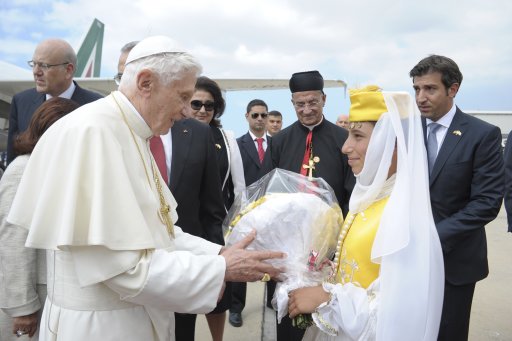
Pope to Lebanese: I am happy to be here with you

Pope Benedict XVI arrived this afternoon in Beirut, the capital of Lebanon, the only country in the Middle East where a person can convert from one religion to another without fear of death.  It is also a country in which eighteen different religions live in basic harmony and the Catholic Church is present is seven different rites.

Photo source: Osservatore Romano/Reuters
Prior to the departure of the Holy Father, John Allen discussed four possibles lenses, if you will, through which this Apostolic Journey can be viewed.  Reuters has a good article exploring the background and political and religious make up of Lebanon.

This morning protesters set fire to a Hardee's and a Kentucky Fried Chicken in the northern city of Tripoli as they chanted, "We don't want the Pope" and "No more insults" in response to a video that ridiculed Mohammed.

In recent days, violence has been spreading throughout the Middle East against the embassies of the United States of America and of Germany.  Despite the spread of this unrest the resulted in the murder of the ambassador of the United States to Libya, "No one ever advised me to cancel this trip and I never took that idea into consideration," the Holy Father said en route to Lebanon, "because I know that as the situation becomes more complicated, it is even more necessary to offer a sign of fraternal encouragement and solidarity. Therefore the aim of my visit is an invitation to dialogue, to peace and against violence, to go forward together to find solutions to the problems."

In the midst of this civil result, at the Welcome Ceremony at Rafiq Hariri Airport, Pope Benedict reminded the Lebanese people that the coexistence of religions in one country "will run deep only if it is founded upon a welcoming regard for the other and upon an attitude of benevolence, and if it is rooted in God who wishes all men to be brothers."  He also expressed his confidence that "your country is preparing a fine welcome for me, a warm welcome, the welcome that is given to a beloved and respected brother. I know that your country wishes to be worthy of the Lebanese Ahlan wa Sahlan [welcome]. It is already so, and from now on it will be so even more," he said, adding, "I am happy to be here with you."

The Holy Father has traveled to Lebanon to sign the post-Synodal Apostolic Exhortation of the Special Assembly for the Middle East of the Synod of Bishops, titled Ecclesia in Medio Oriente (Church in the Middle East), which he signed this evening in the Basilica of Saint Paul in Harissa.

Before signing the document, Pope Benedict XVI called the act of exalting the Cross an act of faith, love, and hope.

Pope: To exalt the Cross is an act of faith and of hope

Before he signed the post-Synodal Apostolic Exhortation Ecclesia in Medio Oriente, the Holy Father Pope Benedict XVI reflected on today's Feast of the Exaltation of the Holy Cross, saying:
Are not Christian communion and witness grounded in the Paschal Mystery, in the crucifixion, death and resurrection of Christ? Is it not there that they find their fulfilment? There is an inseparable bond between the cross and the resurrection which Christians must never forget. Without this bond, to exalt the cross would mean to justify suffering and death, seeing them merely as our inevitable fate. For Christians, to exalt the cross means to be united to the totality of God’s unconditional love for mankind. It means making an act of faith! To exalt the cross, against the backdrop of the resurrection, means to desire to experience and to show the totality of this love. It means making an act of love! To exalt the cross means to be a committed herald of fraternal and ecclesial communion, the source of authentic Christian witness. It means making an act of hope!

Photo source: Andreas Solaro/AFP

Do I look like Bilbo?

The official blog of the The Hobbit movie released today a character gallery from the upcoming movie The Hobbit: An Unexpected Journey, which will be released nation-wide December 14, 2012.

A friend of mine saw the picture of Bilbo Baggins and told me that I "totally look like Bilbo."


I've often fancied myself a Hobbit, taking the immortal words of Tolkien himself: "I am, in fact, a Hobbit, in all but size."

What do you think?  Is my friend correct?

13 September 2012

Pope to go to Lebanon, needs our prayers

Despite the civil unrest in Lebanon - and many Muslim countries at the moment - the Holy Father Pope Benedict XVI is keeping his plans to visit that country September 14-16.

The decision of His Holiness - like his decision to visit Turkey when the best-selling book in Turkey at the time was a fictional account of his assassination during the visit to Turkey - demonstrates his trust in the Lord and the courage of his faith.

At his Angelus Address on Sunday, the Holy Father addressed those present, saying:
I will make an apostolic visit to Lebanon to sign the Post-Synodal Apostolic Exhortation, fruit of the Special Assembly for the Middle East of the Synod of Bishops, held in October 2010. I will have the happy opportunity to meet with the Lebanese people and authorities, and the Christians of that beloved country and those from neighboring countries. I am aware of the often dramatic situation experienced by the people of this region, too long torn apart by incessant conflicts. I understand the anguish of many Middle Eastern people immersed in daily sufferings of all kinds, which sadly, and at times mortally, plague their personal and family life. My concerned thoughts go out to those who, in search of a place of peace, leave their family and professional life, and experience the precariousness of being exiles. Even though the search for solutions to the various problems affecting the region seems difficult, we can not resign ourselves to the violence and exasperation of tensions. A commitment to dialogue and reconciliation must be a priority for all parties involved, and must be supported by the international community, increasingly aware of the importance of a stable and lasting peace in the region for the whole world. My apostolic visit to Lebanon, and by extension in the Middle East as a whole, is placed under the sign of peace, referring to the words of Christ: "My peace I give to you" (John 14:27). May God bless Lebanon and the Middle East! May God bless you all!
The greatest sign of peace is the Cross of Jesus Christ, the Cross of our salvation by which we have been reconciled to the Father.  It is no mere coincidence that the Holy Father will embark on this journey on the day celebrates the Exaltation of the Holy Cross.

Please remember the Holy Father and the success of this Apostolic Journey in your prayers.

12 September 2012

A false history

Every year around Independence Day and Thanksgiving Day, Americans of all stripes bring out the same distorted notion of our history that President Obama referenced in this mornings in his remarks concerning the murder of the His Excellency Chris Stevens, the Ambassador of the United States of America to Libya.  President Obama said, in part:
Since our founding, the United States has been a nation that respects all faiths.
This is simply not true.  This country was established on the notion of religious freedom, but only for members of a particular faith.

To see the falsity of this statement (and those like it), one need only consider the difficulty of Catholic priests who stepped foot in Massachusetts on pain of death for no other reason than that we were Catholic priests.  One could also look to the Irish immigrants who were continually told they "need not apply" for work.

Anti-Catholicism in America: The Last Acceptable Prejudice, by Mark S. Massa, S.J. is an an excellent and readable account of the history of Catholics in this country.  It is a history that is too little known and too little discussed.

The history of the Catholic Church in the United States of America is a clear testimony that this country has, in fact, not been a nation that respects all faiths since its founding, and Catholicism is not the only faith whose history will bear this out.

President Obama continued,
We reject all efforts to denigrate the religious beliefs of others.
Yet his administration continues to denigrate the beliefs of Catholics regarding the dignity of human life and of procreation.

The President was right, though, when he said that "there is absolutely no justification to this type of senseless violence" that resulted in the death of the Ambassador, a member of the Foreign Service, and two others.  May the Lord grant them eternal rest and let perpetual light shine upon them.

Good news from Alton!

A few minutes ago I had the occasion to speak with one of the Sisters of St. Francis of the Martyr St. George who works at St. Anthony's Hospital in Alton.

After discussing the matter that initiated my call, Sister shared with me some very good news in regard to their community.

You will remember, I hope, that on August 15, 2012, thirteen women made their Final Profession and three women made their First Profession in the Community, even as two women entered the Novitiate.  Somehow, the Sisters of St. Francis of the Martyr St. George remain one of the best kept secrets in the Diocese of Springfield in Illinois.

The good news that was shared with is this: three women entered the Community as Postulants last week, four entered this week, one will enter this week, and there are several more women who will enter as Postulants before the end of the year.

The Holy Spirit is moving in the hearts of the young people of this Diocese and across the country in very clear ways; we have seen this also in the increasing numbers of our seminarians.

Let us continue to pray that more young men and women will continue to respond with courageous and generous love to the call of the Lord to dedicate themselves to his service.