Showing posts with label History. Show all posts

02 March 2016

Did Catholics forbid meat to support the fishing industry, or Protestants?

At some point in your life you have probably been told that the only reason Catholics eat fish on Fridays - at least during the season of Lent - is because a medieval pope - who is never named - had family in the fishing industry - which is also never named - and they needed a financial boost. This claim, of course, is false and is made by those ignorant of history.
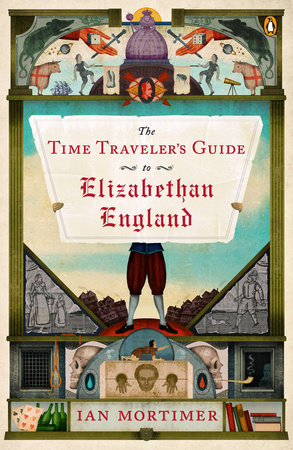
I have recently finished reading Ian Mortimer's enjoyable and educational book, The Time Traveler's Guide to Elizabethan England (New York: Penguin Books, 2012); his The Time Traveler's Guide to Medieval England is also excellent. Loaded with endnotes, his books are well-researched and documented, and written in a readable, intelligent, and humorous fashion; I cannot recommend them enough.

Of particular interest to me is Mortimer's treatment of religion. These days, it can be difficult to find historians who give religion - especially Catholicism - a fair treatment, but Mortimer does so very well.

In his third chapter on "Religion," for example, we find several important - and historically accurate - observations:
  • "In Mary's reign, no fewer than 283 men and women are burned at the stake for maintaining their Protestant beliefs - many of which were called orthodox in Elizabeth's reign. Although Elizabeth's government does not burn as many people as Mary's [N.B.: It was not the Church that killed people, but the state], proscribed views are still enough to get you killed" (61).
  • "What is orthodox in 1558 is sufficient to have you hanged in 1570" (61).
  • "And propaganda is key. Elizabeth makes sure all history books praise her and Protestantism, and reflect Mary's reign in a negative light" (68).
  • "A second act [of Parliament] forbids the importation of [papal] bulls from Rome, as well as crucifixes and rosary beads" (69).
  • "Anyone trying to persuade people to join the Catholic Church is held to be guilty of high treason and executed" (70).
  • "Catholics are not allowed to travel more than five miles from their homes - on pain of forfeiting all their property and estates" (71).
  • "Just thirty-five years see Catholicism change from being the respectable norm to the religion of a persecuted minority" (71).
You will not likely find such clear statements in most history text books, although the statements are entirely true.

Now, then, back to the topic at hand, that of eating fish on Fridays. Before we continue, let it be remembered that Catholics are not required to eat fish on Fridays; rather, they are simply not to eat meat on Fridays (fish is not the only meatless option).

In Mortimer's ninth chapter on "What to Eat and Drink," he includes an informative and useful paragraph about the eating of meat and fish in Elizabethan England, that is, between 17 November 1558 and 24 March 1603 (with my emphases):
Harvest time and fruit picking impose one form of seasonality. Another is entirely artificial. The medieval Church [that is, the Catholic Church] used to restrict the eating of meat on Wednesdays, Fridays, and Saturdays, as well as in Advent and Lent and on the vigils on certain saints' feast days. In 1549 Edward VI [a Protestant] reestablishes Fridays and Saturdays as nonmeat days, as well as Lent and other religious feasts.  In 1563 Elizabeth's [also a Protestant] government imposes fasting on Wednesdays too, including a prohibition on slaughtering animals. There is an important difference compared to pre-Reformation [that is, Catholic] times, however: avoidance of meat is no longer a religious observance but secular law. The purpose of fasting on Wednesdays is specifically to encourage the eating of fish, to support the fishing industry. People therefore respond differently. Some households uphold the old religious fasts during Advent and Lent, as if they are still observing the old religious law; others ignore Advent but observe the Lenten fast. Still others ignore Wednesdays and just fast on Fridays and Saturdays. But be careful if you adopt a partial regime: heavy fines are levied for eating meat on nonmeat days. The standard fine is £3 or three months imprisonment, but in 1561 a London butcher slaughtering three oxen in Lent is find £20. Fines can be levied on the head of a household for every single member who breaks the fast, so if you have lots of servants, make sure they obey the law (215).
Did you catch it? The forbidding of the eating of meat in order to support the fishing industry did not arise from the Catholic Church, but from Elizabeth's Protestant/Anglican government. Prior to this decision of Elizabeth's government, the Catholic Church did not forbid the eating of meat to support the fishing industry; rather, the reason for the forbidding of meat was less temporal, much simpler, and more spiritual.

As John Myre explains in his Liber Festivalis, written in the later 1400s: "For when God, for Adam’s sin, cursed the earth and the land, he cursed not the water; wherefore it is lawful for a man to eat in Lent that which cometh of the water."

In fact, centuries earlier, Saint Isidore of Seville, who died in 636, wrote in his De Ecclesiasticis Officiis, "We are certainly able to eat fish, because the Lord accepted one after the resurrection. Neither the savior nor the apostles have forbidden this" (1.45[44].2). The non-eating of meat and the eating of fish was both a penance and a reminder of God's mercy.

In this Jubilee of Mercy, then, do not forget the second spiritual work of mercy, that of instructing the ignorant.

19 December 2015

A Jubilee tragedy (quite a few years ago)

As you approach the Ponte Sant'Angelo [Holy Angel Bridge] in Rome to cross the Tiber River on your way from the heart of the ancient city toward the Basilica of St. Peter on the Vatican hill, you are met by two statues of the Apostles Saint Peter and Saint Paul:


Pope Clement VII placed these two statues at the end of the bridge in 1535 where two chapels previously stood. One of the chapels was dedicated to Saint Mary Magdelene - whose left foot is enshrined in the nearby church of St. John the Baptist of the Florentines - and the other to the Holy Innocents. Pope Nicholas V ordered their construction to commemorate a horrific tragedy that occurred during the Jubilee of 1450.

The Volto Santo, once housed in Rome
and now housed in Manoppello
In the writings of Paolo di Benedetto di Cola dello Mastro, we find a description of that Holy Year:
I recollect that even in the beginning of the Christmas month a great many people came to Rome for the Jubilee... Such a crowd of pilgrims came all at once to Rome that the mills and bakeries were quite insufficient to provide bread for them. And the number of pilgrims daily increased, wherefore the Pope [Nicholas V] ordered the handkerchief of St. Veronica [the Volto Santo] to be exposed every Sunday, and the heads of the Apostles Saints Peter and Paul every Saturday; the other relics in all the Roman churches were always exposed. The Pope solemnly gave his benediction at St. Peter's every Sunday.
Because of the great number of pilgrims present at the Basilica of St. Peter on 19 December 1450, it was announced that the Holy Father Nicholas V would not give his customary benediction that evening; the crowds were simply too great. Consequently, the pilgrims left the basilica - mostly en masse - by way of the Ponte Sant'Angelo.

In his excellent and thorough work, The Holy Year of Jubilee: An Account of the History and Ceremonial of the Roman Jubilee  (Westminster, MD: The Newman Press, 1949), Herbert Thurston, S.J. gives us an account of what happened on that fateful day:
Some horses and mules took fright, and a block ensued. Many pilgrims were pushed down, trampled under foot, or fell into the Tiber. The castellan of St. Angelo caused the gates of the bridge to be closed to prevent others entering, but the fatal crush lasted for an hour. The dead were carried into the Church of San Celso. "I myself carried twelve dead bodies," writes the chronicler Paolo della Mastro, "and it was pitiful to see there one hundred and seventy-two corpses; the weeping and lamenting of those who found father, mothers, sons, and brothers among the dead resounded in the streets usque ad mediam noctem. Truly, it was misery to see the poor people, with candles in their hands, looking through the rows of dead who  lay there. At midnight, by the Pope's orders, one hundred and twenty-eight were carried to the Campo Santo, near St. Peter's, where they were left all Sunday for identification. The remainder of the bodies were brought to Sta. Maria della Minverva, or buried in St. Celso (69-70).
To prevent so great a tragedy in the future, Pope Nicholas V ordered the removal of several buildings at the end of the bridge in order to widen the entrance to the bridge and allow the people to funnel in or out more efficiently.

On this 565th anniversary of their unhappy end, let us remember them in our prayers. These 172 pilgrim souls desired to look upon the Face of Jesus. May the Lord in his merciful love grant their desire and let the light of his countenance shine upon them forever.

05 May 2015

An invasion that never was

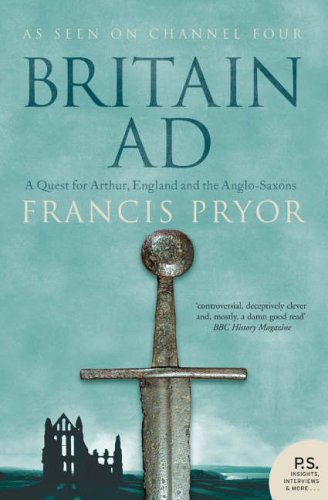
This afternoon I finished reading a book about "evolving identities, origin myths and the use or abuse of archaeology and history," Francis Pryor's Britain AD: A Quest for Arthur, England and the Anglo-Saxons (233). Though the author seems to have an aversion to the use of the Oxford comma and did not find King Arthur (which was not a surprise in itself), I found the book thoroughly intriguing and recommend it to you, even if you have no immediate interest in the topics it concerns. Interest in the historical period aside, how can you not enjoy a book whose author's writes sentences such as these: "Over the centuries Britain has produced its fair share of religious innovations, ranging from the Celtic Church to Quakerism. Generally speaking the official Church greeted them as one would welcome a scorpion to one's trousers" (144-145)?

Ever since I discovered the legends of King Arthur and the Knights of the Round Table as a boy, I have been fascinated by that period of British history known pejoratively - and incorrectly - as "the Dark Ages," which is why I first picked up the book. Beginning with the notion that "the fundamental attitudes underlying human society take a long time to change," Pryor examines and refutes the claim of an Anglo-Saxon invasion of the east of England in the 5th century that completely changed the people and landscape of the British isle, an invasion accepted without question by historians and archaeologists alike (xviii).

Pryor brings his experience and expertise as a prehistoric archeologist to the excavations of Roman, post-Roman, and Anglo-Saxon England, as well as the few documents which have come down to us, and arrives a jarring conclusion:
I am in doubt that archeology is the only means by which the Dark Ages can become fully illuminated. There is a huge amount of exciting new work taking place, and the more we discover, the more it becomes apparent that the fifth and sixth centuries were never truly Dark. There was no no population collapse, the countryside never reverted to woodland, field systems continued in use, towns quite rapidly appeared and then stayed for good. Yes, there were major social and political changes, and, yes, we can see the effects of real raiding in the Viking depredations of the mid-ninth century, that were followed by the collapse of long-distance trade. But where is the evidence for such happenings in the 'Dark Ages,' when communication with mainland Europe and the Mediterranean was a regular occurrence, by both land and sea (234-244)?
After examining the written records and comparing them with the archaeological evidence of landscapes, graves, clothing, skeletons, towns, fortifications, etc., Pryor says, "I can see no convincing archaeological evidence for 'Dark Age' chaos, disruption and turmoil" (96). Why, then, have so many archaeologists and historians held so firmly to the notion of an invasion, even ignoring available evidence to the contrary?

Pryor suggest the answer may have something to do with the nineteenth, a claim that at first seems odd until you seriously consider the biases with which people - even historians - write:
The Victorian era was a time when the previously separate strands of history and science came together in a form of both pseudo-history and pseudo-science which today we would simply label as racist. This doctrine held that human beings came in physically, mentally and intellectually distinct races, the 'purity' of which would be threatened by mixing with the blood of another race. This was of course a fundamentally flawed doctrine, which would have appalling consequences in the twentieth century.

Different races were ascribed different characteristics. Celts, for example, were hot-headed and emotional, while the German or Teutonic race, which included the English, thanks to those Anglo-Saxon migrations, was the best of the lot: rational, loyal, artistic, inventive, etc., etc. (152).
What does this have to do with the post-Roman Britain? The answer is both obvious and disturbing:
When Victorian ideas about the characteristics and purity of races were allied to the 'culture-historical' approach, archaeologists and historians believed they could provide a solid academic basis for English Teutonic origins. That is why manifestly unreliable sources such as Gildas were pressed into service. Gildas' shortcomings were ignored because he was saying what people wanted to hear. These then were the forces that lay behind the circular argument that has bedevilled the study of fifth- and sixth-century Britain for over a century (153).
Rather than attributing everything to the Anglo-Saxons and their supposed supplanting of everything that came before them, Pryor convincingly suggests the possibility of a continued memory, even going back to prehistory:
Surely it is not unreasonable to suggest that many of the ancient themes that we find in the Arthurian tales could have been current for much longer than was once believed, and that they found their way into the literature in ways that recall Mallory's adoption of the legend of the Holy Blood, which was already an old cult when he encountered it. Mallory, Geoffrey of Monmouth and other contributors to the Arthurian tale were seeking to flavour their stories with an air of antiquity, so it would have made good sense to seek customs that were known, or believed, to have had ancient roots (219).
The fundamental attitudes underlying human society do quickly change; rather, they are passed on and utilized in perhaps new ways, while retaining something of the ancient memory, even after the origin is lost and shrouded in time.

Pryor's work is not a "revisionist" history, but rather a reading of history as it actually was, as best as it can be read. He challenges the generally accepted history not because he disagrees with it on principle (which he does), but because there is simply no archaeological evidence to support the theory of the Anglo-Saxon invasions and plenty of archaeological evidence to disprove the theory. His book is a timely reminder for us to question the evidence presented before us and not simply to accept someone's story based solely on the word of the teller.

20 April 2015

Reforming the teaching of the Reformation, as seen in Scotland

Professor Eamon Duffy has written a brief article in which he argues why the story of the Reformation needs reforming. Duffy's argument, however, is not simply another attempt at "revisionist" history, but rather an attempt to tell what really happened:
For five centuries England has been in denial about the role of Roman Catholicism in shaping it. The coin in your pocket declares the monarch to be Defender of the Faith. Since 1558 that has meant the Protestant faith, but Henry VIII actually got the title from the Pope for defending Catholicism against Luther. Henry eventually broke with Rome because the Pope refused him a divorce, and along with the papacy went saints, pilgrimage, the monastic life, eventually even the Mass itself – the pillars of medieval Christianity.
All of this was accompanied by tremendous destruction of Catholic churches, cathedrals, libraries, monasteries, etc., not just in England, but across Europe. Over the Easter holiday I witnessed firsthand some of this destruction wrought in Scotland, especially at the ruins of the Cathedral of St. Andrew in St. Andrews.


The above photo was taken from near what had been the main doors of the Cathedral of St. Andrew, looking toward what remains of the wall behind the main altar, behind which was the choir for the canons of the Cathedral.

This photo gives you just a small sense of the size, grandeur, and beauty of the most important cathedral in Scotland, first completed in 1272 (it underwent a few renovations/restorations after that):


John Knox, one of the "reformers" in Scotland, preached so vehemently in 1559 that he roused the people to rip down the trappings in the cathedral. By 1600, the Cathedral of St. Andrew was in ruins, after which the grounds of the Cathedral were turned into a cemetery:


Even the graves of the canons were desecrated:


One of the official signs in the ruins of the cathedral even declared the Catholics had "abandoned" the cathedral complex, without bothering to mention why. Regrettably, I did not take a picture of this sign.

As if all of this destruction were not senseless enough on its own, the "reformers" of the Church of Scotland, after destroying Catholic churches, built their own churches, in Gothic style, complete with stained-glass windows, statues of saints, votive candles, and holy water.

Such destruction in Scotland was, of course, not only reserved to the Cathedral of St. Andrew. A sign in the National Museum of Scotland in Edinburgh noted that "the fortunes of the Catholic Church were affected by the religious leanings of the monarch." A more honest way to put it would be to say that the treasures of the Catholic Church were stolen. What are these treasures to which the sign refers? These:


That's right: the treasures of the Catholic Church "affected" by the monarchs were the vessels and appointments used for the worship of God. You will not likely read about this in most history textbooks.

As a student of history, I have studied this destruction wrought by the so-called Reformation, but, in my 37 years of life, this was the first time I walked in Catholic places destroyed by Protestants. I have, over the years, been in many Catholic places destroyed by Muslims, which is lamentable enough, but there was something especially sad and painful about walking in Catholic places destroyed by fellow Christians, a pain of which I could not find the words to express.

Why is this aspect of the history of the Reformation not well known and discussed in history classes and textbooks? Professor Duffy briefly explains:
At the height of the hysteria, Protestant mythology achieved definitive form in a book that would shape the writing of Tudor history down to our own day. In 1679 Gilbert Burnet, a Scottish cleric, published the first volume of a massive History of the Reformation, an anti-Catholic narrative given scholarly credibility by the inclusion of dozens of documents gathered from public and private archives. Burnet would be the chief propagandist for the “Glorious Revolution” which deposed James II and set the Protestant William of Orange on the throne. His history rammed home the message that Catholicism and Englishness were utterly incompatible: Catholicism was tyranny, Protestantism liberation. “They hate us,” he wrote, “because we dare to be freemen and Protestants.” 

It was a message the nation wanted to hear: Burnet was thanked by a special vote of Parliament. His work was supplemented by John Strype, another ardent “Orange” cleric, in a stream of biographies and collections of Reformation documents, many of them gathered from Foxe’s archives. Till well into the 20th century, historians of the English Reformation would rely on Burnet and Strype for their source materials, in the process perpetuating their late-Stuart take on the Tudor age.
Thankfully, as Duffy goes on to note, "historians no longer take that venerable Protestant version for granted, but it is still alive and well in the wider culture." Still, there is much work yet to be done to give a true and accurate account of what happened, and why.

18 June 2014

Today in History: Vandals begin their sack of Rome in 455

Readers - and watchers - of George R.R. Martin's popular series of A Song of Ice and Fire, whose first installment was titled A Game of Thrones, will be familiar with the Red Wedding or, more precisely, the bloodshed that followed after a betrothal between House Stark and House Frey was broken. The betrothal was to have united two houses but resulted in violence and division when the wedding was called off.

This theme is not unique to Westeros; similarities to it can be found throughout history. Take, as just one example, the betrothal in A.D. 442 of Eudocia - daughter of Valentinian III, Emperor of Rome - to Huneric - son of Gaiseric, King of the Vandals. Since, at the time, Eudocia was only three years old, the wedding was delayed for several years.

Valentinian III died on March 16, 455 at the hands of two Hunnish assassins before the marriage took place (it was Valentinian III who sent Pope Saint Gregory Leo the Great to negotiate with Attila the Hun in 452). Valentinian was succeeded by Petronius Maximus (who may have hired the assassins).

The Emperor Maximus broke the agreed upon betrothal by marrying Eudocia to his own son, Palladius, to strengthen his ties with another noble Roman family (one of whom would later declare Christianity the official religion of the Roman Empire and ban pagan religions altogether (it was not, contrary to what is written in many high school textbooks, Constantine who did this). Naturally, this did not please King Gaiseric who responded by marching his armies to Rome to sack the city.

They arrived on this day in the year 455. Pope Saint Gregory Leo the Great again went into diplomatic mode. While he was not able to persuade Gaiseric from sacking the city altogether, as he had done with Attila, he was able to persuade Gaiseric from destroying the city and from murdering her citizens, provided they did not oppose him. Once this agreement was made, the gates of the city were opened to the Vandals. The pillaging of the city lasted fourteen days; among the looted items was the great menorah taken by Titus from the Temple in Jerusalem in the year 70.

The Emperor Maximus fled and was murdered by a Roman mob; his son Palladius may also have been murdered. Eudocia was taken captive and eventually married to Huneric as originally planned.

The sack of the Imperial City by the Vandals marked the fourth time in less than half a century that an army of barbarians approached the gates of the city. It was clear that the end of the Western Empire was near.

03 March 2014

If at first you don't succeed...

...skydiving isn't for you (that's my favorite ending for the phrase and often catches people a bit off guard).

One of the unexpected pleasures of living at the Casa Santa Maria - the American house for priests studying in Rome - is living also with two Englishmen and seven Australians with whom I can have conversations about English history.

A few days ago I saw a t-shirt on  Twitter that I found rather amusing; the Americans in the house did not understand it, but the English and the Australians did:


A descendant of the House of Wessex and son of King Edgar and Queen Ælfthryth, Æthelred was King of England from about 968 until his death on the 23rd of April in 1016. Though the circumstances of his ascension to the throne and his reign, in general, were not very pleasant, I've long enjoyed his name (and that of his mother).

His epithet is a bit unfortunate and is something of a play on his name.  Æthelred means "noble counsel" while unræd means "bad counsel". When first recording around the 1180s, he was not called "the Unready," but as Æthelred Unræd, "Noble counsel, no counsel." As such, it does not so much refer to the King himself as to his counselors.

King Æthelred was the father of King Saint Edward the Confessor.

26 September 2012

History and faith

Earlier today a friend shared this image on Facebook:


The image of Blessed John Henry Newman, a convert from Anglicanism, contains one of my favorite quotes and reminds of a conversation I had when I did my Clinical Pastoral Education, a form of observed chaplaincy, at BroMenn Hospital in Bloomington, Illinois.

For the program, I joined four other students: a young man with the Disciples of Christ who sought to be a youth ministry; an assistant pastor with the Methodist ecclesial community (who didn't believe taught by the Methodist tradition); a female seminarian with the Evangelical Lutheran Church of America; and a woman studying to be a pastor in the United Church of Christ.  We got along very well and respected and loved each other; it was a very good experience.

Now to the conversation.  One day I was sitting in the conference room working on something when the Methodist man came in and sat down.  After a while he said to me, "Daren (I wasn't a priest yet), if you weren't Catholic what would you be?"  His question was straight forward and sincere.

After a moment's pause, I answered, "I guess I'd have to be Orthodox."

"No," he replied.  "I mean, if you had to be a Protestant, which one would you be?"

Without a moment's pause, "None," I said.  "From my study of history alone I could not be Protestant."  I went on to explain that Protestantism began in the 1500s yet claims to be the Church established by Jesus, a claim history can't defend.  It seems logical enough to me.

"Huh," he answered, and that was the end of the conversation; he never brought it up again.

Cardinal Newman is right: To be deep in history is to cease to be a Protestant.

01 September 2011

On the stupidity of liberal academics

For years now some in academia have been trying to banish the use of the terms "B.C." and "A.D." from historical dating systems for something that is not "offensive" to certain people.  It seems such a foolish idea has now taken hold in Australia:
BCE (Before Common Era), BP (Before Present) and CE (Common Era) are the new neutral terms to replace the historical terms BC (Before Christ) and AD (Anno Domini).
[snip]
A spokesman for the Australian Curriculum, Assessment and Reporting Authority, responsible for developing the national curriculum from kindergarten to Year 12, said BCE and CE were to be introduced because this was an increasingly common standard for the representation of dates.

The little known term BP (Before Present) will be used when dealing with "very ancient history and archaeology, and allows for the teaching of more sophisticated understandings of representations of time".In anticipation of the curriculum change, textbooks for student teachers such as Teaching And Learning In Aboriginal Education, by Neil Harrison, were already using the term BP.

A spokesman for Education Minister Adrian Piccoli said yesterday the minister was not concerned about the changes, adding that BCE and CE were commonly used terms [more].
While it may be true that BCE and CE are commonly used terms in some circles, for those with any shred of intellectual or academic prowess they are a sheer absurdity.

These liberal academics think themselves so intelligent, so wise, so tolerant and accepting, but in this way of thinking logic and reason has flown the coop.

New terms may indeed have been designated, but the reference point remains the same!  What determines if something is Before the Common Era or within the Common Era?  The birth of Jesus Christ!  To create something new they simply throw a sheet over what ever knows remains at the center.  Oh, the irony!  Oh, the stupidity!

If they want to devise a new system of dating history that will not offend a small segment of society, then let them devise a truly new system of dating history. 

If such a non-intellectual system takes hold of the United States of America, I, for one, will never adopt it, simply based on its lack of logic.

15 June 2011

How do you shoot yourself in the head with own bow?

That's a very good question, but apparently it has happened before.  From the BBC comes this intriguing article describing "10 strange ways Tudors died:"
New research into accidental deaths in Tudor England reveals the strange way people died, writes Sean Coughlan.


Oxford University historian, Dr Steven Gunn, has been scouring 16th Century coroners' reports and researching accidental deaths in Tudor England.

These reports revealed an intriguing possible link with William Shakespeare's tragic character Ophelia. But they also revealed examples of some strange and sometimes stupid deaths.

1. Bears were part of the Tudor entertainment scene. There were performing bears and there were bears kept for the bloodthirsty attraction of bear-baiting. In a purpose-built bear garden, a bear would be tied to a post in an enclosed pit and would be set upon by hunting dogs. Henry VIII had his own royal arena built in Whitehall.

But sometimes they escaped. A widow called Agnes Rapte was killed by Lord Bergavenny's bear when it broke loose at his house at Birling, Kent in 1563. Another victim, Agnes Owen from Herefordshire, was killed in her bed by a runaway bear. When a bear bit a man to death in Oxford in 1565, the bear wasn't punished but was taken into royal custody. Perhaps because it was worth 26 shillings and 8 pence - about six months' wages for a labourer.

2. Archery was a dangerous pastime, both for participants and spectators. Coroners' reports reveal 56 accidental deaths from people standing too close to the targets or those who decided on just the wrong time to go and collect the fired arrows.

Don't stand too close There were also some bad judgement calls. Thomas Curteys of Bildeston, Suffolk, was practising archery on a fine June evening in 1556, when he took off his hat and invited another bowman called Richard Lyrence to try to hit it with an arrow. No prizes for what happened next.

Coroners even noted the depth of wounds. The unwanted record is held by a Nicholas Wyborne, who was lying down near a target when he was hit by a falling arrow, which pierced him to a depth of six inches.

3. The first time a coroners' court came up against the new-fangled problem of a fatal shooting accident was 1519, when a woman in Welton near Hull was accidentally killed by a handgun.

The perpetrator was a bookbinder from France, called with dazzling Tudor wit, Peter Frenchman. The victim, not understanding this noisy gadget, had walked in front of the gun as it had been fired.

Establishing the gun's place in the social order, in 1557 when the Duke of Norfolk's horse stumbled on a road in Tottenham, his gun went off and shot dead a servant. Showing the marvels of scientific progress, by the 1560s guns were causing more accidental deaths than longbows.

4. How do you shoot yourself in the head with your own bow? In 1552, Henry Pert, gentleman, in Welbeck, Nottinghamshire, drew his bow to its full extent with the aim of shooting straight up into the air.

The arrow lodged in the bow, and while he was leaning over to look, the arrow was released. He died the next day. Of embarrassment.

5. Imagine an episode of Casualty. How could baking a loaf lead to a fatal accident? There's not even a gas oven or an electric gadget to worry about, because neither had been invented.

Elizabeth Bennet, spinster, was baking bread at the house of Matilda Nanfan, widow, at Birtsmorton, Worcestershire, on 29 January 1558. She went to the moat to collect cabbage leaves to put under the loaves she was baking. The fence broke and she fell into the moat and drowned.

6. "John Hypper was 'playinge Christenmas games' on Boxing Day 1563 at about 6pm with divers other parishioners of Houghton, Hampshire in the house of Thomas Purdew of Houghton, husbandman. While playing he involuntarily crushed himself and injured his testicles so that by reason of his old bodily infirmity he became ill and languished until about 3am on 28 December when he died."

If he'd lived, would anyone have believed him? Old bodily infirmity? Testicles crushed in a Christmas game? Pull the other one.

7. Tudor-style mad cow disease took the form of a "madd cow" belonging to William Cheills of Hogsthorpe, Lincolnshire. A man walking through the fields in March 1557 was attacked by the cow, which gored him to death with her horn. The victim's name was Robert Calf.

8. Maypole injuries were not only caused by careering into another country dancer. Thomas Alsopp of Coventry was standing in the former cemetery of the Coventry Greyfriars under a stone wall on 26 April 1558 when a maypole fell over.

It hit the city wall and knocked a stone out of the top of it, which hit him on the left part of his head and penetrated his brain, killing him instantly. What were the chances? What would they have said in the health and safety assessment?

9. A quick shower after work wouldn't usually be a matter of life and death. But the Tudor post-work scrub meant taking advantage of nature's washtub in the nearest pond or river. It tells historians that working people liked to keep themselves clean. Clean, but unlucky.

Looks so simple Thomas Staple, a labourer of Biddenden, Kent, went into Mr Mayne's pond to wash and cool down on 2 June 1558, then suddenly fell into the deepest part and drowned.

In the same summer, John Joplyn and George Lee drowned while washing in rivers at Cambridge and Leicester, one getting trapped by bushes and the other falling into a whirlpool.

10. The occupation of "gong farmer" sounds quite cheerful until you realise it was what the Tudors called people who were paid to clear out the sewage from cesspits.

So what can be said about the drunken Cambridge baker who, while relieving himself, fell backwards into a cesspit on 2 June 1523? He died horribly. What a way to go.

22 July 2009

Very cool!

William, one of my friends and readers, sent in this very cool story this morning:

Medieval Database Logs Long-Dead English Warriors

(Undated) -- Medieval English warriors fended off the French during the Hundred Years War but they were apparently no match for their own accountants. Britain's "Daily Mail" reports that British academics have compiled the Medieval Soldier Database based on service records kept in the 14th and 15th centuries. The 250-thousand listings include not only names and ranks, but how much money each captain spent and which duke or king commanded them. Even sick days were logged and Medieval mileage was tracked -- on horseback, of course.

The records were compiled at the insistence of the English exchequer, the guy who doled out the dough for the royal treasury. Adrian Bell of the University of Reading, who spearheaded the project, said the ancient accountant's, quote, "had a very modern obsession with wanting to be sure that the government's money was being spent as intended."

Search the database for free at www.medievalsoldier.org.