Showing posts with label King Arthur. Show all posts

04 June 2016

Travels in England: The Round Table and King Arthur's Grave

A meme has been going round on Facebook over the last few days that several friends have shared with me:

 
Though I am a great fan of King Arthur and the Knights of the Round Table, and I have been since I was a boy, I find this meme to be something of a groaner. The timing of the meme, however, is interesting, because it was only a few days ago that I visited the Great Hall at Winchester to see the Round Table that hangs there.

Part of the beauty and the appeal of the Arthurian legends is the manner in which this body of literature has been - and continues to be - adapted in different times and places for various means and purposes. As the Matter of Britain grew and expanded, new elements were introduced by particular authors.

The Round Table, for instance, perhaps the most politically important element of Arthuriana, was, so far as we can tell, introduced into the corpus in 1155 by Robert Wace in his "translation" of Geoffrey of Monmouth's History of the Kings of Britain. Concerning the Round Table, Wace writes:
Arthur fashioned the Round Table
Of which many tales are told
There sit his knights,
Each one equal to the next:
The sit equally at the Table
And are equally served.
None of them can boast
That he sits ahead of the next.
None has a favored position,
And none is excluded.
Sir Thomas Malory (if memory serves, though it may have been Chrétien de Troyes) would later say instead that the Round Table was not made by King Arthur, but received as a wedding gift from Guinevere's father, King Leodegrance, though the symbolism given to the Round Table by Robert Wace was retained.

Hanging today in the Great Hall at Winchester is a Round Table that, although repainted by order of King Henry VIII around 1516, the table itself dates between 1250 and 1350 and was likely constructed by order of either King Edward I (who sought to make use of the Arthurian Legends to his advantage) or of King Edward II. This Round Table measures some eighteen feet in diameter and weighs 1.3 tons:

 
From Winchester, I made my way to Glastonbury where, in 1191, the monks of Glastonbury Abbey - one of the finest in England - claimed to have discovered the lost (and previously forgotten) grave of King Arthur and Queen Guinevere. 


Gerald of Wales relates what was found in his De Instructione Principis, written about 1223:
However, Arthur’s body, which the fables allege was like a fantastic thing at the end, and as it were moved by the spirit to far away places, and not subject to death, in our own days was discovered at Glastonbury between two stone pyramids erected in the holy cemetery, hidden deep in the ground by a hollow oak and marked with wonderful signs and marvels, and it was moved into the church with honor and committed properly to a marble tomb. Whence a leaden cross with a stone underneath, not above as it usually is in our day, but rather lower nailed on the side, (which I have seen, and in fact I have traced these sculpted letters - not projecting and protruding, but carved into the stone) contains the words: “Here lies buried the famous King Arthur with Guinevere, his second wife, in the isle of Avalon.”
At the time, not everyone accepted the claim of the monks and some viewed it as an utter deception, a belief held by many - though not all - historians and archeologists today. in fact, Graham Phillips claimed last month to have discovered two possible locations for King Arthur's grave in Shropshire (I'm a bit skeptical of his claims, but I haven't yet read his book and my skepticism is greatly increased by looking at the titles of his books).

Several decades later, King Edward I ordered the exhumation of the mortal remains and their re-interment in a marble tomb in the sanctuary of the great abbey on Easter Tuesday in 1278, as Adam of Domerham recounts:
[T]he lord king had the tomb of the famous king Arthur opened. Wherein in two caskets painted with their pictures and arms, were found separately the bones of the said king, and those of Queen Guinevere, which were of marvelous beauty...on the following day...the lord king replaced the bones of the king and the queen those of the queen, each in their own casket, having wrapped them in costly silks. When they had been sealed they ordered the tomb to be placed forthwith in front of the high altar, after the removal of the skulls for the veneration of the people.

After King Henry VIII ordered the "dissolution" of the abbeys in 1536, the Glastonbury Abbey - with the graves - was destroyed in 1539 and the bones lost to history, though the leaden cross discovered with the bones survived. We know John Leland saw it about 1540 and William Camden seems to have used it for an illustration in a work printed in 1607. In the early 1700s, the cross was in the keeping of William Hughes of Wells Cathedral, though what happened to it afterward is uncertain.

18 March 2016

The Disneyfication of England?

I first read Geoffrey of Monmouth's History of the Kings of Britain, which is mostly a purported history of the life and deeds of King Arthur, when I was a freshman in high school. Ever since then, I have wanted to visit Tintagel Castle in Cornwall to visit the legendary birthplace of King Arthur and to admire the beauty of the landscape and hope to be able to do in the next few months.

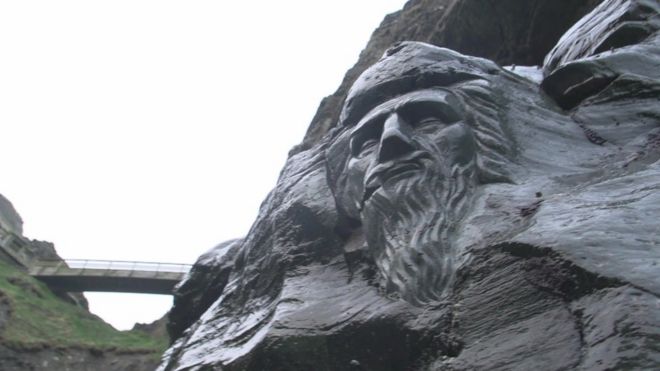
Until recently, Tintagel Castle was home to some archeological investigations, but little else. Now, however, a sculpture of Merlin's head in the cliff of a nearby cave where Merlin is said to have taken the infant Arthur to help tourists understand why the site is important:

Photo: BBC
In addition to this sculpture, which is reminiscent of Mount Rushmore, an eight-foot tall knight is set to be attached to the rocks near the castle. Naturally, these additions to the landscape do not please all of the locals:
Cornwall councillor Bert Biscoe has written to the charity to complain about the "comic-book face".

It said the carving would help visitors understand the history of the site.
[snip]
"This is one of the most heavily designated pieces of landscape and archaeology in Britain," he said.

"If we start carving comic book characters into the geology, where do we stop? This is not Disneyland, it's Cornwall" [more].
I can't say I disagree with him. A explanatory plaque could be displayed or, better yet, tourists could be encouraged to read a book.

Mr. Biscoe isn't the only Englishman with a dislike of things Disney. In 1937, Allen & Unwin, the publisher of J.R.R. Tolkien's The Hobbit and The Lord of the Rings, informed The Professor that an American firm wanted to produce a few illustrations to accompany an American publication of The Hobbit.

Tolkien responded on 13th May (Letter 13) that he hoped to be able to provide a few more illustrations himself, but time would limit his ability to do so. So it was that he suggested, "It might be advisable, rather than lose the American interest, to let the Americans do what seems good to them - as long as it was possible (I should like to add) to veto anything from or influenced by the Disney studios (for all whose works I have a heartfelt loathing)."

Nine years later, Tolkien described illustrations sent to him by Horus Engles as "too 'Disnified' for my taste: Bilbo with a dribbling nose, and Gandalf as a figure of vulgar fun rather than the Odinic wanderer that I think of" (Letter 107).

Is the Disneyfication of archaeological sites a good idea? I don't think so. Such an attempt my draw more tourists who take more selfies, but at what cost?

24 July 2015

Galgano, the Saint of the Sword in the Stone

Summer vacation is always a good time to spend extra time with books, especially with books you've long wanted to read. So it was that I delved with great interest into a recently published collection of essays titled, The Arthur of the Italians: The Arthurian Legend in Medieval Italian Literature and Culture (a generous gift from a good friend). Curiously (or not), I'm the only person to have added this book to my collection over at Library Thing.

When I first became aware of the book a few months ago, I knew I wanted to read it to learn more about the Otranto mosaic (about which I've written briefly before) and the sword of Saint Galgano (about which I've also written before). Though the book provides me with no new information or insight into the mosaic at Otranto, it did answer a question I've long had about the Sword in the Stone (which, according to the legends, was not named Excalibur [which came from the Lady of the Lake], but Caliburn).

Saint Galgano was born in the castle at Chiusdino, a short distance away to the south of Siena) somewhere in the middle of the twelfth century. We have several historical documentations of him, so there can be no question of his existence even if his dates are not so certain. He died on November 30th, probably in 1181, but some texts say in 1183.

He is mostly remembered because of a sword that he thrust into stone, a sword which remains in the stone to this day:


In his essay titled "Arthur in Hagiography: The Legend of San Galgano," Franco Cardini relates that after receiving two visions of the Archangel Saint Michael, Galgano decided to leave behind his military life and become a hermit. Cardini continues:
Sometime afterwards, riding from his native Chiusdino to nearby Civitella, he noticed that at a certain point his horse obstinately stopped. Galganus let the reins hang loose on the horse's neck, and it carried him up to the top of the Montesiepi hill. Then and there he chose the hill for his dwelling-place and dismounted. Either not finding or not wanting to seek wood to make himself a cross, he unsheathed his sword - crucifom, as swords were in the twelfth century - and thrust it into the ground. The sword struck deep into the rock and afterwards could not be removed. That stone, topped by the sword-cross, served as an altar and, more significantly, as a symbol of Calvary. Before it, the aspiring knight lived and prayed as a hermit until the end of his life - a short period, as his biographers say that he died less than a year later.
I have long wondered which came first, Galgano's sword or the Sword in the Stone of the Arthurian legends. Before reading this essay, I could not easily or clearly determine the answer.

After exploring the symbolism of Galgano's dreams and his name (a popular one at the time which may have connections with Gawain), Cardini concludes that the sword of the saint came first:
Ultimately, the name Galgano/Galvano and the echo of the 'sword in the stone' - attested since the end of the twelfth century in the written sources, but present as a material and concrete datum further back than we can pinpoint - could actually suggest an idea that was born in the episcopal-seigneurial court of Volterra and in the Cistercian order during the Duecento, when Arthur was well known, to popularize the 'sanctuary' of Montesiepi and the adjancent abbey [built in honor of Saint Galgano].
Unfortunately, he ends his essay with this sentence.

One particular element of the connection between the sword of Saint Galgano and the Sword in the Stone noted by Cardini is worthy of both mention and reflection:
Arthur proved that he was destined for the throne by removing the sword held fast in a tree or anvil; Galganus by contrast abandoned the world of sin and signalled [sic] his conversion by fixing his sword in the stone and thereby renouncing his arms, to worship the cross whose form the sword suggests.
Let us strive to follow Saint Galgano's example. He stopped pursuing the glory of this world to pursue the glory of heaven. Through his intercession, may we do the same.

05 May 2015

An invasion that never was

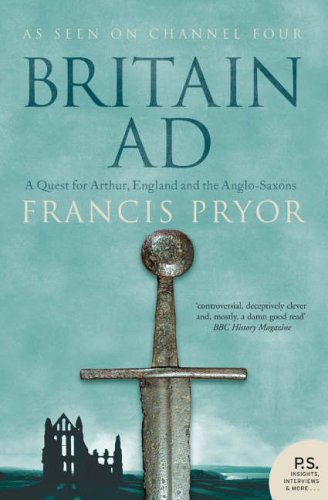
This afternoon I finished reading a book about "evolving identities, origin myths and the use or abuse of archaeology and history," Francis Pryor's Britain AD: A Quest for Arthur, England and the Anglo-Saxons (233). Though the author seems to have an aversion to the use of the Oxford comma and did not find King Arthur (which was not a surprise in itself), I found the book thoroughly intriguing and recommend it to you, even if you have no immediate interest in the topics it concerns. Interest in the historical period aside, how can you not enjoy a book whose author's writes sentences such as these: "Over the centuries Britain has produced its fair share of religious innovations, ranging from the Celtic Church to Quakerism. Generally speaking the official Church greeted them as one would welcome a scorpion to one's trousers" (144-145)?

Ever since I discovered the legends of King Arthur and the Knights of the Round Table as a boy, I have been fascinated by that period of British history known pejoratively - and incorrectly - as "the Dark Ages," which is why I first picked up the book. Beginning with the notion that "the fundamental attitudes underlying human society take a long time to change," Pryor examines and refutes the claim of an Anglo-Saxon invasion of the east of England in the 5th century that completely changed the people and landscape of the British isle, an invasion accepted without question by historians and archaeologists alike (xviii).

Pryor brings his experience and expertise as a prehistoric archeologist to the excavations of Roman, post-Roman, and Anglo-Saxon England, as well as the few documents which have come down to us, and arrives a jarring conclusion:
I am in doubt that archeology is the only means by which the Dark Ages can become fully illuminated. There is a huge amount of exciting new work taking place, and the more we discover, the more it becomes apparent that the fifth and sixth centuries were never truly Dark. There was no no population collapse, the countryside never reverted to woodland, field systems continued in use, towns quite rapidly appeared and then stayed for good. Yes, there were major social and political changes, and, yes, we can see the effects of real raiding in the Viking depredations of the mid-ninth century, that were followed by the collapse of long-distance trade. But where is the evidence for such happenings in the 'Dark Ages,' when communication with mainland Europe and the Mediterranean was a regular occurrence, by both land and sea (234-244)?
After examining the written records and comparing them with the archaeological evidence of landscapes, graves, clothing, skeletons, towns, fortifications, etc., Pryor says, "I can see no convincing archaeological evidence for 'Dark Age' chaos, disruption and turmoil" (96). Why, then, have so many archaeologists and historians held so firmly to the notion of an invasion, even ignoring available evidence to the contrary?

Pryor suggest the answer may have something to do with the nineteenth, a claim that at first seems odd until you seriously consider the biases with which people - even historians - write:
The Victorian era was a time when the previously separate strands of history and science came together in a form of both pseudo-history and pseudo-science which today we would simply label as racist. This doctrine held that human beings came in physically, mentally and intellectually distinct races, the 'purity' of which would be threatened by mixing with the blood of another race. This was of course a fundamentally flawed doctrine, which would have appalling consequences in the twentieth century.

Different races were ascribed different characteristics. Celts, for example, were hot-headed and emotional, while the German or Teutonic race, which included the English, thanks to those Anglo-Saxon migrations, was the best of the lot: rational, loyal, artistic, inventive, etc., etc. (152).
What does this have to do with the post-Roman Britain? The answer is both obvious and disturbing:
When Victorian ideas about the characteristics and purity of races were allied to the 'culture-historical' approach, archaeologists and historians believed they could provide a solid academic basis for English Teutonic origins. That is why manifestly unreliable sources such as Gildas were pressed into service. Gildas' shortcomings were ignored because he was saying what people wanted to hear. These then were the forces that lay behind the circular argument that has bedevilled the study of fifth- and sixth-century Britain for over a century (153).
Rather than attributing everything to the Anglo-Saxons and their supposed supplanting of everything that came before them, Pryor convincingly suggests the possibility of a continued memory, even going back to prehistory:
Surely it is not unreasonable to suggest that many of the ancient themes that we find in the Arthurian tales could have been current for much longer than was once believed, and that they found their way into the literature in ways that recall Mallory's adoption of the legend of the Holy Blood, which was already an old cult when he encountered it. Mallory, Geoffrey of Monmouth and other contributors to the Arthurian tale were seeking to flavour their stories with an air of antiquity, so it would have made good sense to seek customs that were known, or believed, to have had ancient roots (219).
The fundamental attitudes underlying human society do quickly change; rather, they are passed on and utilized in perhaps new ways, while retaining something of the ancient memory, even after the origin is lost and shrouded in time.

Pryor's work is not a "revisionist" history, but rather a reading of history as it actually was, as best as it can be read. He challenges the generally accepted history not because he disagrees with it on principle (which he does), but because there is simply no archaeological evidence to support the theory of the Anglo-Saxon invasions and plenty of archaeological evidence to disprove the theory. His book is a timely reminder for us to question the evidence presented before us and not simply to accept someone's story based solely on the word of the teller.

14 March 2015

Sir Thomas Malory asks our prayers

Le Morte D'Arthur, by John Mullaster Carrick
The author of the great literary classic Le Morte D'Arthur (The Death of Arthur), Sir Thomas Malory, died on this day in the year 1471. William Caxton first published Sir Thomas' work in 1485.

Very little is known with certainty about this man who made such a significant contribution to the Matter of Britain other than the fact that he was held as a "knight prisoner" in France, during which time he wrote his work in twenty-one books in his cell.

At the conclusion of his work, Sir Thomas leaves us with these words:
Here is the end of King Arthur, and of his noble knights of the Round Table, that when they were whole together there was ever an hundred and forty. And here is the end of the death of Arthur. I pray you all, gentlemen and gentlewomen that readeth this book of Arthur and his knights, from the beginning to the ending, pray for me while I am alive, that God send me good deliverance, and when I am dead, I pray you all pray for my soul. For this book was ended the ninth year of the reign of King Edward the fourth, by Sir Thomas Maleore, knight, as Jesu[s] help[ed] him for his great might, as he is the servant of Jesu[s] both day and night.
His words are a fitting remember for us to pray for those who have gone before us, even those whose books we frequently read.

24 May 2013

The Fall of Arthur: A Review


I have remarked here on occasion of my love of the legends of King Arthur and the Knights of the Round Table that I first discovered as a young boy.  Still today I take delight in these stories and am always eager for more, particularly as regards the quest to discover the man who lay at the foundation of the legends.

When some weeks back I first learned of the coming release of an alliterative verse poem by J.R.R. Tolkien titled The Fall of the Arthur, excitement grew in my heart because I knew the brilliance of his version of Sir Gawain and the Green Knight.  Tolkien was a master at taking ancient metrical patterns and making modern English fit to them.

His The Fall of Arthur is sadly incomplete, despite the urging of R. W. Chambers who, on reading the incomplete poem wrote to Tolkien, urging him, "You simply must finish it."  How I wish he had finished it!

The poem itself consists of but five cantos and covers the betrayal of Mordred, Lancelot and Guinevere, and the circumstances that would lead to the terrible Battle of Camlann, though The Fall of Arthur ends rather abruptly, too abruptly and at a moment where it lifts the heart ever more into its tale.

It seems to me that the poem is best read aloud, but even when read quietly one cannot help but feel as though he were in the presence of a great hall, sitting round a fire with a mug of ale, enraptured at the tale of wandering minstrel telling of the glorious and tragic days of the King whom Tolkien calls the "lord of legions,     light in darkness (I.106-110).

Over the last several days a discussion has begun on the list serve Arthurnet about what it is that still brings such great passion to the Arthurian legends.  The Fall of Arthur continues in this great tradition and presents us with a thoroughly Christian Arthur who carries as his emblem "a white lady in holy arms / a babe bearing born of maiden" (IV.127-128).  But, as in other tales, Arthur is not simply a Christian monarch, but a representation of Christ, another Christ, if you will, a true Christian, who is "a king of peace kingdom wielding / in a holy realm besides Heaven's gateway" (V.10-11).

When King Arthur returns to confront Mordred and set right his treachery, "he would pass in peace pardon granting / the hurt healing and the whole guiding, / to Britain the blessed bliss recalling" (V.44-45).    Here I cannot help but recall Aragorn, in whose hands are healing.  What is more, Tolkien speaks of those who "their king betraying, Christ forsaking" (V.16).

It is, I think, this hope of a kingdom restored, of mercy given and justice done, that elicits such passion even these many centuries later, centered on the person of Arthur who is betrayed by those dearest to him but who does not betray them in return.

Hope is a common theme in the writings of Tolkien and it is not absent in this text.  In the middle of the poem we find these moving lines:
Ever times would change and tides alter,
and o'er hills of morning hope come striding
to awake the weary, while the world lasted (III.218-220).
Are not we weary who awaken each day to look for the coming of hope, for the coming of Christ?

Before I am called out on this interpretation, I know that Tolkien great dislike allegory in all of its manifestations where he could detect it, but he did allow for, and even encourage, what he termed applicability.  Consideration my interpretation here not as allegory, but as applicability, spurred on by a famous mosaic of Rex Arturus in the Cathedral of Otranto, in which Arthur is shown riding on a goat in the scenes of the Fall of Man:


I have yet to find an adequate explanation for the curious placing of this mosaic, though I do have my own thoughts (that Arthur is here depicted as a Christ-figure), which I first began to put down on paper when I was in the seminary.  It is a topic to which I shall have to return when I am soon in Italy, after visiting this Cathedral and seeing the mosaic with my own eyes.  And while I'm at it, I must also see St. Galgano's sword in the stone.

10 October 2012

Two loves united

From the days of my childhood I have very much enjoyed the legends of King Arthur and the Knights of the Round Table.  It started, I think, with the cartoon The Legend of Prince Valiant:


From this cartoon I delved into the legends themselves and dabbled into the historicity of King Arthur (a topic that sill captures my attention).  I even wrote a senior seminar paper on King Arthur when I attended Quincy University.

My love of the legends continues to this day and I am a member of the International Arthurian Society - North American Branch.  I look forward to receiving the quarterly issues of Arthuriana and typically devour its contents soon after it arrives.

Also as a boy I was introduced to The Hobbit and The Lord of the Rings and quickly fell in love with the tales of Middle Earth, as well.

Now it seems these two loves will soon be, in a certain sense, merged together: Next year Tolkien's poem in narrative verse titled, "The Fall of Arthur," will be published:
It's the story of a dark world, of knights and princesses, swords and sorcery, quests and betrayals, and it's from the pen of JRR Tolkien. But this is not Middle-earth, it's ancient Britain, and this previously unpublished work from the Lord of the Rings author stars not Aragorn, Gandalf and Frodo, but King Arthur.
The Guardian goes on to give us a brief excerpt of the opening lines:
Arthur eastward in arms purposedhis war to wage on the wild marches,over seas sailing to Saxon lands,from the Roman realm ruin defending.Thus the tides of time to turn backward and the heathen to humble, his hope urged him,that with harrying ships they should hunt no moreon the shining shores and shallow watersof South Britain, booty seeking.
I've already read Tolkien's masterful translation of Sir Gawain and the Green Knight and I can't wait to read this poem.

Just last week I finished reading Tolkien's essay On Fairy Stories where he says of the Arthurian legends:
It seems fairly plain that Arthur, once historical (but perhaps as such not of great importance), was also put in the Pot.  There he was boiled for a long time, together with many other older figures and devices, of mythology and FaĂ«rie, and even some other stray bones of history (such as Alfred's defence against the Danes), until he emerged as a King of FaĂ«rie.
I wonder what elements Tolkien has put into the soup?

19 December 2011

Preparing for Christmas with King Arthur: Making clean your life

For a great many years now - since my childhood - I have enjoyed the legends of King Arthur and the Knights of the Round Table, both their historical background (however firm it may be) behind the victor of the Battle of Mount Badon and the literary tales that have arisen around him over the course of many centuries.

As I read the latest issue of Arthuriana, the scholarly journal of the International Arthurian Society-North American Branch, last week, it occurred to me that several of these stories take place at Christmas.  Consequently, I thought it might be interesting to take a look at some of these tales and examine what they say about the Nativity of our Redeemer.

Let us begin, then, with the tale of the Sword in the Stone, as related to us by Sir Thomas Malory in his Le Morte D'Arthur (The Death of Arthur), which, incidentally, may or may not be connected with the sword of Saint Galgano:

The Sword of Saint Galgano
Montesiepi, Italy

Some even suggest that the life of Saint Galgano gave rise to the story of Sir Percival/Parsifal.  But be that as it may, let us return to our tale.

According to Malory's telling in the fifth chapter of the first book of his great work, following the death of King Uther Pendragon - who died without an heir - the Archbishop of Canterbury, accepting the counsel of Merlin, "sent for all the lords and gentlemen of arms that they should come by Christmas even unto London."*

It may seem odd to us to summon the lords and gentlemen at Christmas, but the Archbishop had a reasonable intent: "that Jesus, that was born on that night, that he would of his great mercy show some miracle, as he was come to be king of mankind, for to show some miracle who should be rightwise king of this realm."

Heeding the call of the Archbishop, the lords and gentlemen chose to prepare themselves to celebrate Christmas and to ask this miracle from the Lord.  They "made clean of their life, that their prayer might be the more acceptable unto God."

When the appointed time had come, they gathered in "the greatest church of London" for prayer.  After the celebration of the first Mass of Christmas Day,
there was seen in the churchyard, against the high altar, a great stone four square, like unto a marble stone; and in the midst thereof was like an anvil of steel a foot on high, and therein stuck a fair sword naked by the point, and letters there were written in gold about the sword that said thus: Whoso pulleth out this sword of this stone and anvil, is rightwise king born of all England.
This miraculous appearance was the answer to their prayers and the promise of a peaceful realm.

When word of this miracle was brought to the archbishop, he ordered everyone to stay in the church at prayer, making it clear that "no man touch the sword till the high mass be all done."

As might be expected, after the Mass everyone went out into the churchyard and marvelled at the sight.  Try as the might, none could move the sword and so it was determined that the rightwise king born of all England was not present.  A tournament was announced for New Year's Day and the call went out through all the land "to keep the lords together and the commons, for the Archbishop trusted that God would him known that should win the sword."

On New Year's Day, while on his way to the tournament, Sir Kay, the son of Sir Ector, realized he had forgotten his sword (how this could possibly have happened is not revealed) and sent Arther, his father's foster-son, to fetch his sword.

But Arthur found the inn where they were staying empty and locked, so he thought, "I will ride to the church yard, and take the sword with me that sticketh in the stone, for my brother Sir Kay
shall not be without a sword this day."  Taking hold of the sword (which was not Excalibur, but rather Caliburn), Arthur drew it forth "lightly and fiercely" and gave it to Sir Kay, who recognized it.

How Arthur drew forth the sword
by Howard Pyle


Sir Kay went to his father and said, "Sir, lo here is the sword of the stone, wherefore I must be king of this land."

Returning to the church, Sir Ector made his son "swear upon on a book [presumably the Scriptures] how he came to that sword."  When Kay confessed Arthur gave it to him, Arthur explained how he came to the sword.

Now, it seems Arthur was somehow completely unawares as to the nature of the sword, for when he was told that because he drew it forth he was the true king, he said, "That is no mastery," and put the sword back in the stone and anvil.  Even so, neither Sir Ector nor Sir Kay could re-draw the sword, but only Arthur.

When Arthur's deed was reported to the Archbishop, he declared that on the twelfth day of Christmas, the sword should be placed again in the stone for the lords to attempt to draw it, but "there might none take it out but Arthur."  Still the lords were unwilling to accept Arthur - whom they thought to be of no high birth - as their King, so it was decided that on Candlemas (February 2nd) the lords of the realm should attempt to withdraw the sword yet again.  "And right as Arthur did at Christmas, he did at Candlemas, and pulled out the sword easily, whereof the barrons were sore aggrieved and put it off in delay till the high feast of Easter."  Even so, the situation remained the same.

The Legend of King Arthur Recognized As King
by Henry Hugh Armstead

Finally, on the day of Pentecost, when still none but Arthur could remove the sword, "the commons cried out at once, We will have Arthur unto our king, we will put him no more in delay, and who that holdeth it against it, we will slay  him."

And so it was that, after pardoning the lords their delay, Arthur took the sword and "offered it upon the altar where the Archbishop was" and finally was Arthur crowned king of all England.

Arthur draws the sword and places it on the altar
Of particular note to us in this final week of Advent is the preparation made by the lords and gentlemen to make their lives clean so their prayers would be more favorably heard.  They knew the truth of the words of Saint James, that "the prayer of a righteous person has great power in its effects" (James 5:16).

How is it, then, that we can cleanse our lives in preparation for the great day of Christmas?  The means are simple, but of great profundity: sacramental confession; increased prayer, fasting and almsgiving; and reading the Scriptures, particularly the accounts of the Lord's birth and of the prophecies concerning him.  Certainly there are more ways to cleanse our lives in preparation for his coming, but these are a good and trustworthy beginning.

We have in these remaining days of Advent still time - even with the busyness of these days - to follow the example of Elizabeth who went into a period of seclusion before the birth of her son, John the Baptist (cf. Luke 1:24).  It is a matter of recognizing what is most important: certainly being prepared to welcome family and friends is important, but not as important as being spiritually ready to welcome the Christ-Child.

In the Collect prayer of today's Mass we prayed "that we may venerate with integrity of faith the mystery of so wondrous an Incarnation and always celebrate it with due reverence."  At the end of the Mass we prayed that "we may welcome the Nativity of our Savior and honor it with minds made pure."

Let us then, in these days that remain, follow the example of those lords and gentlemen who heard the summons of the Archbishop of Canterbury and with them cleanse our lives that our prayers, too, may be heard.

And now, for your viewing pleasure:


* This and subsequent quotations from Le Morte D'Arthur come from Thomas Malory, Le Morte D'Arthur: Complete, Unabridged, New Illustrated Edition, John Matthew, ed. (New York: Barnes & Noble Books, 2004).

27 August 2011

Could it be?! The Round Table?!

From the days of my childhood I have enjoyed the Legends of King Arthur and the Knights of the Round Table and few things lighten my heart even today as do these same legends.
This morning my heart took a childish and enthusiastic leap when I saw that archealogists may have found the round table!  From the Telegraph (with my emphases and comments):
The King's Knot, a geometrical earthwork in the former royal gardens below Stirling Castle, has been shrouded in mystery for hundreds of years.
Though the Knot as it appears today dates from the 1620s, its flat-topped central mound is thought to be much older.
Writers going back more than six centuries have linked the landmark to the legend of King Arthur.
Archaeologists from Glasgow University, working with the Stirling Local History Society and Stirling Field and Archaeological Society, conducted the first ever non-invasive survey of the site in May and June in a bid to uncover some of its secrets.
Their findings were show there was indeed a round feature on the site that pre-dates the visible earthworks.

Historian John Harrison, chair of the SLHS, who initiated the project, said: "Archaeologists using remote-sensing geophysics, have located remains of a circular ditch and other earth works beneath the King's Knot.
"The finds show that the present mound was created on an older site and throws new light on a tradition that King Arthur's Round Table was located in this vicinity" [I've long wondered if too much skepticism is used when reading old legends; by definition, they are, after all, based on some fact.  The lost city of Troy was discovered when Schliemann decided to follow the directions given in the Illiad to find city.  Everyone thought he was crazy but find the city he did].
Stories have been told about the curious geometrical mound for hundreds of years -- including that it was the Round Table where King Arthur gathered his knights.
Around 1375 the Scots poet John Barbour said that "the round table" was south of Stirling Castle, and in 1478 William of Worcester told how "King Arthur kept the Round Table at Stirling Castle".
Sir David Lindsay, the 16th century Scottish writer, added to the legend in 1529 when he said that Stirling Castle was home of the "Chapell-royall, park, and Tabyll Round".
It has also been suggested the site is partly Iron Age or medieval, or was used as a Roman fort [which also make sense since Arthur would have lived shortly after the Romans left the island to its own defenses].
Extensive work on the royal gardens was carried out in the early 17th century for Charles I, when the mound is thought to have taken its current form.
The first known record of the site being called the King's Knot is from 1767, by which time it was being leased for pasture.
Locals refer to the grassy earthworks as the "cup and saucer", but aerial photographs taken in 1980 showed three concentric ditches beneath and around the King's Knot mound, suggesting an earthwork monument had preceded it.
The new survey -- funded by Historic Scotland and Stirling City Heritage Trust -- used the latest scientific techniques to showing lost structures and features up to a metre below the ground.
It also revealed a series of ditches south of the main mound, as well as remains of buildings, and more recent structures, including modern drains which appear at the northern end of the gardens.
Mr Harrison, who has studied the King's Knot for 20 years, said: "It is a mystery which the documents cannot solve, but geophysics has given us new insights.
"Of course, we cannot say that King Arthur was there, but the feature which surrounds the core of the Knot could explain the stories and beliefs that people held."
Archaeologist Stephen Digney, who coordinated the project, said: "The area around Stirling Castle holds some of the finest medieval landscapes in Europe.
"This investigation is an exciting first step in a serious effort to explore, explain and interpret them. The results so far suggest that Scotland's monarchs integrated an ancient feature into their garden, something we know happened in other countries too.
"We are looking forward to the next stage in September when we hope to refine some of the details." 
Dr. Kirsty Owen, Cultural Heritage Adviser at Historic Scotland, added: "The project has the potential to add to our knowledge of the landscape context of the medieval and early modern occupation of Stirling Castle.
"The ditches identified may intriguingly be part of historically documented earlier garden features, or if prehistoric in origin could add to our scant knowledge of prehistoric activity at Stirling Castle.
"We look forward to seeing the results of the next phase of investigations."Futher work including a ground-penetrating radar survey, is now planned to take place next month to find out more.
A small display of the interim results can be seen close to the site at the Smith Museum.

06 November 2008

From the time I was a young boy I have always enjoyed the legends of King Arthur and his Knights of the Round Table. I spent much of my childhood building bigger and better castles with Legos and even playing in the fields as knights. One of my senior seminar papers - required to receive the B.A. - concerned King Arthur.


Lately I have not had much opportunity to pursue my love of all things Arthurian; priestly duties and, more lately, teaching must take priority. (When my students ask what I would be if not a priest, I tell them I would be in England looking for King Arthur.)


This morning I just happened to open the November volume of Butler's out of curiosity to see which saints are celebrated today. The first listed is the sixth century Saint Illtud.

"'Illtud?' I thought. Wait, I know that name!" Saint the Illtud has connections to the legends of King Arthur.

In the Life of Saint Illtud - which I've seen dated anywhere between the ninth and twelfth centuries - we are told that Illtud is a cousin of King Arthur. The intertwining of the two personalities are brief. Illtud,
hearing of the magnificence of his cousin, king Arthur, desired to visit the court of so great a conqueror. He left what we call Further Britannia, Brittany, and arrived by sailing, and here he saw a very great company of soldiers,being also honourably received in that place, and being rewarded as regards his military desire. His desire to receive guerdons being also satisfied, he withdrew very pleased from the royal court (Life of St. Illtud, 2).
I just thought you might like to know.


Today - being a rainy, dreary day durning which the temperature is to begin falling - may well be a good day to pick up the legends again. With the change in weather my left knee is throbbing; if I could make my knee cap pop right off I would do so gladly! Laying down with a good book may be just the remedy!