13 September 2011

CCI: HHS exemption threatens religious freedom

In a Letter to the Editor in the State Journal-Register, Zach Wichmann, Director of Government Relations of the Illinois Catholic Conference, addresses forthcoming changes in health care regulations, about which I posted earlier.

His letter follows, with my emphases and comments:

Headlines declared “free birth control for all” when the federal government recently issued an interim rule mandating health-care plans to cover sterilization and prescription contraceptives, including the abortifacient drug Ella. But an under-reported provision of the same rule proposed an incredibly narrow definition of religious employer for exemption from the mandate.

The Catholic Church’s teaching on the immorality of contraception and sterilization as a rejection of God’s life-giving design may lack popular support. However, our nation’s commitment to protecting the free-exercise of religion has led to long-standing conscience exemptions from mandates concerning abortion, contraception and sterilization in both federal and state law for health-care professionals, insurers and purchasers. President Barack Obama’s health-care plan, the Illinois Health Care Right of Conscience Act and the exemption of “church plans” in various federal laws are just a few examples.

But the newly defined exemption for religious belief is stricter than anything found in current federal law. Exemptions may now be unavailable to individuals or insurers and apply only to religious employers that meet the extremely narrow criteria of 1.) having the purpose of teaching religious values, 2.) primarily hiring persons who share the organizations’ religious tenets, 3.) primarily serving people who share those tenets and 4.) being a nonprofit as described in the Internal Revenue Code.

Under this proposal, an organization would not be “religious enough” if it served people of different faiths, failed to hire based on religion or did not restrict its mission to the teaching of religious values. As organizations striving to serve all people in need, Catholic hospitals, Catholic universities and Catholic social service agencies would be denied the exemption.
Astonishingly, Jesus Christ and the early Church could not qualify for the exemption. His ministry was not confined to members of the Church, nor did it consist only of preaching.

By ignoring individual conscience and attempting to determine which ministries of the Church are not “religious enough,” the federal government abrogates existing law and undermines the free-exercise protections of the First Amendment. Left unchanged, the final implementation of this provision will present an impossible dilemma: forcing the Catholic Church to either withdraw from public ministry or violate deeply held religious belief through the compelled provision of health insurance coverage for contraceptives and sterilization [which is precisely the goal of the newly defined criteria].

Illinois residents surely cannot accept this threat to religious freedom.

12 September 2011

From the Cathedral of Our Lady of Peace

After greeting the faithful of Honolulu after the 9:00 a.m. Mass, I was told the Mass was streamed live throughout the world and would be posted online later in the day.  You can watcht he video here.

11 September 2011

Selling Jesus?

Back in Madrid I was able to concelebrate a Mass with the U.S. Bishops for the U.S. pilgrims before heading out to Cuatro Vientos for the Saturday night vigil.

It struck me again at that Mass that many youth ministers within the Church simply do not understand young people and what they seek from the Church.  Young people are not the same today as they were twenty or thirty or forty years ago (I suspect this has always been the case).

Most youth ministers seem to approach today's youth from the point of view of the minister's remembrances of his or her own youth.

While it is true that the basic and central questions of life remain the same in every generation, the method of addressing these questions seems to change.

A friend recently directed my attention to this excellent post by Rachel Held Evans in which she asks, "Is your church too cool?"  She writes (with my emphases):

People sometimes assume that because I’m a progressive 30-year-old who enjoys Mumford and Sons and has no children, I must want a super-hip church—you know, the kind that’s called “Thrive” or “Be,” and which boasts “an awesome worship experience,” a fair-trade coffee bar, its own iPhone app and a pastor who looks like a Jonas brother.
While none of these features are inherently wrong (and can of course be used by good people to do good things), these days I find myself longing for a church with a cool factor of about 0.

That’s right.

I want a church that includes fussy kids, old liturgy, bad sound, weird congregants and—brace yourself—painfully amateur “special music” now and then.

Why?

Well, for one thing, when the Gospel story is accompanied by a fog machine and light show, I always get this creeped-out feeling like someone’s trying to sell me something. It’s as though we’re all compensating for the fact that Christianity’s not good enough to stand on its own so we’re adding snacks.

But more importantly, I want to be part of an uncool church because I want to be part of a community that shares the reputation of Jesus. Like it or not, Jesus’ favorite people in the world were not cool. They were mostly sinners, misfits, outcasts, weirdos, poor people, sick people and crazy people [more].

Over the past several days I have stumbled upon several articles and blog posts suggesting ways to, in their words, sell Jesus to the present generation.

I've never been comfortable with such a notion of evangelization because it completely misses the mark.  A salesman does what he can to convince you to buy something that you do not need; you may want it, but you don't need it.  If you needed it, there would be no reason for a salesman, only a cashier.

The notion of "selling Jesus" - or of "making religion relevant" - implies that someone does not need Jesus, that life might simply be enhanced.  This is not in keeping with the Gospel; it's no wonder it fails time and time again.

Homily - 11 September 2011

The Twenty-Fourth Sunday of the Year (A)
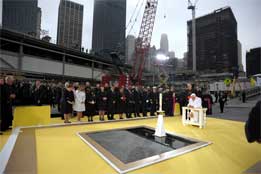
The Tenth Anniversary of the Terrorist Attacks of 9/11
Dear brothers and sisters in Christ,

“Wrath and anger are hateful things, yet the sinner hugs them tight” (Sirach 27:30).  “He pardons all your iniquities, heals all your ills” (Psalm 103:).  “For this is why Christ died and came to life, that he might be Lord of both the dead and the living” (Romans 14:9).  “I give you a new commandment, says the Lord: love one another as I have loved you” (John 13:34).  “So will my heavenly Father do to you, unless each of you forgives his brother in his heart” (Matthew 18:35).

Today, ten years after the world was changed following the horrific attacks at New York, Arlington and Shanksville, these sacred words resound with the deepest truths of the Gospel of Jesus Christ.  Among the unique qualities of Christianity is its refusal to allow for any form of revenge, following the example of its Divine Founder.

In the aftermath of 9/11 we were shown images of the terrorist supporters and sympathizers rejoicing at the collapse of the Twin Towers.  Nine years later, following the death of Usama bin Laden on May 2, 2011, we saw images of Americans rejoicing at the death of a man.  They proved themselves no better than our attackers; their desire for vengeance and their thirst for blood were quenched, forgetting all the while that “the vengeful will suffer the Lord’s vengeance, for he remembers their sins in detail” (Sirach 28:1).

Such sights and sounds of jubilation run flatly contrary to the teachings of Jesus.  “Though harshly treated, he submitted and did not open his mouth; like a lamb led to slaughter or a sheep before shearers, he did not open his mouth” (Isaiah 53:7).  He says to us, “Forgive your neighbor’s injustice; then when you pray, your own sins will be forgiven” (Sirach 30:2).

Following the death of Usama bin Laden, the Holy See issued a simple and straightforward statement: 

Osama bin Laden – as everyone knows – has had the gravest responsibility for spreading hatred and division among people, causing the deaths of countless people, and exploiting religion for this purpose. 

Faced with the death of a man, a Christian never rejoices, but reflects on the serious responsibility of everyone before God and man, and hopes and pledges that every event is not an opportunity for a further growth of hatred, but of peace.
The Christian response to such violence is not more violence, nor is it a desire for revenge.  It is, rather, a pledge for peace and healing; it is to take the path taken by the heroes of 9/11 who, at their own peril, sought to rescue and save those in danger.  They knew the truth of Saint Paul’s words: “None of us lives for oneself, and no one dies for oneself.  For if we live, we live for the Lord, and if we die, we die for the Lord; so then, whether we live or die, we are the Lord’s” (Romans 14:7-8).

J.R.R. Tolkien, the celebrated author and literary genius, was a devout Catholic who allowed his faith in Jesus Christ to shape and guide his life.  His faith flowed into his trilogy of The Lord of the Rings; consequently, there is much we can learn of faithful discipleship in its pages.

In the mines of Moria, Gandalf explains to Frodo something of Gollum’s history.  Hearing of Gollum’s past, Frodo says, “It’s a pity Bilbo didn’t kill him when he had the chance.”  Is this not the very same sentiment that drove so many to rejoice at the death of Usama bin Laden?

In response, Gandalf says to Frodo, “Pity?  It was pity that stayed Biblo’s hand.  Many that live deserve death.  Some that die deserve life.  Can you give it to them, Frodo?  Do not be too eager to deal out death in judgment.”  Neither should we be eager for the death of another, nor should we rejoice in a man’s death, despite the atrocities committed by his hand or at his direction.

It was an abuse and a distortion – a perversion - of true religion that led to the terrorist attacks that took the lives of innocent people while the terrorists claimed to act in the name of God.  Pope Benedict XVI has repeatedly and consistently reminded us that violence has no place in religion, that it is contrary to religion.  In a letter he sent to Archbishop Timothy M. Dolan, President of the United States Conference of Catholic Bishops, Pope Benedict reminds us that “every human life is precious in God’s sight and no effort should be spared in the attempt to promote throughout the world a genuine respect for the inalienable rights and dignity of individuals and people everywhere.”  Our love, our forgiveness, must extend even to those who take the lives of others; they, too, have been created in love and for love.

The teachings of Jesus Christ are simple, but they are not easy.  He says to us, without condition or qualification, “Love your enemies, and pray for those who persecute you” (Matthew 5:44).  This is our high calling, and to it we must always aspire.

Today is a day for us to pause and consider how authentically we live our faith and practice our religion.  How willing are we to forgive those who commit atrocious acts of violence and hatred?  How firmly do we hold to the teachings of the Master?  When we pose Peter’s question to him, “Lord, if my brother sins against me, how often must I forgive?” the answer remains the same: forgive your brother from the heart (Matthew 18:21, 35).

Let each of us, then, heed the wisdom of Sirach: “Remember your last days, set enmity aside; remember death and decay, and cease from sin!  Think of the commandments, hate not your neighbor; remember the Most High’s covenant, and overlook faults” (Sirach 28:6-7).  If we live with the reality of our own death in mind, life begins to take on a new meaning and a new purpose; if we remember death and decay we learn that what we do each day is important.  Our good deeds matter and so does our sin.  It is always good to ask, “Could anyone nourish anger against another and expect healing from the Lord” (Sirach 28:3)?  Each day we pray, “Forgive us our trespasses as we forgive those who trespass against us” (Matthew 6:12).  These are daring words and rest upon our forgiveness of others, even our enemies; let us not speak them in vain.

Gathered as we are in this Cathedral dedicated to Our Lady of Peace, let us implore the intercession of the Blessed Mother.  May she, whose heart was pierced by seven sorrows, teach us to love and to forgive, even as she forgave those who crucified her Son (cf. Luke 2:35).  Our Lady, Queen of Peace, pray for us!

Let us pray

O God of love, compassion, and healing,
look on us, people of many different faiths and traditions,
who gather today at this site,
the scene of incredible violence and pain.

We ask you in your goodness
to give eternal light and peace
to all who died here—
the heroic first-responders:
our fire fighters, police officers,
emergency service workers, and Port Authority personnel,
along with all the innocent men and women
who were victims of this tragedy
simply because their work or service
brought them here on September 11, 2001.

We ask you, in your compassion
to bring healing to those
who, because of their presence here that day,
suffer from injuries and illness.
Heal, too, the pain of still-grieving families
and all who lost loved ones in this tragedy.
Give them strength to continue their lives with courage and hope.

We are mindful as well
of those who suffered death, injury, and loss
on the same day at the Pentagon and in Shanksville, Pennsylvania.
Our hearts are one with theirs
as our prayer embraces their pain and suffering.

God of peace, bring your peace to our violent world:
peace in the hearts of all men and women
and peace among the nations of the earth.
Turn to your way of love
those whose hearts and minds
are consumed with hatred.

God of understanding,
overwhelmed by the magnitude of this tragedy,
we seek your light and guidance
as we confront such terrible events.
Grant that those whose lives were spared
may live so that the lives lost here
may not have been lost in vain.
Comfort and console us,
strengthen us in hope,
and give us the wisdom and courage
to work tirelessly for a world
where true peace and love reign
among nations and in the hearts of all.

- Pope Benedict XVI
20 April 2008, at Ground Zero

In honor of the day


Our Lady, Queen of Peace, pray for us!

09 September 2011

Nothing like I've ever known

When I was in college one of my professors slept for only three hours each night.  I marvelled how he was able to make it through each day with so little sleep, especially since he was always full of good humor and joy.

Whenever I am in Hawaii it seems I need only about five hours of sleep each night, for which I am grateful.  Generally I spend the early morning hours catching up on e-mail, but yesterday I decided to watch the sunrise at Makapu'u.

Sunrise at Makapu'u
Though I didn't arrive early enough to watch the sun rise out of the ocean (I hope to do that next week), the experience was unlike anything I've ever known.

As I climbed the side of the mountain and rounded the turn towards the east, the bright rays of dawn seemed instantly to spread out over the waters, upon the path and cacti and other vegetation.  The temperature warmed and everything was covered in a beautiful glow.  I thought about taking a picture of what I saw in that instant, but I knew the image wouldn't compare to the reality.

There was something in that light that made my heart skip and leap for joy within me.  I was drawn out of myself and knew a happiness beyond description.  I even found myself wanting to run up the rest of the mountain to greet the rising sun.

It occured to me as I quickened my pace with a bright smile on my face, that this must be way Christians have for centuries buried their dead facing the east, toward the rising sun.  When Christ the Lord, the Morning Star, returns, we are to run toward him and toward the beauty of his light with an even greater joy than I experienced yesterday morning.

Let each of us be found waiting in joyful hope for the coming of our Savior, Jesus Christ!

US Bishops: Let us pray that the lasting legacy of 9/11 is not fear, but rather hope for a renewed world

The United States Conference of Catholic Bishops have issued a statement on the tenth anniversary of 9/11, A Time for Remembrance, Resolve and Renewal (with my emphases):

As we commemorate the tenth anniversary of the 9/11 terrorist attacks in New York, Shanksville, Pennsylvania, and at the Pentagon, it is a time for remembrance, resolve and renewal.

We reverently recall those who were most directly affected by this tragedy—those who died, were injured or lost loved ones.In a special way we recall the selfless first responders—firefighters, police, chaplains, emergency workers, and other brave persons—who risked, and many times lost, their lives in their courageous efforts to save others.

We also remember how our nation responded to the terrifying events of that day—we turned to prayer, and then turned to one another to offer help and support.  Hands were folded in prayer and opened in service to those who had lost so much.

We resolve today and always to reject hatred and resist terrorism.The greatest resource we have in these struggles is faith. Ten years ago our Conference of Bishops issued a Pastoral Message, Living with Faith and Hope after September 11, which drew on the rich resources of our Catholic faith to minister to our nation and world. The truth of that Pastoral Message still resonates today.

A decade later we remain resolved to reject extreme ideologies that perversely misuse religion to justify indefensible attacks on innocent civilians, to embrace persons of all religions, including our Muslim neighbors, and to welcome refugees seeking safety. We steadfastly refrain from blaming the many for the actions of a few and insist that security needs can be reconciled with our immigrant heritage without compromising either one. Gratefully mindful of the continuing sacrifices of the men and women in our armed forces, and their families, we also resolve to bring a responsible end to the conflicts in Afghanistan and Iraq.

This tenth anniversary of 9/11 can be a time of renewal. Ten years ago we came together across religious, political, social and ethnic lines to stand as one people to heal wounds and defend against terrorism. As we face today's challenges of people out of work, families struggling, and the continuing dangers of wars and terrorism, let us summon the 9/11 spirit of unity to confront our challenges. Let us pray that the lasting legacy of 9/11 is not fear, but rather hope for a world renewed.

In remembering the fateful events of September 11, 2001, may we resolve to put aside our differences and join together in the task of renewing our nation and world.Let us make our own the prayer of Pope Benedict XVI when he visited Ground Zero in New York in 2008:

O God of love, compassion, and healing,
look on us, people of many different faiths and traditions,
who gather today at this site,the scene of incredible violence and pain….

God of understanding,
overwhelmed by the magnitude of this tragedy,
we seek your light and guidance
as we confront such terrible events.
Grant that those whose lives were spared
may live so that the lives lost here
may not have been lost in vain.
Comfort and console us,
strengthen us in hope,
and give us the wisdom and courage
to work tirelessly for a world
where true peace and love reign
among nations and in the hearts of all.

Paprocki: More efforts are needed to counter a worldwide culture of death and to promote a culture of life

Writing in the Catholic Times, His Excellency the Most Reverend Thomas John Paprocki reflects on the tenth anniversary of the 9/11 attacks (with my emphases):

My dear brothers and sisters in Christ,

Sunday, Sept. 11, marks the 10th anniversary of the terrorist attacks of 9/11/2001. Most people remember exactly where they were when hearing of this dreadful news. I was pastor of St. Constance Parish in Chicago at the time, and had just finished celebrating the 8 o'clock morning Mass. I came back to the rectory for some breakfast, turned on the television, and watched the shocking events unfold on live television. People came to church to pray throughout the day as they did not know what was happening and were turning to God in this time of crisis. Our parish was just under a landing pattern for O'Hare Airport, so the silent skies were eerie as all flights were canceled for about 10 days.

Our world changed forever on that day, but some aspects of life remained the same. The increased number of people coming to church unfortunately did not last; in fact in some places church attendance declined as some people blamed religion or were angry with God for permitting the evil of these lethal terrorist attacks. Air travel changed, as we continue to wrestle with balancing the tension between ensuring security and respecting rights to privacy. What did not change were the essential character of the American people and the commitment of our nation to make this a better world.

The heroes of 9/11 gave their lives seeking to save others. Since then, more heroes continue to make personal sacrifices to help others by serving in the military or by contributing to the betterment of the world in a variety of ways. But more efforts are needed to counter a worldwide culture of death and to promote a culture of life.

The wanton destruction of human life in the terrorist attacks of 9/11/2001 was horrific, but we need to remember other attacks on human life that are even more numerous. The terrorist attacks of Sept. 11, 2001 resulted in 2,996 deaths, including the 19 hijackers and 2,977 victims. Meanwhile, an estimated 42 million abortions are performed globally each year. In the United States alone, over 50 million babies have been aborted since 1973.

I plan to take a small step to promote the culture of life next month. Actually I will take quite a few steps running 26.2 miles in the Kansas City Marathon on Saturday, Oct. 15. I will be running with a group called LIFE Runners (LIFE stands for Living In Faith Exchange). The group's core values are, "Keep the faith, respect life from conception to natural death, run so as to win." LIFE Runners seek to "raise funds, awareness, and prayers for pro-life activities, while training for and racing in marathons." On the runners' shirts, there is a simple line: "REMEMBER The Unborn Jer 1:5." (From the Book of the Prophet Jeremiah, "Before I formed you in the womb I knew you.")

As I've done with other worthwhile causes in the past, I am dedicating my running of the Kansas City Marathon this Oct. 15th to raise money for charity, including various pro-life causes. The LIFE Runners are helping the Sioux Falls Alpha Pregnancy Center to purchase a pregnancy-help bus that will provide free sonograms in rural areas. They will also help the Wyandotte Pregnancy Clinic in Kansas City. While I will contribute to the causes designated by LIFE Runners, most of the funds raised in the Diocese of Springfield in Illinois will help support pro-life causes right here in our own diocese. Specifically, donations for my running of the Kansas City Marathon on Oct. 15 will support: 1) scholarships to assist deserving youth from our diocese going to the January March for Life in Washington, D.C.; 2) multi-media educational resources for diocesan youth in schools and parishes; and 3) Internet publicity about post-abortion assistance and healing.

The way it works is that I ask people to pledge or pay whatever they are willing to donate per mile for the 26.2 miles that make up the distance of every marathon. My sacrifice is doing the training and running the race. Your sacrifice is making a pledge and contributing your donation. I have already been getting up early in the morning for the past few months to get in my training runs. I hope you will do your part as well. Below is a form for your pledge or contribution. You can also make your pledge or donation online at www.dio.org/marathon.

As Sacred Scripture says, "Let us run with endurance the race that is set before us" (Hebrews 12:1). Your generosity will be greatly appreciated.
May God give us this grace. Amen.

In Illinois, as in Britain

In what seems a rather surprising move in Britain - as it would in many other places today, sad as it is - the Advertising Standards Authority has banned a cell phone commercial that was to air during Holy Week the ASA deemed would be offensive to Christians.  From the description given of the commerical, I'm not sure it is so much offensive as it is simply in bad taste and poor in thought.
Said the ASA:
"We considered that, although the ads were intended to be light-hearted and humorous, their depiction of Jesus winking and holding a thumbs-up sign, with the text "miraculous" deals during Easter, the Christian Holy Week which celebrated Christ's resurrection, gave the impression that they were mocking and belittling core Christian beliefs," the ASA said on Wednesday.
"We therefore concluded that the ads were disrespectful to the Christian faith and were likely to cause serious offence, particularly to Christians."
Could it be that these is part of the fruit being born in Britain after Pope Benedict XVI's recent pastoral visit there?

Perhaps, but there is also the distubring news from Britain - that will soon likewise happen in the USA (indeed, it is already being to happen) - that a Member of Parliament has called on Prime Minister David Cameron to make it illegal for Christian churches to refuse to conduct homosexual civil unions; indeed, Mike Weatherley would go so far as to refuse to allow Christian ministers to conduct even true marriages.  It sounds all too familiar to the present situation in Illinois.

Prior to the passage of the Religious Freedom Protection and Civil Unions Act we were told explicitly - on the floor of the chamber - that the new legislation would not affect foster care and adoptions.  After the passage of the law we find the contrary to the true: the State is actively seeking to force Catholic Charities out of foster care and adoptions, all on the basis of our inability to recognize as a civil union as the equivalent of a valid marriage (which, it should be remember, the RFPCUA does not require us to do).

What is the basis for MP Weatherley's push to force the Church out of marriages?  Her inability to recognize civil unions as the equivalent of a valid marriage:

He told Mr Cameron to follow a precedent he suggested had been set by laws compelling 11 Catholic adoption agencies to assess gay couples as potential adopters and foster parents, although most of them have either since closed or left the control of the church.

Mr Weatherley said that the alternative would be to surrender to a “messy compromise” in which gays would remain the victims of inequality.

“I am becoming increasingly concerned about the inequality which exists between the unions of same-sex couples and those of opposite-sex couples in this country,” he said in his letter.

“As long as religious groups can refuse to preside over ceremonies for same-sex couples, there will be inequality,” he said.

“Such behaviour is not be tolerated in other areas, such as adoption, after all.”

Mr Weatherley described the 2004 Civil Partnership Act, which permitted legal recognition of same-sex unions, as an “uneasy truce” between campaigners for equality and people who sought to uphold the religious significance of marriage.
This is all too close for comfort, as they say.

A similar situation will - if things continue to progress as they are - come upon us in the United States of America, all in the name of tolerance.  But one group will not be tolerated: those who hold to the teachings of Jesus Christ.

In Illinois, when the Religious Freedom Protection and Civil Unions Act was passed, we were told it was not an attempt to push the Church out of marriage and that those advocating for the passage of the Act only wanted the same rights of married couples.  All of these civil rights they could already have if they simply went through the appropriate channels and filed the proper papers.  But that wasn't enough.

Neither will simply forcing Catholic Charities out of foster care and adoptions be enough for them.  As long as the Church stands against their agenda and goals, they will not rest.  The next assault in Illinois will be as in Britian; it will be an assault against marriage.

07 September 2011

If we can't believe you on civility...

The Anchoress has an open letter of sorts to President Obama in which she asks him if he really meant his call to a more civil speech in politics.

It seems to her - and to me - that he did not truly mean this speech because he has remained silent with members and leaders of his Party have derided others since he called for a greater civility.

The Anchoress wonders, if we can't believe him on something as simple - and hopeful - as a call to greater civility, how can we believe him on the budget, or anything else for that matter.

06 September 2011

Something to consider

If you are immersed in the temporal world and your heart finds it's treasure in it, then meeting with God in the Eucharist is only an episode or a passing affect. At the same time, this meeting is also a drama that reveals the emptiness of your faith.

-S.C. Biela

Bobo's Restuarant, and a full stomach

If you ever find yourself in Tucson, Arizona, let me recommend Bobo's Restaurant to you.

This morning I had a pancake with apples, pecans and syrup:


It was a massive pancake and was amazingly delicious.

Persecution Watch: India

From Catholic World News:

Twenty masked men destroyed the altar, confessionals, and vestments in a parish in the southwestern Indian state of Kerala on the evening of September 4.

“We have had, in recent years, a growth of these Hindu extremist groups in Kerala and we begin to suffer the consequences,” Bishop Stanley Roman of Quilon said following the desecration of Our Lady of Vailankanni parish in Kottenkulangara. “But it is also true that, consequently, small Islamic groups are proliferating” [more].

Irish government to cooperate with Holy Spirit

In the Holy See's response to the Cloyne Report which documented the sad state of clerical abuse in Ireland, it was proposed that the Holy See and the Irish government might engage in a fruitful and constructive dialogue to "work together to ensure that the Church and, indeed, society in general will always be safe for children and young people."

The Irish government has accepted this proposal.

This is welcome news indeed.

Abortion has a medical link to breast cancer

From Life Site News:

Washington, DC (LifeNews.com) – A microbiologist says there are so many published studies confirming the link between induced abortion and breast cancer that he plans to publish one every day on his blog until he’s mentioned them all. It will take Dr. Gerard Nadal so many weeks to cover them all, the blogging will continue until early next year.

Nadal, who has a has a PhD in Molecular Microbiology from St John’s University in New York, has spent 16 years teaching science, most recently at Manhattan College.

He will report on one abortion-breast cancer study daily until he has exhausted all of the abortion-breast cancer studies and he anticipates he may be reporting on these studies as late as January or February of 2011 [more].

You can read Dr. Nadal's blog here.

A typical day for the Pope

Have you ever wondered what a typical day is like for Pope Benedict XVI?  Andrea Tornielli provides us with a basic run through his typical day, complete with what he generally eats for breakfast.

05 September 2011

Pope: We must participate both in fraternal correction and in prayer

These days we are often told that we shouldn't confront someone on account of his or her sins.  Yesterday Pope Benedict XVI reminded us that Jesus says otherwise.

The text of his Angelus follows, via Zenit, with my emphases:

Dear Brothers and Sisters,
The biblical readings for the Mass this Sunday center on the theme of fraternal charity in the community of believers, which has its source in the communion of the Trinity. The apostle Paul affirms that the whole Law of God has its fullness in love in such a way that in our relationships with others, the 10 Commandments and every precept are summed up thus: "You will love your neighbor as yourself" (cf. Romans 13:8-10). The Gospel text, taken from Matthew 18, which treats of the life of the Christian community, tells us that brotherly love also includes reciprocal responsibility, on account of which, if my brother sins against me, I must be charitable to him and, first of all, speak with him personally, showing him that that what he said or did is not good. This way of behaving is called fraternal correction: it is not a reaction to the offense I have suffered but a being moved by love for my brother. St. Augustine comments: "He who has offended you, in offending you, he has caused himself a grave injury, and will you not care for the wound of your brother? […] You must forget that you have been offended but not your brother’s wound" (Sermon 82, 7).

And what if my brother does not listen to me? In today's Gospel, Jesus indicates a gradual approach: first go back and talk to him with two or three other persons so as to help him better grasp what he has done; if despite this he rejects the observation, the community must be told; and if he does not listen to the community either, it is necessary to make him see the rupture that he himself has provoked, separating himself from the Church. All of this shows that there is a co-responsibility in the journey of the Christian life: everyone, conscious of his own limits and defects, is called to welcome fraternal correction and to help others with this particular service.

Another fruit of charity in the community is unified prayer. Jesus says: "If two of you on earth agree to ask for something, my Father who is in heaven will grant it. Because wherever two or three are gathered in my name, there I am in their midst" (Matthew 18:19-20). Personal prayer is certainly important, indeed indispensable, but the Lord assures his presence in the community that -- even if it is very small -- is united and of one accord, because it reflects the reality itself of God One-and-Three, perfect communion of love. Origen says that "we must play in this symphony" (Commentary on the Gospel of Matthew 14:11), that is, within this concord of the Christian community. We must participate both in fraternal correction, which requires much humility and simplicity of heart, and in prayer, that it might rise up to God from a community truly united in Christ.

Let us plead for all of this through the intercession of Mary Most Holy, Mother of the Church, and of St. Gregory the Great, Pope and Doctor, whom we commemorated in yesterday’s liturgy.

04 September 2011

The first King of all England

One thousand and eighty-four years ago today, Athelstan became the first King of all England.


I just thought you might like to know.

Is the Church against science?

It is - sadly - often claimed today by some of a certain mindset that the Church stands against reason and science and opposes scientific discovery.  The truth of the matter is quite the opposite.

Simply consider the following list of Catholics (with their scientific fields) compiled by A Reluctant Sinner, most of whom were priests:

Roger Bacon (founder of the modern scientific method); Robert Grosseteste (father of scientific experimentation); Basil Valentine (father of modern chemistry); Nicolaus Copernicus (proponent of heliocentrism); Giovanni Battista Riccioli (leading astronomer and the first person to measure the rate of acceleration of a freely falling body); Athanasius Kircher (father of Egyptology, first man to view microbes, and founder of modern geography); Václav Prokop Diviš, Giuseppe Toaldo and Luigi Galvini (discoverers of various types of electricity); Jean Mabillon (founder of palaeography); Marin Mersenne (father of acoustics); René Just Haüy (founder of chrystallography); Jean-Antoine Nollet (who discovered the phenomenon of osmosis in natural membranes); Louis Pasteur (genius of mirco-biology); Francesco Lana de Terzi (father of aeronautics and proponent of what later became known as Braille); Jean Baptiste Carnoy (founder of cytology); Pierre Teilhard de Chardin (world famous palaeontologist and discoverer of Peking Man - even if his theology was suspect); Gregor Mendel (father of genetics - pictured, left); and Georges Lemaître (proposer of the Big Bang theory - pictured top and below).

Very few people who hold to the theory of The Big Bang not about the man who first theorized about it: Monsignor Georges Lemaitre.  That's right: a Catholic priest is the founder of the Big Bang theory (which he called the hypothesis of the primeval atom).

Why is it that we hear so little about this great scientific mind?  A Reluctant Sinner suggests:

It seems that the modern world is uncomfortable with the fact a Belgian Catholic priest was also one of its greatest astronomers, mathematicians and physicists. Fr Georges Lemaître, who taught at the Catholic University of Louvain, is a massive stumbling block to those who suffer from the delusion that science and religious faith cannot (or should not) be compatible.

Curiously enough, when he proposed this hypothesis of the primeval atom, the secularist scientists of the time ridiculed Msgr. Lemaitre for what was then considered a ridiculous idea.

Go and read more.

Making healthcare unaffordable, government style?

For a State already several billion dollars in debt each year, the Affordable Health Care Act will cost the State of Illinois an additional $1.3 billion per year.

The State Journal-Register has the story; for some reason I can't copy and paste the story.


A lesson in graciousness and protocol

Yesterday evening I returned to Effingham to bid farewell to a young man who tomorrow departs to begin his training in the United States Marine Corps.

He is, as you might expect, a fine fellow who taught me a simple lesson.

As he and his father walked me to my car as I prepared to return to Springfield, he thanked me again for coming, shook my hand and slipped a token of appreciation into my hand.

It has not been an uncommon experience for me, nor is it for many priests.  People want to express their gratitude and they often do so with a small monetary gift.

When I felt the gift in my hand, I said, "You don't have to do that," which I meant.

The young marine looked at me and said, "You're supposed to take it, Father."

Taken a bit by surprise, I answered, "Oh, okay."  No one had answered with those - or even similar words - before.  As I accepted the gift, he said, "It's for your gas."

As I left Effingham I filled up my car, with gratitude for his kindness and for a simply lesson learned.

If you would, please offer a prayer this young marine.

03 September 2011

The Dark Decade

Yesterday I read Emmett Cahill's The Dark Decade 1829-1839:Anti-Catholic Persecutions in Hawai'i.

Beginning with the arrival of the Calvinists from the United States of America, Cahill traces the growth and spread of Christianity within the islands, with a particular focus and concentration on the island of Oahu, the seat of the Hawaiian monarch.

He skillfully demonstrates the Protestant missionaries' bias against those of the Catholic faith, and their ignorance of the true teachings of Catholicism.  Without condemning the Hawaiian Kings and Queens for their persecution of Catholics - which he repeatedly notes seems very much not in keeping with the nature of the Hawaiian people - shows how the missionaries coerced the monarchs toward persecution.

The history of anti-Catholicism across the globe - and especially in our own country - is too little known.  This book will prove helpful for both those well versed in the history of Hawaii and for those who know nothing about the islands' past.

Priestly ministry and the U.S. Open

Like all people, priests have hobbies and ways they like to spend their friend.  And, like all people, the hobbies of priests are varied and diverse.

Deacon Greg Kandra passes on a story about a priest whose hobby involves tennis.  Indeed, he is an official at the U.S. Open.

Father Arinze also happens to be to the Vocations Director for the Diocese of Madison.

Holy See responds to Cloyne report

Today the Holy See issued its response to the Cloyne Report - an investigation into the sexual abuse of minors by Churchmen in Ireland - and the accusations leveled against the Holy See by the Report and by Irish politicians.

The official summary of the report follows, which contains a link to the full English text, with my emphases:

VATICAN CITY, 3 SEP 2011 (VIS) - Msgr. Ettore Balestrero, under secretary for Relations with States met this morning with Helena Keleher, charge d'affaires a.i. of the Embassy of Ireland to the Holy See, and consigned to her the "Holy See's Response to the Irish Government concerning the Cloyne Report".

The Cloyne Report was published by the Commission of Investigation into the Diocese of Cloyne. Eamon Gilmore, Irish deputy prime minister and minister for foreign affairs and trade, in the course of a meeting on 14 July with Archbishop Giuseppe Leanza, apostolic nuncio to Ireland, requested him to convey a copy of the report to the Holy See, together with the Irish Government's views on the matters raised, to which the minister requested a response.

Recognising the seriousness of the crimes detailed in the report, which should never have happened within the Church of Jesus Christ, and wishing to respond to the Irish Government's request, the Holy See, after carefully examining the Cloyne Report and considering the many issues raised, has sought to respond comprehensively.

A summary of the response is given below. The full English-language text is available here.

1. General remarks about the Cloyne Report

The Holy See has carefully examined the Cloyne Report, which has brought to light very serious and disturbing failings in the handling of accusations of sexual abuse of children and young people by clerics in the diocese of Cloyne.

The Holy See wishes to state at the outset its profound abhorrence for the crimes of sexual abuse which took place in that diocese and is sorry and ashamed for the terrible sufferings which the victims of abuse and their families have had to endure within the Church of Jesus Christ, a place where this should never happen. It is very concerned at the findings of the Commission concerning grave failures in the ecclesiastical governance of the diocese and the mishandling of allegations of abuse. It is particularly disturbing that these failures occurred despite the undertaking given by the bishops and religious superiors to apply the guidelines developed by the Church in Ireland to help ensure child protection and despite the Holy See's norms and procedures relating to cases of sexual abuse. However, the approach taken by the Church in Ireland in recent times to the problem of child sexual abuse is benefiting from ongoing experience and proving more and more effective in preventing the recurrence of these crimes and in dealing with cases as they arise.

2. Issues raised by the Cloyne Report

The Holy See's Response addresses in detail the various charges made against it, which seem to be based primarily on the Cloyne Report's account and assessment of the letter addressed to the Irish bishops on 31 January 1997 by the then apostolic nuncio, Archbishop Luciano Storero, concerning the response of the Congregation for the Clergy to the document "Child Sexual Abuse: Framework for a Church Response" (the Framework Document). The Commission of Inquiry asserts that this response gave comfort to those who dissented from the stated official Church policy and was unsupportive especially in relation to reporting to the civil authorities.

The Holy See wishes to state the following in relation to the response of the Congregation for the Clergy:

The Congregation described the Framework Document as a "study document" on the basis of information provided by the Irish bishops, who described the text not as an official document of the Irish Bishops' Conference, but, rather, as a "report" of the Irish Catholic Bishops' Advisory Committee on Child Sexual Abuse by Priests and Religious, recommended "to individual dioceses and congregations as a framework for addressing the issue of child sexual abuse".

The Irish bishops never sought the "recognitio" of the Holy See for the Framework Document, which, in accordance with canon 455 of the Code of Canon Law, would have been required only if they intended it to be a general decree of the conference binding on all its members. However, the lack of "recognitio" itself did not preclude the application of the document's guidelines, since individual bishops could adopt them without having to refer to the Holy See. This is, in fact, what generally happened in Ireland.

The Irish bishops consulted the congregation to resolve difficulties relating to some of the content of the Framework Document. The congregation offered advice to the bishops with a view to ensuring that the measures which they intended to apply would prove effective and unproblematic from a canonical perspective. For this reason, the congregation drew attention to the requirement that these measures should be in harmony with canonical procedures in order to avoid conflicts that could give rise to successful appeals in Church tribunals. The congregation did not reject the Framework Document. Rather, it wanted to ensure that the measures contained in the Framework Document would not undermine the bishops' efforts to discipline those guilty of child abuse in the Church. At the same time, it is important to bear in mind the decision of the Holy See in 1994 to grant special provisions to the bishops of the United States to deal with child sexual abuse in the Church. These provisions were extended to the bishops of Ireland in 1996 to assist them to overcome difficulties that they were experiencing at that time (cf. part six of the response).

Meeting canonical requirements to ensure the correct administration of justice within the Church in no way precluded co-operation with the civil authorities. The Congregation for the Clergy did express reservations about mandatory reporting, but it did not forbid the Irish bishops from reporting accusations of child sexual abuse nor did it encourage them to flout Irish law. In this regard, the then prefect of the congregation, Cardinal Dario Castrillon Hoyos, in his meeting with the Irish bishops at Rosses Point, County Sligo (Ireland), on 12 November 1998 unequivocally stated: "I also wish to say with great clarity that the Church, especially through its pastors (bishops), should not in any way put an obstacle in the legitimate path of civil justice, when such is initiated by those who have such rights, while at the same time, she should move forward with her own canonical procedures, in truth, justice and charity towards all". It should be noted that, at the time, not only the Church but also the Irish State was engaged in efforts to improve its own legislation on child sexual abuse. To this end, the Irish government organized an extensive consultation on mandatory reporting in 1996 and, after taking into account the reservations expressed by various professional groups and individuals in civil society - views broadly in line with those expressed by the congregation - it decided not to introduce mandatory reporting into the Irish legal system. Given that the Irish government of the day decided not to legislate on the matter, it is difficult to see how Archbishop Storero's letter to the Irish bishops, which was issued subsequently, could possibly be construed as having somehow subverted Irish law or undermined the Irish State in its efforts to deal with the problem in question.

3. Issues raised by Irish political leaders

The Holy See wishes to state the following in relation to some of the reactions of Irish political leaders:

While the Holy See understands and shares the depth of public anger and frustration at the findings of the Cloyne Report, which found expression in the speech made by the Taoiseach, Enda Kenny, in Dail Eireann on 20 July 2011, it has significant reservations about some aspects of the speech. In particular, the accusation that the Holy See attempted "to frustrate an inquiry in a sovereign, democratic republic as little as three years ago, not three decades ago" is unfounded. Indeed, when asked, a government spokesperson clarified that Mr Kenny was not referring to any specific incident.

In fact, accusations of interference by the Holy See are belied by the many reports cited as the basis for such criticisms. Those reports - lauded for their exhaustive investigation of sexual abuse and the way it was managed - contain no evidence that the Holy See meddled in the internal affairs of the Irish State or was involved in the day-to-day management of Irish dioceses or religious congregations with respect to sexual abuse issues. Indeed, what is impressive about these reports, and the vast information that they rely upon, is that there is no support for these accusations.

In this regard, the Holy See wishes to make it quite clear that it in no way hampered or sought to interfere in any inquiry into cases of child sexual abuse in the diocese of Cloyne. Furthermore, at no stage did the Holy See seek to interfere with Irish civil law or impede the civil authority in the exercise of its duties.

The Holy See would also point out that the text of the then Cardinal Joseph Ratzinger quoted by Mr Kenny in his speech is taken from No. 39 of the "Instruction on the Ecclesial Vocation of the Theologian", published by the Congregation for the Doctrine of the Faith on 24 May 1990. This text is concerned neither with the manner in which the Church should behave within a democratic society nor with issues of child protection, as Mr Kenny's use of the quotation would seem to imply, but with the theologian's service to the Church community.
In his meeting with the apostolic nuncio, Eamon Gilmore deputy prime minister and minister for foreign affairs and trade, stated that "among the most disturbing of the findings of the Cloyne report is that the Vatican authorities undermined the Irish Church's own efforts to deal with clerical child sexual abuse by describing the framework document adopted by the bishops' conference as a mere 'study document'". As is made clear in the Holy See's response this description was based on the explanations of its nature as provided by the Irish bishops and in the published text itself. In no way was it a dismissal of the serious efforts undertaken by the Irish bishops to address the scourge of child sexual abuse.

With regard to the motion passed in Dail Eireann on 20 July 2011, and by Seanad Eireann a week later, deploring "the Vatican's intervention which contributed to the undermining of the child protection framework and guidelines of the Irish State and the Irish bishops" the Holy See wishes to clarify that at no stage did it make any comment about the Irish State's child protection measures, let alone seek to undermine them. The Holy See observes that there is no evidence cited anywhere in the Cloyne Report to support the claim that its supposed "intervention" contributed to their "undermining". As for those of the Irish bishops, the response offers sufficient clarifications to show that these were in no way undermined by any intervention of the Holy See.

4. Concluding remarks

In its response, the Holy See offers a presentation of the Church's approach to child protection, including the relevant canonical legislation, and refers to the Holy Father's "Letter to the Catholics of Ireland", published on 19 March 2010, in which Pope Benedict indicates his expectation that the Irish bishops will co-operate with the civil authorities, to implement fully the norms of canon law and to ensure the full and impartial application of the child safety norms of the Church in Ireland.

The publication of the Cloyne Report marks a further stage in the long and difficult path of ascertaining the truth, of penance and purification, and of healing and renewal of the Church in Ireland. The Holy See does not consider itself extraneous to this process but shares in it in a spirit of solidarity and commitment.

In a spirit of humility, the Holy See, while rejecting unfounded accusations, welcomes all objective and helpful observations and suggestions to combat with determination the appalling crime of sexual abuse of minors. The Holy See wishes to state once again that it shares the deep concern and anxiety expressed by the Irish authorities, by Irish citizens in general and by the bishops, priests, religious and lay faithful of Ireland with regard to the criminal and sinful acts of sexual abuse perpetrated by clergy and religious. It also recognises the understandable anger, disappointment and sense of betrayal of those affected - particularly the victims and their families - by these vile and deplorable acts and by the way in which they were sometimes handled by Church authorities, and for all of this it wishes to reiterate its sorrow for what happened. It is confident that the measures which the Church has introduced in recent years at a universal level, as well as in Ireland, will prove more effective in preventing the recurrence of these acts and contribute to the healing of those who suffered abuse and to the restoration of mutual confidence and collaboration between Church and State authorities, which is essential for the effective combating of the scourge of abuse. Naturally, the Holy See is well aware that the painful situation to which the episodes of abuse have given rise cannot be resolved swiftly or easily, and that although much progress has been made, much remains to be done.

Since the early days of the Irish State and especially since the establishment of diplomatic relations in 1929, the Holy See has always respected Ireland's sovereignty, has maintained cordial and friendly relations with the country and its authorities, has frequently expressed its admiration for the exceptional contribution of Irish men and women to the Church's mission and to the betterment of peoples throughout the world, and has been unfailing in its support of all efforts to promote peace on the island during the recent troubled decades. Consistent with this attitude, the Holy See wishes to reaffirm its commitment to constructive dialogue and co-operation with the Irish government, naturally on the basis of mutual respect, so that all institutions, whether public or private, religious or secular, may work together to ensure that the Church and, indeed, society in general will always be safe for children and young people.
OP/ VIS 20110903 (2360)

The Sacred Name of Jesus is the Sacred Name of God

When God revealed his name to Moses, he revealed his name but at the same time he did not.  The name he revealed to Moses is YHWH (at the time Hebrew did not make written use of vowels); that is, I am He who was, who is and who will be (or something very like it; it is a difficult name to translate).
In giving this name, "He reveals the truth about who He is, but He refuses to take on himself a name like any other name, as it He were just one more in a long list of gods and goddesses who might be useful to Moses" (Bertram, Jesus, Teach Us to Pray, 77).
For this reason the Jews would not utter the Divine Name.  For this same reason the Holy See recently reminded Christians that they ought not to speak this name, either.  As Pope Benedict XVI has written, "The Israelites were perfectly right in refusing to utter this self-designation of God, expressed in the word YHWH, so as to avoid degrading it to the level of names of pagan deities.  By the same token, recent Bible translations were wrong to write out this name - which Israel always regarded as mysterious and unutterable - as if it were just any old name" (Jesus of Nazareth, 143).
Picking up where the Pope left off, Father Bertram left me quite speechless for a time when I read these words:
Writing out that Name is something that causes scandal and offence to the Jews, but never more so than when that Name was written up over the body of an executed criminal.  By one of the most bizarre workings of Providence, a Jewish hand wrote this, at the dictation of a pagan:
Yehoshua HaNozri, WuMelek HaYehudim
Jesus the Nazarene, and King of the Jews.

Pilate surely did not know or realize what prophecy he was uttering, though he claimed responsibility for it: "What I have written, I have written" (John 19:19, 22).  The Name that was so publicly disgraced has become the "Name above all other Names" (Philippians 2:9).  That is why we are to keep it holy (78).
I only hope I remember this come Good Friday.

Prayer is like love in marriage

Every good book on prayer has something beneficial for both a beginner at prayer and one is long adept at it.  I've recently finished reading just such a book: Father Jerome Bertram's Jesus, Teach Us to Pray.
After considering why we pray in the first place, Father Bertam begins his reflections in the Upper Room as a way to understand the basis and the purpose of prayer.  From the Upper Room he offers his reflections about how and why we should talk with God and then why and how we should think about God.  The final chapters of the book are insightful considerations on the various lines of the Our Father.
Prayer, he says,
...is an opening of heart and soul and might to absorb the love of God, to allow Him to irratdiate us with His love, to soak into us so that we are saturated with a love that must overflow and radiate outwards towards those we meet.  In the process we will become aware of His overwhelming love for us, a love that builds us up, burns away all our defects, transforms us into precisely the sort of person we most want to be.  It is true, then, that prayer does enhance us, but only if we begin on the road of opening outwards towards love.  If our intention is our own gain, we shall succeed in gaining nothing.  If our intention is to turn outwards to God and neighbor, then we shal discover how much we have gained in the process, not less than everything.
In this, it is exactly like married human love, which is why that is the perfect parable for the love of God (Ephesians 5:32).  If our intention is simply to use a spouse as a means of enhancing our own life, we shall fail in misery.  If our whole delight is in the happiness of the spouse, we shall find that our own life has been transformed in love, we shall discover that we have everything we could possibly want.  Of course many of the things we thought we wanted turn out to be childish toys that we no longer care for, but once we are perfect in love, why then "You cannot now cherish a wish which ought not to be wish'd" (Newman, Dream of Gerontius).
How long does all this take?  At least one lifetime.  Indeed they are fortunate who complete it in this life, which is why for most of us the ultimate purging experience of the love of God comes after death.  But we can make a good start now.  What else is life for (17-18)?
Toward the end of the book, he offers these profound words:
Fortunately for us, there is a great difference between "being in love" and really loving.  The common disease of "being in love" can often lead to marriage, and family life, and fifty or more years of cooking and breadwinning and cleaning and nappy-changing and home-making, not without the occasional throwing of pots and pans and slamming of doors.  After fifty years a couple can be seen to be deeply and truly loving, grown into each other so that neither is complete without the other, but the sparkle and the superficial glitter of "being in love" has long ago given place to something altogether more lasting and deeper.  Few can experience "being in love with God" for very long, but we all can have a share, eventually, in the deep and transcendent love of God that cuts through all distractions, and overcomes all our stubborn reluctance to pray.  After fifty years or more of trying to pray, trying to keep the commandments, trying to listen to the word of God, there may not be the glamor and the glitter - there may never have been - but the real deep love of God is there in the heart.
Prayer is not about feelings of love, it is about being, truly and literally, in Love, living in Him in whom we have our being.  It occupies the whole of heart and might, and in an odd way, despite distractions, it can occupy the whole mind too.  Everything that flits through the mind in prayer, no matter how irrelevant or irreverent it may seem, can be caught up into our love of God.  Nothing is wasted.  Above all we should never let our feelings in prayer deter us from persevering in prayer, for God listens to our prayer even when we don't" (142-143).
I think that about covers it.  You should read this book.

02 September 2011

Pope: Art can assist us in prayer and convert our hearts

During his General Audience Address this past Wednesday, the Holy Father Pope Benedict XVI spoke of beauty as a way to God.
The text of his address follows, with my emphases:
Dear brothers and sisters,

On several occasions in recent months, I have recalled the need for every Christian to find time for God, for prayer, amidst our many daily activities.The Lord himself offers us many opportunities to remember Him. Today, I would like to consider briefly one of these channels that can lead us to God and also be helpful in our encounter with Him: It is the way of artistic expression, part of that "via pulchritudinis" -- "way of beauty" -- which I have spoken about on many occasions, and which modern man should recover in its most profound meaning.

Perhaps it has happened to you at one time or another -- before a sculpture, a painting, a few verses of poetry or a piece of music -- to have experienced deep emotion, a sense of joy, to have perceived clearly, that is, that before you there stood not only matter -- a piece of marble or bronze, a painted canvas, an ensemble of letters or a combination of sounds -- but something far greater, something that "speaks," something capable of touching the heart, of communicating a message, of elevating the soul.

A work of art is the fruit of the creative capacity of the human person who stands in wonder before the visible reality, who seeks to discover the depths of its meaning and to communicate it through the language of forms, colors and sounds. Art is capable of expressing, and of making visible, man's need to go beyond what he sees; it reveals his thirst and his search for the infinite. Indeed, it is like a door opened to the infinite, [opened] to a beauty and a truth beyond the every day. And a work of art can open the eyes of the mind and heart, urging us upward.

But there are artistic expressions that are true roads to God, the supreme Beauty -- indeed, they are a help [to us] in growing in our relationship with Him in prayer. We are referring to works of art that are born of faith, and that express the faith. We see an example of this whenever we visit a Gothic cathedral: We are ravished by the vertical lines that reach heavenward and draw our gaze and our spirit upward, while at the same time, we feel small and yet yearn to be filled. … Or when we enter a Romanesque church: We are invited quite naturally to recollection and prayer. We perceive that hidden within these splendid edifices is the faith of generations. Or again, when we listen to a piece of sacred music that makes the chords of our heart resound, our soul expands and is helped in turning to God. I remember a concert performance of the music of Johann Sebastian Bach -- in Munich in Bavaria -- conducted by Leonard Bernstein. At the conclusion of the final selection, one of the Cantate, I felt -- not through reasoning, but in the depths of my heart -- that what I had just heard had spoken truth to me, truth about the supreme composer, and it moved me to give thanks to God. Seated next to me was the Lutheran bishop of Munich. I spontaneously said to him: "Whoever has listened to this understands that faith is true" -- and the beauty that irresistibly expresses the presence of God's truth.
But how many times, paintings or frescos also, which are the fruit of the artist's faith -- in their forms, in their colors, and in their light -- move us to turn our thoughts to God, and increase our desire to draw from the Fount of all beauty. The words of the great artist, Marc Chagall, remain profoundly true -- that for centuries, painters dipped their brushes in that colored alphabet, which is the Bible.

How many times, then, can artistic expression be for us an occasion that reminds us of God, that assists us in our prayer or even in the conversion of our heart! In 1886, the famous French poet, playwright and diplomat Paul Claudel entered the Basilica of Notre Dame in Paris and there felt the presence of God precisely in listening to the singing of the Magnificat during the Christmas Mass. He had not entered the church for reasons of faith; indeed, he entered looking for arguments against Christianity, but instead the grace of God changed his heart.

Dear friends, I invite you to rediscover the importance of this way for prayer, for our living relationship with God. Cities and countries throughout the world house treasures of art that express the faith and call us to a relationship with God. Therefore, may our visits to places of art be not only an occasion for cultural enrichment -- also this -- but may they become, above all, a moment of grace that moves us to strengthen our bond and our conversation with the Lord, [that moves us] to stop and contemplate -- in passing from the simple external reality to the deeper reality expressed -- the ray of beauty that strikes us, that "wounds" us in the intimate recesses of our heart and invites us to ascend to God.
I will end with a prayer from one of the Psalms, Psalm 27: "One thing have I asked of the Lord, that will I seek after; that I may dwell in the house of the Lord all the days of my life, to behold the beauty of the Lord, and to inquire in his temple" (Verse 4). Let us hope that the Lord will help us to contemplate His beauty, both in nature as well as in works of art, so that we might be touched by the light of His face, and so also be light for our neighbor. Thank you.
Translation via Zenit.

The 9/11 Clergy: The Church's Noblest

Reflecting on the upcoming ten year anniversary of the tragedy at Ground Zero, Sister Mary Ann Walsh considers the response of Catholic clergy to the national disaster.  It's well worth a read.

Sister Mary Ann Walsh: HHS is trying to define what a religion is and does

Sister Mary Ann Walsh has a great post at the Media Blog of the United States Conference of Catholic Bishops on the present course of action for the implementation of the Patient Protection and Affordable Health Care Act (with my emphases and comments):

When it comes to church-state relations, both church and government historically have watched to keep the government out of church business. The U.S. Constitution acknowledged the significance of the role of the First Estate, when it declared that "Congress shall make no law respecting an establishment of religion, or prohibiting the free exercise thereof..."

It is a clear message that government must not stick its proverbial camel's nose under the church tent [this is the real meaning of the separation of Church and State]. Now, however, the U.S. Department of Health and Human Services (HHS) has gone beyond nuzzling its nose where it does not belong. It has plunked itself right in the middle of the sanctuary. It is trying to define what a religion does and does not do [well said!].

This misguided move comes with a proposed HHS regulation to guide implementation of the Patient Protection and Affordable Care Act. The regulation for the new health care reform bill demands that all health plans pay for contraceptives, sterilizations and education to use both.

In a tacit acknowledgement that this violates the Constitution's cherished respect for religious liberty, HHS provides an exemption for religious employers -- but with a catch. The church agency can only claim exemption if it primarily serves people of its own faith [which contradicts the very nature and mission of a church; what the exemption describes is more of a sect or cult than a church]. It also must meet other requirements, such as employing mostly people of its own faith.

This means HHS is setting itself up to determine what constitutes church ministry and who Jesus meant when he referred to serving "the least of my brethren."

Catholic hospitals, charities and educational institutions provide about $30 billion worth of service annually in this country. No one presents a baptismal certificate at the emergency room. The hungry do not recite the Creed to get groceries at the food pantry. Students can pursue learning at The Catholic University of America, Villanova or any other Catholic college without passing a catechism admissions test. The commitment to serve those in need, the sick, the hungry, the uneducated, is intrinsic to Catholicism. No federal rule (except now HHS's) says the church must limit its service to Catholics if it is to be true to its teaching. HHS doesn't get the parable of the Good Samaritan, who helped the stranger simply because he was in need.

Look at the numbers. Catholic hospitals admit about 5.6 million people annually. That's one out of every six persons seeking hospital care in the United States. Catholic Charities serves more than 9 million people annually. Catholic colleges and universities teach 850,000 students annually. Among those served are Catholics, Protestants, Jews, Muslims, atheists, agnostics and members of any other religious or irreligious group you can name.

For the time being HHS has given itself wiggle room, saying that the public in the next two months can suggest an "alternative" definition of a "religious employer." That's good because health care reform ought to increase access to basic care, not push religious groups to either violate their principles or abandon service to those in need whatever their religious beliefs.

Meanwhile, the sanctuary is getting crowded. It is time for HHS to remove itself.
Many of us warned that this was coming, but few people listened.

Friday Fun

Earlier and earlier

This afternoon I attended to a few necessary errands I was surprised to see, next to the Halloween and Thanksgiving cards, Christmas cards, an in the individual kind made by Hallmark and other such companies.

I suppose I shouldn't be surprised at Christmas cards on the shelves three months early.  Maybe what surprised is that there were no Christmas trees or other obvious Christmas items for sale.

Naturally, the commercialization of Christmas - and other religious and civic holidays, as well - continues with full force and is a clear reminder to us to stop for a moment and conisder that which is truly important: the Birth, Death and Resurrection of Jesus Christ.

01 September 2011

On the stupidity of liberal academics

For years now some in academia have been trying to banish the use of the terms "B.C." and "A.D." from historical dating systems for something that is not "offensive" to certain people.  It seems such a foolish idea has now taken hold in Australia:
BCE (Before Common Era), BP (Before Present) and CE (Common Era) are the new neutral terms to replace the historical terms BC (Before Christ) and AD (Anno Domini).
[snip]
A spokesman for the Australian Curriculum, Assessment and Reporting Authority, responsible for developing the national curriculum from kindergarten to Year 12, said BCE and CE were to be introduced because this was an increasingly common standard for the representation of dates.

The little known term BP (Before Present) will be used when dealing with "very ancient history and archaeology, and allows for the teaching of more sophisticated understandings of representations of time".In anticipation of the curriculum change, textbooks for student teachers such as Teaching And Learning In Aboriginal Education, by Neil Harrison, were already using the term BP.

A spokesman for Education Minister Adrian Piccoli said yesterday the minister was not concerned about the changes, adding that BCE and CE were commonly used terms [more].
While it may be true that BCE and CE are commonly used terms in some circles, for those with any shred of intellectual or academic prowess they are a sheer absurdity.

These liberal academics think themselves so intelligent, so wise, so tolerant and accepting, but in this way of thinking logic and reason has flown the coop.

New terms may indeed have been designated, but the reference point remains the same!  What determines if something is Before the Common Era or within the Common Era?  The birth of Jesus Christ!  To create something new they simply throw a sheet over what ever knows remains at the center.  Oh, the irony!  Oh, the stupidity!

If they want to devise a new system of dating history that will not offend a small segment of society, then let them devise a truly new system of dating history. 

If such a non-intellectual system takes hold of the United States of America, I, for one, will never adopt it, simply based on its lack of logic.
I've said several times over the years that - with all due respect and devotion to Blessed Pope John Paul II - there is something about Pope Benedict XVI that draws me toward him in a way that Pope John Paul II did not.
It seems I am not the only one who feels this way.  Considering "why Benedict XVI has youth on his side," Milo Yiannoupolos suggests, with my emphases:
Now, it’s true that young Catholics were pretty keen on John Paul II as well. But I sense a peculiar sort of affection for Benedict XVI from young people; something that goes beyond the enthusiasm for John Paul II. For one thing, the present Pope is easily as charismatic as his predecessor. But while John Paul II was a skilful media operator who revelled in his frequent “photo ops” with the likes of Princess Di, there was always a feeling that JPII the man wasn’t quite the same individual as JPII the Pope. You might even go as far as to say that his personal charisma and his office were in tension with one another.

John Paul II’s Masses were sometimes uncomfortable marriages of prescribed ritual and modern culture, but there’s a particular genius about the way the present Pope interprets his role. And observe how, acting through his master of ceremonies, Mgr Guido Marini, he stamped his authority – and, at the same time, his personality – on the papal visit to Britain. That authority came across as authentic and compelling. And young people have natural desire to attach themselves to such charismatic figures.
In Benedict XVI, the public and private seem to be in much closer harmony. His ability to blend his own personality with the grandeur of his office seems to be leading young people to feel a personal connection with him that they don’t with a faceless diocesan bureaucracy.

His kindliness and grandfatherly demeanour appeal to them, because they seem more genuine than the cringeworthy attempts to “reach out” that young Catholics are so often made to suffer [more].
I couldn't agree more.

Oh, to be an archeologist!

It's a good week on the archeological front.  Earlier this week we learned of the possible finding of the Round Table of King Arthur (though it is - admittedly - doubtful) and of the finding of Blackbeard's ship, the Queen Anne's Revenge.

Today we have news of the discovery of the ossuary of Caiaphas and of a Roman gladiatorial arena in Vienna.