Showing posts with label Art. Show all posts

26 October 2015

The Art of The Lord of the Rings, a review

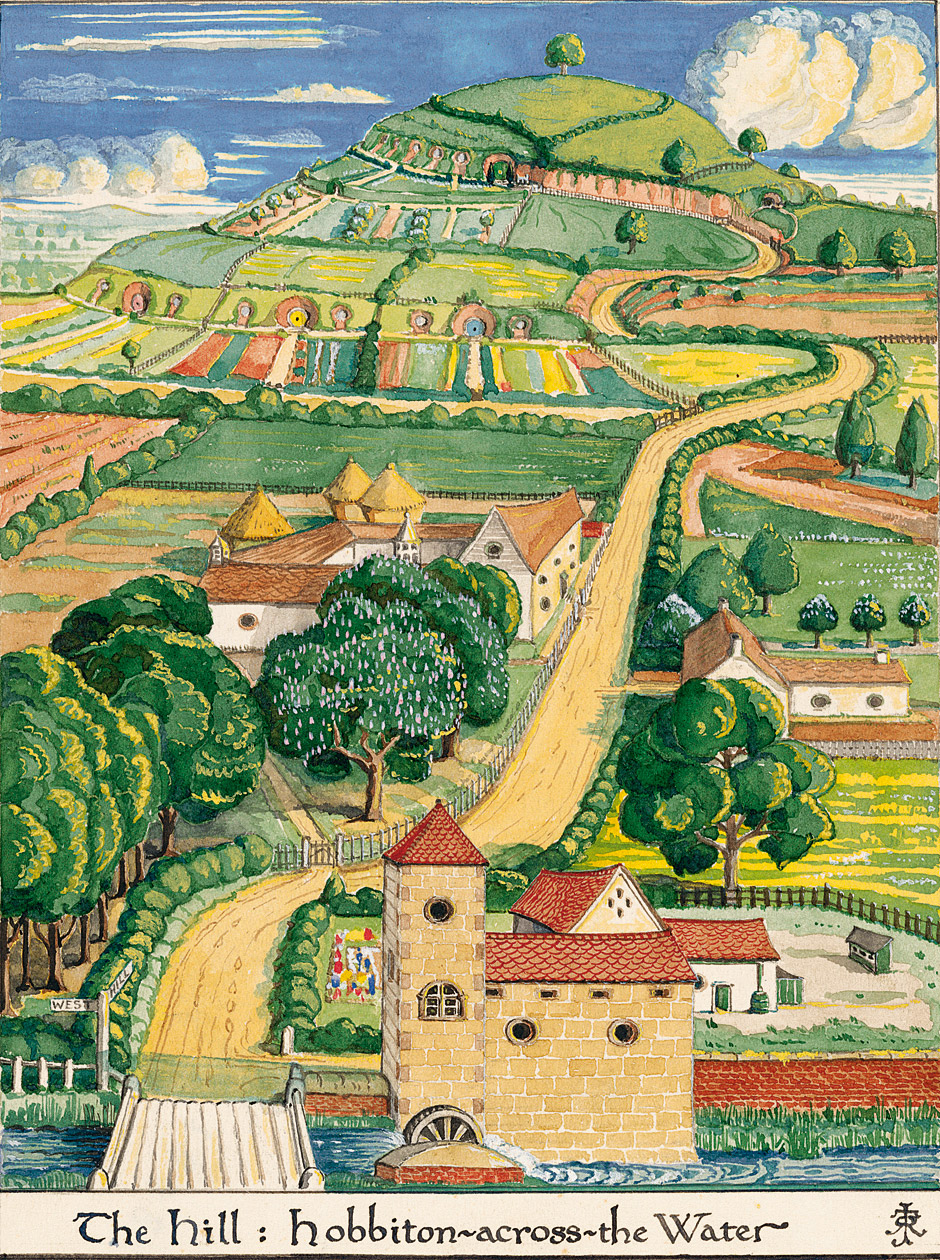
Anyone who has read J.R.R. Tolkien knows that he has a particular style to his writings, both in the quality of the words he utilizes and in the order in which he places them. Every author has a style of writing particular to him or her; that of Tolkien is even more so, and those who have read it can detect it with ease. As it is with Tolkien's writing, so it is with Tolkien's art.

Reading the multi-volume work of Christopher Tolkien, The History of Middle-earth, one gains great insight into the mind of the professor and the world of which he is the sub-creator. Simply learning the way in which Tolkien both discovered and told the story of the Ring of Power is fascinating in itself. Reading the various modifications to the story is especially helpful in understanding this development.
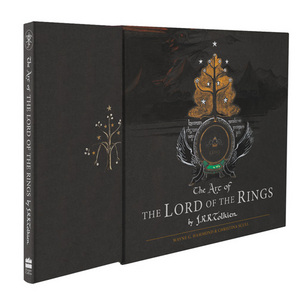
Looking at Tolkien's art can also help us in this understanding because, as Wayne G. Hammond and Christina Scull write in the Introduction to their recently released book, The Art of The Lord of the Rings by J.R.R. Tolkien (London: HarperCollinsPublishers, 2015), behind Tolkien's words "were the author's mental pictures, and some of these found expression first, or as well, in drawings - pictorial renderings, chiefly landscape or architecture, as well as maps, plans, and inscriptions" (10).

In this large and impressive volume which happily arrived today, Hammond and Scull "aimed to publish every illustration, map,  piece of formal calligraphy, and design Tolkien produced for his earlier book, and (with one possible exception) we appear to have succeeded," at least of those known to remain in existence (13). As loving and knowledgeable curators, they have presented the existent art of Tolkien in, more or less, the order in which it would accompany his life's work, with helpful explanatory notes, quotations from Tolkien's writings, and, of course, identifying captions. What is more, they
...have reproduced Tolkien's pictures as large as possible, but have no enlarged to excess, if at all, pictures which in the original are very small, so as to present them without distortion. In this same respect, we have shown sketches made within a manuscript in the context of the manuscript. Although we have aimed throughout for accuracy of colour, we have slightly darkened some sketches, the better to see faint pencil-work. There are natural variations in background tones - Tolkien used a variety of papers, from white to black, sometimes blank pages or parts of pages of student examination scripts. All of the reproductions in this book have been made from the original art, with only a few exceptions as noted, chiefly where the original art no longer exists (14).
This volume is a fitting way to celebrate the sixtieth anniversary of the publication of The Return of the King and is sure to delight anyone who, like Tolkien, is a hobbit in all but size. It will be a good aid to conversation sitting on the coffee table to be admired and will also be perfect to curl up with on the couch on a quiet evening again and again.

02 September 2011

Pope: Art can assist us in prayer and convert our hearts

During his General Audience Address this past Wednesday, the Holy Father Pope Benedict XVI spoke of beauty as a way to God.
The text of his address follows, with my emphases:
Dear brothers and sisters,

On several occasions in recent months, I have recalled the need for every Christian to find time for God, for prayer, amidst our many daily activities.The Lord himself offers us many opportunities to remember Him. Today, I would like to consider briefly one of these channels that can lead us to God and also be helpful in our encounter with Him: It is the way of artistic expression, part of that "via pulchritudinis" -- "way of beauty" -- which I have spoken about on many occasions, and which modern man should recover in its most profound meaning.

Perhaps it has happened to you at one time or another -- before a sculpture, a painting, a few verses of poetry or a piece of music -- to have experienced deep emotion, a sense of joy, to have perceived clearly, that is, that before you there stood not only matter -- a piece of marble or bronze, a painted canvas, an ensemble of letters or a combination of sounds -- but something far greater, something that "speaks," something capable of touching the heart, of communicating a message, of elevating the soul.

A work of art is the fruit of the creative capacity of the human person who stands in wonder before the visible reality, who seeks to discover the depths of its meaning and to communicate it through the language of forms, colors and sounds. Art is capable of expressing, and of making visible, man's need to go beyond what he sees; it reveals his thirst and his search for the infinite. Indeed, it is like a door opened to the infinite, [opened] to a beauty and a truth beyond the every day. And a work of art can open the eyes of the mind and heart, urging us upward.

But there are artistic expressions that are true roads to God, the supreme Beauty -- indeed, they are a help [to us] in growing in our relationship with Him in prayer. We are referring to works of art that are born of faith, and that express the faith. We see an example of this whenever we visit a Gothic cathedral: We are ravished by the vertical lines that reach heavenward and draw our gaze and our spirit upward, while at the same time, we feel small and yet yearn to be filled. … Or when we enter a Romanesque church: We are invited quite naturally to recollection and prayer. We perceive that hidden within these splendid edifices is the faith of generations. Or again, when we listen to a piece of sacred music that makes the chords of our heart resound, our soul expands and is helped in turning to God. I remember a concert performance of the music of Johann Sebastian Bach -- in Munich in Bavaria -- conducted by Leonard Bernstein. At the conclusion of the final selection, one of the Cantate, I felt -- not through reasoning, but in the depths of my heart -- that what I had just heard had spoken truth to me, truth about the supreme composer, and it moved me to give thanks to God. Seated next to me was the Lutheran bishop of Munich. I spontaneously said to him: "Whoever has listened to this understands that faith is true" -- and the beauty that irresistibly expresses the presence of God's truth.
But how many times, paintings or frescos also, which are the fruit of the artist's faith -- in their forms, in their colors, and in their light -- move us to turn our thoughts to God, and increase our desire to draw from the Fount of all beauty. The words of the great artist, Marc Chagall, remain profoundly true -- that for centuries, painters dipped their brushes in that colored alphabet, which is the Bible.

How many times, then, can artistic expression be for us an occasion that reminds us of God, that assists us in our prayer or even in the conversion of our heart! In 1886, the famous French poet, playwright and diplomat Paul Claudel entered the Basilica of Notre Dame in Paris and there felt the presence of God precisely in listening to the singing of the Magnificat during the Christmas Mass. He had not entered the church for reasons of faith; indeed, he entered looking for arguments against Christianity, but instead the grace of God changed his heart.

Dear friends, I invite you to rediscover the importance of this way for prayer, for our living relationship with God. Cities and countries throughout the world house treasures of art that express the faith and call us to a relationship with God. Therefore, may our visits to places of art be not only an occasion for cultural enrichment -- also this -- but may they become, above all, a moment of grace that moves us to strengthen our bond and our conversation with the Lord, [that moves us] to stop and contemplate -- in passing from the simple external reality to the deeper reality expressed -- the ray of beauty that strikes us, that "wounds" us in the intimate recesses of our heart and invites us to ascend to God.
I will end with a prayer from one of the Psalms, Psalm 27: "One thing have I asked of the Lord, that will I seek after; that I may dwell in the house of the Lord all the days of my life, to behold the beauty of the Lord, and to inquire in his temple" (Verse 4). Let us hope that the Lord will help us to contemplate His beauty, both in nature as well as in works of art, so that we might be touched by the light of His face, and so also be light for our neighbor. Thank you.
Translation via Zenit.

14 December 2010

A reason for beauty

The ever hilarious and often insightful Crescat gives us a simple and profound reason why the Church likes beauty in her buildings, in her music and in her art:

I like pretty. Pretty makes me happy. I lack the discipline of the Carthusians... I need to be surrounded by all the pretty the Church has to offer. It keeps me sane. It keeps me in love.
May the beauty of the Church's arts keep each of us in love.

31 August 2008

Eureka!

That is, I've found it!

One of my favorite artists is the Englishman Sir Edward Burne Jones, one of the Pre-Raphaelite artists. He worked with tapestries, paintings, mosaics and even stained glass. I especially admire his work relating to the legends of King Arthur.

Here is his Annunciation:
When Edward Clifford went to Moloka’i to visit Father Damien in, I believe, 1888, he brought with him “a water-color painting of the Vision of St. Francis, by Mr. Burne Jones, sent by the painter.”

It took quite a bit of googling but I've finally managed to find a copy of it at the quotes page at the shrine and museum of Blessed Marianne Cope. I presume the painting is now located there.

Here it is: