Showing posts with label prayer. Show all posts

16 February 2016

Archbishop Lori's Prayer for Persecuted Christians

The Knights of Columbus are doing a great deal to come to the aid of our persecuted brothers and sisters in the Middle East, particularly through their Christians at Risk campaign.

On their Instagram account, the Knights of Columbus shared a Prayer for Persecuted Christians written by their Supreme Chaplain, His Excellency the Most Reverend William E. Lori, Archbishop of Baltimore, which you might consider making use of during these Lenten days:
O God of all the nations,
the One God who is and was and always will be,
in your providence you you willed that your Church
be united the suffering of your Son.
 
Look with mercy on your servants
who are persecuted for their faith in you.
Grant them perseverance and courage
to be worthy imitators of Christ.
 
Bring your wisdom upon leaders of nations
to work for peace among all peoples.
 
May your Spirit open conversion
for those who contradict your will,
that we may live in harmony.
 
Give us the grace to be united in truth and freedom,
and to always seek your will in our lives.
 
Through Christ our Lord. Amen.

08 March 2015

We should stop lying to God

In matters of prayer we are only too apt to deceive ourselves because, generally speaking, man does not enjoy praying. He easily experiences boredom, embarrassment, unwillingness, or even hostility. Everything else appears to him more attractive and more important. He persuades himself that he has not got the time, that there are other more urgent things to do; but no sooner has he given up prayer than he applies himself to the most trivial of tasks. We should stop lying to God. Better to say openly, "I do not wish to pray," than to make such excuses. Better not to resort to specious justifications such as, for instance, tiredness, but to declare, "I do not feel like praying." This may sound less decorous, but at least it is the truth which leaves the way open, whereas self-deception does not.

- Romano Guardini

05 February 2015

One hour of prayer is worth more than the whole world

King David in prayer
With the holy season of Lent now fast approaching (Ash Wednesday is February 18th), we would each do well to give some serious and prayerful consideration to what particular and personal penance(s) we might take up during the penitential days. These penances typically involve an in increase of prayer, fasting, and alms-giving.

Increasing our fasting by decreasing the amount of food we eat is not - for most of us - a tremendously difficult task (even if our stomachs do not agree), nor is increasing the amount of money we give to worthy charitable causes and even to the poor directly. Increasing the time we spend in prayer each day, however, can prove a great challenge, particularly because we are tempted to wonder if our prayer does any good at all.

As if in answer to this concern, Saint Bonaventure wrote these words to the Abbess of the Poor Clares in Longchamps, France in 1259:
Devout prayer has such power that a person can profit from it in all things and at all times: in winter and in summer, in tranquil and rainy times, night and day, on feast days and on ordinary days, in sickness and in health, when young and old, standing, sitting and walking, in the choir and outside the choir [by which he meant the Divine Office]. What is more, sometimes one hour of prayer is worth more than the whole world, because by a brief devout prayer a person gains the kingdom of heaven (On the Perfection of Life, V.1).
If we consider the way in which the Seraphic Doctor expresses the power in all things and at all times, we can see that it resembles in some way the exchange of consent between a husband and his bride. Indeed, this is only fitting because the Church is the Bride of Christ the Bridegroom, and the members of the Church are members of the Bride.

Aside from the question of whether or not our prayers profit us or others, another stumbling block to increasing the amount of time we spend in prayer is not knowing quite what "to do" in prayer.  Again, as if in answer to this concern, Saint Bonaventure suggests three necessary things to arrive at perfect prayer.

The first, he says, "is that when you are prepared to pray, then standing erect with an upright heart and shutting down all your senses, you must noiselessly reflect from a heart bitter and contrite about all of your miseries [sins], present, past and future" (V, 2).

It might seem strange to speak of being "prepared to pray," but preparing to pray is essential. Some things of greater or lesser importance might well distract from our prayer. Such things might be anything from a stack of bills needing to be sent off today, the laundry that needs to go into the drier, the worksheet that needs to be completed before the next class, or even putting gas in the car.

None of this is to say that prayer should be put off until our tasks and chores are complete; rather, it is a matter of knowing ourselves. Will I pray better without the stack of bills waiting for me? If the answer is yes, then pay them first and then go to pray - prepared. Do I pray better in the morning or in the afternoon or in the evening? Other questions might also prudently be considered.

Before a priest offers the Holy Mass, he prepares himself; he prepares himself to pray. He washes his hands. He quiets his thoughts and offers a prayer to celebrate worthily. He puts on the sacred vestments, often praying while doing so. In an analogous way, we, too, should prepare ourselves for a daily prayer.

The second thing needed to arrive at perfect prayer, he says, is to "be grateful, namely for all the benefits already received and those yet to be received" (V, 3). Too often do we go to prayer with a list of requests - and sometimes even demands - to make of the Lord without first humbly giving him thanks.

Finally, the third necessary thing "is that there be nothing else in your mind except what you are praying for" (V, 4). If someone comes to us in a distracted fashion and makes a request of us, we tend not to give much thought to it because - if the person is so distracted - how important can the request be? To be single-minded in the service of God is key.

To be sure, following these three steps in prayer will move us toward perfect prayer, but it will not likely put us their instantly. Prayer is fundamentally about a relationship with the Lord and these three steps will help keep us focused on that relationship so that, in time, we can come to spend even an hour in prayer without feeling forced.

14 May 2014

Sometimes it seems a book chooses you, rather than you it

This past weekend I returned to my beloved city of Assisi to join in the celebrations of Calendimaggio 2014, a medieval festival for which the City of Peace is known, in which the upper part of the city competes against the lower part of the city (I'll have a separate post on this later today or tomorrow).

As I was leaving the city late yesterday afternoon, I stopped in one of the local shops to have a look around and stayed much longer than I expected talking with the shopkeeper and arrived at the train station after my intended train departed. Since I had almost another two hours before the next train left for Rome, I took a little walk to visit the International Franciscan Bookstore in the piazza of the Basilica of St. Mary of the Angels build over the Portiuncula which has a very good selection of English books.

Browsing through the offerings, I told myself that I had enough "books to be read" sitting on my shelves as it was and that I did not need another book at this book. Still, as I was about to leave the store for a bite to eat as I awaited the train, the cover of one small little book caught my attention that I had earlier overlooked.

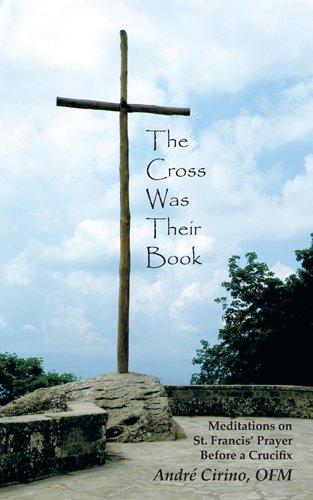
The cover of The Cross Was Their Book: Meditations on St. Francis' Prayer Before a Crucifix, by André Cirino, O.F.M. (Phoenix, Arizona: Tau Publishing, 2009), shows a photograph of a simple cross that stands at Mt. LaVerna where Saint Francis of Assisi received the stigmata in the year 1224.


I visited the holy mountain when I attended Quincy University in, I believe, 1998 while on a Franciscan Pilgrimage Experience and have been longing to return every since. However, the mountain is, as it were, off the beaten path.

The image caught my attention because I think I took the same picture those many years ago and because this weekend I will meet a group of alumni pilgrims from Quincy University in Assisi to go with them to Mount LaVerna. Thinking it might be good to read it before my little pilgrimage (it is only 78 pages, including the end notes), I sat down to read it yesterday and was very much impressed with it. Before I return to the Diocese of Springfield in Illinois for a time this summer, I think I will use this book to make a private retreat in Assisi after I have taken my exams. You may find it helpful, as well.

In his introduction to the book, Father André explains the organization of the book:
This book centers on five themes found in this Prayer Before a Crucifix, namely, the themes of Light, Faith, Hope, Love and the Will of God. These themes animated Francis' prayer whenever he sat before a crucifix and they would have been for him a deep well from which to draw living water that nourished his meditation. So I have expanded each theme with one or more stories from the Franciscan sources which help illustrate the topic under consideration accompanied by my own reflection or meditation on each one (8).
Each of the five principle chapters concludes with suggested passages of Scripture to take to prayer and two questions for meditation.

Saint Francis' Prayer Before a Crucifix is one of my favorite prayers and I make use of it often. You might consider memorizing it, as well (it's very short):
Most high, glorious God,
enlighten the darkness of my heart
and give me right faith,
certain hope,
and perfect charity, sense and knowledge, Lord,
that I may do
Your holy and true command.
Amen.

29 January 2014

Why does prayer feel different in a church than in my room?

As I sat down this morning to catch up on the world through Facebook and Twitter, one of my former students asked a question of me.  He had just returned from a period of prayer in a nearby church and asked, "While I was there it was really weird feeling compared to like just praying in my room.  Why is that?"

I thought I understood what he meant, but, just to be sure, I asked what felt different about it.  He said, "Like someone was there with me when I was alone for the majority of the time."  He had just come from a Catholic church and was praying before the tabernacle.

He had not been alone, I answered, but was in the very presence of Jesus Christ, present in the tabernacle; the Lord was with him.  He had stumbled upon the great secret of life and found the means through which Jesus keeps his promise to be with us always; though a Catholic who prays, the reality of the Eucharist was revealed to him in those moments of prayer in a way it had not been before.  Have you had such an encounter with the Lord?

If often happens - regrettably - that we do not feel the Real Presence of the Lord at Sunday Mass.  There are often many distractions around us: friends and family, music and responses, children crying, people chatting and moving about, and even by a desire to participate as fully and consciously as possible.  None of these are bad in and of themselves but do sometimes lead us to miss the simply reality that we have come into God's presence; they can disturb the silence necessary to be aware of his presence.

To enter a Catholic church or chapel where the Blessed Sacrament is reserved at a more quiet time is quite another matter.  If we quiet ourselves and are still, we will slowly become aware of a certain stillness unlike any other.  There is a quiet peace and a subtle glory to it and, as my former student found, it can also be uncomfortable.  Why?

To be in the very presence of Christ makes us aware of our sins, of our failures to love, and of our need for his tender mercy.  Rather than acknowledge our sinfulness and confess our sins, we often would prefer to put our minds to something else and so we carry on about our day without spending much time in his presence (if we even visit him in the tabernacle outside of Sunday Mass).  This is a great tragedy.  If we do not wish to be in his presence in this life, would we want to be in his presence for eternity?

He gently calls us to himself, saying, "Come to me."  The uncomfortableness we might experience does not come from him, but from ourselves; it comes from our pride.  If we enter his presence with humility and allow ourselves to rest his stillness; if we allow ourselves to be vulnerable; if we yield and allow ourselves to be conquered by his love, then we will know a joy and a peace the world cannot give and does not even know.

This was the experience of Saint Damien of Moloka'i, who wrote of the Blessed Sacrament:

I find my consolation in the one and only companion who will never leave me, that is, our Divine Savior in the Holy Eucharist. . . .It is at the foot of the altar that we find the strength necessary in this isolation of ours. Without the Blessed Sacrament a position like mine would be unbearable. But, having Our Lord at my side, I continue always to be happy and content. . . . Jesus in the Blessed Sacrament is the most tender of friends with souls who seek to please Him. His goodness knows how to proportion itself to the smallest of His creatures as to the greatest of them. Be not afraid then in your solitary conversations, to tell Him of your miseries, your fears, your worries, of those who are dear to you, of your projects, and of your hopes. Do so with confidence and with an open heart.
Please, do not shy away from him!  Enter his presence with thanksgiving.  Bow down in humility and he will raise you up!


13 March 2012

When God is silent

Last week the Holy Father devoted his Wednesday General Audience address to silence within prayer.  He said, in part:
For in fact there exists not only our silence, which disposes us to listening to God’s Word; often in our prayer, we find ourselves before the silence of God; we experience a sense of abandonment; it seems to us that God is not listening and that He does not respond. But this silence of God - as Jesus also experienced - is not a sign of His absence. The Christian knows well that the Lord is present and that he is listening, even in the darkness of suffering, rejection and solitude. Jesus reassures the disciples and each one of us that God knows well our needs at every moment of life. He teaches the disciples: “In praying do not heap up empty phrases as the Gentiles do; for they think that they will be heard for their many words. Do not be like them, for your Father knows what you need before you ask Him” (Matthew 6:7-8): an attentive, silent, open heart is more important than many words [more, via Zenit].
These are powerful words for these Lenten days as we prepare for that day when the Word himself was silent.

At some point in the future, the official English translation will be available at the web site of the Holy See.

18 November 2011

Archbishop Carlson silence as key to youth ministry

Writing in his column in the St. Louis Review, the Most Reverend Robert J. Carlson, Archbishop of St. Louis describes silence as "a necessary condition for discernment and reflection, for meditation and prayer."

What is more, he proposes silence as the key to leading young people to a deeper and more intimate relationship with Jesus Christ:
If we want to reach out to members of the young Church and encourage them to welcome God's word in their lives, we need to help them discover what it means to be silent. If we want to foster vocations to ordained ministry, to consecrated life, to marriage and to the dedicated single life, we must help young men and women discover times and places where they can turn off the noise of modern life and tune in to the grand silence of God's holy peace.
To do so, he suggests we look to the example of St. Joseph.

03 September 2011

Prayer is like love in marriage

Every good book on prayer has something beneficial for both a beginner at prayer and one is long adept at it.  I've recently finished reading just such a book: Father Jerome Bertram's Jesus, Teach Us to Pray.
After considering why we pray in the first place, Father Bertam begins his reflections in the Upper Room as a way to understand the basis and the purpose of prayer.  From the Upper Room he offers his reflections about how and why we should talk with God and then why and how we should think about God.  The final chapters of the book are insightful considerations on the various lines of the Our Father.
Prayer, he says,
...is an opening of heart and soul and might to absorb the love of God, to allow Him to irratdiate us with His love, to soak into us so that we are saturated with a love that must overflow and radiate outwards towards those we meet.  In the process we will become aware of His overwhelming love for us, a love that builds us up, burns away all our defects, transforms us into precisely the sort of person we most want to be.  It is true, then, that prayer does enhance us, but only if we begin on the road of opening outwards towards love.  If our intention is our own gain, we shall succeed in gaining nothing.  If our intention is to turn outwards to God and neighbor, then we shal discover how much we have gained in the process, not less than everything.
In this, it is exactly like married human love, which is why that is the perfect parable for the love of God (Ephesians 5:32).  If our intention is simply to use a spouse as a means of enhancing our own life, we shall fail in misery.  If our whole delight is in the happiness of the spouse, we shall find that our own life has been transformed in love, we shall discover that we have everything we could possibly want.  Of course many of the things we thought we wanted turn out to be childish toys that we no longer care for, but once we are perfect in love, why then "You cannot now cherish a wish which ought not to be wish'd" (Newman, Dream of Gerontius).
How long does all this take?  At least one lifetime.  Indeed they are fortunate who complete it in this life, which is why for most of us the ultimate purging experience of the love of God comes after death.  But we can make a good start now.  What else is life for (17-18)?
Toward the end of the book, he offers these profound words:
Fortunately for us, there is a great difference between "being in love" and really loving.  The common disease of "being in love" can often lead to marriage, and family life, and fifty or more years of cooking and breadwinning and cleaning and nappy-changing and home-making, not without the occasional throwing of pots and pans and slamming of doors.  After fifty years a couple can be seen to be deeply and truly loving, grown into each other so that neither is complete without the other, but the sparkle and the superficial glitter of "being in love" has long ago given place to something altogether more lasting and deeper.  Few can experience "being in love with God" for very long, but we all can have a share, eventually, in the deep and transcendent love of God that cuts through all distractions, and overcomes all our stubborn reluctance to pray.  After fifty years or more of trying to pray, trying to keep the commandments, trying to listen to the word of God, there may not be the glamor and the glitter - there may never have been - but the real deep love of God is there in the heart.
Prayer is not about feelings of love, it is about being, truly and literally, in Love, living in Him in whom we have our being.  It occupies the whole of heart and might, and in an odd way, despite distractions, it can occupy the whole mind too.  Everything that flits through the mind in prayer, no matter how irrelevant or irreverent it may seem, can be caught up into our love of God.  Nothing is wasted.  Above all we should never let our feelings in prayer deter us from persevering in prayer, for God listens to our prayer even when we don't" (142-143).
I think that about covers it.  You should read this book.

27 August 2011

If prayer can't change God, what good is it?

Today being the memorial of Saint Monica, the mother of Saint Augustine, Father Erlenbush asks the question, "If prayer can't change God, what good is it?"  Looking to the example of Saint Monica, he finds his answer.  Go have a read.

05 June 2011

A Prayer for More Priests

Some time ago I composed a prayer asking the Lord for more priests through the intercession of the Servant of God Father Augustus Tolron.

His Excellency the Most Reverend Thomas John Paprocki, Bishop of Springfield in Illinois, has approved the prayer and it will soon be printed on holy cards to distribute throughout the Diocese.

The text of the prayer is as follows:
God our Father, you have found Father Augustus Tolton to be an obedient servant of Christ our eternal high priest and a faithful steward of the mysteries of God.


Father Tolton’s sharing in the Cross of our salvation led him to a life of long suffering in the face of prejudice and misunderstanding, which produced within him the fruits of a great joy and a humble love for you and for your people. His zeal for the priestly ministry shines brightly before us in this Diocese of Springfield in Illinois in which he served, illuminating for us the path to you.

Through his example and intercession, may many young men within this Diocese respond with generous and courageous love to your Son’s invitation to share in his priesthood so that each of your altars in this Diocese may be served by such a faithful priest as this Servant of God.

We ask this through Christ our Lord. Amen.
I thought today, on which we will soon celebrate in Quincy Father Tolton's priestly anniversary, a fitting day on which to share this prayer with you.

02 June 2011

Pope explains what's in a name and the importance of surrendering to God

At last week's general audience, the Holy Father Pope Benedict XVI continued his catecheses on prayer, reflecting on Jacob's wrestling with God.  The text of his address follows, with my emphases:
Dear Brothers and Sisters,

Today I would like to reflect with you on a text from the Book of Genesis which recounts a rather curious incident in the narrative of the Patriarch Jacob. It is a passage that is not easy to interpret, but it is important for our life of faith and prayer; we are talking about the story of his struggle with God at the ford of the Jabbok, a portion of which we just heard.

As you will recall, Jacob had deprived his twin brother Esau of his birthright in exchange for a dish of lentils and then, by trickery, managed to receive the blessing from his father Isaac, now very elderly, taking advantage of the latter’s blindness. Having fled from Esau’s wrath, he took refuge with one of his relatives, Laban; he married, acquired some wealth, and was returning to his homeland, ready to face his brother having first put into place some prudent provisions. However, when everything was ready for this meeting, after having had those who were with him cross the ford of the stream that marked the boundary of Esau’s territory, Jacob, who had remained behind alone, was suddenly set upon by an unknown man with whom he wrestled the whole night. This hand-to-hand combat, which we find described in chapter 32 of the Book of Genesis, became for him a singular experience of God.

Night is the favourable time for acting secretly, the best time, therefore, for Jacob to enter his brother’s territory unseen, perhaps thinking to take Esau by surprise. It is he, however, who is surprised by an unforeseen attack, one for which he was unprepared. Having used his cleverness to try to escape a dangerous situation, he thought he had managed to have everything under control; instead he now finds himself forced to enter a mysterious struggle that catches him alone and gives him no opportunity to organize a proper defence. Unarmed, in the night, the Patriarch Jacob wrestles with someone. The text does not specify the identity of the aggressor; it uses a Hebrew word that indicates “a man” in a generic sense, “one, someone”; it is, therefore, a vague, indeterminate definition that purposely keeps the assailant shrouded in mystery. It is dark, Jacob does not manage to see his opponent clearly, and even for the reader, for us, he remains anonymous; someone is opposing the Patriarch, and this is the only certain data supplied by the narrator. Only at the end, when the wrestling is over and that “someone” will have disappeared, only then will Jacob name him and be able to say that he had wrestled with God.

The episode, therefore, takes place in darkness and it is difficult to ascertain not only the identity of Jacob’s assailant, but also how the struggle is going. On reading the passage, it is rather difficult to determine which of the two contenders is gaining the upper hand; the verbs used often lack a specific subject, and the actions take place almost in a contradictory manner, so that when it looks as though one of the two is winning, the next action immediately denies that and shows the other to be the victor. At the beginning, in fact, Jacob seems to be the stronger and of his opponent, the text says, “he did not prevail over him” (v. 25); yet he strikes Jacob’s hip at its socket, dislocating it. Thus one thinks that Jacob would have to give in, but instead it is his opponent who asks him to release him; and the Patriarch refuses, setting one condition: “I will not let you go, unless you bless me” (v. 27). The one who tricked his brother and robbed him of the blessing of the firstborn now claims it from the stranger, thus perhaps beginning to perceive some kind of divine meaning, but without yet being able to recognize it for certain.

His rival, who seems to be held back and therefore defeated by Jacob, rather than giving in to the Patriarch’s request, asks him his name: “What is your name?”. And the Patriarch replies: “Jacob” (v. 28). Here the struggle takes an important turn. In fact, knowing someone’s name implies a kind of power over that person because in the biblical mentality the name contains the most profound reality of the individual, it reveals the person’s secret and destiny. Knowing one’s name therefore means knowing the truth about the other person and this allows one to dominate him. When, therefore, in answer to the unknown person’s request Jacob discloses his own name, he is placing himself in the hands of his opponent; it is a form of surrender, a total handing over of self to the other.

However, in this act of surrender paradoxically Jacob too emerges victorious because he receives a new name with the recognition of his victory by his adversary, who says to him: “You shall no longer be spoken of as Jacob, but as Israel, because you have contended with divine and human beings and have prevailed” (v. 29). “Jacob” was a name that recalled the Patriarch’s problematic beginnings; in Hebrew, in fact, it recalls the term “heel” and takes the reader back to the time of Jacob’s birth when, as he left his mother’s womb, he held onto the heel of his twin brother (cf. Gen 25:26), almost prefiguring the unfair advantage he would take over his brother in adulthood; however the name Jacob also recalls the verb “to deceive, to supplant”. Well, now, in the struggle in this act of surrender and submission, the Patriarch reveals his true identity as a deceiver, the one who supplants; however the other, who is God, transforms this negative reality into something positive: Jacob the deceiver becomes Israel, he is given a new name as a sign of a new identity. Here, too, the account maintains its deliberate duplicity because the more probable meaning of the name Israel is “God is strong, God is victorious”.

Therefore Jacob has prevailed, he won — his adversary himself says so — but his new identity, which he has received from the adversary himself, affirms and bears witness to God’s victory. And when Jacob in turn asks his opponent his name, the latter refuses to say it, but reveals himself in an unequivocal gesture, giving him the blessing. The blessing that the Patriarch had requested at the beginning of the struggle is now granted him. However, it is not a blessing obtained through deceit, but one given freely by God, which Jacob can receive because he is now alone, without protection, without cunning or tricks; he gives himself over unarmed, agrees to surrender and confesses the truth about himself. Therefore, at the end of the struggle, having received the blessing, the Patriarch can finally recognize the other, the God of blessings: Truly, he says, “I have seen God face to face, and yet my life is preserved” (v. 30), and now he can cross the ford, the bearer of a new name but “conquered” by God and marked forever, limping because of the injury he received (v. 31).

Biblical exegetes give many interpretations to this passage; the scholars in particular recognize in it literary connotations and components of various genres, as well as references to some popular accounts. But when these elements are taken up by the authors of the Sacred texts and incorporated into the biblical narrative, they change their meaning and the text opens up to broader dimensions. For the believer the episode of the struggle at the Jabbok thus becomes a paradigm in which the people of Israel speak of their own origins and outline the features of a particular relationship between God and humanity. Therefore, as is also affirmed in the Catechism of the Catholic Church, “from this account, the spiritual tradition of the Church has retained the symbol of prayer as a battle of faith and as the triumph of perseverance” (n. 2573). The Bible text speaks to us about a long night of seeking God, of the struggle to learn his name and see his face; it is the night of prayer that, with tenacity and perseverance, asks God for a blessing and a new name, a new reality that is the fruit of conversion and forgiveness.

For the believer Jacob’s night at the ford of the Jabbok thus becomes a reference point for understanding the relationship with God that finds in prayer its greatest expression. Prayer requires trust, nearness, almost a hand-to-hand contact that is symbolic not of a God who is an enemy, an adversary, but a Lord of blessing who always remains mysterious, who seems beyond reach. Therefore the author of the Sacred text uses the symbol of the struggle, which implies a strength of spirit, perseverance, tenacity in obtaining what is desired. And if the object of one’s desire is a relationship with God, his blessing and love, then the struggle cannot fail but ends in that self-giving to God, in recognition of one’s own weakness, which is overcome only by giving oneself over into God’s merciful hands.

Dear brothers and sisters, our entire lives are like this long night of struggle and prayer, spent in desiring and asking for God’s blessing, which cannot be grabbed or won through our own strength but must be received with humility from him as a gratuitous gift that ultimately allows us to recognize the Lord’s face. And when this happens, our entire reality changes; we receive a new name and God’s blessing. And, what is more: Jacob, who receives a new name, and becomes Israel, also gives a new name to the place where he wrestled with God, where he prayed; he renames it Penuel, which means: “The Face of God”. With this name he recognizes that this place is filled with the Lord’s presence, making that land sacred and thus leaving a memorial of that mysterious encounter with God. Whoever allows himself to be blessed by God, who abandons himself to God, who permits himself to be transformed by God, renders a blessing to the world. May the Lord help us to fight the good fight of the faith (cf. 1 Tim 6:12; 2 Tim 4:7) and to ask, in prayer, for his blessing, that he may renew us in the expectation of beholding his Face. Thank you.

05 May 2011

Pope begins school of prayer

Pope Benedict XVI began a new teaching series during his General Wednesday Audience yesterday focused on prayer.

The text of his address, via Zenit, follows, with my emphases:
Dear Brothers and Sisters,

Today I would like to begin a new series of catecheses. After the catecheses on fathers of the Church, on great theologians of the Middle Ages, on great women, I would now like to choose a subject that we all have very much at heart: It is the subject of prayer, specifically, Christian prayer, which is the prayer that Jesus taught us and that the Church continues to teach us. It is in Jesus, in fact, that man is made capable of approaching God with the depth and intimacy of the relationship of fatherhood and sonship. Together with the first disciples, we now turn with humble trust to the Master and ask: "Lord, teach us to pray" (Luke 11:1).

In the forthcoming catecheses, approaching sacred Scripture, the great tradition of the fathers of the Church, the teachers of spirituality, and the liturgy, we will learn to live yet more intensely our relationship with the Lord, as though in a "school of prayer." We know well, in fact, that prayer cannot be taken for granted: We must learn how to pray, almost as if acquiring this art anew; even those who are very advanced in the spiritual life always feel the need to enter the school of Jesus to learn to pray with authenticity.

We receive the first lesson from the Lord through his example. The Gospels describe to us Jesus in intimate and constant dialogue with the Father: It is a profound communion of the One who came into the world not to do his will but that of the Father who sent him for man's salvation.

In this first catechesis, by way of introduction, I would like to propose some examples of prayer present in ancient cultures, to reveal how, virtually always and everywhere, people have turned to God.

I begin with ancient Egypt, as an example. Here a blind man, asking the divinity to restore his sight, attests to something universally human, as is the pure and simple prayer of petition on the part of one who is suffering. This man prays: "My heart desires to see you ... You who made me see the darkness, create light for me, that I may see you! Bend over me your beloved face" (A. Barucq -- F. Daumas, Hymnes et prieres de l'Egypte ancienne, Paris, 1980, translated into Italian as Preghiere dell'umanita, Brescia, 1993, p. 30).

That I may see you; here is the heart of prayer!

Prevailing in the religions of Mesopotamia was a mysterious and paralyzing sense of guilt, though not deprived of the hope of rescue and liberation by God. Hence we can appreciate a supplication by a believer of those ancient cults, which sounds like this: "O God who are indulgent even in the most serious fault, absolve my sin ... Look, Lord, to your weary servant, and blow your breeze on him: Forgive him without delay. Alleviate your severe punishment. Free from the shackles, make me breathe again; break my chain, loosen my ties" (M. J. Seux, Hymnes et prieres aux Dieux de Babylone at d'Assyrie, Paris, 1976, translated into Italian in Preghiere dell'umanita, op. cit., p. 37).

These are expressions that show how, in his search for God, man intuited, though confusedly, on one hand his guilt and on the other, aspects of divine mercy and kindness.

At the heart of the pagan religion of ancient Greece we witness a very significant evolution: prayers, though continuing to invoke divine help to obtain heavenly favor in all circumstances of daily life and to obtain material benefits, are oriented progressively toward more selfless requests, which enable believing man to deepen his relationship with God and to become better. For example, the great philosopher Plato reported a prayer of his teacher, Socrates, who is justly regarded as one of the founders of Western thought. Socrates prayed thus: "Make me beautiful within. That I may hold as rich one who is wise and possess no more money than the wise man can take and carry. I do not ask for anything more" (Opere I. Fedro 279c, translated into Italian by P. Pucci, Bari, 1966).

Above all he wanted to be beautiful and wise within, and not rich in money. 
In the Greek tragedies -- those outstanding literary masterpieces of all time that still today, after 25 centuries, are read, meditated and performed -- there are prayers that express the desire to know God and to adore his majesty. One of these reads thus: "Support of the earth, who dwell above the earth, whoever you are, difficult to understand, Zeus, be the law of nature or of the thought of mortals, I turn to you: given that, proceeding by silent ways, you guide human affairs according to justice" (Euripide, Troiane, 884-886, translated into Italian by G. Mancini, in Preghiere dell'umanita, op. cit., p. 54).

God remains somewhat nebulous and yet man knows this unknown God and prays to him who guides the affairs of the earth.

Also with the Romans, who constituted that great Empire in which a large part of the origins of Christianity was born and spread, prayer -- though associated to a utilitarian conception fundamentally bound to the request for divine protection on the life of the civil community -- opens at times to admirable invocations because of the fervor of personal piety, which is transformed into praise and thanksgiving. Apuleius, an author of Roman Africa of the 2nd century after Christ, is a witness to this. In his writings he manifests contemporaries' dissatisfaction at comparing the traditional religion and the desire for a more authentic relationship with God. In his masterpiece, titled Metamorphosis, a believer addresses a feminine divinity with these words: "You, yes, are a saint, you are at all times savior of the human species, you, in your generosity, always give your help to mortals, you offer the poor in travail the gentle affection that a mother can have. Not a day or a night or an instant passes, no matter how brief it is, that you do not fill him with your benefits" (Apuleius of Madaura, Metamorphosis IX, 25, Translated into Italian by C. Annaratone, in Preghiere dell'umanita, op. cit., p. 79).

In the same period the emperor Marcus Aurelius -- who was as well a thoughtful philosopher of the human condition -- affirmed the need to pray to establish a fruitful cooperation between divine and human action. He wrote in his Memoirs: "Who has told you that the gods do not help us even in what depends on us? Begin then to pray to them and you will see" (Dictionnaire de Spiritualite XII/2, col. 2213). This advice of the philosopher-emperor was put into practice effectively by innumerable generations of men before Christ, thus demonstrating that human life without prayer, which opens our existence to the mystery of God, is deprived of meaning and reference. Expressed in every prayer, in fact, is the truth of the human creature, which on one hand experiences weakness and indigence, and because of this asks for help from heaven, and on the other is gifted with extraordinary dignity, as, preparing himself to receive divine Revelation, he discovers himself capable of entering into communion with God.

Dear friends, emerging from these examples of prayer from various periods and civilizations is the human awareness of his condition as a creature and his dependence on Another superior to him and the source of every good. The man of all times prays because he cannot fail to ask himself what is the meaning of his existence, which remains dark and discomforting, if he is not placed in relationship with the mystery of God and of his plan for the world. Human life is an interlacing of good and evil, of unmerited suffering and of joy and beauty, which spontaneously and irresistibly drives us to pray to God for that interior light and strength which aid us on earth and reveal a hope that goes beyond the boundaries of death. The pagan religions remain an invocation that from the earth awaits a word from Heaven. Proclus of Constantinople, one of the last great pagan philosophers, who lived already at the height of the Christian age, gave voice to this expectation, saying: "Unknowable, no one contains you. Everything that we think belongs to you. Our ills and goods are from you, every breath depends on you, O Ineffable One, may our souls feel you present, raising a hymn of silence to you" (Hymn,ed. E. Vogt, Wiesbaden, 1957, in Preghiere dell'umanita, op. cit., p. 61).

In the examples of prayer from the various cultures that we considered, we can see a testimony of the religious dimension and of the desire for God inscribed in the heart of every man, which receive fulfillment and full expression in the Old and New Testaments. Revelation, in fact, purifies and leads to fullness man's original longing for God, offering him, with prayer, the possibility of a more profound relationship with the heavenly Father.

At the beginning of this journey of ours in the "school of prayer" we now wish to ask the Lord to illumine our minds and hearts so that our relationship with him in prayer is ever more intense, affectionate and constant. Once again, let us say to him: "Lord, teach us to pray" (Luke 11:1).

08 March 2011

Paprocki: If we are not generous, our selfishness will lead to bitterness and resentment

The Most Reverend Thomas John Paprocki reflected in his weekly column in the Catholic Times on the importance and value of Lenten disciplines of increased prayer, fasting and alms-giving.

His text follows, with my emphases:
My dear brothers and sisters in Christ,

Ash Wednesday falls on March 9 this year, marking the beginning of the season of Lent. In the Gospel for Ash Wednesday, Jesus reminds us that prayer, fasting and almsgiving are three key ways for us to make the most of this sacred season.

Prayer, of course, is something that people of faith should do every day, not just during Lent. Prayer is our conversation with God, and such conversation is not relegated or limited to certain times of year. For example, the Liturgy of the Hours, also known as the Divine Office or Breviary, is a form of prayer used by priests, deacons, nuns and some lay people to mark the rhythms of each day. Morning prayer, daytime prayer, evening prayer and night prayer keep us and our activities connected to God during the different times of day.

Just as each day has different times, there are different seasons during the course of the year. The church also observes these seasons in her liturgical calendar, with special prayers for Advent, Christmas, Lent and Easter. The rest of the year we call Ordinary Time, not because it is ordinary in the sense of being plain or routine, but because it marks the orderly progression of time from one week to the next.

Many parishes offer not only increased opportunities for prayer during Lent, but also different forms of prayer such as a Lenten mission and the Stations of the Cross.

Regarding fasting during Lent, many people fast with the hope that they will lose weight, especially the extra pounds accumulated during the Christmas season. There is nothing wrong with such a goal, as God wants us not only to avoid the sin of gluttony, but also to look out for our health. I believe that the old maxim, “a sound mind in a sound body” is a worthwhile objective, and I try to live by it.

But ultimately our Lenten fasts are not merely weight reduction programs designed to reduce corpulent figures, but a means for helping us stay connected to God. When we are hungry and thirsty, we are reminded that the deepest hungers and thirsts of our hearts are satisfied only by God. When we become aware of our longings and desires, we are reminded that the deepest longing and desire we can have is to be connected in a close and loving relationship with God. When we are tempted to become attached to a life of conspicuous consumption of rich foods, exotic drinks, expensive cars, luxurious homes, fashionable clothes, gaudy jewelry and sexual pleasure, we are reminded that the only attachment of our hearts that matters when all is said and done is for our hearts to be attached to God.

Fasting during Lent can also be an opportunity not just to limit our own consumption, but also become more mindful of those who lack the basic necessities of life. Operation Rice Bowl is one such way of helping the hungry.

St. Paul wrote that athletes deny themselves all kinds of things in order to win a perishable crown, but Christians deny themselves in order to win a crown that will never wither or fade, namely, life eternal in God’s heavenly kingdom.

Regarding almsgiving, the Catechism of the Catholic Church (par. 2462), says, “Giving alms to the poor is a witness to fraternal charity: it is also a work of justice pleasing to God.” A person usually does not have to look very far to find opportunities to help the poor. Often our daily mail delivers scores of solicitations from charitable organizations, many of them quite worthy, who perform a variety of benevolent works. Sometimes we encounter beggars or homeless people on the street. There are various approaches that we can take in response. Some people are willing to give a small amount of cash to strangers they meet. Others will give them coupons for food that they can use at local restaurants or grocery stores. Another approach is to refer these people to responsible social service agencies, such as Catholic Charities.

Perhaps the most commonplace for our charitable giving is the collection basket at Mass. In this case our donations are more than just charity, they are obligations required by the fifth precept of the church, “You shall help to provide for the needs of the church.” This means that the faithful are obliged to assist with the material needs of the church, each according to his own ability (Catechism of the Catholic Church, par. 2043). This “ability” will vary from person to person, of course, so I would like to offer a suggestion that I had made when I was pastor of a parish: each person’s first hour of work should be dedicated to God, meaning that you should give your first hour’s pay each week as a donation to the church. In this way, the dollar amount will depend on how much you are paid, but the time dedicated to earning that pay (one hour) will be the same for each person.

Remember the story of Cain and Abel in the Bible? Abel brought an offering to God from the firstlings of his flock, while Cain’s offering was not so generous. The Bible tells us that the Lord looked with favor on Abel and his offering, but did not look favorably on Cain or his offering. Cain resented this, and the bitterness of his resentment led Cain to kill his brother Abel. (See Genesis 4: 3-8.) If we are generous with God, he will reward us. If we are not generous, our selfishness will lead to bitterness and resentment.

Through prayer, fasting and almsgiving during this upcoming Lenten season, with God’s grace we can overcome our self-centeredness and become more focused on God, leading us further on the path to holiness.
May God give us this grace. Amen.

29 November 2010

A minor friar: Prayer is the Lord's Nativity in us

A Minor Friar has this to say about this season of Advent (with my emphases):

On a deeper level, though, I find Advent to be among the most mystical times in the year. It is a time for us who stand in between. On the one hand we celebrate as we recall with joy the first coming of Christ, a coming that was humble, and, as we sometimes forget, secret. On the other hand, we look forward with wonder to the second coming of Christ in full and public glory, when he will bring the whole creation to its final destiny.

What's mystical to me about the season is the way in which it seems to emphasize the two comings of Christ in the reverse of their logical and temporal order: The liturgy of the early days, especially the first Sunday, focuses us on the end times, but as we go forward, and certainly by the time we arrive at the 'pre-octave' of the Nativity on December 17, we are fully into a celebration of the first coming of Christ.

We begin at the end times and proceed backwards to the dawn of our salvation in the Nativity of the Lord. We then notice how our own lives are moving in the course of a return from this recollection: the secret intimacies of grace and prayer in our own lives, in which the presence of Christ is conceived and carried in our own hearts, are moving toward a full and public harvest in the communion of the saints in heaven. Christ's movement from his conception by the Virgin to his ministry and passion and final glorification is also the journey of each Christian soul con-formed to Christ by Baptism, Confirmation, and Eucharist. Each secret and humble moment of prayer we experience in this life is destined for the final joy of heaven. Prayer is the Lord's Nativity in us, and it will become our Resurrection in Him as well.

07 November 2010

For whom shall we pray?

It is always good to spend at least some time on Sunday - the Day of the Lord - in prayer and sometimes it may happen that you are uncertain for whom you should pray.

A Minor Friar offers the answer to the dilemma today with this prayer suggestion from the Seraphic Doctor, Saint Bonaventure:

Propose to pray for the Pope, the cardinals, patriarchs, archbishops, bishops, doctors, rectors, priests, clerics, monks, religious, monasteries and all of Christ’s servants; for kings, generals, princes and all the nobility; for virgins, widows, orphans, pilgrims, prisoners, the afflicted, the crippled, the sick and for all the people of God; also for the pagans, schismatics and heretics, that they may return to the true God and to the unity of the holy Church.
That should about cover everyone.

10 April 2010

KCs announce novena for Pope

The Supreme Council of the Knights of Columbus is calling its members to join in prayer for Pope Benedict XVI "and his pastoral mission leading the Church, that the Holy Father may be strengthened and uplifted at this time of considerable challenge."

The novena begins Sunday and goes through April 19th, the fifth anniversary of the Holy Father's election to the See of Peter.

The Supreme Council has made printable cards available with the following prayer:


Lord,source of eternal life and truth, give to your shepherd, Benedict, a spirit of courage and right judgment, a spirit of knowledge and love. By governing with fidelity those entrusted to his care, may he, as successor to the Apostle Peter and Vicar of Christ, build your Church into a sacrament of unity, love and peace for all the world. Amen.

V/ Let us pray for Benedict, the pope.
R/ May the Lord preserve him, give him a long life, make him blessed upon the earth, and not hand him over to the power of his enemies.
V/ May your hand be upon your holy servant.
R/ And upon your son, whom you have anointed.

Our Father… Hail Mary… Glory Be…