Showing posts with label humor. Show all posts

12 October 2013

Worshipping Animals, or Man at Play

The Scriptures frequently summon all of creation to give praise to God and for our purposes this morning one selection, the final verse of the Psalms, will be sufficient:
Let everything that breathes praise the LORD! Praise the LORD (Psalm 150:6)!
We know that the highest form of praise which the Church can offer to God is the Holy Mass in which the sacrificial love of Christ Jesus is re-presented to the Father. Indeed, the Eucharist "is the culmination both of God’s action sanctifying the world in Christ and of the worship men offer to Christ and through him to the Father in the Holy Spirit" (Eucharisticum mysterium, 6, emphasis mine, quoted in the Catechism of the Catholic Church, 1325).

This being the case, we don't often think of the animals participating at the Mass, though sometimes the medievals did, even if only as a bit of fun.

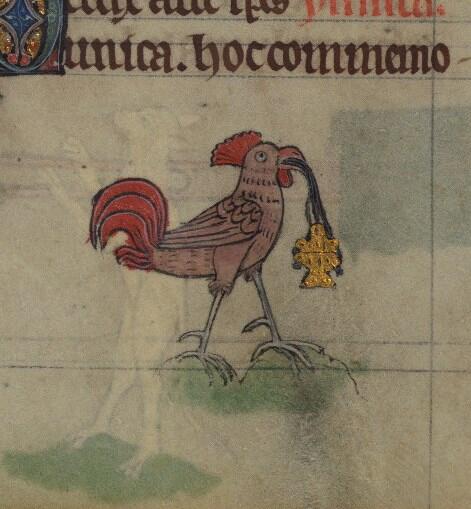
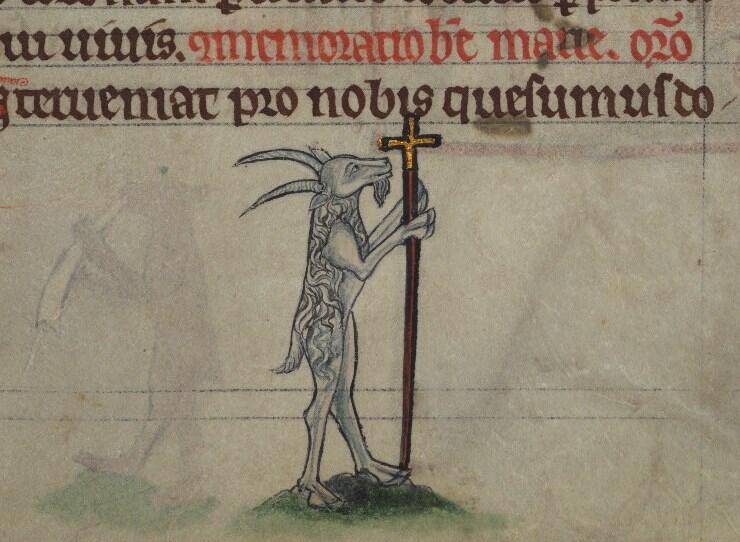
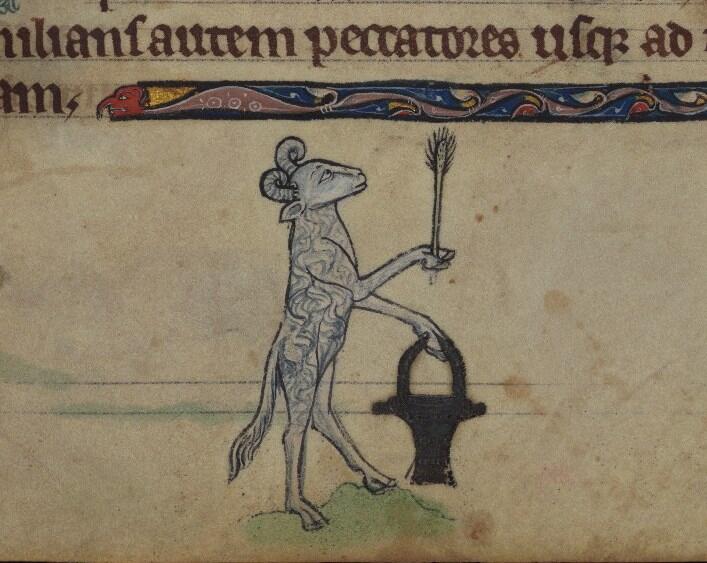
I mention all of this simply because Damien Kempf has been sharing such images (from Walter MS 102, from A.D. 1300) on his Twitter feed which greatly amuse me, as I hope they will you:
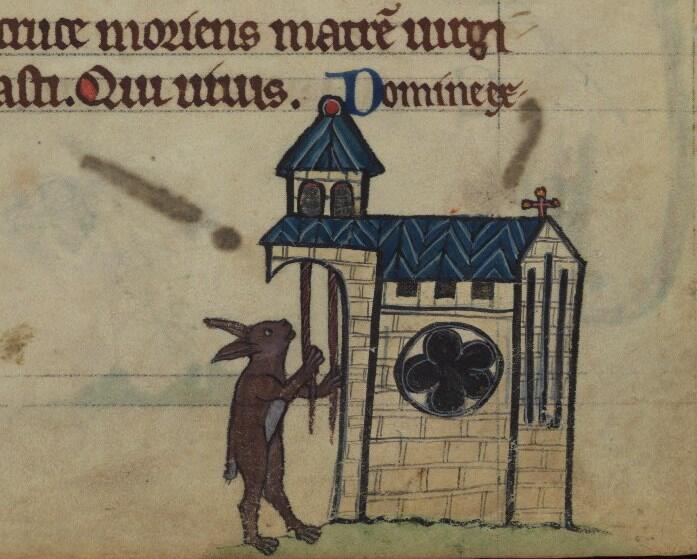
A rabbit calls creation to worship with the tolling of bells.
A rooster with the thurible (the incense), though someone needs to teach him how to make it smoke.
A goat with the processional cross (which should now be a crucifix).
A ram ready for the sprinkling rite.
These images demonstrate a quality of the Middle Ages that I have always found endearing: there is a light-heartedness to them that shows the medievals often did not take themselves too seriously.  They remind me of the notion of the homo ludens, the "playing man" or the "grave-merry man".

Plato said that "fun and gravity [seriousness] are sisters" (Epistulae, 6) and in the Book of Sirach we read, "Leave in good time and do not be the last; go home quickly and do not linger.  Amuse yourself there, and do what you have in mind, but do not sin through proud speech" (Sirach 32:11-12).  In our more enlightened days in which we take ourselves far too seriously, we often forget these words.  Even Saint Thomas Aquinas kept these words in mind when he wrote, "Therefore, unmitigated seriousness betokens a lack of virtue because it wholly despises play, which is a necessary for a good human life as rest is" (Eth. ad Nic., IV, 16, 854).

This concept of the man at play is masterfully explored in Hugo Rahner's, S.J., excellent book simply titled Man at Play (New York: Herder and Herder, 1967).  In it, he describes the homo ludens as:
a man with an easy gaeity of spirit, one might almost say a man of spiritual elegance, a man who feels himself to be living in invincible security; but he is also a man of tragedy, a man of laughter and tears, a man, indeed, of gentle irony, for he sees through the tragically ridiculous masks of the game of life and has taken the measure of the cramping boundaries of our earthly existence.
And so, only one who can fuse these two contradictory elements into a spiritual unity is indeed a man who truly plays.  If he is only the first of these two things, we must write him down as a frivolous person who has, precisely, played himself out.  If he is only the second, then we must account him as one who cannot conquer despair.  It is the synthesis of the two things that makes the Homo ludens, the "grave-merry" man, the man with a gentle sense of humour who laughs despite his tears, and finds in all earthly mirth a sediment of insufficiency.  This grave-merriness - the wonderful "humour" has been worn so threadbare, has indeed been so grossly misused - is something suspended between heaven and earth (27-28).
In our time, we tend between one or the other extreme, a boor or a buffoon; only rarely do you find the two intermingled and when you do, you often find a saint (or at least a saint in the making).

Rahner sums up his description of the man at play thusly:
The man who truly plays is, therefore, first of all, a man in whom seriousness and gaiety are mingled; and, indeed, at the bottom of all play lies a tremendous secret.  We had some intimation of it, surely, when we were considering the creative play of God.  All play - just as much as every task we set ourselves to master with real earnestness of purpose - is an attempt to approximate to the Creator, who performs his work with the divine seriousness which its meaning and purpose demand, and yet with the spontaneity and effortless skill of the great artist he is, creating because he wills to create and not because he must (28).
It should be obvious that the playing of man is not simply about entertainment but is also of tremendous spiritual importance.  So it as the Saint Gall wrote, "Lo, under the gentle / vine, O Christ / the whole Church / plays in peace" and the great Romano Guardini wrote of the Mass wrote of the liturgy as a divine game.  Saint Bede the Venerable recognized this centuries before when he preached that "to the eyes of the beholder the person appears to come out of the baptismal font the same as he went in, and all that is done seems no more than a piece of play" (Homiliae, II, 12).


This is indeed true; it is a game, but as we normally think of games.  In one of his hymns on the Cross, Saint Bede sang, "It is as play for the faithful / to enjoy thy embraces / for thou begettest such great joys / and openst the gates of heaven" (Hymni, 13).

Deep within our hearts is a desire to be always at play.  As one example of this, simply consider the refusal of the modern world to grow old, the makeup and hair dyes, the face lifts and surgeries all performed to give the appearance of youth, however false.

The religious man, like all men,
hopes for freedom, rest, release from all the preoccupations of mind, for untroubled gladness of soul; he longs to be once more like a child, a child in utter security, and, like a child, to play; he hopes, in a word, for that complete heartsease that will allow even his body, freed now from the burden of its earthly life, to move and sway to the measures of a heavenly dance (60).
Because in the Liturgy, and especially in the Eucharist, we are united with the heavenly Liturgy, worship and praise is the man at play truly plays (CCC, 1326).

So it is that Rahner can say,
Man redeemed has one more become a child, even as he was at the time of his earthly birth and of his begetting out of the Church's primal sacrament [Baptism].  A child once more, he plays....
The child in man desires to play - and the final answer to that longing, the answer of truth to all our searchings, is the word of him who being himself the Word, became a little child: "Unless you become as little children, you shall not enter into the kingdom of heaven" (Matthew 18:3).  That is why the streets of the heavenly city will be full of playing children and the Ancient of Days, whose face is forever young, will never cease to say to men: "Ite et ludite" [Go and play] (63-64).

14 December 2011

Vader, did you know?

It's going to be a gloomy day here in the Diocese, with rain and fog, high winds and falling temperatures tomorrow.  As such, here's a little something to cheer you up:


Capello tip to The Anchoress.

10 October 2011

The perfect priest?

A recent survey shows that 90% of priests describe themselves as happy, compared with just under 50% of "normal" people.

Priests are happy - moreso than others - despite the unrealistic expectations many people put upon them, summarized by this humorous - and somewhat true - caricature of the perfect priest:
The results of a computerized survey indicate the perfect priest preaches exactly fifteen minutes. He condemns sins but never upsets anyone. He works from 8:00 AM until midnight and is also a janitor. He makes $50 a week, wears good clothes, buys good books, drives a good car, and gives about $50 weekly to the poor. He is 28 years old and has preached 30 years. He has a burning desire to work with teenagers and spends all of his time with senior citizens.


The perfect priest smiles all the time with a straight face because he has a sense of humor that keeps him seriously dedicated to his work. He makes 15 calls daily on parish families, shut-ins and the hospitalized, and is always in his office when needed.
Capello tip to Father Z.

28 April 2011

Faith and humor

Father Dwight Longenecker has a good post in which he reflects on faith and humor.  He also mentions the legend of medieval juggler who wanted to give a gift to God but didn't know what he could give.  Go read the post.

And then go find the story of The Clown of God, beautifully illustrated and told by the master of children's books, Tomie dePaola.

07 February 2010

Is wine good for the soul?

Drink wine, and you will sleep well.
Sleep, and you will not sin.
Avoid sin, and you will be saved.
Ergo, drink wine and be saved.

According to the above Medieval German proverb, it would seem so.

06 December 2009

19 May 2009

A very strange sight

After anointing an elderly gentlemen this afternoon - for whom I ask your prayers - I went to Decatur to join a few of the members of the track team who were participating in the Decatur Area Best (or something like that) meet.

Three of the boys rode home in my car and as we drove through Sullivan we stopped at the local Subway. One of the guys insisted on the drive-thru, causing I to find what may well be the strangest drive-thru in the United States.

If this is your typical fast food restaurant,

_____
--------
you would enter the drive-thru on the right of the building (as we see it), drive around the back and exist from the left of the building. Such a set-up allows the driver to both place the order and pay through the driver's window. Not so this Subway.
We realized the drive-thru was backward after I drove toward following the usual convention. After turning around, we entered the drive-thru from the left of the building and I placed our order through my window.
It wasn't until I began to pull forward that I thought, "Wait a minute. How am I going to pay?" You see, we'd already driven through that way.
On the right side of the building a sliding door was cut into the wall from which the cashier exited the building to collect our payment and pass our order through the passenger's window. It was weird, almost surreal.
The cashier admitted it was a bit backward. The drive-thru is also open in the winter; I hope they have several parkas in reserve!

23 April 2009

A little Catholic humor

State - and maybe federal - law requires the placement of signs in every classroom describing what actions should be taken in the event of a disaster.

For example, we have the following signs in the chapel at the high school:

EARTHQUAKE: Drop to the floor, seek shelter, cover your head

FIRE ESCAPE: Go up the north stairs, exit the building - walk to the track, stay with your teacher

TORNADO: Proceed to the north corridor, stand facing the wall
But also in the chapel is a sign that is found in no other room, which may even have been my idea (I can't quite remember), but I only noticed it this morning after Mass:

In the event of the Second Coming... Drop to your knees and beg God's mercy.

25 March 2009

A little office humor

From time to time we all get in the routine of making the same motion over and over as we carry about day to day business. One of those routines for me is passing my right hand across my desk and down to the trash can immediately to my right.

Just a few moments ago I was speaking to someone through the telephone. After our conversation I made said motion and just about tossed the receiver into the trash can before saying to myself, "That doesn't belong there."

It's probably a good thing I haven't spent much time in the office today.

17 March 2009

Darenham?

It has always been a dream of mine to live in a medieval manor (I've often said I was born a thousand years too late and an ocean away).

In the seminary each floor typically had a resident priest who served as a mentor and also a seminarian representative for the floor who received memos and other such things. I received the questionable honor of being elected as the representative on my floor. Our resident priest was also responsible for the pre-theology program and transferred from our floor to another and was not replaced, while I remained the representative. Shortly thereafter I adopted the title of Lord Regent, which became a good joke across campus.

Some of my classmates even joked about what name the village in which I might live would be called. Some suggested Darenbridge and others Darenham, which seems to flow better. Zehnle just doesn't seem to work as a village name.

Now it seems this might actually be possible. A friend sent in this delightful news:

(Linkenholt, England) -- A complete English village is going up for sale. The hamlet is complete with 22 houses and cottages, a clock tower, two blacksmiths and a cricket pitch. It's listed for sale at more than 31-million dollars. It's nestled in rolling countryside and is part of a two-thousand acre estate. One of the residents says he hopes the buyer will live on the property and act as lord of the manor. The agents for the property call it a "safe and sound investment," noting the spread includes 15-hundred acres of farmland. The late owner of the village died with no heirs and left the property to a trust to benefit sick children, the elderly and injured jockeys.
It sounds perfect! Is there a kind and generous donor willing to purchase the village?

12 March 2009

Ha!

I just saw this on a local message board and thought I'd share it with you:


If you don't attend a Mass this Sunday in which the First Scrutiny is held, this is the Gospel you will hear.

31 December 2008

Choose your weapon

In response to my comment that I'm better with swords, Jake asked the question:

'If' you were to hunt ducks and gophers, would you use:

a)Durandal:

b)Excalibur:

c)Rhindon:

d)Anduril

e)Curtana


For those not in the know, Durandal is the legendary two-handed sword of Roland; Excalibur is the sword given to King Arthur by the Lady of the Lake [the sword from the stone was Caliburn]; Rhindon is the sword of the High King Peter in the Chronicles of Narnia; Anduril is the sword of Aragon in the Lord of the Rings, forged from the shards of Narsil; and Curtana (known as the Sword of Mercy) is the sword of King Saint Edward the Confessor.
"If" I were to hunt ducks and gophers, I would use Excalibur, with it's scabbard. Merlin made it known to King Arthur that he would never die of injury so long as he wore the scabbard of the great sword. You never know when you might run into a giant killer gopher.
I admit it: I am a nerd.

18 December 2008

For your amusement

My friend Jonathan - who is the founder of Vinum Novum (to which I should contribute something soon) - sent along a new: Where's Father Zehnle?

I thought it was hilarious:

He first put it on my Facebook page, to which my friend Fr. House asked, "Who else would wear a cope to an amusement park?" I love it!

15 December 2008

The resemblance is a little uncanny

On a day as frigid and dismal as this, we need a little something to bring a smile to the face. This brought one to mine this morning:


It's good to be able to laugh at ourselves now and again.

Capello tip to Orbis Catholicus.

12 December 2008

Argh!

I have a few personal pet peeves, and maybe a few more than most people. That's simply because I often expect too much out of people, but only what I consider reasonable expectations. Others must disagree.

Being that time of year again, Christmas cards have been arriving on my desk for the past few days. For these I am very grateful and hope in the near future to begin answering them and sending out my own. (I'm even thinking about including a short letter, which I've not done before. We'll see how time goes.)

Every year it happens that some silly card maker thinks - for some bizarre reason - that it would be good to put glitter all over a card. Let it be known that I very strongly dislike these cards.

Consider this. Father So-and-so is quietly sitting at his desk during a quiet moment of the day, happily going through his mail. Naturally, he is in his clerics (the "black suit"). He opens an envelope and glitter flies everywhere. Have you ever tried to remove all traces of glitter from black clothing? It even seems to linger around the office for days.

Remember, friends don't let friends send glitter cards. Please. Thank you.

28 November 2008

A squirrelly moment

After attending my first Mass celebrated in the extraordinary form this afternoon at the Shrine of St. Rose of Lima, I went to the cemetery to pray at the graves of my parents. I try to do this every time I return to Quincy, at least for a few minutes.

This afternoon my prayer was distracted by two squirrels, both with rather bushy tails. One of them seemed to be running from the other who was not a bit deterred. It was quite funny.

I burst out laughing (that's not something you often do in a cemetery) when the one squirrel went behind a tombstone that was about two feet high and three feet long. This particular stone had flowers on top of it and two vases with flowers on either side of it. The second squirrel hopped on top of the stone and climbed up on the flowers, while the squirrel on the ground looked at it.

The second squirrel then put its head into one of the vases while keeping its body on the stone; the squirrel was now upside down. I think he must have been looking for nuts. After trying to peer inside the vase, he pulled himself out, picked up the flowers that were in the vase, tossed them on the ground and popped his head back in the vase. (That's when I burst out laughing.) It might be one of the funniest things I've seen. Not finding anything of note in the vase, the two squirrels went off and happily climbed a tree.

Before leaving the cemetery I put the flowers back in the vase.