13 September 2013

Pope to the Equestrian Order: Be witnesses of the light that faith gives

An English translation of His Holiness Pope Francis' address to the members of the Equestrian Order of the Holy Sepulchre of Jerusalem is now available via Zenit, with my emphases and comments:
Lord Cardinal,
Members of the Grand Mastery and Lieutenants,
Dear Brothers and Sisters!
I give my welcome to you all, who represent the Equestrian Order of the Holy Sepulcher of Jerusalem. In particular, I greet Cardinal Edwin O’Brien, Grand Master of the Order, and I thank him for the words he addressed to me on behalf of all. I greet the Grand Prior, His Beatitude Fouad Twal, Patriarch of Jerusalem of the Latins.
You are gathered in Rome on the occasion of the Order’s World Consultation, which is convoked every five years to reflect on the situation of the Catholic community in the Holy Land, to assess the activities carried out and to establish directives for the future. Held contemporaneously is the International Pilgrimage, which witnesses the participation of more than 2,000 people [as the number of pilgrims continued to grow, it would seem an updated figure was not provided to the Holy Father; the first number I had last week was 3,000; yesterday the Grand Magisterium was aware of more than 3,500 Knights and Ladies, out of a total of 23,000 members worldwide]. I thank you for your visit and wish to express my appreciation and encouragement for the initiatives of solidarity that the Order promotes in favor of the Holy Places, and which in the last years have been developed and expanded. In this Year of Faith, your pilgrimage to the Tomb of the Apostle Peter is marked by prayer and catechesis on the subject of faith. Beginning from these elements, I would like to be guided by three words, which I already proposed at the beginning of my ministry, but which can offer motives for reflection also to the activity of your Order. The three words are: journey, build and confess.
Journey. You are living the experience of pilgrimage, which is a great symbol of human and Christian life. Every one of us can be “errant” [during the audience, the live translator used the word "rambler" to express one without direction] or “pilgrim”: either errant or pilgrim. The times we are living witness many “errant” people, because they are deprived of an ideal of life and are often incapable of giving meaning to events of the world. With the sign of pilgrimage, you show you will not to be “errant.” Your journey is in history, in a world in which the boundaries are ever more widened, many barriers fall and our ways are linked ever more closely to those of others. Be witnesses of the profound meaning, of the light that faith gives; know how to preserve the great richness of values, of the wisdom of the past, but living intensely in the present, committed in our today, with a look to the future, opening horizons of hope with your work to give a human face to society.
And here is the second word: build. To journey to build the community, above all with love. The Equestrian Order of the Holy Sepulcher of Jerusalem has an almost age-old history: yours is one of the most ancient still active welfare and charitable Orders. Instituted for the custody of the Holy Sepulcher, it has enjoyed special attention from the Bishops of Rome. To build with charity, with compassion, with love. And, in fact, your pilgrimage also has a charitable end, in favor of brothers and sisters of the Holy Land, especially the neediest, of those who are living moments of suffering, tension and fear. And also of our Christian brothers who suffer so much. To them I address with great affection a greeting and embrace; to all – Christians and non-Christians --, I assure my daily prayer.
However, your journey to build stems from confessing the faith ever more profoundly; it grows from the constant commitment to nourish your spiritual life, from permanent formation for an ever more genuine and coherent Christian life. This is an important point for each one of you and for the whole Order, so that everyone will be helped to deepen his/her adherence to Christ: the profession of faith and the witness of charity are closely connected and are the qualifying and forceful points – points of force – of your action. An ancient bond links you to the Holy Sepulcher, perennial memorial of Christ crucified who was laid there and of the Risen Christ who conquered death. May Jesus Christ crucified and resurrected really be the center of your existence and of every personal and associative project. May you believe in the redemptive power of the Cross and the Resurrection, to offer hope and peace. In a particular way, the Land of Jesus is not so needy! Faith does not remove us from the responsibilities to which we are all called to assume, but on the contrary, it triggers and drives to a concrete commitment in view of a better society.
May the Lord help you to be always ambassadors of peace and love among brothers. He it is who will always render your work more fruitful. May the Virgin of Nazareth assist you in your mission to guard with love the Places where Christ passed doing good and healing. May my Blessing also accompany you, which I impart to you and to the whole Order.

Pope Francis receives the Equestrian Order

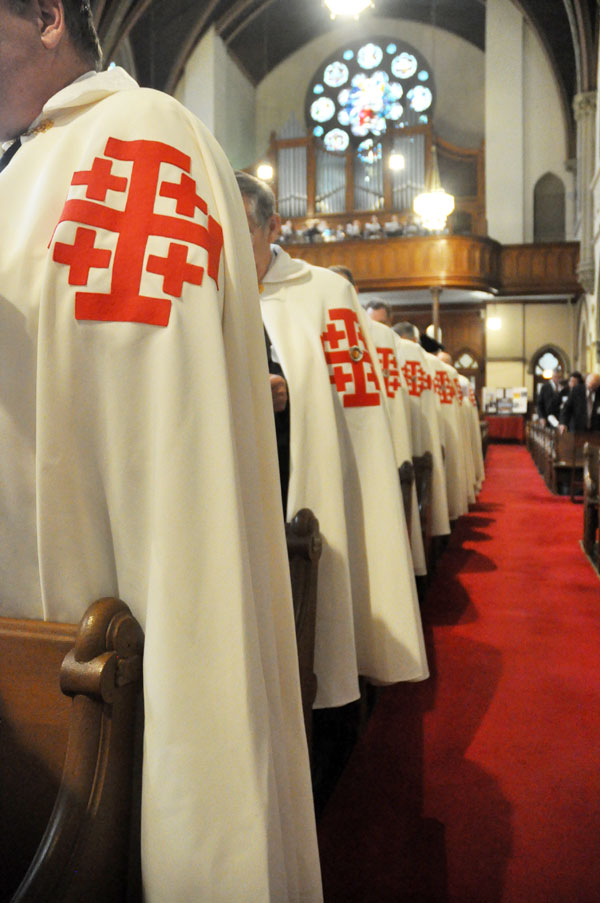
This evening the Holy Father Pope Francis received some 3,500 Knights and Ladies of the Equestrian Order of the Holy Sepulchre of Jerusalem in an audience the Paul VI Hall.  The Knights and Ladies have gathered in Rome for an international pilgrimage to pray at the tombs of the Apostles Peter and Paul, to make a public profession of the Creed, and to renew their fidelity to the Church and to the person of the Successor of Peter in this Year of Faith.

Following an conference given by His Excellency Archbishop Salvatore Fisichella, President of the Pontifical Council for Promoting the New Evanglization, His Eminence Edwin Cardinal O'Brien, Grand Master of the Order, addressed the Holy Father and present the Knights and Ladies to him.


His Holiness briefly addressed the members of the Order (the Italian text has been posted; I would work on a translation, but at the present moment I'm out of energy), hearkening back to the three words he proposed just after his election to the See of Peter: walking, building, and professing.


Relating the walking of the Knights and Ladies to this earthly pilgrimage, His Holiness brought together his three words, saying, "your journeying in order to build is born of [your] professing the faith ever more profoundly, it grows from ongoing efforts to nourish your spiritual life, from a lifelong Christian formation for an ever more authentic and coherent Christian life."

The Equestrian Order has, as one of its chief aims, the support, maintenance, and growth of the Church in the Holy Land by providing for all of the needs of the Patriarch of Jerusalem and, following a recent decision of the Order, throughout the Holy Land.  To this end, the Order funds the work of the Church, builds schools, and helps support Christians financially in their daily struggles.  The building done by the Order is, however, not only physical; each of the Knights and Ladies promise to pray daily for their brothers and sisters who live in the land where the Savior himself walked.

Pope Francis concluded his remarks by urging the Knights and Ladies to "believe in the redemptive power of the Cross and the Resurrection."  It is this belief, strengthened in these days of pilgrimage, that have led the members of the Order to devote themselves to the work of charity, conscious of what His Holiness Benedict XVI wrote in Porta Fidei: "Faith without charity bears no fruit, while charity without faith would be a sentiment constantly at the mercy of doubt.  Faith and charity each require the other, in such a way that each allows the other to set out along its respective path" (14).

The feel of the audience with Pope Francis was notably different than the audiences with Pope Emeritus Benedict XVI, a difference that may be attributed to the different personalities of the two Popes or to the make-up of those in the audience.  I need to ponder this a bit more in the day or so before putting more thoughts together.

A Prayer of the Knights and Ladies

O Lord Jesus Christ, for Your five wounds
that we carry on our insignia
we pray to You.

Give us the strength to love all whom
Your Father has created
and, more so, our enemies.

Free our soul and heart
from sin, from partiality,
from egoism and from cowardice
so that we can be worthy of Your sacrifice.

Let Your Spirit fall upon us all,
the Knights and Ladies of the Holy Sepulchre,
so that it may render us convinced and sincere ambassadors
of peace and love among our brothers and sisters and, especiallly,
among all those who think they do not believe in You.

Give us Faith
to face all the problems of everyday life
and to deserve, one day, to approach,
humbly but without fear,
Your presence.

Amen.

12 September 2013

The days of pilgrimage have come

In his Apostolic Letter Porta Fidei in which he announced the present Year of Faith, His Holiness Benedict XVI wrote: "Religious communities as well as parish communities, and all ecclesial bodies old and new, are to find a way, during this Year, to make a public profession of the Credo "(8).  He also wrote that, "Profession of faith is an act both personal and communitarian" (10).

With these words in mind, the Grand Magisterium of the Equestrian Order of the Holy Sepulchre of Jerusalem announced an International Pilgrimage of the Order to Rome to pray at the tombs of the Apostles Peter and Paul and public recite together the words of the Creed. The Order was one of the first to take up the Holy Father's summons to this Year of Faith.

The more solemn events of the pilgrimage begin tomorrow morning with the Holy Mass offered in the Basilica of St. Paul Outside the Walls.  As I understand it, the opening Mass was to have been celebrated in the Basilica of St. Mary Major, but the number of pilgrims has became too great.

Tomorrow afternoon, the Holy Father Pope Francis will received the 3,000 or so Knights and Dames - there are 23,000 members in the Order worldwide - in an audience in the Paul VI Hall, which will be preceded by a conference given by His Excellency the Most Reverend Salvatore Fisichella, President of the Pontifical Council for Promoting the New Evangelization.

On Saturday we will gather for prayer in the Basilica of St. John Lateran and offer the Mass in the Basilica of St. Peter, while on Sunday we will tour the Vatican Gardens and conclude the pilgrimage with the Holy Mass again in the Basilica of St. Paul Outside the Walls.

His Eminence Edwin Cardinal O'Brien, Grand Master of the Order, will preside at the Masses.

Writing to the Knights and Dames in the pilgrimage the Governor General of the Order offers a helpful reminder of the two-fold significance of this pilgrimage to the tombs of the Apostles Peter and Paul:
  1. to strengthen our faith through a trip which is physical route [admittedly, mine will be rather short] but is also and more importantly a spiritual path; and,
  2. at the same time, in the wake of generations of pilgrims who came to Rome to worship at the tombs of the Apostles, to restate our unswerving loyalty to Peter's successor, in the person of Pope Francis, and to his teachings.
These are important spiritual goals for any pilgrimage to Rome, but especially so for the members of our Order.

I am very much looking forward to this pilgrimage and am beginning to grow excited in anticipation of the blessings that will come from it.  I am especially happy that two of my fellow Knights and two Dames have come to Rome from the Diocese of Springfield in Illinois to join the pilgrimage, with whom I had dinner the other night.


Please remember us in your prayers in these days of pilgrimage, that having visited to the tombs of the Apostles Peter and Paul and renewed our own professions of faith, we may return home - they to Illinois and me to the other side of Rome - strengthened in fidelity to the Lord and his Church, and in charity for our Christian brothers and sisters in the Holy Land and throughout the Middle East.

I ask you to pray especially that, in the words of the Governor General, this pilgrimage will become for us "the image of Christian life itself, of man, a pilgrim on earth, waiting to reach his heavenly destination."

Thank you, and know that you will be remembered in my prayers at the tombs of the Apostles.

What ought we to do in Syria?

Following my recent post in which I took a critical look at President Obama's recent speech in which he attempted an emotional appeal in support of a military strike in Syria by the United States of America, one reader asked:
If I may ask, however, what would you propose to do in order to deter Assad (and other dictators) from further use of chemical weapons?

Yes, I do realize that you have questioned whether Assad's regime was even responsible for the attack, but there is much more information out there which suggests that IS the case -- including documented movement of chemical weapons, by Assad's military, in the days leading up to the attack. So if would grant for a moment that Assad is very likely responsible...what action would you propose be taken?
A very good question indeed.

First, acting on information that "suggests" Assad ordered a chemical attack as opposed to evidence that definitively proves he did is rash and unwise, particularly when there is evidence that also suggests Assad did not order such an attack.  The present Administration has been wrong about a great many aspects relating to foreign policy - simply look at what has unfolded in Egypt and Libya, particularly in Benghazi, as just two glaring examples.  This Administration cannot work well, adequately, or justly on suggestions.

Second, it is common and unquestioned knowledge that Saddam Hussein used chemical weapons against his people; this fact is one of the reasons President George W. Bush pushed for the extension of the war on terror into Iraq.  Certainly President Assad is aware that Hussein had employed chemical weapons.

If the "shock and awe" of the U.S.A. - together with a host of allied nations - in Iraq, which leveled cities, deposed Hussein, set up a new government, and, in the end, resulted in the execution of Hussein for his crimes against his people was not enough to deter Assad from using chemical weapons, why would an "unbelievably, small limited" strike - in the words of Secretary of State John Kerry - act as a deterrent, especially when the goal is rather undefinable but that certainly does not result in a change of regime, according to White House Press Secretary Jay Carney?  There is, to be quite honest and blunt, absolutely no reason to think the propose strike will be a deterrent to Assad, which renders the entire affair entirely pointless.

Third, back in May of July there were serious concerns raised by the United Nations that Syrian rebels had used chemical weapons, and even as early as March of 2013.  Iran (in July of 2012) submitted a report to the U.N. that the rebels had chemical weapons and Russia (in July of 2013) submitted a report to the U.N. that chemical weapons had been used by the rebels.

Even so, President Obama did not move for a military strike against the rebels; indeed, we continue to give them weapons.  Why?  If the use of chemical weapons is "a crime against humanity, and a violation of the laws of war" - as he said yesterday and with which I whole heartedly agree - it is a crime and a violation regardless of who uses them, whether government or rebels.

In point of fact, atrocities have been committed on both sides, both by the Syrian government and by the Syrian rebels.  There is no clear "good guy" in all of this.  So the choice is, seemingly, one of two evils; which is better?  It cannot really be known.  The situation is far more grave that the Administration has yet suggested.

In an editorial written to the New York Times and published yesterday, President Vladimir Putin cautioned against the proposed military intervention by the U.S.America. because:
The potential strike by the United States against Syria, despite strong opposition from many countries and major political and religious leaders, including the pope, will result in more innocent victims and escalation, potentially spreading the conflict far beyond Syria’s borders. A strike would increase violence and unleash a new wave of terrorism. It could undermine multilateral efforts to resolve the Iranian nuclear problem and the Israeli-Palestinian conflict and further destabilize the Middle East and North Africa. It could throw the entire system of international law and order out of balance.
Syria is not witnessing a battle for democracy, but an armed conflict between government and opposition in a multireligious country. There are few champions of democracy in Syria. But there are more than enough Qaeda fighters and extremists of all stripes battling the government. The United States State Department has designated Al Nusra Front and the Islamic State of Iraq and the Levant, fighting with the opposition, as terrorist organizations. This internal conflict, fueled by foreign weapons supplied to the opposition, is one of the bloodiest in the world.
Mercenaries from Arab countries fighting there, and hundreds of militants from Western countries and even Russia, are an issue of our deep concern. Might they not return to our countries with experience acquired in Syria? After all, after fighting in Libya, extremists moved on to Mali. This threatens us all [more].
He is correct about all of this; if the U.S. moves against Syria there is every reason to believe it will trigger the beginning of World War III.

Now, here it would be good for me to say that I never thought I would agree with Vladimir Putin more than I do with Barack Obama, but so it is, at least in so far as words go.

The plight of the Christians living in Syria is one aspect of the present situation is on that the world seems quite content to ignore, as it does in other places such as Iraq and Nigeria, but President Putin has publicly voiced his concerns for the safety of the Syrian Christians - as far back as May of 2012 - saying:

For many months now the persecution of Christians in Syria has been commonplace (here is but one example), and at the hands of the Syrian rebels whom the United States of America is presently supporting.  There is a reason why the Christians there support the Syrian government and not the Syrian rebels.

On Saturday, three Christians were killed by Syrian rebels who are connected with al Qaeda and who took the ancient Christian city of  Maaloula, with the remaining Christian inhabitants forced to flee; they were threatened with death unless they converted to Islam.

Meanwhile, what has President Obama said about the persecution of Syrian Christians?  Nothing.

To the specific question of what, precisely, we should do about the situation in Syria I do not have a good answer; there may not be one.  However, I am quite certain that a military intervention will only further escalate the troubles of the region and the throughout the world.  In this, I am not alone; those who agree include:
There are many others, as well, links to whose statements I do not have handy at the present moment.  Suffice it to say that even the Editorial Board of the New York Times is not in favor of President Obama's strike.

The Holy See has suggested a six-step plan for peace in Syria, though I am not sure how seriously anyone is taking it:
1) Re-launch dialogue and reconciliation 

2) Avoid division of the country into different zones

3) Maintain territorial integrity 

4) Stress all minorities must be involved in preparing any new constitution and laws

5) Propose the establishment of a ministry dedicated to minorities, insists on the concept of citizenship with equal dignity, and emphasizes the importance of respecting human rights and religious freedom 

6) Ensure “all necessary cooperation and assistance for the immense task of reconstruction in the country.”
The way of peace can be the only way truly forward.  To quote from a letter of J.R.R. Tolkien written on August 9, 1945:
The news today about the 'Atomic bombs' is so horrifying one is stunned.  The utter folly of these lunatic physicists to consent to do such work for war-purposes: calmly plotting the destruction of the world!  Such explosives in men's hands, while their moral and intellectual status is declining, is about as useful as giving out firearms to all inmates of a gaol [jail] and then saying that you hope 'this will ensure peace'.  But one good may arise out of it, I suppose, if the write-ups are not overheated: Japan ought to cave in.  Well we're in God's hands.  But He does not look kindly on Babel-builders.

11 September 2013

God of peace, bring your peace to our violent world

O God of love, compassion, and healing,
look on us, people of many different faiths and traditions,
who gather today at this site,
the scene of incredible violence and pain.

We ask you in your goodness
to give eternal light and peace
to all who died here—
the heroic first-responders:
our fire fighters, police officers,
emergency service workers, and Port Authority personnel,
along with all the innocent men and women
who were victims of this tragedy
simply because their work or service
brought them here on September 11, 2001.

We ask you, in your compassion
to bring healing to those
who, because of their presence here that day,
suffer from injuries and illness.
Heal, too, the pain of still-grieving families
and all who lost loved ones in this tragedy.
Give them strength to continue their lives with courage and hope.

We are mindful as well
of those who suffered death, injury, and loss
on the same day at the Pentagon and in Shanksville, Pennsylvania.
Our hearts are one with theirs
as our prayer embraces their pain and suffering.

God of peace, bring your peace to our violent world:
peace in the hearts of all men and women
and peace among the nations of the earth.
Turn to your way of love
those whose hearts and minds
are consumed with hatred.

God of understanding,
overwhelmed by the magnitude of this tragedy,
we seek your light and guidance
as we confront such terrible events.
Grant that those whose lives were spared
may live so that the lives lost here
may not have been lost in vain.
Comfort and console us,
strengthen us in hope,
and give us the wisdom and courage
to work tirelessly for a world
where true peace and love reign
among nations and in the hearts of all.

- His Holiness Benedict XVI, 20 April 2008

On the President's speech

Yesterday President Obama addressed the people of the United States of America about the ongoing and deplorable situation in Syria as he continued to make his case for war even as the Russian government is, curiously, making moves for peace.

As I read through his remarks this morning, I couldn't help but notice a series of inconsistencies in the logic he set forth or statements made without any evidence to support his claims.

Take, for example, his attempt at emotional manipulation at the beginning of his address:
The situation profoundly changed, though, on August 21st, when Assad’s government gassed to death over a thousand people, including hundreds of children.  The images from this massacre are sickening:  Men, women, children lying in rows, killed by poison gas.  Others foaming at the mouth, gasping for breath.  A father clutching his dead children, imploring them to get up and walk.  On that terrible night, the world saw in gruesome detail the terrible nature of chemical weapons, and why the overwhelming majority of humanity has declared them off-limits -- a crime against humanity, and a violation of the laws of war.
Without denying or lessening the horror of the death of these innocent children and certainly without excusing or condoning it, one cannot fail to ask the glaring and obvious question of the President: What of the millions of children killed in the United States of America and throughout the world in the gruesome acts of abortion?  These innocent children are either torn apart with forceps and a vacuum or killed with chemicals.  Surely this is also a great crime against humanity.

The images from abortion are at least equally sickening, if not more so, yet they seem not to disturb the President, which at least partly explains why he did not speak out about the terrible nature of the "clinic" run by Dr. Kermit Gosnell.  Clearly, Mr. Obama's pitch for war is not simply about children.

The President then went on to remind us that "in 1997, the United States Senate overwhelmingly approved an international agreement prohibiting the use of chemical weapons, now joined by 189 governments that represent 98 percent of humanity."  This is true, though one may ask, especially with the present Congress and Administration, if these governments truly represent their people.  At least in the case of the United States of America with regard to what our response in Syria should be, the answer is, frankly, "No."

Mr. Obama next asserted that "no one disputes that chemical weapons were used in Syria" - which is true - and that "we know the Assad regime was responsible" - which is questionable.  The President offers no evidence to support his claim, except that "we’ve also studied samples of blood and hair from people at the site that tested positive for sarin," which hardly proves who is responsible for the attack.

In explaining why he thinks it is necessary for the U.S.A. to launch missiles into Syria, Mr. Obama said: "As the ban against these weapons erodes, other tyrants will have no reason to think twice about acquiring poison gas, and using them."  I'm not sure too many tyrants give much thought to such things.  After all, it wasn't that long ago that chemical weapons were used in Iraq, and our response their seems already not to have deterred President Assad if, in fact, he did order the use of chemical weapons in Syria.  This being the case, why would an additional military intervention deter him?

The Commander in Chief next rightly said that "if fighting spills beyond Syria’s borders, these weapons could threaten allies like Turkey, Jordan, and Israel."  This is true, but it is a near certainty that if the U.S.A. attacks Syria that war will indeed spread beyond Syria's borders, especially given that a Syrian official has already said Syria will launch an attack on Tel Aviv if we attack Damascus.  It should not be forgotten that Hezbollah and Iran have also said they will attack Israel if the U.S. attacks Syria.  What President Obama says he seeks to avoid, he may well bring about himself.

The President further explained his reasoning behind his desire to launch an attack on Damascus: "The purpose of this strike would be to deter Assad from using chemical weapons, to degrade his regime’s ability to use them, and to make clear to the world that we will not tolerate their use."  How he expects a military assault to deter Mr. Assad from using chemical weapons in the future is beyond me. It seems more likely that Mr. Assad may well decide to use chemical weapons in the event of an assualt; what would there be to lose?

Mr. Obama then explained why he is seeking Congressional approval at this time for a military intervention in Syria: " I believe our democracy is stronger when the President acts with the support of Congress.  And I believe that America acts more effectively abroad when we stand together."  I'm not sure I've seen much evidence of this belief in the past years of his presidency; it will be interesting to see if he really believes this.

President Obama then boldly asserted, "I will not put American boots on the ground in Syria," which runs contrary to what his Secretary of State said last week.  Even if the President meant what he said - which is always difficult to tell - how would such a reckless statement, so similar to his "red line" comment that led us to this present moment, not set another dangerous precedent of standing by the President's word in the future?

If we launch an assault on Syria - however brief - and the unforeseen consequences should lead to a situation where it become necessary for us to intervene more fully - he did acknowledge such consequences in Iraq and Libya in this same speech - it would seem the President's hands would be tied by his words.  Unless he didn't really mean them.

The President went on to clarify his remarks, saying, "I will not pursue a prolonged air campaign like Libya or Kosovo.  This would be a targeted strike to achieve a clear objective:  deterring the use of chemical weapons, and degrading Assad’s capabilities."  But...again...what if a prolonged campaign should prove necessary?  At the same time...is this really the only way to "deter" President Assad?  Since we do not know if such an attack will deter himself, the objective seems actually not very clear at all.  How will we know when an adequate level of deterrence has been reached, and for how long?

The just war teaching of the Catholic Church has long asserted that one requirement for a war to be just is that there be "a serious prospect of success."  Given that we cannot even clearly what our intended objective is, the prospect of success is rather weak.

President Obama suggested that "a targeted strike can make Assad, or any other dictator, think twice before using chemical weapons."  This may be true, but thinking twice might not do much at all; such a dictator or tyrant may very well still chose to use such weapons in the future.  People think twice all the time about choices in their lives and still often make the wrong, unethical, and, dare I say, immoral choice.

When it came time to address the possible consequences such an assault might have, Mr. Obama dismissed concerns over possible retaliation, saying simply that "he Assad regime does not have the ability to seriously threaten our military."  While this may be true, it is certainly possible that the threats of Hezbollah and Iran, taken together with the suggestions of Russia and China that they will also defend Syria, could very well pose a serious threat to our military.

The President next claimed that "al Qaeda will only draw strength in a more chaotic Syria if people there see the world doing nothing to prevent innocent civilians from being gassed to death."  Again, this may be true and it may not be true; nothing seems to have prevented al Qaeda from using non-chemical weapons in its attacks in the past.  And, more to the point, Syria has been in chaos for the past two years, long before the use of a chemical weapon.

Toward the end of his address, President Obama spoke to his "friends on the right" - of whom, in the past, he's admitted to not having many - saying, " I ask you to reconcile your commitment to America’s military might with a failure to act when a cause is so plainly just."  If the cause were indeed so "plainly just" he would have a much greater amount of support.  The fact remains, however, that the cause is not so plainly just; in fact, is quite debatable.  Simply saying it is just does not make it just.

To his "friends on the left," Mr. Obama renewed his emotional appeal: "I ask you to reconcile your belief in freedom and dignity for all people with those images of children writhing in pain, and going still on a cold hospital floor."  Here one might well return to my first question.

Beginning and ending with an emotional appeal is not always an effective means of persuasion.  People also want a logical and consistent argument, which we did not receive last night.

10 September 2013

All is ready for the pilgrimage

This morning I set out for the Piazza di San Calisto to collect my bag and badge for this weekend's International Pilgrimage of the Equestrian Order of the Holy Sepulchre of Jerusalem to Rome for the Year of Faith proclaimed by His Holiness Benedict XVI.

Since my registration was made only late last week, I did have some concern as to whether or not everything would be ready upon my arrival and was very happy to find that indeed it was.

The bag provided for the pilgrimage is simple, yet should be useful for carrying papers and books, an iPad (a laptop might be too heavy) or, thinking like a priest, an amice, alb, cincture, and stole (and perhaps a surplice and mozetta).

The pilgrimage book is very helpful with a letter of welcome from His Eminence Edwin Cardinal O'Brien, Grand Master of the Order; an introduction about Christian pilgrimages to the Eternal City; the text of the Pope Emeritus' Apostolic Letter Porta Fidei; a brief write-up about the four Papal Basilicas; the text of the Creed and the texts for the various Masses; and two prayers particular to the Order.

One of the happy things about living in Rome is that you are always noticing something new, an unexpected sight here and a surprise there.  As I walked along this morning an inscription above a door caught my attention:

You alone are Lord.
This is a good reminder for us everyday; Rome is filled with such reminders.

In the vicinity of the Piazza di San Calisto a sign outside of a restaurant caught my attention, not so much as a spiritual reminder but as a good bit of humor:


I may have to give this place a try.

A prayer for today

Lord Jesus, who wanted to be born as the first of many brothers and sisters, grant us the grace of true brotherhood.  Help us to become like you.  Help us to recognize your face in others who need our assistance, in those who are suffering or forsaken, in all people, and help us to live together with you as brothers and sisters, so as to become one family, your family.  Amen.

- Pope Emeritus Benedict XVI

09 September 2013

Directions and encouragement

The Italians are a very encouraging people, once you start speaking to them or once they start speaking to you.

Over the past several months I have made a much more conscious effort at regular exercise with the aim of getting my aging body into some semblance of shape while at the same time alleviating, at least a little, my arthritis, which - thanks be to God! - has been rather quiet of late (if I lose another four pounds, I will have lost a total of forty pounds since the beginning of this past Lent).

So it was that this morning I set out to buy a new fascia (the "belt" for the cassock) because mine has been far too large for some time and by design shortening it is rather tricky).


At any rate, on my way back to the Casa Santa Maria, an Italian lady, a Roman, with my same skill for directions, asked where the Piazza della Pilotta was (it was in the opposite direction of where she was headed).  I was happy to be able to tell her vaguely where it was (it's not often I actually know where something is when someone asks me, at least from where I am at that moment) and to walk her to the piazza since I was also headed that way.

Along the way, we chatted about generalities, where I'm from, why I'm in Rome, etc.  With my simple and broken Italian she was able to understand me and repeatedly told me that Italian is a very difficult language to learn (it's not the first time an Italian has said this).  The basics of the language - sentence structure, conjugation, etc. - aren't too difficult to pick up, but the many exceptions to the rule are, as is learning when to which use which prepositional phrase (there are forty different words to say "to/from/of/in/at/on this/that/these/those").

Still, the Italians tend to be very patient with those who are at least attempting to speak their language.  Overall, our simple conversation was rather encouraging on a rainy and humid day.

Is a war in Syria just?

Monsignor Charles Pope recently took and "sober and serious" look at the President's proposed action in Syria in the light of the Church's teaching on just war, a post that is both brief and well-worth reading.

Given that one of the requirements for a just war is a serious prospect of success (Catechism of the Catholic Church, 2309), I can find no justification for the President's plan to launch a few missiles and be done.  There can be no prospect of success in such a plan.

Please, if you have not read Pope Francis' homily that he preached at the Vigil of Prayer for Peace, do so today and continue to pray for peace!

An inconvenient truth

It's been some time since I mentioned anything on these pages about so-called "global warming" which, when that turned out to be not quite right quickly - and quietly - became "climate change," but it seems even that isn't quite the case.

Several years back, the BBC predicted that by the summer of 2013 - this summer - the North polar ice cap would be no more.

However, in what must be a very inconvenient truth for Al Gore and company, not only is the polar ice cap still present, but within the last year it has increased by some 1,000,000 square miles, an increase of some 60%:
A chilly Arctic summer has left nearly a million more square miles of ocean covered with ice than at the same time last year – an increase of 60 per cent.

The rebound from 2012’s record low comes six years after the BBC reported that global warming would leave the Arctic ice-free in summer by 2013.

Instead, days before the annual autumn re-freeze is due to begin, an unbroken ice sheet more than half the size of Europe already stretches from the Canadian islands to Russia’s northern shores [more].

08 September 2013

Pope: Violence and war occur when man stops contemplating beauty and goodness and withdraws into himself

Taking up the call of the Holy Father Pope Francis to pray for peace in Syria, the Middle East, and throughout the world, I made my way last evening to St. Peter's Square for the Vigil of Prayer for Peace.


The piazza was filling up when I arrived about 5:30 p.m. and continued to fill up throughout the evening.  I was particularly struck throughout the evening by the great number of people of stayed through the entirety of the vigil.  There were many, to be sure, who came, stayed for a short (for example, to pray the rosary), and then left, but their spaces were quickly taken by late comers.

Prior to the beginning of the vigil at 7:00 p.m., the words of the Holy Father were read as a reminder to everyone of our purpose for being gathered together in such great numbers.

I wish he would wave a bit more, or something.

After His Holiness arrived, he greeted us and thanked us being present with him to pray for peace, after which he made the Sign of the Cross and the Veni, Creator Spiritus was intoned.

When Pope Francis appeared, I was surprised not to hear chants of "Fra-anceso," as had been common with Pope Emeritus Benedict XVI and with Blessed Pope John Paul II.  Whether this was at the request of His Holiness, I do not know; it did, however, seem clear that he does not like applause breaking out when he speaks (for which I do not blame him; it can be difficult to recover the moment).

Accompanied by the singing of the Ave, Maria, the Swiss Guard next processed in with the beloved icon of Mary, Salus populi Romani (Health of the Roman People), said to have been written by the Evangelist Saint Luke and which is usually housed in the Papal Basilica of Santa Maria Maggiore, was enshrined near the altar and venerated by the Holy Father.


The icon itself is much larger than it appears when it is in the basilica.

The Joyful Mysteries of the Rosary were prayed and followed by the singing of the Litany of Loreto, after which Pope Francis preached to those assembled (with my emphases):
“And God saw that it was good". The biblical account of the beginning of the history of the world and of humanity speaks to us of a God who looks at creation, in a sense contemplating it, and declares: 'it is good'. This, dear brothers and sisters, allows us to enter into God’s heart and, precisely from within him, to receive his message. We can ask ourselves: what does this message mean? What does it say to me, to you, to all of us?
It says to us simply that this, our world, in the heart and mind of God, is the "house of harmony and peace", and that it is the space in which everyone is able to find their proper place and feel "at home", because it is "good". All of creation forms a harmonious and good unity, but above all humanity, made in the image and likeness of God, is one family, in which relationships are marked by a true fraternity not only in words: the other person is a brother or sister to love, and our relationship with God, who is love, fidelity and goodness, mirrors every human relationship and brings harmony to the whole of creation. God’s world is a world where everyone feels responsible for the other, for the good of the other. This evening, in reflection, fasting and prayer, each of us deep down should ask ourselves: Is this really the world that I desire? Is this really the world that we all carry in our hearts? Is the world that we want really a world of harmony and peace, in ourselves, in our relations with others, in families, in cities, in and between nations? And does not true freedom mean choosing ways in this world that lead to the good of all and are guided by love?
 
But then we wonder: Is this the world in which we are living? Creation retains its beauty which fills us with awe and it remains a good work. But there is also "violence, division, disagreement, war". This occurs when man, the summit of creation, stops contemplating beauty and goodness, and withdraws into his own selfishness.
 
When man thinks only of himself, of his own interests and places himself in the centre, when he permits himself to be captivated by the idols of dominion and power, when he puts himself in God’s place, then all relationships are broken and everything is ruined; then the door opens to violence, indifference, and conflict. This is precisely what the passage in the Book of Genesis seeks to teach us in the story of the Fall: man enters into conflict with himself, he realizes that he is naked and he hides himself because he is afraid, he is afraid of God’s glance; he accuses the woman, she who is flesh of his flesh; he breaks harmony with creation, he begins to raise his hand against his brother to kill him. Can we say that from harmony he passes to "disharmony"? Can we say this: that from harmony he passes to "disharmony"? No, there is no such thing as "disharmony"; there is either harmony or we fall into chaos, where there is violence, argument, conflict, fear.
 
It is exactly in this chaos that God asks man’s conscience: “Where is Abel your brother?” and Cain responds: "I do not know; am I my brother’s keeper?". We too are asked this question, it would be good for us to ask ourselves as well: Am I really my brother’s keeper? Yes, you are your brother’s keeper! To be human means to care for one another! But when harmony is broken, a metamorphosis occurs: the brother who is to be cared for and loved becomes an adversary to fight, to kill. What violence occurs at that moment, how many conflicts, how many wars have marked our history! We need only look at the suffering of so many brothers and sisters. This is not a question of coincidence, but the truth: we bring about the rebirth of Cain in every act of violence and in every war. All of us! And even today we continue this history of conflict between brothers, even today we raise our hands against our brother. Even today, we let ourselves be guided by idols, by selfishness, by our own interests, and this attitude persists. We have perfected our weapons, our conscience has fallen asleep, and we have sharpened our ideas to justify ourselves. As if it were normal, we continue to sow destruction, pain, death! Violence and war lead only to death, they speak of death! Violence and war are the language of death!
 
After the chaos of the Flood, when it stopped raining, a rainbow appeared and the dove returned with an olive branch. I think also of the olive tree which representatives of various religions planted in Plaza de Mayo, in Buenos Aires, in 2000, asking that there be no more chaos, asking that there be no more war, asking for peace.
 

And at this point I ask myself: Is it possible to walk the path of peace? Can we get out of this spiral of sorrow and death? Can we learn once again to walk and live in the ways of peace? Invoking the help of God, under the maternal gaze of the Salus Populi Romani, Queen of Peace, I say: Yes, it is possible for everyone! From every corner of the world tonight, I would like to hear us cry out: Yes, it is possible for everyone! Or even better, I would like for each one of us, from the least to the greatest, including those called to govern nations, to respond: Yes, we want it! My Christian faith urges me to look to the Cross. How I wish that all men and women of good will would look to the Cross if only for a moment! There, we can see God’s reply: violence is not answered with violence, death is not answered with the language of death. In the silence of the Cross, the uproar of weapons ceases and the language of reconciliation, forgiveness, dialogue, and peace is spoken. This evening, I ask the Lord that we Christians, and our brothers and sisters of other religions, and every man and woman of good will, cry out forcefully: violence and war are never the way to peace! Let everyone be moved to look into the depths of his or her conscience and listen to that word which says: Leave behind the self-interest that hardens your heart, overcome the indifference that makes your heart insensitive towards others, conquer your deadly reasoning, and open yourself to dialogue and reconciliation. Look upon your brother’s sorrow – I think of the children, look upon these - look upon your brother's sorrow, and do not add to it, stay your hand, rebuild the harmony that has been shattered; and all this not by conflict but by encounter! May the noise of weapons cease! War always marks the failure of peace, it is always a defeat for humanity. Let the words of Pope Paul VI resound again: "No more one against the other, no more, never! ... war never again, never again war!". "Peace expresses itself only in peace, a peace which is not separate from the demands of justice but which is fostered by personal sacrifice, clemency, mercy and love". Forgiveness, dialogue, reconciliation – these are the words of peace, in beloved Syria, in the Middle East, in all the world! Let us pray for reconciliation and peace, let us work for reconciliation and peace, and let us all become, in every place, men and women of reconciliation and peace! Amen.
Following the Holy Father's words, a brief time of silent prayer was observed before the Blessed Sacrament was exposed on the altar for a period of Eucharistic Adoration, interspersed with readings from the Scriptures, hymns, and intercessions.


After the Office of Readings, the faithful received the Benediction of the Blessed Sacrament and the vigil concluded with the Divine Praises right about 11:00 p.m. when the Holy Father thanked us again for our presence and bid us a good night.


Let us continue to pray for peace!

07 September 2013

Our Lady of Peace, pray for us!

God of compassion, listen to the cries of the people of Syria. Give comfort to those who suffer because of the violence.  Give comfort to those who mourn their dead, and strength to neighboring countries to welcome the refugees. Convert the hearts of those who resort to arms and protect those who work to promote peace.

God of hope, inspire leaders to choose peace instead of violence and to seek reconciliation with enemies. Inspire compassion in the universal Church for the Syrian people and give us hope for a future of peace based on justice for all.

We ask this through Jesus Christ, Prince of Peace and Light of the world. Amen.
- Pope Francis and Patriarch Twal

05 September 2013

Piano a piano

This morning I wrote a letter in Italian to the Secretary of the Governor General of the Equestrian Order of the Holy Sepulchre of Jerusalem - at the direction of my Lieutenant - asking how I might take part in the activities of the Order's upcoming pilgrimage for the Year of Faith.

Before sending the letter by fax, I asked the secretary here at the Casa Santa Maria to give it a read and tell me if it made sense.  She said she could understand it, but it was not correct Italian; even so, she seemed to think it sufficient to send.

Still, I asked her to help me correct it and she scribbled away on the letter.  I was, I think, glad to see that she also had to stop and think for a moment when choosing the appropriate preposition in certain cases where I chose incorrectly.

As I continue to learn the language, one thought continually comes to mind: When you want Italian to be precise, it isn't; and when you don't want it to be precise, it is.

Ah, well, as they say here: "Piano a piano."  Literally, it means "floor to floor," but figuratively it means "little by little."  There seem to be in Italian many words that have a variety of meanings which are not immediately connected.

Our Lady, Queen of Palestine, pray for us!

The Blessed Mother of God is, under title of Our Lady of Palestine, patroness of the Equestrian Order of the Holy Sepulchre of Jerusalem and of the Middle East.  When her liturgical feast was established in 1927 and confirmed by the Holy See in 1933 Palestine included the territory of the Middle East.

As war looms in Syria, we do well to turn to her intercession for peace:
O Mary Immaculate, gracious Queen of Heaven and of Earth, behold us prostrate before thy exalted throne. Full of confidence in thy goodness and in thy boundless power, we beseech thee to turn a pitying glance upon Palestine, which more than any other country belongs to thee, since thou hast graced it with thy birth, thy virtues and thy sorrows, and from there hast given the Redeemer to the world. 
Remember that there especially thou wert constituted our tender Mother, the dispenser of graces. Watch, therefore, with special protection over thy native country, scatter from it the shades of error, for it was there the Sun of Eternal Justice shone. Bring about the speedy fulfilment of the promise, which issued from the lips of Thy Divine Son, that there should be one fold and one Shepherd. 
Obtain for us all that we may serve the Lord in sanctity and justice during the days of our life, so that, by the merits of Jesus and with thy motherly aid, we may pass at last from this earthly Jerusalem to the splendours of the heavenly one. 
Amen.
Our Lady, Queen of Palestine, pray for us all and all the peoples of the lands made sacred by your Son's Life, Death, and Resurrection.  Amen.

Calls for peace

His Holiness Pope Francis renewed his call for peace in Syrian, in the Middle East, and throughout the day yesterday, saying:
This coming Saturday we will live together a special day of fasting and prayer for peace in Syria, the Middle East, and throughout the world. I renew the invitation to the whole Church to live this day intensely, and even now I express gratitude to the other Christian brethren, to the brethren of other religions and to the men and women of good will who desire to join in this initiative, in places and ways of their own. I especially urge the Roman faithful and pilgrims to participate in the prayer vigil here in St. Peter's Square at 19.00, in order to ask the Lord for the great gift of peace. May a powerful cry for peace go up from every land [emphasis mine]!
In answer to the Holy Father's plea, the Grand Mufti of Syria, in the Sunni tradition, has welcomed Pope Francis' call.  In a letter sent through diplomatic channels, Ahmed Badreddin Hassou wrote to the Holy Father, saying, "We will be together on September 7, to raise our plea to God," and proposed to "organize a spiritual summit with religious leaders in Damascus or in the Vatican: so maybe we can stop the fire of those who want to destroy the land of Abraham, Moses, Jesus, Muhammad."  Whether such a summit takes place and where remains to be seen.

His Eminence Timothy Cardinal Dolan, Archbishop of New York and President of the United States Conference of Catholic Bishops, also wrote yesterday to President Obama assuring him of the prayers of the U.S. Bishops and urging the President do seek peace:
We have heard the urgent calls of the Successor of Saint Peter, Pope Francis, and our suffering brother bishops of the venerable and ancient Christian communities of the Middle East.  As one, they beg the international community not to resort to military intervention in Syria.  They have made it clear that a military attack will be counterproductive, will exacerbate an already deadly situation, and will have unintended negative consequences.  Their concerns find a strong resonance in American public opinion that questions the wisdom of intervention and in the lack of international consensus.
 Last week, a community of Trappist nuns in Aleppo wrote a letter in which they considered the prospect of war in Syria:
Will they make us breathe the toxic gases of the depots they hit, tomorrow, so as to punish us for the gases we have already breathed in?
The people are straining their eyes and ears in front of the television: all they’re waiting for is a word from Obama!
A word from Obama? Will the Nobel Peace Prize winner drop his sentence of war onto us? Despite all justice, all common sense, all mercy, all humility, all wisdom?
The Pope has spoken up, patriarchs and bishops have spoken up, numberless witnesses have spoken up, analysts and people of experience have spoken up, even the opponents of the regime have spoken up…. Yet here we all are, waiting for just one word from the great Obama? And if it weren’t him, it would be someone else. It isn’t he who is “the great one,” it is the Evil One who these days is really acting up.
The problem is that it has become too easy to pass lies off as noble gestures, to pass ruthless self-interest off as a search for justice, to pass the need to appear [strong] and to wield power off as a “moral responsibility not to look away…"
 The world is calling for peace, but will those entrusted with the common good heed these cries?

04 September 2013

Will you answer the Pope's call?


Tolkien bridges cultures

As part of my ongoing efforts to settle into my room here at the Casa Santa Maria, I went out on a mission this afternoon to purchase a set of speakers for my laptop (I decided my desktop and monitor were too bulky to lug all the way to Rome).
When looking for a store in Rome, you almost need to know exactly where you are going beforehand because very the few of the shops have signs as we are used to seeing since they are all right on the edge of the sidewalk.  To see what a store sells, you really have to look in the window as you walk by and hope you didn't miss the store you wanted while you looked at another.
After some time, I finally stumbled upon an electronics store - and began to understand a bit more of the neighborhood around the Casa; the streets will start to make sense to me (I hope!) - and went inside.
I mentioned to the salesmen that I was looking for a speaker for my laptop and he demonstrated a smallish speaker with which I was not satisfied.  When he asked what sort of speaker I was looking for, I answered, "Per quando io guardo il film "Il Signore degli Anelli" ("For when I watch the movie The Lord of the Rings").
He laughed and understood straight away.

On being small, and on being a priest in Rome

As part of the ongoing Year of Faith, the Pope Emeritus, His Holiness Benedict XVI, invited the Knights and Ladies of the Equestrian Order of the Holy Sepulchre of Jerusalem to make a pilgrimage to the Eternal City 13-16 September 2013 for a series of meditations and prayers and a luncheon with the Holy Father.

So far as I know, His Holiness Pope Francis will honor this invitation, though it does seem part of the original schedule has changed.

As a Knight of the Holy Sepulchre, I wanted to take up the Holy Father's invitation, together with the 3,000 or so Knights and Ladies who are coming (10% of the entire Order), some of whom are coming from the Diocese of Springfield in Illinois, but was not sure if the schedule of my Italian classes would allow me to do so.  Now I know it will, so I am in the process of determining how I can take part in the planned activities.

Having left my mozzetta (a shoulder cape worn over a cassock and surplice) behind in the U.S.A. because it was rather large on me, I intended to get a new mozzetta from the good folks at Barbiconi, which I visited for this purpose this morning.


After getting the proper measurements, the gentlemen mentioned that it would be a "piccolo" mozzetta, that is, a small one, because of the size of my neck, with which I could not disagree.

I told him I would need it by 12 September and he said it would probably be ready by 10 September, but, if not, not until the following week.  He politely asked if this would cause a problem and when I said it would not he mentioned it was a good thing because, if it weren't ready by the 10th, nothing could be done about it anyway.

Afterwards, for whatever reason, and again commenting about it being piccolo, he went back to one of the workrooms and a few minutes later returned with a mozzetta which he had me try on.  It fit perfectly.  "Che buon fortuna," he exclaimed, and began to bag it up for me.  I was both surprised and very pleased; sometimes being small has its advantages.

As I made my way back to the Casa Santa Maria, an older couple from Spain stopped me to ask where the Church of the Gesù was located; in that brief moment, all of the Spanish that I was knew was replaced with Italian and completely forgotten even how to say, "de nada."

I knew the church was in the vicinity somewhere, but I was not quite certain which direction to send them.  I have never had a sense of direction and, sure enough, after consulting my phone found the church was in the opposite direction I thought it was (this is, for me, par for the course).

At any rate, this brief encounter demonstrates one of the chief difficulties of priests in Rome who go about in the Roman collar: tourists automatically presume that you know where every church is.  I suppose I now have three years to learn.

03 September 2013

Pope Calls for Day of Fasting and Prayer for Peace

As you probably already know, this past Sunday His Holiness Pope Francis called for a global day of fasting prayer for peace in Syria and all of the Middle East on Saturday, September 7th.  In his urgent plea, he said:
I have decided to proclaim for the whole Church on 7 September next, the vigil of the birth of Mary, Queen of Peace, a day of fasting and prayer for peace in Syria, the Middle East, and throughout the world, and I also invite each person, including our fellow Christians, followers of other religions and all men of good will, to participate, in whatever way they can, in this initiative.
On 7 September, in Saint Peter’s Square, here, from 19:00 until 24:00, we will gather in prayer and in a spirit of penance, invoking God’s great gift of peace upon the beloved nation of Syria and upon each situation of conflict and violence around the world. Humanity needs to see these gestures of peace and to hear words of hope and peace! I ask all the local churches, in addition to fasting, that they gather to pray for this intention.
Let us ask Mary to help us to respond to violence, to conflict and to war, with the power of dialogue, reconciliation and love. She is our mother: may she help us to find peace; all of us are her children! Help us, Mary, to overcome this most difficult moment and to dedicate ourselves each day to building in every situation an authentic culture of encounter and peace. Mat, Queen of Peace, pray for us!
Though, strictly speaking, not required, I can see no good reason - aside from illness or some other such serious cause - why everyone should not answer the Pope's call.

The Franciscan Foundation for the Holy Land has released the text of a prayer composed by both Pope Francis and Patriarch Twal:
God of compassion, listen to the cries of the people of Syria. Give comfort to those who suffer because of the violence.  Give comfort to those who mourn their dead, and strength to neighboring countries to welcome the refugees. Convert the hearts of those who resort to arms and protect those who work to promote peace.
God of hope, inspire leaders to choose peace instead of violence and to seek reconciliation with enemies. Inspire compassion in the universal Church for the Syrian people and give us hope for a future of peace based on justice for all.
We ask this through Jesus Christ, Prince of Peace and Light of the world.  Amen.
Please consider praying this prayer with your families when gathered for meals especially on Saturday, but during the leads up to and following the day of prayer.

For my part, being back now in Rome for a while, I intend to join Pope Francis in prayer in St. Peter's Square.  Please, pray and fast for peace!

Update:

The United States Conference of Catholic Bishops has provided another prayer that may be used to pray for peace:
God of Compassion,
Hear the cries of the people of Syria,
Bring healing to those suffering from the violence,
Bring comfort to those mourning the dead,
Strengthen Syria’s neighbors in their care and welcome for refugees,
Convert the hearts of those who have taken up arms,
And protect those committed to peace.
God of Hope,
Inspire leaders to choose peace over violence and to seek reconciliation with enemies,
Inspire the Church around the world with compassion for the people of Syria,
And give us hope for a future of peace built on justice for all.

We ask this through Jesus Christ,
Prince of Peace and Light of the World,
Amen.
Additionally, the USCCB has offered a petition that may be included in the Universal Prayer at Mass:
For the people of Syria, that God may strengthen the resolve of leaders to end the fighting and choose a future of peace.
We pray to the Lord...

02 September 2013

A simple thought for Labor Day

A few days ago it occurred to me that Americans expend a great deal of effort and energy in trying to make work more efficient so more work can be done.

Italians, on the other hand, seem to expend a great deal of effort and energy in trying to avoid work in the first place to enjoy life more in relaxation.

The last sunset

There was last night over the city of Saint Francis a most beautiful sunset:


I left my casa to watch the setting of the sun because, as the Little Prince says, "You know, one loves the sunset, when one is so sad..."

As I considered the statue depicting the expression of Saint Francis as he returned to Assisi rather dejected after a failed attempt at military glory, I couldn't help but notice his sadness much resembled mine; not so much because of a failed attempt for glory, but because of the thought of leaving Assisi.

The other day, Barb, who blogs at Franciscan Mom, commented on one of my recent posts that my "time in Assisi has been more than language learning. It's a retreat, in a way."  She's quite right, of course, and that is no small part of what I do not wish to leave this tranquil city.  How I wish that everyone could experience the beauty of this living tomb as I have done!

Today, my last day in Assisi (for now!), there is both deep gratitude and sorrow in my heart; I am truly grateful for the many blessings of these past several weeks and sad to leave this holy place.  Still, I know I shall return as often as possible over the next three years.