Showing posts with label Equestrian Order of the Holy Sepulchre of Jerusalem. Show all posts

18 July 2017

On the Defender of the Holy Sepulchre, Duke Godfrey de Bouillon

On this day in the year 1100, Godfrey de Bouillon died in Jerusalem at the age of about forty after suffering from some sort of illness. One of the leaders of the First Crusade who set out to reclaim the city of Jerusalem from the Muslims (who first took it from the Christians in 637 - this is often forgotten), Duke Godfrey became the ruler of the Kingdom of Jerusalem, ruling for only about a year, after the city fell to the Crusaders on 15 July 1099 after 462 years under Muslim control.
 
In his Historia rerum in partibus transmarinis gestarum, William of Trye described Godfrey in these words:
Godfrey was the eldest of them by birth and the foremost in his inner qualities as well.... He was a religious man, mild mannered, virtuous, and God­fearing. He was just, he avoided evil, he was trustworthy and dependable in his undertakings. He scorned the vanities of the world, a quality rare in that age and especially among men of the military profession. He was assiduous in prayer and pious works, renowned for his liberality, graciously affable, civil, and merciful. His whole life was commendable and pleasing to God. His body was tall and although he was shorter than the very tall, yet he was taller than men of average height. He was a man of incomparable strength, with stout limbs, a manly chest, and a handsome face. His hair and beard were a medium blond. He was considered by everyone to be most outstanding in the use of weapons and in military operations.
That William did not exaggerate the piety of Godfrey can be seen in what he said after his election as the first ruler of the Kingdom of Jerusalem on 22 July 1099. Not only did he refuse to wear a golden crown because Jesus wore only a crown of thorns, he also refused the title of king because Christ Jesus is the only true King of Jerusalem. He took instead the title of Advocatus Sancti Supulchri ("Defender of the Holy Sepulchre," the tomb of Christ) and, for this reason, Godfrey is the founder of the Equestrian Order of the Holy Sepulchre of Jerusalem, of which I am a Knight. Regrettably, those who succeeded him did not always demonstrate a similar humility.
 
Godfrey was respected not only by Christians, but also by Muslims, one of whom noted Godfrey was "satisfied with such a modest apparel, without rugs or silk drapes and without a royal attire". Such was Godfrey's fame in the Middle Ages that he was soon numbered among the Nine Worthies, of whom three were pagan (Hector, Alexander the Great, and Julius Caesar), three Jewish (Joshua, David, and Judas Maccabeus), and three Christian (Arthur, Charlemagne, and Godfrey).
 
The tomb of Duke Godfrey de Bouillon was destroyed in 1808.
 
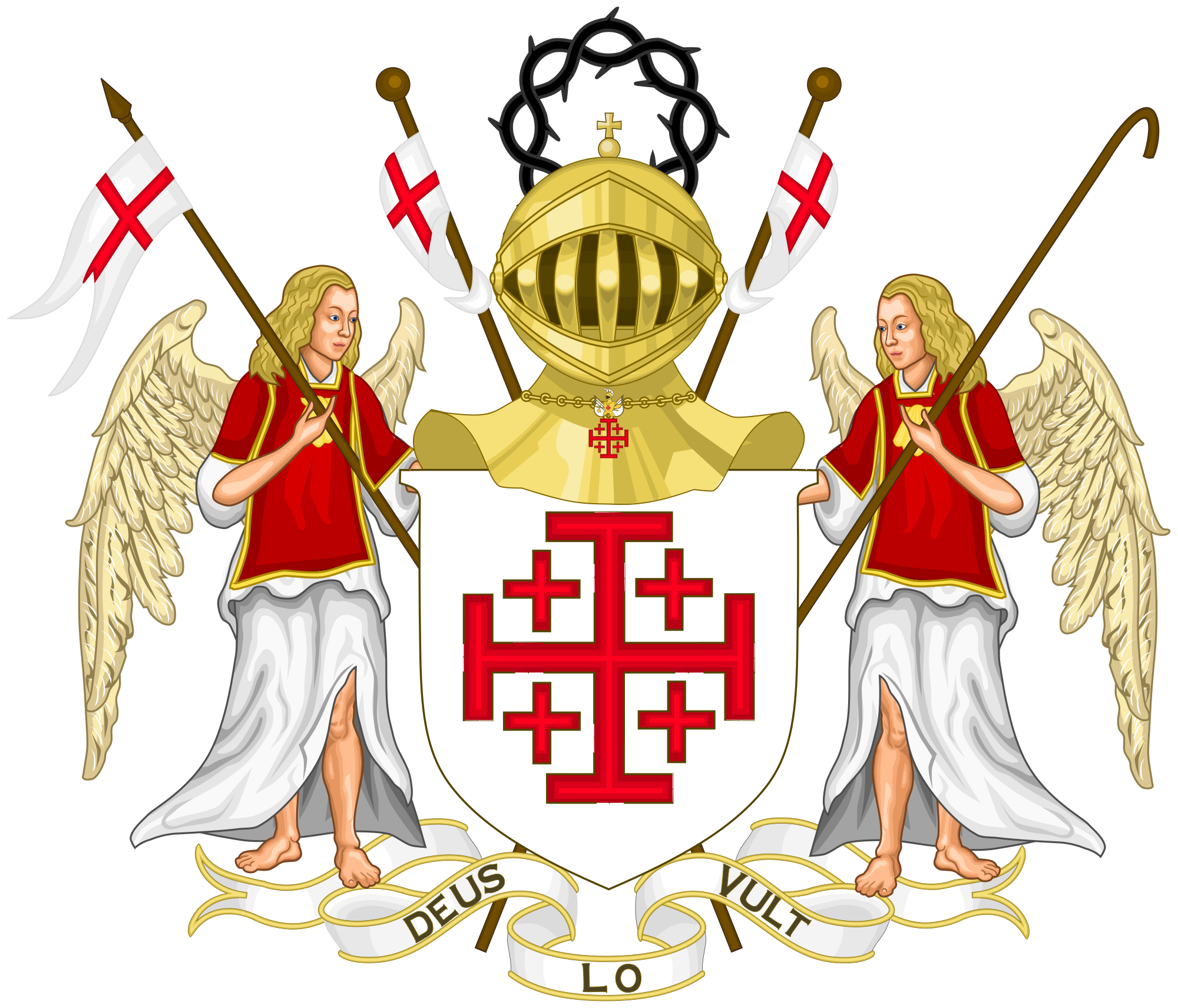
The creation of the Jerusalem Cross, the symbol of the Equestrian Order of the Holy Sepulchre of Jerusalem, is attributed to Duke Godfrey:
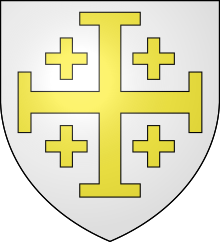


The meaning of the five crosses varies, mostly commonly being held to recall the Five Wounds of Christ, or the Cross of Christ and the Four Evangelists, or the Cross of Christ and the four corners of the world. The color of the Jerusalem Cross was later changed from gold to red.

To the rank of Knight Commander

Last week I received the happy news that I am to be promoted from the rank of Knight to that of Knight Commander of the Equestrian Order of the Holy Sephulchre of Jerusalem this coming October. One of the few remaining chivalric orders, the Equestrian Order of the Holy Sepulchre has a long history:
 
 
The Constitution of the Order states four specific purposes to which the Knights and Dames are committed:
  1. To strengthen in its members the practice of Christian life, in absolute fidelity to the Supreme Pontiff and according to the teachings of the Church, observing as its foundation the principles of charity of which the order is a fundamental means for assistance to the Holy Land;
  2. To sustain and aid the charitable, cultural and social works and institutions of the Catholic Church in the Holy Land, particularly those of and in the Latin Patriarchate of Jerusalem, with which the Order maintains its traditional ties;
  3. To support the preservation and propagation of the Faith in those lands, and promote interest in this work not only among Catholics scattered throughout the world, who are united in charity by the symbol of the Order, but also among all other Christians; and,
  4. To uphold the rights of the Catholic Church in the Holy Land.
Please join me in praying for the work of the Order and for our brothers and sisters in Christ living in the Holy Land.

25 February 2016

What is the Good Friday Collection?

Four weeks from today, a collection will be taken up throughout the Church at the direction of His Holiness Pope Francis to support the institutions and mission of the Church in the Holy Land. The funds received are forwarded to the Franciscans of the Custody of the Holy Land, who have been caretakers of the holy places for some eight centuries.

As so many of the faithful are fleeing the Holy Land and the Middle East generally, our prayerful and financial support is needed more than ever. The funds received in this universal collection are used in many ways to support and strengthen the faithful who remain in the Holy Land.

Last year, for example, the annual collection benefited the faithful in Iraq and Syria in these ways:
  • Supported 29 parishes, four homes for orphans, three academic institutions
  • Helped keep 16 schools open for over 10,000 pre-K through grade 12 students
  • Funded university scholarships for 295 students
  • Provided 398 homes benefiting Christian families
  • Helped rehabilitate over 100 homes for Christians families
  • Provided senior care facilities in Bethlehem and Nazareth
  • Created more than 1,500 jobs in the Holy Land
  • Preserved 74 sanctuaries and shrines from the life of Jesus and the prophets
  • Supported over 100 men preparing to be priests or brothers
The collection, however, not only benefited Iraq and Syria, but other places in the Holy Land in these ways:
  • In Old City of Jerusalem, 80 homes were renovated for Christian families
  • Senior care facilities were built in both Bethlehem and Nazareth
  • Archeological research was funded at Magdala
  • New parish centers were built in Jericho and Cana
 You can learn more about the projects funded by Good Friday Collection here.

As a Knight of the Equestrian Order of the Holy Sepulchre of Jerusalem, which provides 75% of the annual budget of the Latin Patriarchate of Jerusalem, one of my principle duties is to contribute both spiritually and financially toward the welfare of the Christians in the Holy Land and toward the holy places in the Holy Land. A related duty - and no less important - is to encourage others to join the Knights and Ladies of the Holy Sepulchre in this work.

As Saint Paul proclaimed the Gospel of Christ to the Gentiles throughout the world, he made it part of his mission to take up collections to assist the poor Christians of Jerusalem:
I hope to see you in passing as I go to Spain, and to be sped on my journey there by you, once I have enjoyed your company for a little. At present, however, I am going to Jerusalem with aid for the saints. For Macedonia and Achaia have been pleased to make some contribution for the poor among the saints at Jerusalem; they were pleased to do it, and indeed they are in debt to them, for if the Gentiles have com to share in their spiritual blessings, they ought also to be of service to them in material blessings. When therefore I have completed this, and have delivered to them what has been raised, I shall go on by way of you to Spain (Romans 15:24-28).
In much the same way, we, too, share in the spiritual blessings of the Christians who live in the land where Jesus walked. Therefore, we, too, should be of service to them in material blessings. Please, in these next few weeks, ask the Lord what contribution you can and ought to make to our brothers and sisters in the Holy Land. In this way, when the Good Friday Collection is taken up four weeks from today, may you and I be pleased to contribute toward it.

20 November 2015

Cardinal O'Brien says the "public is very blasé" about the plight of Christians in the Middle East

The Grand Master of the Equestrian Order of the Holy Sepulchre, His Eminence Edwin F. Cardinal O'Brien, recently addressed the dire plight of Christians in the Middle East when he spoke with members of the Order in Sydney, Australia. As the Catholic Review, reports, he spoke bluntly but truthfully:
“I think our public is very blasé about the whole thing,” he told The Catholic Weekly, newspaper of the Archdiocese of Sydney.

“We’re afraid to say that this is an extremist terrorist group that is basing their principles falsely on the tenets that they believe are theirs from God himself.

“Unless we face the facts, this radicalism, this extremism, is going to keep spreading.”

Most disturbing for Cardinal O’Brien is the lack of military response from the United States.

“We’ve had an opportunity to stop those forces,” he said.

Islamic State fighters attacked 35 Assyrian villages on the Khabur River in Syria in February, killing a dozen people, kidnapping more than 90 Assyrian Christians, burning two churches, and forcing more than 3,000 people to flee.

“We did nothing to stop them,” he said [more].

“And now those Christian villages have been eradicated, (people) killed, taken into slavery.

“What have we done about it?”
It is time for us to wake from our slumber and to step up our efforts, both communally and individually, to assist our brothers and sisters suffering for their faith in Christ.

17 January 2015

On the Pilgrim Shell

The Equestrian Order of the Holy Sepulchre of Jerusalem, in which I have the honor to be a Knight, has four principle aims:
  • To strengthen in its members the practice of Christian life, in absolute fidelity to the Supreme Pontiff and according to the teachings of the Church, observing as its foundation the principles of charity which make the Order a fundamental means of assistance to the Holy Land;
  • To sustain and aid the charitable, cultural and social works and institutions of the Catholic Church in the Holy Land, particularly those of and in the Latin Patriarchate of Jerusalem, with which the Order maintains traditional ties;
  • To support the preservation and propagation of the Faith in those lands, and promote interest in this work not only among Catholics scattered throughout the world, who are united in charity by the symbol of the Order, but also among all other Christians; and,
  •  To uphold the rights of the Catholic Church in the Holy Land.
We seek to fulfill these aims through daily prayer for our brothers and sisters in the Holy Land (especially through the intercession of Our Lady of Palestine), through our annual dues to the Order and other charitable gifts, and through at least one pilgrimage to the Holy Land, which, as you know, I recently completed.

The members of the Order who have completed a pilgrimage to the Holy Land and who have prayed at the Holy Sepulchre of the Risen Lord receive the Pilgrim Shell, the most significant decoration awarded by the Order, often from the Latin Patriarch himself.

The shell has long been the symbol of a pilgrim, in no small part due to the important medieval pilgrimage destination of Santiago de Compostela:
The identification of a seashell with a pilgrim is of ancient origin.  In the beginning, the shell was never awarded or conferred on the recipient as it is today.  Instead, it was a self-chosen decoration that the pilgrim proudly pinned on his own cloak, so that as he returned homeward, other pilgrims would know that the wearer had made it to the place of pilgrimage.

Legend has it that Saint James, the apostle, had been the apostle of the Iberian Peninsula and had first brought the Good News of salvation to the people of that part of the world.  He subsequently made his way back to Palestine to die and after death his body was returned to Spain to be buried in his own mission land in the city now called Santiago de Compostela, in honor of the apostle.  In the 9th Century, the place of his burial was rediscovered and gradually became a place of pilgrimage.

Before the first Crusade in the 11th Century, Christians were not allowed by the Seljuk Turks to visit the Holy Land and Jerusalem.  As a result, the faithful started to flow from all parts of Europe by different routes and streams, to pay homage to Our Lord at the spot where one of His apostles lay buried - Santiago de Compostela.  Each year thousands of pilgrims visited and prayed at the tomb of St. James.  Since Santiago de Compostela is so close to the sea, seashells were abundant and they became the badge of one who had traveled there.  As they started the long walk home, the shell on their garment was a symbol of encouragement to those whom they passed who were on their way to visit the Tomb of St. James.

As history changed, pilgrims once again started their arduous trips to Palestine and the land of Jesus, but the Sea Shell of Santiago de Compostela had become the sign of a successful pilgrimage, and out of faith and tradition it remained the badge of pilgrims [more].

I hope one day to make this pilgrimage, as well.

The Pilgrim Shell of the Equestrian Order of the Holy Sepulchre of Jersualem remains distinct from that earned by a pilgrimage to the tomb of Saint James, however, because it includes the Jerusalem Cross placed within the shell:

The Pilgrim Shell is worn on the cloak of a Knight or Lady at the center of the Jerusalem Cross on the left breast, or on the mozetta of a priest in the same location:

On 2 January 2015, my fellow pilgrims and I went to Latin Patriarchate to be received in audience by His Excellency the Most Reverend William Shomali, Auxiliary Bishop of Jerusalem. After speaking with us about the importance of the Equestrian Order of the Holy Sepulchre of Jerusalem and of the symbolism of the Pilgrim Shell, he awarded this decoration to me:

Bishop Shomali pins the shell to the mozetta.

Smiling for pictures gets a bit tiresome after a time.

13 September 2013

Pope to the Equestrian Order: Be witnesses of the light that faith gives

An English translation of His Holiness Pope Francis' address to the members of the Equestrian Order of the Holy Sepulchre of Jerusalem is now available via Zenit, with my emphases and comments:
Lord Cardinal,
Members of the Grand Mastery and Lieutenants,
Dear Brothers and Sisters!
I give my welcome to you all, who represent the Equestrian Order of the Holy Sepulcher of Jerusalem. In particular, I greet Cardinal Edwin O’Brien, Grand Master of the Order, and I thank him for the words he addressed to me on behalf of all. I greet the Grand Prior, His Beatitude Fouad Twal, Patriarch of Jerusalem of the Latins.
You are gathered in Rome on the occasion of the Order’s World Consultation, which is convoked every five years to reflect on the situation of the Catholic community in the Holy Land, to assess the activities carried out and to establish directives for the future. Held contemporaneously is the International Pilgrimage, which witnesses the participation of more than 2,000 people [as the number of pilgrims continued to grow, it would seem an updated figure was not provided to the Holy Father; the first number I had last week was 3,000; yesterday the Grand Magisterium was aware of more than 3,500 Knights and Ladies, out of a total of 23,000 members worldwide]. I thank you for your visit and wish to express my appreciation and encouragement for the initiatives of solidarity that the Order promotes in favor of the Holy Places, and which in the last years have been developed and expanded. In this Year of Faith, your pilgrimage to the Tomb of the Apostle Peter is marked by prayer and catechesis on the subject of faith. Beginning from these elements, I would like to be guided by three words, which I already proposed at the beginning of my ministry, but which can offer motives for reflection also to the activity of your Order. The three words are: journey, build and confess.
Journey. You are living the experience of pilgrimage, which is a great symbol of human and Christian life. Every one of us can be “errant” [during the audience, the live translator used the word "rambler" to express one without direction] or “pilgrim”: either errant or pilgrim. The times we are living witness many “errant” people, because they are deprived of an ideal of life and are often incapable of giving meaning to events of the world. With the sign of pilgrimage, you show you will not to be “errant.” Your journey is in history, in a world in which the boundaries are ever more widened, many barriers fall and our ways are linked ever more closely to those of others. Be witnesses of the profound meaning, of the light that faith gives; know how to preserve the great richness of values, of the wisdom of the past, but living intensely in the present, committed in our today, with a look to the future, opening horizons of hope with your work to give a human face to society.
And here is the second word: build. To journey to build the community, above all with love. The Equestrian Order of the Holy Sepulcher of Jerusalem has an almost age-old history: yours is one of the most ancient still active welfare and charitable Orders. Instituted for the custody of the Holy Sepulcher, it has enjoyed special attention from the Bishops of Rome. To build with charity, with compassion, with love. And, in fact, your pilgrimage also has a charitable end, in favor of brothers and sisters of the Holy Land, especially the neediest, of those who are living moments of suffering, tension and fear. And also of our Christian brothers who suffer so much. To them I address with great affection a greeting and embrace; to all – Christians and non-Christians --, I assure my daily prayer.
However, your journey to build stems from confessing the faith ever more profoundly; it grows from the constant commitment to nourish your spiritual life, from permanent formation for an ever more genuine and coherent Christian life. This is an important point for each one of you and for the whole Order, so that everyone will be helped to deepen his/her adherence to Christ: the profession of faith and the witness of charity are closely connected and are the qualifying and forceful points – points of force – of your action. An ancient bond links you to the Holy Sepulcher, perennial memorial of Christ crucified who was laid there and of the Risen Christ who conquered death. May Jesus Christ crucified and resurrected really be the center of your existence and of every personal and associative project. May you believe in the redemptive power of the Cross and the Resurrection, to offer hope and peace. In a particular way, the Land of Jesus is not so needy! Faith does not remove us from the responsibilities to which we are all called to assume, but on the contrary, it triggers and drives to a concrete commitment in view of a better society.
May the Lord help you to be always ambassadors of peace and love among brothers. He it is who will always render your work more fruitful. May the Virgin of Nazareth assist you in your mission to guard with love the Places where Christ passed doing good and healing. May my Blessing also accompany you, which I impart to you and to the whole Order.

Pope Francis receives the Equestrian Order

This evening the Holy Father Pope Francis received some 3,500 Knights and Ladies of the Equestrian Order of the Holy Sepulchre of Jerusalem in an audience the Paul VI Hall.  The Knights and Ladies have gathered in Rome for an international pilgrimage to pray at the tombs of the Apostles Peter and Paul, to make a public profession of the Creed, and to renew their fidelity to the Church and to the person of the Successor of Peter in this Year of Faith.

Following an conference given by His Excellency Archbishop Salvatore Fisichella, President of the Pontifical Council for Promoting the New Evanglization, His Eminence Edwin Cardinal O'Brien, Grand Master of the Order, addressed the Holy Father and present the Knights and Ladies to him.


His Holiness briefly addressed the members of the Order (the Italian text has been posted; I would work on a translation, but at the present moment I'm out of energy), hearkening back to the three words he proposed just after his election to the See of Peter: walking, building, and professing.


Relating the walking of the Knights and Ladies to this earthly pilgrimage, His Holiness brought together his three words, saying, "your journeying in order to build is born of [your] professing the faith ever more profoundly, it grows from ongoing efforts to nourish your spiritual life, from a lifelong Christian formation for an ever more authentic and coherent Christian life."

The Equestrian Order has, as one of its chief aims, the support, maintenance, and growth of the Church in the Holy Land by providing for all of the needs of the Patriarch of Jerusalem and, following a recent decision of the Order, throughout the Holy Land.  To this end, the Order funds the work of the Church, builds schools, and helps support Christians financially in their daily struggles.  The building done by the Order is, however, not only physical; each of the Knights and Ladies promise to pray daily for their brothers and sisters who live in the land where the Savior himself walked.

Pope Francis concluded his remarks by urging the Knights and Ladies to "believe in the redemptive power of the Cross and the Resurrection."  It is this belief, strengthened in these days of pilgrimage, that have led the members of the Order to devote themselves to the work of charity, conscious of what His Holiness Benedict XVI wrote in Porta Fidei: "Faith without charity bears no fruit, while charity without faith would be a sentiment constantly at the mercy of doubt.  Faith and charity each require the other, in such a way that each allows the other to set out along its respective path" (14).

The feel of the audience with Pope Francis was notably different than the audiences with Pope Emeritus Benedict XVI, a difference that may be attributed to the different personalities of the two Popes or to the make-up of those in the audience.  I need to ponder this a bit more in the day or so before putting more thoughts together.

A Prayer of the Knights and Ladies

O Lord Jesus Christ, for Your five wounds
that we carry on our insignia
we pray to You.

Give us the strength to love all whom
Your Father has created
and, more so, our enemies.

Free our soul and heart
from sin, from partiality,
from egoism and from cowardice
so that we can be worthy of Your sacrifice.

Let Your Spirit fall upon us all,
the Knights and Ladies of the Holy Sepulchre,
so that it may render us convinced and sincere ambassadors
of peace and love among our brothers and sisters and, especiallly,
among all those who think they do not believe in You.

Give us Faith
to face all the problems of everyday life
and to deserve, one day, to approach,
humbly but without fear,
Your presence.

Amen.

12 September 2013

The days of pilgrimage have come

In his Apostolic Letter Porta Fidei in which he announced the present Year of Faith, His Holiness Benedict XVI wrote: "Religious communities as well as parish communities, and all ecclesial bodies old and new, are to find a way, during this Year, to make a public profession of the Credo "(8).  He also wrote that, "Profession of faith is an act both personal and communitarian" (10).

With these words in mind, the Grand Magisterium of the Equestrian Order of the Holy Sepulchre of Jerusalem announced an International Pilgrimage of the Order to Rome to pray at the tombs of the Apostles Peter and Paul and public recite together the words of the Creed. The Order was one of the first to take up the Holy Father's summons to this Year of Faith.

The more solemn events of the pilgrimage begin tomorrow morning with the Holy Mass offered in the Basilica of St. Paul Outside the Walls.  As I understand it, the opening Mass was to have been celebrated in the Basilica of St. Mary Major, but the number of pilgrims has became too great.

Tomorrow afternoon, the Holy Father Pope Francis will received the 3,000 or so Knights and Dames - there are 23,000 members in the Order worldwide - in an audience in the Paul VI Hall, which will be preceded by a conference given by His Excellency the Most Reverend Salvatore Fisichella, President of the Pontifical Council for Promoting the New Evangelization.

On Saturday we will gather for prayer in the Basilica of St. John Lateran and offer the Mass in the Basilica of St. Peter, while on Sunday we will tour the Vatican Gardens and conclude the pilgrimage with the Holy Mass again in the Basilica of St. Paul Outside the Walls.

His Eminence Edwin Cardinal O'Brien, Grand Master of the Order, will preside at the Masses.

Writing to the Knights and Dames in the pilgrimage the Governor General of the Order offers a helpful reminder of the two-fold significance of this pilgrimage to the tombs of the Apostles Peter and Paul:
  1. to strengthen our faith through a trip which is physical route [admittedly, mine will be rather short] but is also and more importantly a spiritual path; and,
  2. at the same time, in the wake of generations of pilgrims who came to Rome to worship at the tombs of the Apostles, to restate our unswerving loyalty to Peter's successor, in the person of Pope Francis, and to his teachings.
These are important spiritual goals for any pilgrimage to Rome, but especially so for the members of our Order.

I am very much looking forward to this pilgrimage and am beginning to grow excited in anticipation of the blessings that will come from it.  I am especially happy that two of my fellow Knights and two Dames have come to Rome from the Diocese of Springfield in Illinois to join the pilgrimage, with whom I had dinner the other night.


Please remember us in your prayers in these days of pilgrimage, that having visited to the tombs of the Apostles Peter and Paul and renewed our own professions of faith, we may return home - they to Illinois and me to the other side of Rome - strengthened in fidelity to the Lord and his Church, and in charity for our Christian brothers and sisters in the Holy Land and throughout the Middle East.

I ask you to pray especially that, in the words of the Governor General, this pilgrimage will become for us "the image of Christian life itself, of man, a pilgrim on earth, waiting to reach his heavenly destination."

Thank you, and know that you will be remembered in my prayers at the tombs of the Apostles.

10 September 2013

All is ready for the pilgrimage

This morning I set out for the Piazza di San Calisto to collect my bag and badge for this weekend's International Pilgrimage of the Equestrian Order of the Holy Sepulchre of Jerusalem to Rome for the Year of Faith proclaimed by His Holiness Benedict XVI.

Since my registration was made only late last week, I did have some concern as to whether or not everything would be ready upon my arrival and was very happy to find that indeed it was.

The bag provided for the pilgrimage is simple, yet should be useful for carrying papers and books, an iPad (a laptop might be too heavy) or, thinking like a priest, an amice, alb, cincture, and stole (and perhaps a surplice and mozetta).

The pilgrimage book is very helpful with a letter of welcome from His Eminence Edwin Cardinal O'Brien, Grand Master of the Order; an introduction about Christian pilgrimages to the Eternal City; the text of the Pope Emeritus' Apostolic Letter Porta Fidei; a brief write-up about the four Papal Basilicas; the text of the Creed and the texts for the various Masses; and two prayers particular to the Order.

One of the happy things about living in Rome is that you are always noticing something new, an unexpected sight here and a surprise there.  As I walked along this morning an inscription above a door caught my attention:

You alone are Lord.
This is a good reminder for us everyday; Rome is filled with such reminders.

In the vicinity of the Piazza di San Calisto a sign outside of a restaurant caught my attention, not so much as a spiritual reminder but as a good bit of humor:


I may have to give this place a try.

18 September 2011

Priests and Knights

This past weekend the Knights and Ladies of the North Central Lieutenancy of the Equestrian Order of the Holy Sepulchre of Jerusalem met for their Annual Meeting, Promotions and Investiture in Chicago.

Rev. Christopher J. Comerford, KCHS; Father Christopher A. House, KCHS; Monsignor Carl A. Kemme, V.G., KHS; Most Reverend Thomas John Paprock, KC*HS; Rev. David J. Hoefler, KHS; and Rev. Daren J. Zehnle, KHS.
Yesterday, Fathers Christopher J. Comerford and Christopher A. House were promoted to the rank of Priest Commanders.  Today, Monsignor Carl Kemme and Fathers David Hoefler and I were invested as Knights of the Holy Sepulchre by His Eminence Francis Cardinal George, O.M.I., Archbishop of Chicago and Grand Prior of the North Central Lieutenancy of the Equestrian Order of the Holy Sepulchre of Jersualem.

As Cardinal George invested us with a stole bearing the Jerusalem Cross, the symbol of the Order, he said to us:

Receive this symbol, adorned with the Cross of Our Lord Jesus Christ that brings salvation.  May it be for you a reminder to faithfully profess the faith and to live a virtuous life; may it help you work for the spreading of the Kingdom of Christ.

Afterwards he presented us with the insignia of the Order to be worn at formal events.

01 September 2011

Persecution Watch: Middle East: Will Abp. O'Brien help?

His Holiness the Pope recently appointed His Excellency the Most Reverend Edwin F. O'Brien Pro-Grand Master of the Equestrian Order of the Holy Sepulchre of Jerusalem, an Order Knights charged with fostering the Christian Faith in the land of its birth.
Reflecting on the appointment, John Allen wonders if Archbishop O'Brien will be able to call the world's attention to the plight of Christians in the Middle East.
His text follows, with my emphases:
Archbishop Edwin O’Brien of Baltimore is known for rarely pulling his punches, whether it’s openly wondering if the Legionaries of Christ are capable of reform in the wake of the scandals surrounding their founder, or pushing Maryland Gov. Martin O’Malley on gay marriage.

Here’s hoping O'Brien brings the same "tell-it-like-it-is" style to his new job as pro-Grand Master of the Equestrian Order of the Holy Sepulchre of Jerusalem, because the embattled Christians of the Middle East desperately need a real political heavyweight to take up their cause.

The Vatican announced today that O’Brien, 72, will replace Cardinal John Foley as the head of the Knights of the Holy Sepulchre, a Vatican-sponsored body designed to defend and promote the Christian presence in the Holy Land.

Traditionally, the position has been little more than a sinecure – a quasi-honorary position given to ecclesiastics at the end of their careers, providing them with a route to becoming a cardinal without much real responsibility.

One could also interpret the move in those terms for O’Brien, the dictionary definition of a loyal churchman whose 2007 appointment to Baltimore meant that he wouldn’t get the ultimate prize of becoming the Archbishop of New York. (O’Brien was born in New York in 1939 and was a priest of the archdiocese.) In effect, giving him the Order of the Holy Sepulchre could be styled as a sort of consolation prize, putting him in line to join the College of Cardinals sometime in the next couple of years.

Yet the position is too important to treat as a party favor, because in effect – that is, in terms of its potential, not how it’s actually been used – the Grand Master amounts to a cabinet-level Vatican position exclusively devoted to the fate of Christianity in the land of its birth. Occupied by someone with drive and political savvy – i.e., someone like Edwin O’Brien at his best – it could become the “tip of the spear” for a far more concentrated and effective global Catholic response to the realities facing Christians in today’s Middle East.

The situation is, of course, dire in the Holy Land itself (Israel and the Palestinian Territories), where the Christian footprint has been shrinking for more than a century, and where the exodus has been compounded both by the pathology of the Israeli/Palestinian conflict and by the rise of Islamic radicalism. I recently reported on a conference in London where the Latin Patriarch of Jerusalem, Fouad Twal, warned that the Holy Land risks becoming a “spiritual Disneyland” – full of glittering rides and attractions, but empty of its indigenous Christian population.

Yet Christianity is also at risk in many other parts of today’s Middle East.

Over the weekend, the New York Times magazine published a compelling piece by Negar Azimi sketching the accelerating tendency among Coptic Christians in Egypt to flee. There are an estimated 10 million Copts, one of the largest and oldest Christian communities in the region, and today a growing number are on the verge of pulling up roots – afraid that the democratic promise of the Arab Spring will give way to an Islamic theocracy dominated by Salafists, who openly describe Christian churches as “mafias harboring weapons and sinners.”

In some ways, Egypt could turn into a replay of Iraq, which was itself home to a large Christian community estimated at roughly two million prior to the First Gulf War in 1991. Today the best guess is that perhaps 400,000 Christians remain, meaning that Iraq has lost roughly two-thirds of its Christian population in the arc of just two decades.

All this ought to be of massive concern to Christians in the West, perhaps especially in the United States. Here’s why:
  • The Middle East is where Christianity began, and thus it’s critical to an authentic sense of Christian identity.
  • The West plays an enormous role in the affairs of the Middle East, and thus Christians in the West have a special responsibility to come to the aid of their struggling brothers and sisters in that part of the world.
  • The most passionate vision of religious freedom anywhere in the Christian world today comes from the Middle East, where democracy, tolerance, and a healthy distinction between religion and the state represent a survival strategy. Boosting the Christian presence in the region amplifies that voice in the global church.
  • Christianity is one key to peace in the region, and therefore peace in the world. The presence of Christianity suggests that pluralism is possible in the Middle East – and, conversely, the disappearance of Christianity would send precisely the wrong signal.
As compelling as those arguments may be, somebody with real political heft needs to make them, in a fashion that will cause the Catholic world to sit up and take notice. Somebody needs to cajole, shame, badger and bully Catholic institutions, as well as the rank and file, into getting involved.

Prior to today, it wasn’t exactly clear who that “somebody” might be, even in theoretical terms. The Vatican has put O’Brien in a position to become that somebody, and if he seizes the opportunity, he could go down as the most consequential Grand Master in hundreds of years.

This is almost certainly O’Brien’s last job in the church. Let’s pray he makes it count.

04 August 2011

An evening with Equestrian Order

Last evening, His Excellency Bishop Paprocki celebrated the Holy Mass with the Knights and Ladies of the Equestrian Order of the Holy Sepulchre of Jerusalem at the annual gathering of the Knights of Ladies living within the Diocese of Springfield in Illinois.

Eighteen Knights and Ladies - of whom four are priests and one a deacon (the Bishop, too, is a Knight) were present for Mass to pray for the needs of the Holy Land the repose of His Excellency the Most Reverend Pietro Sambi, formerly not only Apostolic Nuncio to the United States but also Apostolic Nuncio to Israel.

They are, for the most part, a quiet and small group whose works and purpose are little known by the faithful as a whole.

The Equestrian Order has its chief tasks the following purposes stated in the Constitution of 1977:
  1. To strengthen in its members the practice of Christian life, in absolute fidelity to the Supreme Pontiff and according to the teachings of the Church, observing as its foundation the principles of charity of which the Order is a fundamental means for assistance to the Holy Land.
  2. To sustain and aid the charitable, cultural, and social works and institutions of the Holy Land, particularly those of and in the Latin Patriarchate of Jerusalem with which the Order maintains traditional ties.
  3. To support the preservation and propagation of the faith in those lands, interesting in this work the Catholics scattered through the world, united in charity by the symbol of the Order, and also all brother Christians.
  4. To sustain the rights of the Catholic Church in the Holy Land.
To this end, Bishop Paprocki told the Knights and Ladies:
Membership in our Order should, in the words of Blessed Pope John Paul II, "make you feel more and more the burden and responsibility of distinguishing your toil with an exemplary Christian life with consistent and generous adherence to Christ and to the Church.  In this say," the Pope said, "you will give before the world the best confirmation of the reason for its existence and activity."  I, too, urge you to distinguish yourselves in this way so that more men and women might be added to our Equestrian Order.

As our membership increases, so, too, will our holiness and our ability to help foster the faith of Jesus Christ in the Holy Land and to lend our prayers and financial support to our often persecuted brothers and sisters living in Jerusalem and the surrounding environs.
The Equestrian Order of the Holy Sepulchre of Jerusalem is the only Order of Chivalry under the protection of the Holy See, with membership in the Order being the highest papal honor bestowed on both laity and clergy.

The Order has its origins in A.D. 1099 when it was established by Duke Godfrey de Bouillon - one of the Nine Worthies known the medievals, among whom was King Arthur - who gathered together knights who were willing to give their lives defending the newly recovered Holy Sepulchre, the tomb in which the crucified body of Jesus Christ was laid to rest.  The Holy Sepulchre was recovered through Godfrey's distinguished and capable leadership and the Kingdom of Jerusalem was established.  When he established the Kingdom, Godfrey refused to be made King of Jerusalem because he did want to crowned with the gold in the city where Christ was crowned with thornes.  Godfrey's successors, beginning with his brother Baldwin, did not feel the same.

The new Order received Papal approval in 1113 from Pope Pascal II and was reorganized in 1847 by Pope Pius IX.

For the symbol of the Order, Godfrey chose his own insignia, the Red Cross of the Five Wounds of Christ, more commonly known as the Jerusalem Cross:


When used by Godfrey, the crosses were gold but for the Order they were changed to red.

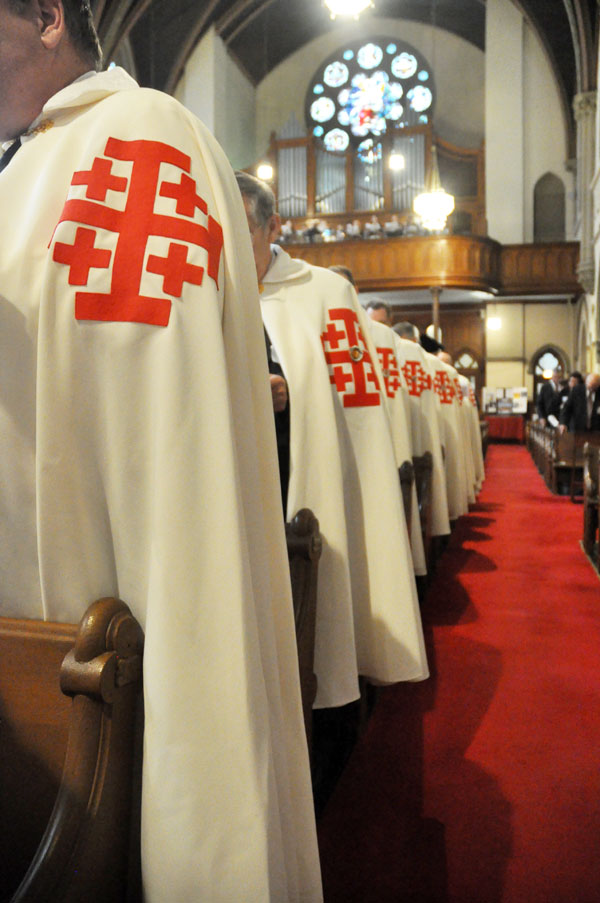
In the early years of the Order, the Knights took the evangelical counsels of poverty, chastity and obedience and wore white robes marked with the Red Cross of the Five Wounds of Christ.  The knights also followed a Rule.

Curiously, one might say the Order was "ahead of its time" when in 1888 Pope Leo XIII allowed women to be admitted to the Order as Ladies of the Holy Sepulchre.  Doyle says of this permission: "This was not to be a 'ladies auxiliary,' but women were to be admitted to all degrees of rank on the same basis as men and to wear the insignia of those degrees."  This bit of historical trivia might be helpful when someone says the Church is always trying to suppress women.

The Order celebrates four patronal feast days throughout the year: the feast of Saint Helena on August 18th; the feast of Pope Saint Pius X on August 21st; the feast of the Exaltation of the Holy Cross on September 14th; and the feast of Our Lady of Palestine on the last Sunday of October.

Members of the Order are moved by a profound love of the Cross of Jesus Cross and by a deep concern for the Holy Land, both its places and its people.  As William J. Doyle, Knight Grand Cross, has written, "membership in this Order entails a personal, solemn commitment to an active apostolate, namely, the fostering and support of a viable, vigorous Christian Presence in the Holy Land."

It has been said that the head or the Order is in Rome, but the heart of the Order is in Jerusalem.