Showing posts with label Holy Land. Show all posts

06 June 2016

New Custos of the Holy Land begins his ministry

The Custody of the Holy Land - which has its origins in 1217 when Saint Francis of Assisi decided to send some of his friars to walk where the Lord Jesus himself lived, died, and rose - today celebrates a day of great joy as Father Francesco Patton, O.F.M. succeeds Father Pierbattista Pizzaballa, O.F.M. in his new ministry as Custos:


As he takes up this vital office in the service of the Church, Father Patton said he is filled with both "trepidation" and "great confidence" because "I believe in the value of obedience and so I believe that the will of God passes through very concrete human mediations, such as the willingness to take up this service as requested by the Order."

The work of the Custos is of great importance, not only for the Holy Land but for Christians everywhere. The Custody of the Holy Land describes his ministry as follows:
The main task of the Custos, in addition to animating the life of the friars, is to coordinate and direct the reception of pilgrims who come to the Holy Land for pilgrimage and pray at the shrines of our Redemption. This task was bestowed by the Holy See over 600 years ago. The term used at those times to designate this task was "custody" of the holy places, from which derived the terms still in use "Custody" and "Custos ".

The first and most important role of the Custos, therefore, is to receive the pilgrims at the Holy Shrines, offering them spaces of prayer and making available hostels for those who cannot afford expensive hotels.

The Custos ensures that friars are available to receive and talk with pilgrims at the holy places. His jurisdiction includes all the Catholic Christian sanctuaries. He ensures their economic support in order that this important function is fulfilled.

Another mission that the Custos assumes is to coordinate information about the Holy Land and instill in the Christians of the world the "loving care" for these sites: archaeological excavations at the holy places, publication of ancient pilgrimages and above all, the study of the Bible through geography and history of these same sites where the events took place. For this reason the Custody has set up the SBF, FAI, FPP, to name a few. These activities depend mainly on the Custos who sponsors such initiatives.

Another important task the Custos undertakes is to care for and sustain, in agreement with the local church, the Christian presence in the Holy Land through various initiatives. This includes ministry to schools and parishes and is done in conjunction with the local church [more].
I congratulate Father Patton and invite you to remember him and his ministry in your daily prayers.

25 February 2016

What is the Good Friday Collection?

Four weeks from today, a collection will be taken up throughout the Church at the direction of His Holiness Pope Francis to support the institutions and mission of the Church in the Holy Land. The funds received are forwarded to the Franciscans of the Custody of the Holy Land, who have been caretakers of the holy places for some eight centuries.

As so many of the faithful are fleeing the Holy Land and the Middle East generally, our prayerful and financial support is needed more than ever. The funds received in this universal collection are used in many ways to support and strengthen the faithful who remain in the Holy Land.

Last year, for example, the annual collection benefited the faithful in Iraq and Syria in these ways:
  • Supported 29 parishes, four homes for orphans, three academic institutions
  • Helped keep 16 schools open for over 10,000 pre-K through grade 12 students
  • Funded university scholarships for 295 students
  • Provided 398 homes benefiting Christian families
  • Helped rehabilitate over 100 homes for Christians families
  • Provided senior care facilities in Bethlehem and Nazareth
  • Created more than 1,500 jobs in the Holy Land
  • Preserved 74 sanctuaries and shrines from the life of Jesus and the prophets
  • Supported over 100 men preparing to be priests or brothers
The collection, however, not only benefited Iraq and Syria, but other places in the Holy Land in these ways:
  • In Old City of Jerusalem, 80 homes were renovated for Christian families
  • Senior care facilities were built in both Bethlehem and Nazareth
  • Archeological research was funded at Magdala
  • New parish centers were built in Jericho and Cana
 You can learn more about the projects funded by Good Friday Collection here.

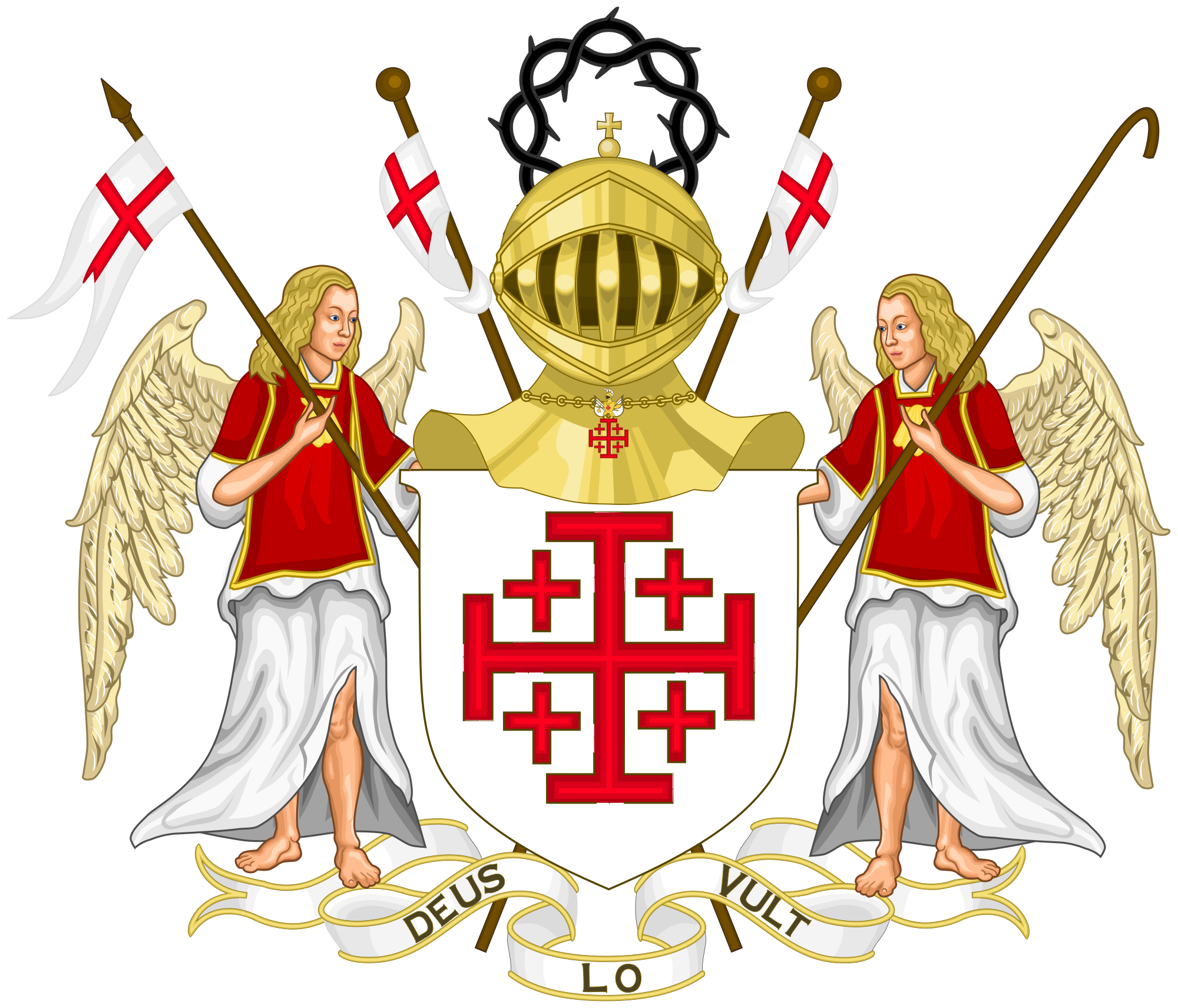
As a Knight of the Equestrian Order of the Holy Sepulchre of Jerusalem, which provides 75% of the annual budget of the Latin Patriarchate of Jerusalem, one of my principle duties is to contribute both spiritually and financially toward the welfare of the Christians in the Holy Land and toward the holy places in the Holy Land. A related duty - and no less important - is to encourage others to join the Knights and Ladies of the Holy Sepulchre in this work.

As Saint Paul proclaimed the Gospel of Christ to the Gentiles throughout the world, he made it part of his mission to take up collections to assist the poor Christians of Jerusalem:
I hope to see you in passing as I go to Spain, and to be sped on my journey there by you, once I have enjoyed your company for a little. At present, however, I am going to Jerusalem with aid for the saints. For Macedonia and Achaia have been pleased to make some contribution for the poor among the saints at Jerusalem; they were pleased to do it, and indeed they are in debt to them, for if the Gentiles have com to share in their spiritual blessings, they ought also to be of service to them in material blessings. When therefore I have completed this, and have delivered to them what has been raised, I shall go on by way of you to Spain (Romans 15:24-28).
In much the same way, we, too, share in the spiritual blessings of the Christians who live in the land where Jesus walked. Therefore, we, too, should be of service to them in material blessings. Please, in these next few weeks, ask the Lord what contribution you can and ought to make to our brothers and sisters in the Holy Land. In this way, when the Good Friday Collection is taken up four weeks from today, may you and I be pleased to contribute toward it.

05 April 2015

The importance of where the young man sat in the tomb

Inside the empty tomb
My own recent experience of the empty tomb of Jesus the Nazarene is still very fresh in my mind. So it was that as I proclaimed last night the account of the Resurrection of the Lord Jesus Christ as recorded by Saint Luke, I was particularly struck by one simple detail he provides for us:
And entering the tomb, they saw a young man sitting on the right side, dressed in a white robe; and they were amazed (Mark 16:5).
Notice where the young man sat.

The first thing you notice on entering the tomb of Christ is that it is very small, so small, in fact, that taking pictures of the entire tomb is very difficult (if even possible). Four people can stand shoulder to shoulder in the tomb; you might possibly be able to squeeze in a fourth person.

The second thing you notice is that on right side is a stone slab on which the body of Jesus was laid. The slab extends the length of the wall. Consequently, if the young man was "sitting on the right side of the tomb," he was sitting on the very stone on which Jesus was laid in the tomb! There is simply no other possibility.

As I read that passage of the Gospel, I imagined the young man almost reclining on the precious slab, as if to mock death with Saint Paul: "O death, where is your victory? O death, where is your sting" (I Corinthians 15:55)? I also imagined the young man laughing as he said to the women, "He has risen, he is not here; see the place where the laid him" (Mark 16:6).

Had I not made a pilgrimage to the Holy Land, the importance of this seemingly obscure detail of Mark's account would have been lost on me. This is why the Holy Land itself has been called the fifth Gospel.

10 January 2015

Did Jesus make angels in the winter snow?

In his inquisitive and memorable song "Boy Like Me," Rich Mullins asks of Jesus, "Did you ever make angels in the winter snow?"


It certainly is possible that the Child of Bethlehem did so, for it does snow with some regularity in the Holy Land. Riding through the Holy Land on a bus, I was greatly surprised to see how unlike a desert the Holy Land is.

Consider this picture of Manger Square taken yesterday and shared by the Facebook group Christmas in Bethlehem:


As much as I would like to be back in the Holy Land, it seems I left just in time. So far, this continues to be my first winter without seeing any snow in person.