Showing posts with label PopeFrancis. Show all posts

15 April 2015

If you can read medieval Latin script, I need your help

One of my professors at Quincy University once complained about having to read Merovingian shorthand script (which is apparently rather difficult to make out). I found his grumbles amusing at the time, but now have some sympathy for him.

Because of our shared devotion to il Volto Santo (the Holy Face) and our common desire to make it known far and wide, Mr. Paul Badde sent to me this image of an intriguing manuscript:
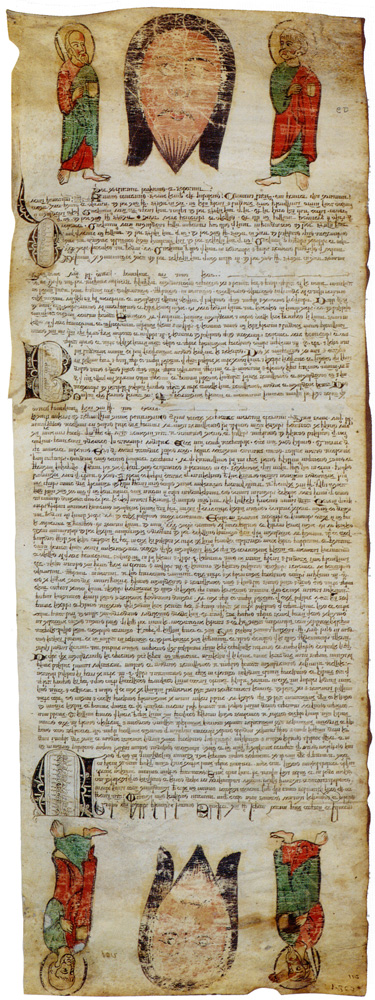

It is the letter of Sylvester of Adria, a scribe at the court of Pope Boniface VIII, written on 22 February 1300 in connection with the first Jubilee. The letter is divided into three parts:
  1. the Bull of Pope Boniface VIII, Antiquorum habet fida relatio;
  2. clarifications about the word "jubilee" being absent from the Bull; and,
  3. answers to certain questions about the jubilee presented to Boniface VIII
I have been able to find the text and translation of the Bull itself, but I have not been able to find either the text or a translation of the second parts of the letter of Sylvester, the two parts which most interest me.
 
So it was that I sent an e-mail last night to the Biblioteca del Comune e dell'Accademia etrusca in Cortona, Italy where the letter is housed, asking if it might be possible for me to go and have a look at the letter, make a transcription of it, and take photographs of it.

Very early this morning - before 8:00 a.m. - I was quite surprised to have a response from the library indicating that I could go and study the letter, but that I could not take photographs of it. Instead, I could request a high resolution jpeg of the letter for the purposes of transcription and translation. I did so, and received this file early this afternoon (it was the most efficient and easiest request I've made yet to any Italian bureaucracy).

You can imagine my delight, then, when I opened the file, enlarged it enough to have a good look at the text, and my great disappointment when I realized what my college professor meant: I cannot make out the medieval script! If you can read these letters, I need your help:

Clicking on the image should enlarge it
Some of the characters I can make out, but enough of them for a transcription. If you are able to read this script and would be willing to make a transcription of the original letter for me (it measures 63cm in length, including the images at the top and bottom), please contact me via e-mail to dzehnle[at]gmail[dot]com. I should be able to work my way through the Latin from a transcription.

In the end, I should like to see what connections this jubilee bull might have with that of Pope Francis' Misericordiae Vultus (Face of Mercy), the possible connections of which should be somewhat obvious from the images on this letter: the Holy Face of Jesus between Saints Peter and Paul.

05 September 2013

Calls for peace

His Holiness Pope Francis renewed his call for peace in Syrian, in the Middle East, and throughout the day yesterday, saying:
This coming Saturday we will live together a special day of fasting and prayer for peace in Syria, the Middle East, and throughout the world. I renew the invitation to the whole Church to live this day intensely, and even now I express gratitude to the other Christian brethren, to the brethren of other religions and to the men and women of good will who desire to join in this initiative, in places and ways of their own. I especially urge the Roman faithful and pilgrims to participate in the prayer vigil here in St. Peter's Square at 19.00, in order to ask the Lord for the great gift of peace. May a powerful cry for peace go up from every land [emphasis mine]!
In answer to the Holy Father's plea, the Grand Mufti of Syria, in the Sunni tradition, has welcomed Pope Francis' call.  In a letter sent through diplomatic channels, Ahmed Badreddin Hassou wrote to the Holy Father, saying, "We will be together on September 7, to raise our plea to God," and proposed to "organize a spiritual summit with religious leaders in Damascus or in the Vatican: so maybe we can stop the fire of those who want to destroy the land of Abraham, Moses, Jesus, Muhammad."  Whether such a summit takes place and where remains to be seen.

His Eminence Timothy Cardinal Dolan, Archbishop of New York and President of the United States Conference of Catholic Bishops, also wrote yesterday to President Obama assuring him of the prayers of the U.S. Bishops and urging the President do seek peace:
We have heard the urgent calls of the Successor of Saint Peter, Pope Francis, and our suffering brother bishops of the venerable and ancient Christian communities of the Middle East.  As one, they beg the international community not to resort to military intervention in Syria.  They have made it clear that a military attack will be counterproductive, will exacerbate an already deadly situation, and will have unintended negative consequences.  Their concerns find a strong resonance in American public opinion that questions the wisdom of intervention and in the lack of international consensus.
 Last week, a community of Trappist nuns in Aleppo wrote a letter in which they considered the prospect of war in Syria:
Will they make us breathe the toxic gases of the depots they hit, tomorrow, so as to punish us for the gases we have already breathed in?
The people are straining their eyes and ears in front of the television: all they’re waiting for is a word from Obama!
A word from Obama? Will the Nobel Peace Prize winner drop his sentence of war onto us? Despite all justice, all common sense, all mercy, all humility, all wisdom?
The Pope has spoken up, patriarchs and bishops have spoken up, numberless witnesses have spoken up, analysts and people of experience have spoken up, even the opponents of the regime have spoken up…. Yet here we all are, waiting for just one word from the great Obama? And if it weren’t him, it would be someone else. It isn’t he who is “the great one,” it is the Evil One who these days is really acting up.
The problem is that it has become too easy to pass lies off as noble gestures, to pass ruthless self-interest off as a search for justice, to pass the need to appear [strong] and to wield power off as a “moral responsibility not to look away…"
 The world is calling for peace, but will those entrusted with the common good heed these cries?

24 March 2013

Pope Francis' Three Words: Joy, Cross, Youth

Here follows the text of the homily preached by Pope Francis today in St. Peter's Square for the Mass of Palm Sunday of the Passion of the Lord, via Vatican Radio and with my emphases:
1. Jesus enters Jerusalem. The crowd of disciples accompanies him in festive mood, their garments are stretched out before him, there is talk of the miracles he has accomplished, and loud praises are heard: “Blessed is the King who comes in the name of the Lord. Peace in heaven and glory in the highest!” (Lk 19:38).

Crowds, celebrating, praise, blessing, peace: joy fills the air. Jesus has awakened great hopes, especially in the hearts of the simple, the humble, the poor, the forgotten, those who do not matter in the eyes of the world. He understands human sufferings, he has shown the face of God’s mercy, he has bent down to heal body and soul. Now he enters the Holy City!

It is a beautiful scene, full of light, joy, celebration.

At the beginning of Mass, we repeated all this. We waved our palms, our olive branches, we sang “Blessed is the King who comes in the name of the Lord” (Antiphon); we too welcomed Jesus; we too expressed our joy at accompanying him, at knowing him to be close, present in us and among us as a friend, a brother, and also as a King: that is, a shining beacon for our lives. And here the first word that comes to mind is “joy!” Do not be men and women of sadness: a Christian can never be sad! Never give way to discouragement! Ours is not a joy that comes from having many possessions, but from having encountered a Person: Jesus, from knowing that with him we are never alone, even at difficult moments, even when our life’s journey comes up against problems and obstacles that seem insurmountable, and there are so many of them! We accompany, we follow Jesus, but above all we know that he accompanies us and carries us on his shoulders. This is our joy, this is the hope that we must bring to this world of ours. Let us bring the joy of the faith to everyone!

2. But we have to ask: why does Jesus enter Jerusalem? Or better: how does Jesus enter Jerusalem? The crowds acclaim him as King. And he does not deny it, he does not tell them to be silent (cf. Lk 19:39-40). But what kind of a King is Jesus? Let us take a look at him: he is riding on a donkey, he is not accompanied by a court, he is not surrounded by an army as a symbol of power. He is received by humble people, simple folk. Jesus does not enter the Holy City to receive the honours reserved to earthly kings, to the powerful, to rulers; he enters to be scourged, insulted and abused, as Isaiah foretold in the First Reading (cf. Is 50:6). He enters to receive a crown of thorns, a staff, a purple robe: his kingship becomes an object of derision. He enters to climb Calvary, carrying his burden of wood. And this brings us to the second word: Cross. Jesus enters Jerusalem in order to die on the Cross. And it is here that his kingship shines forth in godly fashion: his royal throne is the wood of the Cross! I think of what Benedict XVI said to the cardinals: "You are princes but of a Crucified King"...Jesus says: “I am a King”; but his power is God’s power which confronts the world’s evil and the sin that disfigures man’s face. Jesus takes upon himself the evil, the filth, the sin of the world, including our own sin, and he cleanses it, he cleanses it with his blood, with the mercy and the love of God. Let us look around: how many wounds are inflicted upon humanity by evil! Wars, violence, economic conflicts that hit the weakest, greed for money, which no-one can bring with him, my grandmother would say, no shroud has pockets! Greed for money, power, corruption, divisions, crimes against human life and against creation! Dear friends, we can all conquer the evil that is in us and in the world: with Christ, with the force of good! Do we feel weak, inadequate, powerless? But God is not looking for powerful means: it is through the Cross that he has conquered evil! We must not believe the Evil One when he tells us: you can do nothing to counter violence, corruption, injustice, your sins! We must never grow accustomed to evil! ... And we must not be afraid of sacrifice. Think of a mother or a father: what sacrifices they make! But why? For love! And how do they bear those sacrifices? With joy, because they are made for their loved ones. Christ’s Cross embraced with love does not lead to sadness, but to joy!

3. Today in this Square, there are many young people: for 28 years Palm Sunday has been World Youth Day! This is our third word: youth! Dear young people, I think of you celebrating around Jesus, waving your olive branches. I think of you crying out his name and expressing your joy at being with him! You have an important part in the celebration of faith! You bring us the joy of faith and you tell us that we must live the faith with a young heart, always, even at the age of seventy or eighty.! A young heart! With Christ, the heart never grows old! Yet all of us, all of you know very well that the King whom we follow and who accompanies us is very special: he is a King who loves even to the Cross and who teaches us to serve and to love. And you are not ashamed of his Cross! 
 
On the contrary, you embrace it, because you have understood that it is in giving ourselves that we have true joy and that God has conquered evil through love. You carry the pilgrim Cross through all the Continents, along the highways of the world! You carry it in response to Jesus’ call: “Go, make disciples of all nations” (Mt 28:19), which is the theme of World Youth Day this year. You carry it so as to tell everyone that on the Cross Jesus knocked down the wall of enmity that divides people and nations, and he brought reconciliation and peace. Dear friends, I too am setting out on a journey with you, from today, in the footsteps of Blessed John Paul II and Benedict XVI. We are already close to the next stage of this great pilgrimage of Christ’s Cross. I look forward joyfully to next July in Rio de Janeiro! I will see you in that great city in Brazil! Prepare well – prepare spiritually above all – in your communities, so that our gathering in Rio may be a sign of faith for the whole world. Young people must tell the world that it is good to follow Jesus, that it is good to love Jesus and that it is good to go out to the preferies of the world and follow Jesus! 
Three words: Joy, Cross and Youth. 
Let us ask the intercession of the Virgin Mary. She teaches us the joy of meeting Christ, the love with which we must look to the foot of the Cross, the enthusiasm of the young heart with which we must follow him during this Holy Week and throughout our lives. Amen.

19 March 2013

Pope: We must not be afraid of goodness, of tenderness!

Via Vatican Radio, here follows the text of the homily preached by His Holiness Pope Francis during the Inaugural Mass for the Petrine Ministry, with my emphases:
Dear Brothers and Sisters, I thank the Lord that I can celebrate this Holy Mass for the inauguration of my Petrine ministry on the solemnity of Saint Joseph, the spouse of the Virgin Mary and the patron of the universal Church. It is a significant coincidence, and it is also the name-day of my venerable predecessor: we are close to him with our prayers, full of affection and gratitude.

I offer a warm greeting to my brother cardinals and bishops, the priests, deacons, men and women religious, and all the lay faithful. I thank the representatives of the other Churches and ecclesial Communities, as well as the representatives of the Jewish community and the other religious communities, for their presence. My cordial greetings go to the Heads of State and Government, the members of the official Delegations from many countries throughout the world, and the Diplomatic Corps.

In the Gospel we heard that “Joseph did as the angel of the Lord commanded him and took Mary as his wife” (Mt 1:24). These words already point to the mission which God entrusts to Joseph: he is to be the custos, the protector. The protector of whom? Of Mary and Jesus; but this protection is then extended to the Church, as Blessed John Paul II pointed out: “Just as Saint Joseph took loving care of Mary and gladly dedicated himself to Jesus Christ’s upbringing, he likewise watches over and protects Christ’s Mystical Body, the Church, of which the Virgin Mary is the exemplar and model” (Redemptoris Custos, 1).

How does Joseph exercise his role as protector? Discreetly, humbly and silently, but with an unfailing presence and utter fidelity, even when he finds it hard to understand. From the time of his betrothal to Mary until the finding of the twelve-year-old Jesus in the Temple of Jerusalem, he is there at every moment with loving care. As the spouse of Mary, he is at her side in good times and bad, on the journey to Bethlehem for the census and in the anxious and joyful hours when she gave birth; amid the drama of the flight into Egypt and during the frantic search for their child in the Temple; and later in the day-to-day life of the home of Nazareth, in the workshop where he taught his trade to Jesus.

How does Joseph respond to his calling to be the protector of Mary, Jesus and the Church? By being constantly attentive to God, open to the signs of God’s presence and receptive to God’s plans, and not simply to his own. This is what God asked of David, as we heard in the first reading. God does not want a house built by men, but faithfulness to his word, to his plan. It is God himself who builds the house, but from living stones sealed by his Spirit. Joseph is a “protector” because he is able to hear God’s voice and be guided by his will; and for this reason he is all the more sensitive to the persons entrusted to his safekeeping. He can look at things realistically, he is in touch with his surroundings, he can make truly wise decisions. In him, dear friends, we learn how to respond to God’s call, readily and willingly, but we also see the core of the Christian vocation, which is Christ! Let us protect Christ in our lives, so that we can protect others, so that we can protect creation!

The vocation of being a “protector”, however, is not just something involving us Christians alone; it also has a prior dimension which is simply human, involving everyone. It means protecting all creation, the beauty of the created world, as the Book of Genesis tells us and as Saint Francis of Assisi showed us. It means respecting each of God’s creatures and respecting the environment in which we live. It means protecting people, showing loving concern for each and every person, especially children, the elderly, those in need, who are often the last we think about. It means caring for one another in our families: husbands and wives first protect one another, and then, as parents, they care for their children, and children themselves, in time, protect their parents. It means building sincere friendships in which we protect one another in trust, respect, and goodness. In the end, everything has been entrusted to our protection, and all of us are responsible for it. Be protectors of God’s gifts!

Whenever human beings fail to live up to this responsibility, whenever we fail to care for creation and for our brothers and sisters, the way is opened to destruction and hearts are hardened
. Tragically, in every period of history there are “Herods” who plot death, wreak havoc, and mar the countenance of men and women.

Please, I would like to ask all those who have positions of responsibility in economic, political and social life, and all men and women of goodwill: let us be “protectors” of creation, protectors of God’s plan inscribed in nature, protectors of one another and of the environment. Let us not allow omens of destruction and death to accompany the advance of this world! But to be “protectors”, we also have to keep watch over ourselves! Let us not forget that hatred, envy and pride defile our lives! Being protectors, then, also means keeping watch over our emotions, over our hearts, because they are the seat of good and evil intentions: intentions that build up and tear down! We must not be afraid of goodness or even tenderness!

Here I would add one more thing: caring, protecting, demands goodness, it calls for a certain tenderness. In the Gospels, Saint Joseph appears as a strong and courageous man, a working man, yet in his heart we see great tenderness, which is not the virtue of the weak but rather a sign of strength of spirit and a capacity for concern, for compassion, for genuine openness to others, for love. We must not be afraid of goodness, of tenderness!
Today, together with the feast of Saint Joseph, we are celebrating the beginning of the ministry of the new Bishop of Rome, the Successor of Peter, which also involves a certain power. Certainly, Jesus Christ conferred power upon Peter, but what sort of power was it? Jesus’ three questions to Peter about love are followed by three commands: feed my lambs, feed my sheep. Let us never forget that authentic power is service, and that the Pope too, when exercising power, must enter ever more fully into that service which has its radiant culmination on the Cross. He must be inspired by the lowly, concrete and faithful service which marked Saint Joseph and, like him, he must open his arms to protect all of God’s people and embrace with tender affection the whole of humanity, especially the poorest, the weakest, the least important, those whom Matthew lists in the final judgment on love: the hungry, the thirsty, the stranger, the naked, the sick and those in prison (cf. Mt 25:31-46). Only those who serve with love are able to protect!

In the second reading, Saint Paul speaks of Abraham, who, “hoping against hope, believed” (Rom 4:18). Hoping against hope! Today too, amid so much darkness, we need to see the light of hope and to be men and women who bring hope to others. To protect creation, to protect every man and every woman, to look upon them with tenderness and love, is to open up a horizon of hope; it is to let a shaft of light break through the heavy clouds; it is to bring the warmth of hope! For believers, for us Christians, like Abraham, like Saint Joseph, the hope that we bring is set against the horizon of God, which has opened up before us in Christ. It is a hope built on the rock which is God.

To protect Jesus with Mary, to protect the whole of creation, to protect each person, especially the poorest, to protect ourselves: this is a service that the Bishop of Rome is called to carry out, yet one to which all of us are called, so that the star of hope will shine brightly. Let us protect with love all that God has given us!

I implore the intercession of the Virgin Mary, Saint Joseph, Saints Peter and Paul, and Saint Francis, that the Holy Spirit may accompany my ministry, and I ask all of you to pray for me! Amen.

18 March 2013

Pope Francis' Coat of Arms

The Holy See has quietly published the coat of arms of His Holiness Pope Francis in the section of the official web site devoted to his writings and preaching:

His motto remains the same: miserando atque eligendo, "lowly and yet chosen".

15 March 2013

Pope Francis: Benedict XVI lit a flame in the depth of our hearts

This morning His Holiness Pope Francis meet with the College of Cardinals in the Sala Clementina.  Below follows the text of his address, with my emphases:
Brother Cardinals,

This period of the Conclave has been filled with meaning not just for the College of Cardinals but also for all the faithful. During these days we have felt almost palpably the affection and solidarity of the universal Church, as well as the attention of many people who, even if not sharing our faith, look upon the Church and the Holy See with respect and admiration.

From every corner of the earth a heart-felt chorus of prayer was raised by Christian peoples for the new Pope, and my first encounter with the crowds filling St. Peter’s Square was an emotional one. With that eloquent image of a praying and joyful populace still fixed in my mind, I would like to manifest my sincere gratitude to the Bishops, priests, consecrated persons, young people, families, and to the aged for their spiritual closeness which is so touching and sincere.

I feel the need to express my deepest gratitude to all of you, venerable and dear Brother Cardinals, for your collaboration in running the Church during the Sede Vacante. I greet, to begin with, the Dean of the College of Cardinals, Angelo Sodano, who I thank with expressions of devotion for the kind wishes he extended to me in your name. With him I thank Cardinal Tarcisio Bertone, Camerlengo of the Holy Roman Church, for his fine work during this delicate transition phase, and also Cardinal Giovanni Battista Re, who led us in the Conclave. Many thanks! I think with particular affection of the venerable Cardinals who, because of age or illness, assured us of their participation and love for the Church by offering their suffering and prayers. And I would like to inform them that, the day before yesterday, Cardinal Mejia had a heart attack and is in hospital. I believe he is in stable condition and he has sent us his greetings.

I cannot forget to thank all those, who in so many ways, worked to prepare and conduct the Conclave, ensuring the safety and tranquillity of the Cardinals during this very important time in the life of the Church.

I extend an especially affectionate thought, filled with gratitude, to my venerable predecessor, Benedict XVI, who, during the years of his pontificate enriched and invigorated the Church with his teaching, his goodness, guidance, faith, humility, and his meekness, which will remain the spiritual patrimony of all. The Petrine ministry, lived with total dedication, found in him a wise and humble interpreter with his gaze always fixed on Christ, the Risen Christ, present and alive in the Eucharist. Our fervent prayer will always accompany him, our eternal memory, and affectionate gratitude. We feel that Benedict XVI lit a flame in the depth of our hearts, a flame that continues to burn because it will be fanned by his prayers that will continue to sustain the Church on its spiritual and missionary journey.

Dear Brother Cardinals, this meeting of ours is meant to be the continuation of that intense ecclesial communion we experienced during this period. Animated by a profound sense of responsibility and sustained by a great love for Christ and for the Church, we prayed together, fraternally sharing our feelings, our experiences and reflections. In this very cordial atmosphere our reciprocal knowledge of one another and mutual openness to one another, grew. And this is good because we are brothers. As someone told me: the Cardinals are the Holy Father’s priests. But we are that community, that friendship, that closeness, that will do good for every one of us. That mutual knowledge and openness to one another helped us to be open to the action of Holy Spirit. He, the Paraclete, is the supreme protagonist of every initiative and manifestation of faith. It’s interesting and it makes me think. The Paraclete creates all the differences in the Church and seems like an apostle of Babel. On the other hand, the Paraclete unifies all these differences – not making them equal – but in harmony with one another. I remember a Church father who described it like this: “Ipse harmonia est.” The Paraclete gives each one of us a different charism, and unites us in this community of the Church that adores the Father, the Son, and Him – the Holy Spirit.

Starting from the authentic collegial affection that united the College of Cardinals, I express my desire to serve the Gospel with renewed love, helping the Church to become ever more in Christ and with Christ, the fruitful life of the Lord. Stimulated by the Year of Faith, all together, pastors and faithful, we will make an effort to respond faithfully to the eternal mission: to bring Jesus Christ to humanity, and to lead humanity to an encounter with Jesus Christ: the Way, the Truth and the Life, truly present in the Church and, at the same time, in every person. This encounter makes us become new men in the mystery of Grace, provoking in our hearts the Christian joy that is a hundredfold that given us by Christ to those who welcome Him into their lives.

As Pope Benedict XVI reminded us so many times in his teachings and, finally, with that courageous and humble gesture, it is Christ who guides the Church through His Spirit. The Holy Spirit is the soul of the Church, with His life-giving and unifying strength. Of many He makes a single body – the mystical Body of Christ. Let us never give in to pessimism, to that bitterness that the devil tempts us with every day. Let us not give into pessimism and let us not be discouraged. We have the certainty that the Holy Spirit gives His Church, with His powerful breath, the courage to persevere, the courage to persevere and to search for new ways to evangelise, to bring the Gospel to the ends of the earth. Christian truth is attractive and convincing because it responds to the deep need of human existence, announcing in a convincing way that Christ is the one Saviour of the whole of man and of all men. This announcement is as valid today as it was at the beginning of Christianity when the Church worked for the great missionary expansion of the Gospel.

Dear Brothers, have courage! Half of us are old: I like to think of old age as the seat of wisdom in life. Old people have wisdom because they know they have journeyed through life – like the aged Simeon and Anna in the Temple. It was that wisdom that allowed them to recognise Jesus. We must give this wisdom to young people: like good wine that improves with age, let us give young people this life’s wisdom. I’m reminded of what a German poet said about aging: “Es ist ruhig, das Alter, und fromm” – “age is the time of peace and prayer”. We need to give young people this wisdom.

You are returning to your respective Sees to continue your ministry, enriched by these days so filled with faith and ecclesial communion. This unique and incomparable experience has allowed us to capture all the beauty of the ecclesial reality, which is a refection of the light of the Risen Christ: one day we shall gaze upon the beautiful face of that Risen Christ.

I commit my ministry, and your ministry, to the powerful intercession of Mary, our Mother, Mother of the Church. Beneath her maternal gaze, may each one of us walk and listen to the voice of her divine Son, strengthening unity, persevering together in prayer and giving witness to the true faith in the continual presence of the Lord. With these sentiments, sincere sentiments, I impart my Apostolic Blessing, which I extend to your collaborators and to the people under your pastoral care.

Pope Francis: When we do not profess Jesus Christ, we profess the worldliness of the devil, a demonic worldliness

Yesterday the Holy Father Pope Francis concelebrated the Holy Mass with the Cardinal Electors in the Sistine Chapel.  Below is the text of his homily, with my emphases:

In these three readings, I see a common element: that of movement. In the first reading, it is the movement of a journey; in the second reading, the movement of building the Church; in the third, in the Gospel, the movement involved in professing the faith. Journeying, building, professing.
 
Journeying. "O house of Jacob, come, let us walk in the light of the Lord" (Is 2:5). This is the first thing that God said to Abraham: Walk in my presence and live blamelessly. Journeying: our life is a journey, and when we stop moving, things go wrong. Always journeying, in the presence of the Lord, in the light of the Lord, seeking to live with the blamelessness that God asked of Abraham in his promise.
 
Building. Building the Church. We speak of stones: stones are solid; but living stones, stones anointed by the Holy Spirit. Building the Church, the Bride of Christ, on the cornerstone that is the Lord himself. This is another kind of movement in our lives: building.
 
Thirdly, professing. We can walk as much as we want, we can build many things, but if we do not profess Jesus Christ, things go wrong. We may become a charitable NGO, but not the Church, the Bride of the Lord. When we are not walking, we stop moving. When we are not building on the stones, what happens? The same thing that happens to children on the beach when they build sandcastles: everything is swept away, there is no solidity. When we do not profess Jesus Christ, the saying of Léon Bloy comes to mind: "Anyone who does not pray to the Lord prays to the devil." When we do not profess Jesus Christ, we profess the worldliness of the devil, a demonic worldliness.
 
Journeying, building, professing. But things are not so straightforward, because in journeying, building, professing, there can sometimes be jolts, movements that are not properly part of the journey: movements that pull us back.
 
This Gospel continues with a situation of a particular kind. The same Peter who professed Jesus Christ, now says to him: You are the Christ, the Son of the living God. I will follow you, but let us not speak of the Cross. That has nothing to do with it. I will follow you on other terms, but without the Cross. When we journey without the Cross, when we build without the Cross, when we profess Christ without the Cross, we are not disciples of the Lord, we are worldly: we may be bishops, priests, cardinals, popes, but not disciples of the Lord.
 
My wish is that all of us, after these days of grace, will have the courage, yes, the courage, to walk in the presence of the Lord, with the Lord’s Cross; to build the Church on the Lord’s blood which was poured out on the Cross; and to profess the one glory: Christ crucified. And in this way, the Church will go forward.
 
My prayer for all of us is that the Holy Spirit, through the intercession of the Blessed Virgin Mary, our Mother, will grant us this grace: to walk, to build, to profess Jesus Christ crucified. Amen.

14 March 2013

Habemus Papam! Five Thoughts

By now you've certainly heard that we have a Pope, Francis.  Many of you have been asking my thoughts about the new Bishop of Rome.  Yesterday being a busy day I didn't really have anything to offer, but now I might.

First, it really doesn't matter what I think one way or the other.  Whether I approve of his election or not does not change the fact that he is the Supreme Pontiff and that we owe to him a filial devotion and obedience and we should remember him in our prayers each day.  We should all remember this.

Second, I don't really know anything Pope Francis' background except what I've been able to read since yesterday afternoon.  John Allen's piece on him seems to be the best I've read so far.


The media - as might be expected - has been making a big deal about his extraordinary care for the poor by trying to juxtapose it against his defence of the teachings of Jesus Christ, as if social justice could should be separated from right belief.  In reality, Pope Francis is simply a man who strives to follow faithfully after Jesus Christ by both holding to the truth and serving the least brethren of the Lord.  There is in this a great lesson for us all.

Third, many are, I think, over exaggerating the displays of his personal humility by stressing such things as his "shunning" - not my word - of some of the papal regalia (at least for the time being).  In time he may began to use more of the symbols of his office, or he may not; we do not know.  All of this can be a sign of his own humility but this does not mean - as many seem to be suggesting - the wearing of the full pontificals indicates a lack of humility.  Anyone who has met His Holiness Benedict XVI - who made frequent use of the full papal vesture - knows him to be a man of genuine humility.  I do hope Pope Francis will follow the example of Pope Benedict XVI, but he must be his own man.

In this regard, I often think of the words of Pope Saint Pius X who hated the regalia of his used but made use of it nevertheless.  To one friend he wrote: "Look how they have dressed me up."  To another, he wrote, "It is certainly a penance to be forced to accept all these practices.  They lead me about surrounded by soldiers like Jesus when he was seized in Gethsemane."  To dislike the trappings so much and still to wear them, that shows no less humility than not wearing the trappings; to my mind, it demonstrates a greater humility.  There are times when each of us has to do things we would rather not do simply because they fitting.

To be sure, I do not write the above as a judgment of Pope Francis, nor do I condmen him; please don't take it as such.  He must do what he feels is best.  On this matter there can be a cordial disagreement that need not lessen unity.

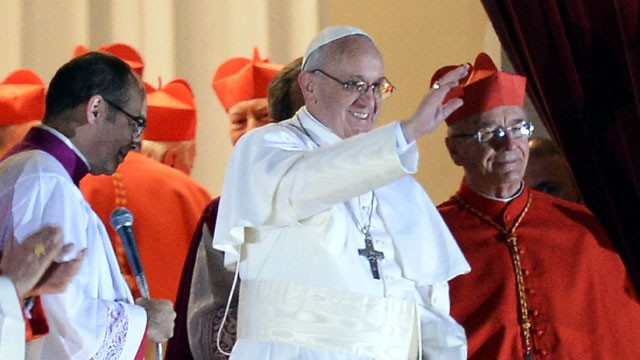
Fourth, what immediately struck me as he walked out on the loggia to greet the world was the look on his face.  He seemed to desire to be anywhere else in the world.  He look stunned and terrified, really.

He did not wave.  He did not smile.  He simply stood there.

When he was appointed Auxiliary Bishop of Beunos Aires, he took as his episcopal motto miserando atque eligendo ("lowly and yet chosen").  As he stood motionless on the balcony looking out upon the faithful the sincerity of these words was most evident.  He knows himself to be unworthy of so lofty an office and for this reason I think he will be a fine Universal Pastor.

But when the time came for him to smile and to speak to the people, both his smile and his words were genuine and from the heart.


He is, it seems, a quiet man who would rather fade away into the background; his new office will not really allow him to do that.  I am glad he said accepto and hope the Lord will give him many consolations in the days and years to come.

Fifth, his name.  For years now people have asked me what name I would choose when I am elected Pope.  Confident that this will never happen, I have always said I would choose to be called Pope Francis (meaning the First).  Now I suppose I will not be able to do that.

Longtime readers of this blog will now of my deep love for and devotion to Saint Francis of Assisi and the Pope's choosing of this name is fitting occassion for me to resume what was once a daily feature on this blog: Ponderables from the Poverello, daily quotes from Saint Francis.

I hope that Pope Francis will lead people to learn more about the Poverello and to discover the animal-loving gentle hippy image is far from the reality (Emily Stimpson has a good post on this).

From yesterday forward, we will no longer be able to speak of "our Holy Father Francis" with reference simply to the thirteenth Saint who renounced his father's wealth to embrace Lady Poverty and the Cross; now, we will have to be specific: Do we mean the man from Assisi or the man who is the Successor of Saint Peter?  Things could be tricky for a while in Franciscan circles.

To His Holiness Pope Francis, I pledge my willing obedience and filial devotion, and I promise a remembrance in my prayers.