
One of my professors at Quincy University once complained about having to read Merovingian shorthand script (which is apparently rather difficult to make out). I found his grumbles amusing at the time, but now have some sympathy for him.
Because of our shared devotion to il Volto Santo (the Holy Face) and our common desire to make it known far and wide, Mr. Paul Badde sent to me this image of an intriguing manuscript:
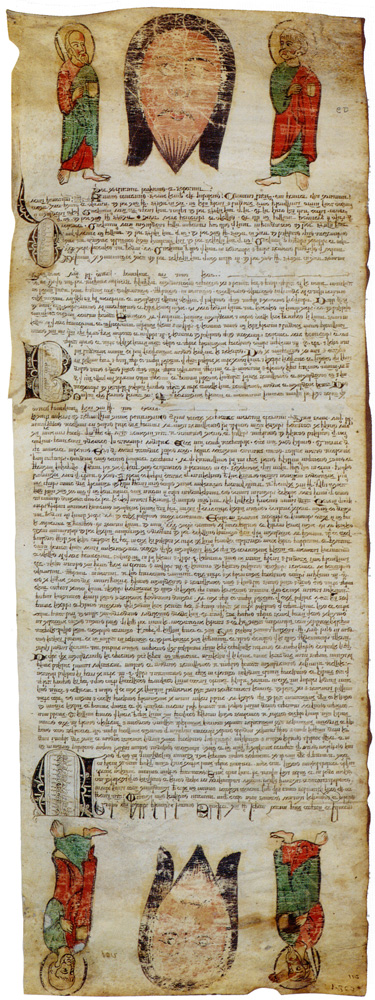
It is the letter of Sylvester of Adria, a scribe at the court of Pope Boniface VIII, written on 22 February 1300 in connection with the first Jubilee. The letter is divided into three parts:
- the Bull of Pope Boniface VIII, Antiquorum habet fida relatio;
- clarifications about the word "jubilee" being absent from the Bull; and,
- answers to certain questions about the jubilee presented to Boniface VIII
I have been able to find the text and translation of the Bull itself, but I have not been able to find either the text or a translation of the second parts of the letter of Sylvester, the two parts which most interest me.
So it was that I sent an e-mail last night to the Biblioteca del Comune e dell'Accademia etrusca in Cortona, Italy where the letter is housed, asking if it might be possible for me to go and have a look at the letter, make a transcription of it, and take photographs of it.
Very early this morning - before 8:00 a.m. - I was quite surprised to have a response from the library indicating that I could go and study the letter, but that I could not take photographs of it. Instead, I could request a high resolution jpeg of the letter for the purposes of transcription and translation. I did so, and received this file early this afternoon (it was the most efficient and easiest request I've made yet to any Italian bureaucracy).
You can imagine my delight, then, when I opened the file, enlarged it enough to have a good look at the text, and my great disappointment when I realized what my college professor meant: I cannot make out the medieval script! If you can read these letters, I need your help:
 |
| Clicking on the image should enlarge it |
Some of the characters I can make out, but enough of them for a transcription. If you are able to read this script and would be willing to make a transcription of the original letter for me (it measures 63cm in length, including the images at the top and bottom), please contact me via e-mail to dzehnle[at]gmail[dot]com. I should be able to work my way through the Latin from a transcription.
In the end, I should like to see what connections this jubilee bull might have with that of Pope Francis' Misericordiae Vultus (Face of Mercy), the possible connections of which should be somewhat obvious from the images on this letter: the Holy Face of Jesus between Saints Peter and Paul.
