19 August 2006

Homily - 20 August 2006

N.B.: Some of this homily will be familiar to those who read last week's homily, although not of it will. I preached different Masses last weekend and wanted to share part of last week's homily with this group. At any rate, here it is:

So very often I hear it said today, “I don’t get anything out of Mass”. “Father’s homilies are boring”. Sometimes I even hear it said, “Father’s homilies are too long”. This second and third statement may well be true, but the first certainly is not and it brings me great pain whenever I hear it.

Why do we come to Mass? Do we come for ourselves or do we come for the Lord? King David today says that we come to the Mass to:

…bless the LORD at all times;
his praise shall be ever in my mouth.
Let my soul glory in the LORD…
Glorify the LORD with me,
let us together extol his name…
Look to him that you may be radiant with joy (Psalm 34:2-4, 6).
To say, “I get nothing out of Mass”, shows a self-centeredness and a deep lack of understanding of the Mass. We do not come for ourselves; rather, we come to praise, worship, thank and adore the Living God who fills us with all good things. We should come, as Saint Paul says, “singing and playing to the Lord in [our] hearts, giving thanks always and for everything in the name of our Lord Jesus Christ to God the Father” (Ephesians 5:1-20). When to the Mass properly prepared and disposed God continues his work for us and leads us closer to salvation if we open our hearts to him.

In this is shown to us the goodness and generosity of the Lord. We come to worship him and he in turn feeds us with the Body and Blood of his Son and pours out his Holy Spirit into our hearts. When we come to praise and adore the Blessed Trinity, we are drawn into the very life of the Trinity; we are drawn into the love that is God.

To say, “I don’t get anything out of the Mass” is really to say, “I am not really here. I am sitting here, yes, but I am not allowing the Lord to speak within the depths of my heart.” It is to say, “I will not listen to the voice of the Lord; I will not recognize his Real Presence in the Sacrament of the Altar.” Saint Paul warns us today, “Watch carefully how you live, not as foolish persons but as wise, making the most of the opportunity” (Ephesians 5:15-16). Those who are wise come to the Mass receptive to the voice of the Lord.

Says Jesus today, “Just as the living Father sent me and I have life because of the Father, so also the one who feeds on me will have life because of me” (John 6:57). Jesus calls each of us to himself; he calls us to become one with him and a part of his Mystical Body. Indeed, he calls out to us:

Let whomever is simple turn in here … Come, eat of my food, and drink of the wine I have mixed (Proverbs 9:4-5). Whoever eats my flesh and drinks my blood has eternal life, and I will raise him on the last day. For my flesh is true food, and my blood true drink. Whoever eats my flesh and drinks my blood remains in me and I in him” (John 6:54-56).
When we eat his body and drink his blood we become one with him and he gives us a share in his eternal life and glory. How can one say, “I don’t get anything out of Mass.” He teaches us throughout the Liturgy of the Word and he feeds us with his very own Body and Blood in the Liturgy of the Eucharist; he unites us to himself. For what more could we possibly ask?

It is because of the immensity of this great gift – the gift of God himself – that Saint Paul warns us in another place:

Whoever, therefore, eats the bread or drinks the cup of the Lord in an unworthy manner will be guilty of profaning the body and blood of the Lord. Let a man examine himself, and so eat of the bread and drink of the cup. For any one who eats and drinks without discerning the body eats and drinks judgment upon himself (I Corinthians 11:27-29).
This is why the Church still insists that all mortal sins must be confessed before one receives Holy Communion. This is why we must prepare ourselves spiritually and physically to receive Holy Communion. We must open our hearts to receive this great gift of love and we must fast for one hour before receiving the Eucharist as a sign of our devotion.

In addition to this, we ought to pay attention to the way that we are dressed when we come to the Mass, when we come into the presence of the great King of heaven and earth. More often than not, a failure to dress more appropriately for the Lord comes from a certain laziness, and laziness always demonstrates a lack of love. We need not dressed in tuxedos or formal gowns – although there is nothing wrong with this – but we also should not come in clothes that we might also wear to bed. To dress in one’s “Sunday best” is a fitting and proper way to show our respect for and love of the Lord Jesus Christ who gives himself totally to us.

It is not enough to say, “I came to Mass. That is all the Lord wants. It is enough that I came.” The Lord desires more than our mere presence; he wants our heart, he desires the totality of who we are. This is why he suffered, died and rose again. Let us make “the most of the opportunity” not tomorrow but today as he comes to us in the Holy Eucharist. Bow down before the Lord your God. Lift up your eyes to him and look into his face. See his eyes already looking down upon you in love, even before you lift your head. Lift up your heart to the Lord. Before the Blessed Eucharist,

Let the whole of mankind tremble
the whole world shake
and the heavens exult
when Christ, the Son of the living God,
is [present] on the altar
in the hands of a priest.
O admirable heights and sublime lowliness!
O sublime humility!
O humble sublimity!
That the Lord of the universe,
God and the Son of God,
so humbles Himself
that for our salvation
He hides Himself under the little form of bread!
Look, brothers, at the humility of God
and pour out your hearts before Him!
Humble yourselves, as well,
that you may be exalted by Him.
Therefore, hold back nothing of yourselves for yourselves so that
He Who gives Himself totally to you may receive you totally (Saint Francis of Assisi, Letter to the Entire Order 26-29).

On Suffering

As I walked from the rectory to the high school last night for a volleyball scrimmage I found myself reflecting on suffering and the love we come to experience through suffering.

We share our sufferings and difficulties with those with love, that is, with our close family and friends. We share our sufferings with our loved ones by talking with them about our trials, hurts and pains, much as we would share with our joys and happiness. Sometimes we seek their assistance and aid, sometimes we seek their advice, and sometimes we simply seek an understanding and listening ear.

We share none of this with complete strangers or even friends with whom we are really more acquaintances.

Is it any wonder then that the Christ desires to share his suffering with us? He does far more than simply describe his suffering to us, as we do with our friends. Jesus calls us friends and so he invites us to share fully in his sufferings by taking up the Cross and following after him, so that we might share also in his glory.

Seen in this light it seems not so strange that we must suffer with him, for in this way he demonstrates his love quite clearly.

How great is the love of God! Give us your grace to carry the Cross!

18 August 2006

Off we go!

The new academic year fast approaches and I feel far from ready for it!

Fortunately, I will be teaching the same course this year as last: Religion IV, being two thousand years of Church history and all seven Sacraments. It is a daunting charge and one that I think is quite impossible. We shall get as far as we do.

I spent last evening setting up the classroom and today there are faculty meetings at the high school. My class begins on Tuesday so I will be spending the weekend finishing up last minute preparations.

All this being said, I am greatly looking forward to teaching again. On Wednesday I had 13 students in my class; on Friday I had 15; I'm curious to see how many I will have on Tuesday.

17 August 2006

What a Feast Day!

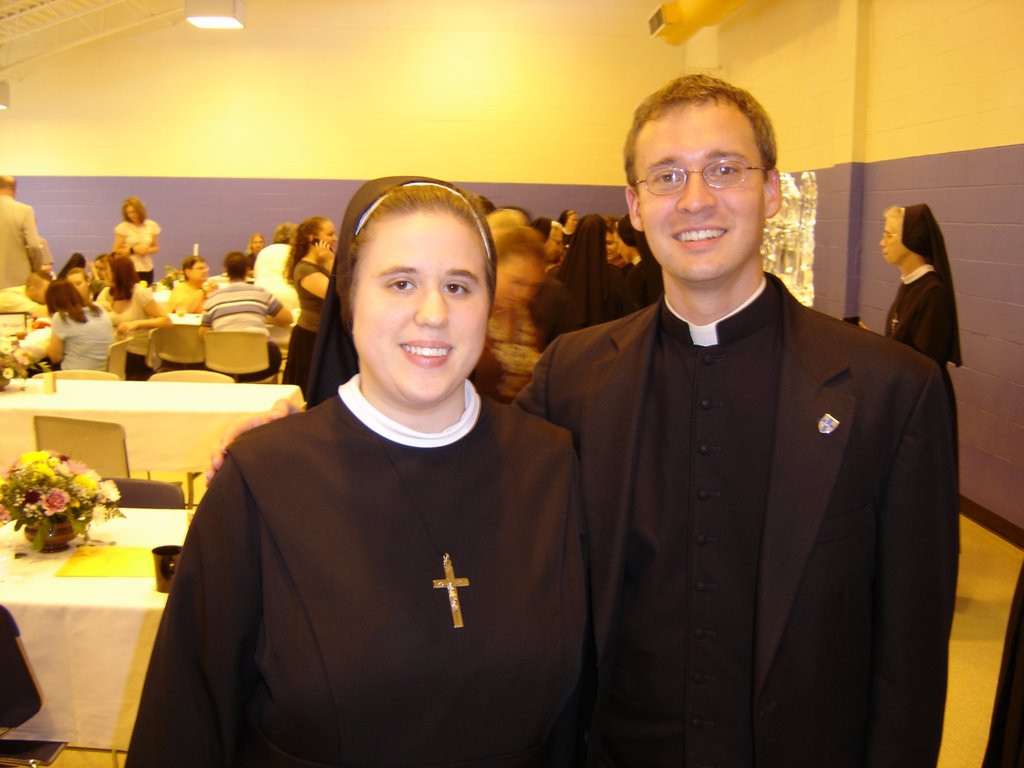
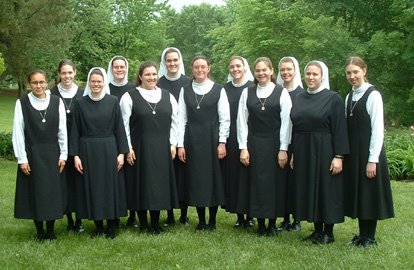
On Tuesday, 15 August, the Solemnity of the Assumption of the Blessed Virgin Mary, the Sisters of St. Francis of the Martyr St. George in Alton, Illinois received six Novices just before six Novices took thir first profession and one sister celebrated her Golden Jubilee.

At the invitation of Sr. M. Clementia, a friend
from Great River Teens Encounter Christ, I served as the Master of Ceremonies for the celebration including seven Bishops, thirty-some priests, and I am not sure how many of the laity. It was a daunting task but the three sisters in the sacristy helped make everything go smoothly. Thanks, Sisters!

Mother Regina Pacis must have been pleased with the day. After the Mass she invited me to celebrate Mass for the Sisters today at 11:30. I will be leavning shortly to be witht he sisters again and I am very much looking forward to it.


It brings great joy to my heart to see so many young sisters. May they be blessed with many more!

Not quite Hobbiton

St. Anthony of Padua parish held its annual parish picnic this past weekend. Hundreds of people returned home for the festivities and a good time seems to have been had by all in attendance.

I spent most of Satuday evening and Sunday at the picnic visiting with parishioners and making myself seen at all corners of the picnic (at least I think I did). That's always the trick with events like this. People expect the priest to be around but it's hard to be present for 4,000 parishioners.

At any rate, I did what I could and enjoyed my time at the picnic. I'm looking forward already to next year's picnic.

Advanced Catholic Training

Some of you may recall that some weeks back I gave two days of presentations on the Scriptures and the Sacraments to a group of youth from across the Diocese at what we call Christian Leadership Institute: Advanced Catholic Training.

Our Diocesan newspaper, The Catholic Times ran a story on ACT.

The article makes mention that I spoke "at length" about the Sacraments. My family found that rather amusing as they always have said that I am always talking.

12 August 2006

Homily - 13 August 2006

Today Jesus reminds us that our “ancestors ate manna in the desert, but they died” (John 6:49). After the Lord saved his people from slavery in Egypt

the whole congregation of the people of Israel murmured against Moses and Aaron in the wilderness, and said to them, ‘Would that we had died in the land of Egypt, when we sat by the fleshpots and ate bread to the full; for you have brought us out into this wilderness to kill this whole assembly (Exodus 16:3).
The people saw and experienced the mighty deeds of the Lord but they did not trust in his providential care for them.

They had plenty of bread to eat in Egypt – despite their great sufferings there – but no bread they had in the desert. Hearing their grumblings and knowing their plight, the Lord said to Moses, “Behold, I will rain bread from heaven for you; and the people shall go out and gather a day’s portion every day, that I may prove them, whether they will walk in my law or not” (Exodus 16:4). The Lord would feed them till they were satisfied each day, but he would also test their faith through this manna from heaven.

But what was this manna that rained down from heaven in the morning? The manna was “a flake-like thing, fine as hoarfrost on the ground” (Exodus 16:14); “it was like coriander seed, white, and the taste of it was like wafers made with honey” (Exodus 16:31). “The people of Israel ate the manna forty years, till they came to a habitable land” (Exodus 16:35). It was their bread for the journey. As the lembas bread for the elves of Tolkien’s middle earth, the manna was the way bread for the pilgrim Israelites, just as the Eucharist is our way bread, our bread for the journey, on our pilgrim way “to a habitable land,” the kingdom of heaven.

Today Elijah begs for death because he feared the power of Jezebel after he killed 450 of the prophets of her false god. The Lord hears his cry and gives him food and drink and says to him, “Get up and eat, else the journey will be too long for you!” (I Kings 19:7). Elijah, “strengthened by that food,” journeyed then to the presence of God; so, too, do we (I Kings 19:8).

We know that the Christian journey is a “narrow road” upon which to walk, one that is filled with many difficulties, trials and temptations but one that leads to great joy and peace. How often do we, fully aware of our sinfulness and our many failures to love and to remove “all bitterness, fury, anger, shouting, and reviling” (Ephesians 4:31), cry out, “This is enough, O Lord! Take my life, for I am no better than my fathers” (I Kings 19:4)? As we cry out to the Lord he cries out to us, “Get up and eat, else the journey will be too long for you!”

Jesus lovingly says to us:

I am the bread of life. Your ancestors ate manna in the desert, but they died; this is the bread that comes down from heaven so that one may it and not die. I am the living bread that came down from heaven; whoever eats this bread will live forever; and the bread that I will give is my flesh for the life of the world (John 6:48-51).
Let us, then, “taste and see how good the LORD is,” he who gives himself to us so that we might live with him forever.

The Most Holy Eucharist is, indeed, our bread for the journey, our way bread. It is, as Saint Ignatius of Antioch calls it, “the medicine of immortality and the antidote against death, enabling us to live for ever in Jesus Christ” (To the Ephesians 20). For those who receive it in faith and in love, the Body and Blood of the Lord is a safe passage through the perils of this world and a foretaste of the banquet of heaven. Nourished and sustained by the Eucharist, the Bread of Angels, the true manna from heaven, we journey ever onward toward the new and eternal Jerusalem, but we do not journey alone.

One cannot be a follower of Christ by oneself, solitary and alone. Jesus calls us all to himself, he calls us to become one with him and a part of his Mystical Body. Says the Holy Father, Pope Benedict XVI:

Union with Christ is also union with all those to whom he gives himself. I cannot possess Christ just for myself; I can belong to him only in union with all those who have become, or who will become, his own. Communion draws me out of myself towards him and, thus, towards unity with all Christians. We become “one body”, completely joined in a single existence. Love of God and love of neighbor are now truly united: God incarnate draws us all to himself (Deus caritas est, 14).
Such is the power of the love of God.

It is because of the immensity of this great gift – the gift of God himself – that Saint Paul warns us:

Whoever, therefore, eats the bread or drinks the cup of the Lord in an unworthy manner will be guilty of profaning the body and blood of the Lord. Let a man examine himself, and so eat of the bread and drink of the cup. For any one who eats and drinks without discerning the body eats and drinks judgment upon himself (I Corinthians 11:27-29).
This is why the Church still insists that all mortal sins must be confessed before one receives Holy Communion. This is why we must prepare ourselves spiritually and physically to receive Holy Communion. We must open our hearts to receive this great gift of love and we must fast for one hour before receiving the Eucharist as a sign of our devotion.

In addition to this, we ought to pay attention to the way that we are dressed when we come to the Mass, when we come into the presence of the King of heaven and earth. More often than not a failure to dress more appropriately for the Lord comes from a certain laziness, and laziness always demonstrates a lack of love. We need not dress in tuxedos or formal gowns – although there is nothing wrong with this – but we also should not come in clothes that we might wear to bed. To dress in one’s “Sunday best” is a fitting and proper way to show our respect for and love of the Lord Jesus Christ who gives himself totally to us. Before the Blessed Eucharist,

Let the whole of mankind tremble
the whole world shake
and the heavens exult
when Christ, the Son of the living God,
is [present] on the altar
in the hands of a priest.
O admirable heights and sublime lowliness!
O sublime humility!
O humble sublimity!
That the Lord of the universe,
God and the Son of God,
so humbles Himself
that for our salvation
He hides Himself under the little form of bread!
Look, brothers, at the humility of God
and pour out your hearts before Him!
Humble yourselves, as well,
that you may be exalted by Him.
Therefore,
hold back nothing of yourselves for yourselves
so that
He Who gives Himself totally to you
may receive you totally (St. Francis of Assisi, Letter to the Entire Order, 26-29).

It's picnic time!

Every year during the second weekend of August St. Anthony of Padua Parish in Effingham holds it's parish picnic, an event that is quite the homecoming for the entire community.

The festivities begin on Saturday, 12 August, with the 5:00 p.m. Mass and continue that night until midnight. The festivities resume at Noon on Sunday and continue again until midnight. The Sunday Mass schedule is 7:30 a.m., 9:15 a.m., and 11:00 a.m.The picnic includes such activities

-A raffle with prizes including a new vehicle or $15,000 cash; $2,000 cash; a 2006 scooter; a big screen television; a 3-night vacation; and other prizes besides
-Many games including bingo, basketball, plinko, and other sports games
-A country store selling homemade goodies and sweets
-Gourmet hamburgers
-Ice cream and snow cones
-A fancy work stand with great craft items
-A chicken dinner or roasted pork (BBQ or plain) Sunday from 11:00 a.m. to 6:00 p.m. in the air conditioned parish center
If you happen to be free the weekend of the picnic, I invite you to attend our festivities and help support our parish. Like the people of Effingham, I would be very happy to see old friends at the picnic. If you plan on attending, give me a call.

09 August 2006

Ave Crux, spes mea!

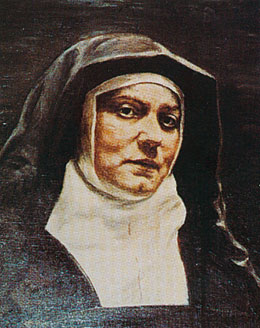
I have had the great joy of being present at the canonization of one saint, that of Teresa Benedicta of the Cross, Edith Stein, whose memorial we celebrate today.

11 October 1998 was a beautiful day in Rome and St. Peter's Square was packed for the Mass as Holy Mother Church raised this Carmelite nun to the dignity of the altars.

Born a Jew, at the age of fourteen, "I consciously decided, of my own volition, to give up praying," she said.

But one night she picked up the autobiography of St. Teresa of Avila and could not put it down. Upon completing it she said to herself, "This is the truth." Thus began her journey to Christ and her embrace of the Cross.

She was killed in a gas chamber at Auschwitz today in 1942.

Here are great words of wisdom from this holy woman:

"I thought that leading a religious life meant giving up all earthly things and having one's mind fixed on divine things only. Gradually, however, I learned that other things are expected of us in this world ... I even believe that the deeper someone is drawn to God, the more he has to 'get beyond himself' in this sense, that is, go into the world and carry divine life into it."

"If anyone comes to me, I want to lead them to [Jesus]."

"Human activities cannot help us, but only the suffering of Christ. It is my desire to share in it."

"Henceforth, my only vocation is to love."

"Ave Crux, spes mea! (I welcome you, Cross, our only hope!)"
St. Teresa Benedicta of the Cross, pray for us!

08 August 2006

Is there a Doctor in the house?

In the July/August issue of Lay Witness, the publication of Catholics United for the Faith, Emily Stimpson has an entertaining article entitled, "The Average Catholic's Guide to Becoming a Doctor of the Church."

In her humorous article she lists ten steps to becoming a Doctor of the Church:

1. Get yourself ordained a Bishop (women excepted on this step, of course)
2. Fight a heresy
3. Spend some time in exile
4. Found (or reform) a religious order
5. Write a book
6. Excel at preaching
7. Have an apparition
8. Do not become a martyr
9. Become a saint
10. Be anointed by the Holy Spirit
Ms. Stimpson rightly notes at the end of her article that "even if the Trinity doesn't come through on the whole Doctor thing, and even if the Church never adds you to the official list, pursuing wisdom and holiness still has other rewards."

05 August 2006

Listen together with trust to the voice of Jesus

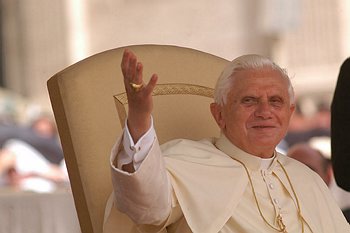
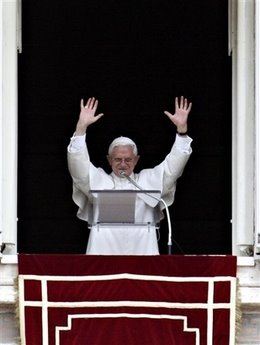
His summer vacation in Les Combes having ended, the Holy Father flew by helicopter on Wednesday from his summer residence of Castel Gandolfo to the Vatican for the general audience. Continuing - albeit briefly - his reflections on the Apostles he spoke especially to altar servers gathered in Rome.

Young Joseph Ratzinger began serving at the altar of the Lord in 1935, "beginning a long journey on this road," he said.

Commenting on the Apostles, Pope Benedict said that, "In a nutshell, we could say that they were the 'friends' of Jesus . . . They were, and they were able to be, apostles and witnesses of Christ because they were his friends, because they knew him on the basis of friendship, because they were close to him."

With the heart of a pastor, the Holy Father said to the altar servers, "Today, seeing all of you here before me in St. Peter's Square, I think of the Apostles and I feel the voice of Jesus telling you: 'I no longer call you servants, but friends: remain in my love, and you will bear much fruit.' I invite you: listen to this voice! Christ didn't just say this 2,000 years ago; he is alive and he says this to you here and now. Listen to this voice with great openness; it has something to say to everyone. Maybe to some of you it says: 'I want to serve in a special way as a priest becoming his witness, him being my friend, and introducing others to this friendship.' Listen together with trust to the voice of Jesus."

Although each person's vocation is different, Jesus calls all of us to be his friends, he said.

At the close of his remarks the Holy Father spoke powerfully on the role of altar servers. I place it below in its entirety:

Dear servers, in reality you are already apostles of Jesus! When you participate in the Liturgy offering your service at the altar, you offer to all a testimony. Your thoughtful attitude, your devotion to the parts of the heart and those expressed in liturgical motions, in singing, in the responses: if you do these in a proper way and not distractedly in whatever way, then yours is a testimony which touches others. The chain of friendship with Jesus has as its source and its summit in the Eucharist. You are very close to Jesus in the Eucharist, in the celebration of the Holy Mass and this is the greatest sign of his friendship for each of us. Do not forget this! And for this I ask: do not get used to this gift, sot hat if does not become a sort of habit, knowing how everything functions and doing it automatically, but discover it anew each day that something so great is happening, that the living God is in our midst, and that you may be ever more close and bring your contributions so that the mystery may be celebrated and reach the people.

If you do not give in to the habit of it and develop your service from your interior selves, then you are truly his apostles and carry fruits of goodness and of service in each area of your life: in your family, at school, in your free time. This love that you receive in the Liturgy, carry it to all people, especially when you notice those who lack love, who do not receive goodness, those who suffer and are alone. With the strength of the Holy Spirit, seek to bring Jesus himself to those who are cast out, who are not loved very much, people who have problems. To these, with the strength of the Holy Spirit, you must bring Jesus. So that Bread, which you see broken on the altar, will be shared and multiplied farther. And so that you, like the twelve Apostles, may help Jesus to distribute the Bread of Life among the people of our time, in the diverse situations of life. They need this bread! So, dear servers, let my final words to you be these: always be friends and apostles of Jesus Christ!
Thanks to Rocco Palmo for the translation! He also a couple of good pictures of Pope Benedict.

Homily - 6 August 2006

Today’s celebration of the transfiguration should give us reason to pause and reconsider whom this Jesus is that we seek to follow. Just what is it that Jesus calls us to do? As the disciples come down the mountain with Jesus today they are confused, baffled and puzzled as to why the glory of Jesus no longer shone before.

Having seen his glory the disciples could not understand what Jesus meant when he told them to keep this event quiet until he should rise from the dead. Indeed, Mark tells us that, as they descended the mountain, the disciples were still “questioning what rising from the dead meant” (Mark 9:10). The disciples did not understand this statement of Jesus because they did not yet understand that the Messiah must suffer and die and so enter into his glory. How often do we, too, misunderstand the mission of the Messiah as well?

If we were with Peter, James and John on the mountain with the Lord standing there with Moses and Elijah I have a feeling that we would say with Peter, “Rabbi, it is good that we are here!” (Mark 9:5). How easy it would be for us to stay in the presence of the Lord to behold his glory, never having to work, never having to fear, never having to feel the pain of love, never having to embrace the Cross.

Yet even so, why were the Apostles “so terrified” at seeing Jesus “transfigured before them”? (Mark 9:6). They would have known well the vision proclaimed for us from the prophet Daniel:

Thrones were set up and the Ancient One took his throne. His clothing was bright as snow, and the hair on his head as white as wool. His throne was flames of fire, with wheels of burning fire. A surging stream of fire flowed out from where he sat; thousands upon thousands were ministering to him, and myriads upon myriads attended him (Daniel 7:9-10).
You will recall that Jesus’ clothes, too, “became dazzling white, such as no fuller on earth could bleach them” (Mark 9:3). Upon Mount Tabor Peter, James and John were permitted a glimpse of Jesus’ true identity as the Son of God and the King of heaven and earth. As they beheld his brilliant radiance, they began to understand that this Jesus was more than they had previously imagined, his power and his glory far greater than they had expected.

But why does the Ancient One sit upon a throne of fire? Fire has always represented holiness and purity and such a throne demonstrates the absolute holiness of God. In the vision of Isaiah and again in that of John, the angels standing around the throne of God cry out, “Holy, holy, holy is the LORD of hosts; the whole earth is full of his glory” (Isaiah 6:3) and “Holy, holy, holy is the Lord, almighty, who was and is and is to come!” (Revelation 4:8)). Three times do they cry “holy” to make known the superlative quality of God; there is nothing holier than God himself and because of this his face radiates with a tremendously bright light. So bright, in fact, that the six-winged seraphim – themselves made of fire – must shield their eyes in the presence of God. When Moses came down from the mountain after speaking with the Lord, he, too, had to veil his face when speaking with the people because his face now shone with the radiance of God, so great is the glory of God.

This helps to explain, then, why “a cloud came, casting a shadow over them; [and] from the cloud came a voice, ‘This is my beloved Son. Listen to him.’” (Mark 9:7). Even these chosen three could only look upon the glory of the Lord for a short time.

Let us return now to the vision of Daniel. When the heavenly court was convened, he saw:

One like a Son of man coming, on the clouds of heaven; when he reached the Ancient One and was presented before him, the one like a Son of man received dominion, glory, and kingship; all peoples, nations, and languages serve him. His dominion is an everlasting dominion that shall not be taken away, his kingship shall not be destroyed (Daniel 7:13-14).
For the Jews of Jesus’ day, the phrase “Son of man” was a code word of sorts for a divine figure. In Jesus Christ, the Son of man is the Son of God.

But what is more, after the Father raised Jesus from the dead by the power of the Holy Spirit, and after Jesus breathed the Holy Spirit upon the Apostles, he ascended to the right hand of the Father upon the clouds, accompanied by the angels. Seated now at the right hand of the Father, Jesus is Christ the King who governs all things and who will return in glory to judge the living and the dead, whose dominion is everlasting.

The Apostles immediately recognized the glory of Christ and his dominion in the transfiguration and so on the way down the mountain there is no need to question this, but they did not understand that Jesus must rise from the dead, for they did not understand that he must die and so they questioned what this meant.

Pope Benedict XVI recently pointed out that Peter, James and John were each present at both the transfiguration and at the Garden of Gethsemane.

Therefore, it is a question of two very different situations: In the one case, James, with the other two disciples, experiences the Lord’s glory, sees him speaking with Moses and Elijah, sees the divine splendor revealed in Jesus; in the other, he finds himself before suffering and humiliation; he sees with his own eyes how the Son of God humbles himself, becoming obedient unto death… [They] had to discern how the Messiah, awaited by the Jewish people as a victor, was in reality not only surrounded by honor and glory, but also by sufferings and weakness. The glory of Christ was realized precisely on the cross, in taking part in our sufferings (Wednesday Audience, 21 June 2006).
The same is true for us. In the waters of baptism we died with Christ and rose with him to new life. The glory of Christ is realized in us precisely because we share in his Cross.

All those who wish to follow after Christ and so share fully in the glory of his Resurrection must run to the Cross and embrace it. This Saint Francis of Assisi knew well. Just before he received the sacred stigmata – the five holy wounds of the Savior – Francis said:

My Lord Jesus Christ, I pray you to grant me two graces before I die: the first is that during my life I may feel in my soul and in my body, as much as possible, that pain which You, dear Jesus, sustained in the hour of Your most bitter passion. The second is that I may feel in my heart, as much as possible, that excessive love with which You, O Son of God, were inflamed in willingly enduring such suffering for us sinners.
Francis, with the advantage of hindsight, was able to understand what the Apostles were unable to grasp: that glory is revealed precisely in weakness and in suffering. This is the heart of the Paschal Mystery. To this we are called.

To many people today this acceptance of suffering seems rather absurd, foolish and maybe even stupid. But as St. Peter tells us today, “We did not follow cleverly devised myths when we made known to you the power and coming of our Lord Jesus Christ, but we had been eyewitnesses of
his majesty” (II Peter 1:16). The glory of the Cross comes not from man but from God. It is a glory that the wisdom of this world cannot understand.

Let us then embrace the Cross and realize that “The saying is sure: If we have died with him, we shall also live with him; if we endure, we shall also reign with him; if we deny him, he also will deny us; if we are faithless, he remains faithful – for he cannot deny himself” (II Timothy 2:11-13).

04 August 2006

Rolling on the river

This past Sunday through Tuesday I went canoeing and horseback riding with several friends with whom I have worked in youth ministry and some of the youth from their various parishes. This was the first time I went canoeing and the first time in more than a decade that I rode a horse, although I have ridden a few elephants and camels since that time.

The trip was simply delightful, so much so that I hope to be able to do this every year now. We canoed for some eleven miles (maybe more) but I enjoyed nearly every minute of it. The next day, though, I discovered that the human body could in more places at the same time than I ever thought possible. It provided a good workout and helped tone up some muscles a bit and may inspire me to attempt to get in shape; probably not, but who knows!

I have wanted to have a horse (and a falcon) since I was a kid and after spending about an hour and a half on a horse named Blue this desire remains. The horse was - as the guide promised - of a very similar personality as me.

When we came to the first spot in the river to cross, Blue stopped on the shore, looked up and down stream, looked across to the other side, and finally decided to step into the water, almost as if to say, "I really don't want to do this." When we crossed the water a second time a large area of mud - several inches deep - awaited us on the other side. Blue stopped in the water, examined the mud and carefully picked his way through. At various spots the trail would split very briefly - maybe ten feet - with one path continuing straight along and another going slightly around a tree; Blue, with the exception of one, always took the straight and direct path. He only climbed the mountain we were on when he was good and ready and on the way down the mountain he decided he did not want to wind around with the trail but wanted to take the direct route through the woods (I was able to stop him in this one). Even with all of this, it was a blast!

If you have not gone canoeing or horseback riding, I highly recommend it!

29 July 2006

Homily - 30 July 2006

Permit me, if you will, to pose to you a most important question in a couple of different ways: Why do you follow the Lord Jesus Christ? Why do we dare to call ourselves Christians? Why have I, who stand before you now, given my life to the Lord Christ so that others live? Today, near the Sea of Galilee, “A large crowd followed him, because they saw the signs he was performing on the sick” (John 6:1).

Within this great crowd of followers exist a great variety of purposes and reasons for following after this teacher from Nazareth. Some followed him, we can be sure, out of a sincere and deep faith in their recognition of Jesus as “the Messiah, the Son of the living God,” as Peter would come to know (Matthew 16:16). Others surely followed him out of great curiosity and wonder, joining the crowd simply to see what might happen like the tax collector Zacchaeus who “was seeking to know who Jesus was” (Luke 19:3). Still others were certainly skeptical about this “carpenter’s son” (Matthew 13:55) and followed him so that they might learn where he found “such wisdom and mighty deeds” (Matthew 13:54). Still others followed him because they saw within the miracles he worked the tell tale sign of the coming of their long-awaited king who would restore the kingdom of Israel (cf. John 6:15).

Each of these more than five thousand individual people followed after Jesus today for a specific reason, be it praiseworthy or not; none of them followed Jesus without purpose or without reason; each had their own motive. None simply followed the crowd to keep the status quo; none remained apathetic. Can the same be said of us?

What have you seen in the person of Christ Jesus that leads you to follow him? Have you heard him saying, “Follow me” (John 1:43) or have you simply seen him “walk by” and followed in his way (John 1:36)? What led you to follow after the one who is “the way and the truth and the life” (John 14:6)?

Some see in Jesus an abundance of food and rightly so, for he says of himself: “I am the living bread come down from heaven; whoever eats this bread will live forever; and the bread that I will give is my flesh for the life of the world” (John 6:51). Others see in him an abundance of health and rightly so, for the people “brought to him all who were ill or possessed by demons” and “he cured many who were sick with various diseases, and he drove out many demons” (Mark 1:32; 34). Others yet see in him an abundance of justice and rightly so for he “is just in all his ways and holy in all his works” (Psalm 145:17). Others seek in Jesus Christ understanding and rightly so, for he is Wisdom itself. I have found in him an abundance of love, of peace, and of joy and so I follow him and have given my life to him. Others seek riches in him and rightly so, for he is the “treasure buried in the field” and the “pearl of great price” (Matthew 13:44; 46). Indeed it is true that in Jesus Christ “The hand of the Lord feeds us; he answers all our needs” (Responsorial Psalm). Just as Jesus said to Andrew so he says to us: “What are you looking for?” (John 1:38).

Whatever it is that you seek you will find in Christ Jesus. He himself tells us: “Ask and it will be given you; seek and you will find; knock and the door will be opened to you” (Matthew 7:7). He will satisfy our every need and for this reason our Blessed Lady says to us, “Do whatever he tells you” (John 2:5).

Today Jesus has Andrew give him the five barley loaves and two fish; in short, he has Andrew give to him all that he has – nothing is to be held back and so it is with us. He says to us: “Come to me, all you who labor and are burdened and I will give you rest” (Matthew 11:28). When we come to him we must also give ourselves to him, holding nothing back. We must give to him all that we have and all that we are; both our strengths and our weaknesses, our joys and our sorrows, our faithfulness and our sin; nothing can be held back. In short, we must unite ourselves to his Cross.

It is true that when we come before him we, like Andrew, recognize how small and useless we are. As we offer ourselves to Jesus, we, too, may be tempted to say, “There is a boy here who has five barely loaves and two fish; but what good are these for so many?” (John 6:9). We may even be that small boy. If we see ourselves as this young boy - who willingly and humbly offers what he has to Jesus despite its seeming insignificance – we do well. We do well to offer ourselves to the Lord, insignificant as we are. Before the Cardinals of the Church entered into the Sacred Conclave, then Cardinal Ratzinger, now Pope Benedict XVI, said this: “Many times we feel like useless servants, and it is true. And, despite this, the Lord calls us friends; he makes us his friends; he gives us his friendship” (Homily before the Conclave, 18 April 2005).

In this way, then, Jesus calls all those who follow him, both those who follow him today in the Gospel and those of us here gathered, to enter into a relationship of friendship with him, a relationship based upon the love that he lavishes upon us by feeding us and satisfying all of our needs. In this friendship with Christ there is no room for doubt, for skepticism, for reservation. There is no room for fear or hesitation. He calls us to abandon ourselves to him and in abandoning our lives to find life for he says, “Whoever finds his life will lost it, and whoever loses his life for my sake will find it” (Matthew 10:39).


In the beginning, we each follow Jesus for a great variety of reasons, each with our own motives, but in the end we must all follow him in faith, hope and love. Let us then abandon ourselves to Christ and so find in him our peace, our joy, and our deepest fulfillment.

Go west, young Father!

Yesterday afternoon I made the long trek across the wide state of Illinois to hold my nephew, Matthew William, for the first time. It was, for the most part, a pleasant and uneventful drive there and back, the round trip of which amounted to some eight hours in the car. I occupied my time listening to a series of lectures about Saint Augustine's Confessions. It was certainly worth the drive but it is one that I cannot do too frequently.

Little Matthew seems to be a happy baby who much prefers to be held than to be laid down. He sleeps well and cries little, always a good combination! I learned after only a few minutes of holding him that having a baby around will develop certain muscles that are rarely ever used, such as those in your wrist.

Mom and Dad are both doing well and are very happy and excited. I look forward with great joy to watching Matthew grow up over the years to come.

Many thanks again for all of your prayers!

28 July 2006

Advanced Catholic Training


This past Sunday and Monday I spent at the Villa Maria in Springfield with a group of high school from across the Diocese gathered together to pray, to grow in the knowledge of the faith, and to join in fellowship.

On Sunday I spoke to the youth about the Sacred Scriptures and on Monday I spoke about the Sacraments, and a great many other topics besides. I spoke for nearly four hours each day, which I must admit was quite exhausting. Only this morning have I recovered from it, and just in time to drive across the state to visit my nephew.

Throughout the days they were very attentive and had many good questions. I celebrated the Holy Mass on Sunday night with them and was very moved at their prayerf
ulness. They responded well; they sang well; they listened well; and they sat well in silence and prayed! Never before have I celebrated the Eucharist and heard no coughing, no shuffling, no page turning, etc., during the moments of silence. These youth have a deep love of the Lord Jesus Christ and for this I am deeply grateful.

It was both a privilege and a pleasure to spend those two days with them. I look forward with great joy to many more such opportunities in the years to come.

Cardinal George out of surgery

After yesterday's surgery to remove a cancerous bladder within Francis Cardinal George, the Archbishop of Chicago is said to be doing "well."

Throughout the five years that I studied at Mundelein Seminary I had the privilege of serving as the master of ceremonies for Cardinal George on a number of occassions. I also had the great pleasure of listening to His Emmincence speak to the seminarians on a great variety of topics. He is a holy man and a true shepherd of the Lord's flock.

The Very Reverend John F. Canary, Vicar General of the Archbishop, issued the following statement after the surgery:

Cardinal George is out of surgery and is doing well after his successful bladder operation at Loyola University Medical Center.
The Cardinal has already expressed his thanks and gratitude to all the people of Chicago for their prayers and best wishes. He also extends his gratitude to his doctors, nurses and all the members of his medical team.
During the days and weeks ahead, we will continue to ask all Catholics in the Archdiocese and other friends and colleagues to pray for the Cardinal's recovery and return to his active life.
It is reported that the doctors expect a fully recovery from the surgery. Please continue to keep the good Cardinal in your prayers in the days and weeks ahead.

26 July 2006

Prayers needed for Cardinal George

Prayers are requested for Francis Cardinal George, the Cardinal Archbishop of Chicago, who will undergo surgery tomorrow, 27 July, for cancer in his bladder. Thankfully, his doctors expect a full recovery.
"I ask my fellow priests, the religious, all Catholics in the Archdiocese adn other friends and colleagues to pray for me," said His Emminence. "I trust that the Lord will give me the strength and grace I need during these next days and weeks."

Saint Francis of Assisi and Saint George, pray for us!

20 July 2006

With the wise and the learned

This evening, the students, faculty and staff of the Liturgical Institute went for a delightful dinner to celebrate the conclusion - and the successes - of the summer session.

I sat at table with Fr.
Edward T. Oakes, S.J., Fr. Sameul F. Weber, O.S.B., and Fr. Robert Schoenstene (among others), three brilliant men in their own right and inspiring priests and preachers, faithful sons of holy Mother Church.

Throughout the evening, there were a number of occassions where all I could do was lean back in my chair and listen, in awe and wonder, to the great wealth of knowledge each of them contained, ranging from the obscure and magnificent in all things musical, liturgical, linguistic, doctrinal, and historical.

During my seminary studies I was privileged to have been taught by Fr. Oakes and Fr. Schoenstene, as well as many excellent learned and holy men and women. As I think back on the tremendous opportunities offered me by my studies here both at
Mundelein Seminary and at the Liturgical Institute, I am deeply grateful to the Lord for his goodness and generosity. I have sat at the feet of a great many masters whom I greatly admire and whose love of the Lord and of learning I am honored to have received.

Jesus reminds us: "No disciple is above his teacher, no slave above his master. It is enough for the disciple that he become like his teacher, for the slave that he become like his master" (Matthew 10:24-25). I hope one day to be only marginally as intelligent as they. That will be enough for me, Lord.


In the morning we will concelebrate Mass and then - in the words of Bilbo Baggins - bid each other "a very fond farewell," until we meet again.

Down to the wire

As classes wind up this week and conclude on Friday there are many things to be done: packing, cleaning, packing, laundry, packing, changing the oil in the car, packing, dry cleaning, packing, writing papers, preparing for exams, returning library books, mailing letters and yet more packing.

This morning I set out to accomplish two of these tasks before class. It stormed all night here and is supposed to do the same throughout the morning. As I left the Institute to pick up some dry cleaning the rain was coming down but none too harshly. The dry cleaners have apparently acquired a new computer system since I dropped off my things two days ago, which quite naturally makes their work much more difficult than need be.

At any rate I collected my things and made off for the post office but on the way I decided I wanted a snack and so I stopped in to the Walgreens just down the street from the post office. When I left the dry cleaners the rain stopped and still had not resumed when I entered Walgreens.

After collecting my muffin and going to the cash register I looked out the window and was quite surprised at what I saw: it was pouring! I had not even been in the store for two minutes...I had left my umbrella in the car thinking I would not need it.

I then chatted with the cashier waiting for the storm to let up for about ten minutes and when it let up slightly I took my chances and dashed out for the car. When I pulled back into the parking lot at the Institute seven minutes later the rain stopped...naturally.

I am happy to say that I passed my Latin class but please do not ask me to translate anything for you; I am not that good. Today I take my oral exam for the Liturgical Year and the Liturgy of the Hours, and my exam for Reformation Thought I took last week. I will return to the parish tomorrow afternoon and will then finish two papers for my classes next week, one on St. Francis of Assisi' view of the priesthood in light of the teachings of the Fourth Lateran Council, and the other on Luther and Calvin's view of the priesthood and the response of the Council of Trent.

Sunday and Monday I will be in Springfield at a youth retreat of sorts that we have called "Advanced Catholic Training." We spend five days teaching the "cream of the cream of the crop" Scripture; Sacraments; Tradition, Doctrine and Dogma; Morality; and Social Justice, just to name a few. I will be presenting several sessions on the Scriptures and the Sacraments. I am very much looking forward to these two days but I am also looking forward to returning to the parish to "relax" for a bit.

A blessed summer to each of you!

Day of Prayer and Penance for Peace

VATICAN CITY, JUL 20, 2006 (VIS) - Faced with worsening situation in the Middle East, the Holy See Press Office has been directed to communicate the following:

"The Holy Father is following with great concern the destinies of all the peoples involved and has proclaimed this Sunday, July 23, as a special day of prayer and penance, inviting the pastors and faithful of all the particular Churches, and all believers of the world, to implore from God the precious gift of peace.

"In particular, the Supreme Pontiff hopes that prayers will be raised to the Lord for an immediate cease-fire between the sides, for humanitarian corridors to be opened in order to bring help to the suffering peoples, and for reasonable and responsible negotiations to begin to put an end to objective situations of injustice that exist in that region; as already indicated by Pope Benedict XVI at the Angelus last Sunday, July 16.

"In reality, the Lebanese have the right to see the integrity and sovereignty of their country respected, the Israelis the right to live in peace in their State, and the Palestinians have the right to have their own free and sovereign homeland.

"At this sorrowful moment, His Holiness also makes an appeal to charitable organizations to help all the people struck by this pitiless conflict."
OP/MIDDLE EAST/... VIS 060720 (230)

19 July 2006

Profession and Novitiate

The Sisters of St. Francis of the Martyr St. George are one of those groups of young women religious who are flourishing and growing by leaps and bounds throughout the country.

On Tuesday, 15 August 2006, the Solemnity of the Assumption of the Blessed Virgin Mary, at the motherhouse in Alton, six sisters will make their First Profession, six sisters will enter the novitiate, and one sister will celebrate her golden jubilee.

I am happy to say that I am friends with one of the sisters who will make her first profession and that I will be able to present for the glorious and beautiful day.

Please keep these sisters in your prayers.

Divine Intervention in the Philippines

Here is an interesting story from the Philippines as reported in The Manilla Times:

Dead for 17 hours, Bicol boy lives again
By Rhaydz B. Barcia, Correspondent

Legazpi City: To the village of Puro, the big news is not the impending eruption of Mayon Volcano. It is the “resurrection” of 10-year-old Dante “Jun-Jun” Cardel Jr.

Jun-jun was declared dead by doctors at the Philippine General Hospital on June 21. He came back to life after 17 hours, in the middle of his wake.

One day in early June, Jun-Jun began to vomit blood. His parents took him to Tanchuling Hospital in Legazpi. When his condition didn’t improve, they brought him to the PGH in Manila.

Doctors at PGH said there was a tumor in the boy’s head that was in a dangerous stage of growth.

There was little they could do to save him.

On June 21 doctors removed Jun-Jun’s life-support system and declared him dead about 4 p.m.

Dante Cardel, 36, and wife, Sheila, 34, took the body home in a service car provided by the Child Sponsorship for Community Development Inc. (CSCDI), a nongovernmental organization helping poor families in Albay.

“In the van I held my boy’s body in my arms. My husband took over as we were passing through Laguna.”

In Naga City, Dante told Sheila he felt Jun-Jun chest was getting warm but he thought nothing more of it.

The van arrived in Puro about 5 a.m. of June 22. The whole neighborhood turned up for Jun-jun’s sad homecoming.

“It was a painful moment for both of us. I saw the black pants and white T-shirt that hung on the wall—my son’s burial clothes—which the CSCDI had bought for him.”

Tents had been set up at the yard for the wake. Everyone pitched in, arranging tables and chairs, preparing food.

At 8 a.m. Jun-Jun suddenly opened his eyes, hugged his father tight and asked for food. He was alive.

“We cheered and thanked God for bringing my son back to life,” Sheila said.

No one could explain what had happened. The parish priest, Fr. Jose Bañares, said Jun-Jun might still have a mission on earth and advised the family to keep praying and believing in God’s grace and power.

Jun-Jun told The Manila Times he woke up from his long sleep because he was told by Jesus Christ to rise from his father’s arms.

“I was in my father’s arms when I saw Jesus Christ with a beard and long blond hair. He told me to wake up. There were two birds beside him, one black and the other white, flying around jackfruit trees. Jesus looked at me and touched my eyes. When I woke up I looked up at the sky, but I didn’t see him again,” Jun-Jun told The Times.

Jun Jun, who finished Grade 4, is the fourth child and the only boy in the family of seven siblings. “I wanted to become an engineer. Next year I will back to school at Puro Elementary School,” he said.

Fr. Lorenzo de Leon, parochial vicar of Saint Raphael parish here, said the family’s strong belief in God, not a miracle, could have brought Jun-Jun back from the dead.”

“We cannot really say that there was a miracle, but it could be a divine intervention because of their strong belief in God,” Father de Leon said.

18 July 2006

More on the Roman Missal

The Most Reverend George J. Lucas recently commented on the approval by the United States Conference of Catholic Bishops of the English translation of the Ordo Missae [the Order of Mass].

After giving a brief history of the Roman Missal, His Excellency states,

Many of us remember both the excitement and confusion that we experienced when we began to use the missal published by Pope Paul VI and translated into English. Priests and people were often not as well prepared as they might have been to receive this new missal and to appreciate its origin and its meaning. Now that we have become used to it, many would simply like to leave well enough alone. But that is not up to us. Nor did the bishops of this country decide on their own that there ought to be changes in the Mass.
I wish that the Bishops in the United States - as a whole - would stop "passing the buck" onto the Holy See for the revised translation of the Missal; Rome is not the bad guy and the U.S. Bishops are not lazy, nor are they simply causing difficulty for everyone in the new translation. A new translation is necessary; period. Why must some be "blamed" for what needs to be done?

The fact remains that we currently use the first typical edition of this Missal and the translation recently approved is the third typical edition; the second edition was translated but the Holy See did not grant the necessary recognitio. Why will the USCCB simply not admit that the translation we currently use - helpful as it has been - has several problematic areas to it, not least of which is the semi-Pelagian sense gathered from many of the translations of the prayers? As I continue my class in Latin I see anew everyday as we translate prayers in class how lacking so many of the prayers are regards to the original.

It is time to admit that the current translation has served its purpose and the time has come for a revision, something that was to have happened shortly after the first translation went into effect. There was to be a period of use, followed by reflection and comment, and then a revision, something that seems never to have occurred.

To those who object to the need for a new translation, Bishop Lucas writes the following:

Perhaps some of the changes that this new translation will bring will necessarily seem trivial. In fact, the words that we hear and speak in the sacred liturgy are very important. They help us articulate who we are, God’s holy people, and they make it possible for us to participate in true worship of God. It will be at least two more years before an English translation of the missal is complete and approved for use. An important part of our “staying on the same page,” or remaining authentically Catholic, is our use of proper liturgical language.
He is quite right. It is high time Catholics in America realize that the Roman Catholic Church does not revolve around them and that, in the grand scheme of things, Catholics in America are a great minority in the Church throughout the world. We must always look to the Universal Church while at the same time looking to the Local Church.

17 July 2006

Pope Calls for Prayers

After praying the Angelus Sunday afternoon with pilgrims who came to visit His Holiness while on vacation in the Alps, the Holy Father asked the faithful to pray for peace in the Middle East. Pope Benedict XVI said:

In recent days the news from the Holy Land is a reason for new and grave concern for all, in particular because of the spread of warlike actions also in Lebanon, and because of the numerous victims among the civilian population. At the origin of these cruel oppositions there are, sadly, objective situations of violation of law and justice. But neither terrorist acts nor reprisals, especially when they entail tragic consequences for the civilian population, can be justified. By such paths, as bitter experiences shows, positive results are not achieved.

This day is dedicated to the Virgin of Carmel, Mount of the Holy Land that, a few kilometers from Lebanon, dominates the Israeli city of Haifa, the latter also recently hit. Let us pray to Mary, Queen of Peace, to implore from God the fundamental gift of concord, bringing political leaders back to the path of reason, and opening new possibilities of dialogue and agreement. In this perspective I invite the local Churches to raise special prayers for peace in the Holy Land and in the whole of the Middle East.
Mary, Queen of Peace, pray for us!

"We are not ICEL"

Last Wednesday evening, Archbishop-designate of Canberra (Australia) Mark Benedict Coleridge and the Reverend Monsignor Bruce Harbert spoke to the students of the Liturgical Institute concerning the translation of the third typical edition of the Roman Missal into English.

The Archbishop-designate began the talk by stating, "We are not ICEL."

ICEL, the International Commission on English in the Liturgy, is comprised of one bishop from each of eleven Bishop's Conferences. Because not all of the bishops who serve on ICEL have scholarly backgrounds in the art and science of translation, the Roman Missal Editorial Committee - which is not a standing committee of ICEL - was established to translate the Roman Missal into the English language.

Bishop Colerige is a member of the committee and Msgr. Harbert is the executive director of ICEL.

In his remarks, Bishop Coleridge reminded the students that the 1973 Missal - which we currently use - was translated from the Latin to English using a notion of "dynamic equivalence" in accord with a decree of 1969.

A revision of the 1973 translation was done fifteen years later - "the 1998 Sacramentary" - and was sent to the Holy See for the required recognitio, a request that was denied.

With the issuance of Liturgiam Authenticam in 2001, "quite different" norms for translations were put into effect resulting from thirty years of reflection upon the previous norm of dynamic equivalency, thus necesitating a new translation of the Roman Missal, not withstanding the fact of the publication of the third typical edition of the Missal.

The Archbishop-designate said, "Christianity has always been a translating religion" and with the translations being undertaken - the "Englishing of the Roman Rite" - now are a "fresh attempt to ensure that the lex orandi [the rule of prayer] and the lex credendi [the rule of belief] are as closely in convergence as possible."

Despite the confusion of the past several years - and the recent squabbles within the United States Conference of Catholic Bishops - there is great hope for the future. The Roman Missal Editorial Committee anticipates completing its initial work with the translation process by August of 2007. This translation would then be sent to ICEL and to the Conferences of Bishops for their consultation and, if approved, to the Holy See for the recognitio.

Welcome to our world!

On the Memorial of Saint Bonaventure, Saturday, 15 July 2006, at 6:19 p.m., Matthew William Zehnle came forth from his mother's womb and entered this world, a beautiful gift to two happy parents and a very happy - and impatiently driving - uncle.

At birth, Matthew weighed eight pounds and four ounces and was nineteen and a half inches long. His coloration was a bit grey so the doctors put him on oxygen until his coloration improved; by Sunday morning he was off of the oxygen and his color was normal.

Little Matthew seems to have been born with a bit of pnuemonia (there was also some concern as to strep throat but that has proven not the case) and will consequenlty be in the hospital for another five days. Mom will be discharged later today so she will not have nurses checking in on her (thereby unecessarily spending large amounts of money), but she will be able to use the room she is in to hold and cuddle her new son. Matthew was taken off of the IVs - except for one for antibiotics - this morning and is now eating/drinking from a bottle and is contentedly in his parents arms. His father is on cloud nine and has held him this morning for the first time.

Because he was kept in the nursery, I have not yet been able to hold him, but he is a beautiful baby who - even with the IVs and oxygen - has been resting quite nicely. Mom, Dad, and baby are all doing well, and Uncle is now back to classes and writing papers. I hope to be able to return early next week to hold my nephew.

Many thanks again for all of your prayers, support, and encouragement!

Saints Bonaventure, Matthew and William, pray for him!

15 July 2006

Let us go!

My brother called a few minutes ago to tell me that they are currently in the hospital awaiting the birth of his son.

Thanks to the generous help of two retired priests - who have been helping me while I have been back at the Liturgical Institute - I will be leaving for Quincy shortly to welcome my nephew into the world.

Many thanks for your continued prayers these past two weeks; please keep them coming!

And to think I almost didn't bring my camera with me when I left for the parish this weekend!

09 July 2006

Childhood revisited

Today as I drove back to the Liturgical Institute from my weekend at the parish, I decided that I needed a DrPepper, always my beverage of choice.

And so seeing a Target, and to quench my thirst and to satisfy my need for caffeine, I left the Interstate - which I am always happy to do - and entered the store.

Thinking it rather silly to go into a Target simply for one DrPepper, I visited the electronics department and looked for a movie that I might watch tonight as I had planned then to write a paper this evening.

As my eyes surveyed the selection of movies, most of which I have never heard of, in a passing glance one title stopped me in tracks.

When I was a boy there a television show made by Jim Henson and his crew which featured, quite natually, his masterfully puppetry and visual skills, coupled with his wonderful narrative vision. Each week I looked forward to this show and I recall being rather upset when it was no longer on the air.

This show - the definitive collection of it - I found on DVD: Jim Henson's, The Storyteller.

If you are of a like mind, I highly recommend this collection, even these many years later.

08 July 2006

Homily - 9 July 2006

It is an unlikely mission on which the Lord sends his prophet Ezekiel, a mission to a people who are “hard of face and obstinate of heart;” they are immensely stubborn (Ezekiel 2:4). But what message did the Lord send Ezekiel to proclaim to this sinful and erring people?

Just before he was sent forthwith to the Israelites suffering under exile, the Lord gave him this mission:

When you hear a word from my mouth, you shall warn them for me. If I say to the wicked man, You shall surely die; and you do not dissuade him or speak out to dissuade him from his wicked conduct so that he may live: that wicked man shall die for his sin, but you I will hold responsible for his death. If, on the other hand, you have warned the wicked man, yet he has not turned away from his evil nor from his wicked conduct, then he shall die for his sin, but you shall save your life.

If a virtuous man turns away from virtue and does wrong when I place stumbling block before him, he shall die. He shall die for his sin, and his virtuous deeds shall not be remembered; but I will hold you responsible for his death if you did not warn him. When, on the other hand, you have warned a virtous man not to sin, and he has in fact not sinned, he shall surely live because of the warning, and you shall save your own life (Ezekiel 3:18-21).
Who would ever ask to be given such a mission? Surely none of us would volunteer to proclaim this message of the Lord. To Ezekiel is given the duty of calling to the attention of the people their evil, wicked and sinful ways. He is to call the people to repent, to turn from their sin and to embrace the way of the Lord, to keep his commands and to walk in his paths.

But beyond this, just as nobody wants this mission, very few people want to hear these words. Few of us want to have our sins pointed out to us; we know them already, if we are truly prayerful and truly honest. Each of us sins daily; “all have sinned and are deprived of the glory of God” (Romans 3:23). And yet, this is the very message Ezekiel is given, and more besides: Ezekiel himself will be held responsible for the sins of the people, just as he will be held responsible for their repentence.

However, the Lord recongizes the great difficulty of this message for he says to his prophet: “But you shall say to them: Thus says the LORD God! And whether they heed or resist – for they are a rebellious house – they shall know that a prophet has been among them” (Ezekiel 2:5). The people refuse to listen to the Lord; they refuse to follow his commands. Indeed, after Moses presented the commandments of the Lord to the people, he said to them:

I call heaven and earth today to witness against you: I have set before you life and death, the blessing and the curse. Choose life, then, that you may live and your descendants may live, by loving the LORD, your Good, heeding his voice, and holding fast to him (Deuteronomy 30:19-20).
Even with such a clear choice as that between life and death, still the people refused to heed the commands of the Lord. Are we any different than they? How often do we ignore the commands of the Lord?

The Lord Jesus came among us proclaiming the same message as Ezekiel: “Repent, for the kingdom of heaven is at hand” (Matthew 4:17). It is because of this message – because he called their sins to their attention – that the people asked “Where did he get all this?” “and they took offense at him” (Mark 6:).

Even today the Lord calls us to repent of our sins and to follow faithfully after him. When we keep our sins to ourselves and refuse to confess them to the Lord through the Sacrament, we are very much like those stubborn Israelites who refuse to listen to the word of the Lord, who refuse to choose life. “As the eyes of servants are on the hands of their masters … so are our eyes on the LORD, our God, till he have pity on us” (Psalm 123:2, 4). Just as servants cannot look upon the face of their masters, neither can we, in our sin, look upon the face of the Lord with the fullness of love, for we will look upon him in guilt.

To save us from this condition, the Lord Jesus “was pierced for our offenses, crushed for our sins” (Isaiah 53:5). To all those who will accept his grace and his mercy, he will free them from their sins and bring them to share the glory of his Resurrection. In his great love, he has given us the sacraments, through which we have access to his grace. His forgiveness is available to us through the sacrament of Penance and Reconciliation.

It is a very great sadness to me that so few people today take advantage of this necessary opportunity to receive divine grace. In a parish of some 4,000 people, on a weekly basis – outside of Lent - only about 5 receive the sacrament. So few avail themselves of the Lord’s love and mercy; so few follow his ways.

It is true that we need not confess our sins – except for serious and mortal sins – every week. Our serious and mortal sins we must confess whenever we are aware of them, before receiving any other sacrament. Our other sins – our venial sins – we are to confess at least once a year. All this besides, we are greatly encouraged to receive the sacrament frequently, so as to frequently receive the Lord’s grace and love. When we confess our sins we can look upon the radiance of his face with the tenderness and intensity of authentic and joyful love, free from all guilt.

We cannot save ourselves from our sins; only the Lord can do so - and he wants to do so - but we must cooperate with his grace. Just as Saint Paul was very much aware of his weaknesses, so should we be aware of our own weaknesses; frequent confession will help us be aware of our sins and will help us to avoid sin and to walk daily in the ways of the Lord. Just as the Lord said to Paul, “My grace is sufficent for you, for power is made perfect in weakness,” so he says to us (II Corinthians 12:10). When we present our weakness to the Lord he will make us strong in his grace. Then, with Paul, we can truly say, “for when I am weak, then I am strong” (II Corinthians 12:11).

05 July 2006

Saint John the Apostle

His Holiness took his seat again today in his teaching chair as he addressed those gathered in Saint Peter's Square for the Wednesday General Audience, reflecting today upon the person of Saint John the Apostle, called "The Theologian" in the Eastern Church.

Making reference to the appearances of John, who, according to tradition is the "beloved disciple," in the Gospels, Pope Benedict reminds us that "John is always part of the restricted group that Jesus took with him on certain occassions." In fact, it was John who, after the Resurrection, "would be the first to recognize the Lord and to point him out to Peter (cf. John 21:1-13)".

The example of John and Peter in bolding proclaiming their faith, says His Holiness, "remains as an example and a warning for all of us that we will be ready to declare with determination our unbreakable adherence to Christ, putting our faith before any human calculation or interest."

Continuing his pattern of drawing an example from the lives of the Apostles, the Holy Father remarked, "we content ourselves with drawing an important lesson for our lives: the Lord wishes to make of each one of us a disciple who lives in personal friendship with him."

But to be a disciple and friend of the Lord, "it is not enough to follow and listen to him exteriorly; it is also necessary to live with him and as him. This is only possible in the context of a relationship of great familiarity, penetrated by the warmth of total trust. It is what happens between friends."

At the conclusion of his address, the Holy Father implored the intercession in two different ways, saying, "Maying the Lord help us to place ourselves in the school of John to learn the great lesson of love so that we feel loved by Christ 'to the end' (John 13:1) and spend our lives for him," and "By his prayers, may we more fully experience the mystery of the Father's love revealed in Christ, and respond by offering our lives ever more generously to him."

To date, His Holiness has reflected upon the person of Peter (17 May, 24 May and 7 June), Andrew (14 June), James the Greater (21 June), James the Less (28 June), and, today of course, John (5 July); 5 down, 7 (or 8?) to go.

I am beginning to wonder: will His Holiness speak on the person of Judas, or will he skip Judas and go on to Matthias? If anybody knows, I would love to know, as well.

Before too long, the Holy Father, like the rest of the Holy See, will begin his summer vacation, during which he will suspend his Wednesday Audiences until he returns to the Vatican in early September. I fear this means that will have to wait until September to hear his continuing reflections on the Apostles. This would be most unfortunate. Perhaps he will continue these catecheses at the Angelus addresses. Inquiring minds want to know.

At any rate, Saint John the Apostle, pray for us!

Valencia or bust!

This weekend, July 8th and 9th, His Holiness will embark upon an Apostolic Journey to Valencia, Spain, to partake in the Fifth World Meeting of the Families which began on July 1st.

After being welcomed at the airport His Holiness will visit the site where 41 people were killed in a subway accident earlier this week.

While in Valencia he will make the usual round of meeting with the Bishops of Spain. He will also lead the recitation of the Angelus twice and, of course, celebrate the Holy Mass for those invovled in the meeting of the families.

During his address after the Angelus this past Sunday, His Holiness offered both some reflections on the importance of the family as well as a challege to families today, together with a reminder that it is precisely within the family where the faith is to be taught and nurtured. We expect he will address this topic more deeply in the speeches he will give in Valencia.

Remember to keep the Holy Father, and all families, in your prayers.

04 July 2006

As we wait in joyful hope

As I wait for the birth of my nephew - now three days past due - I am struck by the growing excitement and anticipation that I feel welling up within me. With each passing day the joy grows greater as I continue to wait by the phone - not anxiously or with worry, but with peace and great expectation.

After having sat with these feelings it occurs to me that this is really how we should be living each and every day of our life, not waiting for the coming an infant, but waiting "in joyful hope for the coming our Savior Jesus Christ," as the priest prays at every Mass.

I have a number of sayings that I toss around from time to time and one them - perhaps my favorite - is, "Bring on the eschaton. Let's get this over with. It's been two thousand years; some of us are tired of waiting." While I often say this in jest, I also mean what I say.

My heart yearns for the coming of the Lord. I want, with all my being, to dwell in his presence for "better one day in [his] courts than a thousand elsewhere" (Psalm 84:11). And yet, I am not sure that I have felt the same excitement about the Second Coming of the Lord as I have felt about the birth of my nephew.

I cannot give any real reason as to why the intensisty of anticipation has not been the same for I do not know why, although I do know that I do indeed want the anticipation to be the same.

I often ask the Lord Jesus why he still has not yet returned and he answers me with the words of St. Peter: "The Lord does not delay his promise, as some regard 'delay,' but he is patient with you, not wishing that any should perish but that all should come to repentance" (II Peter 3:9).

Sometimes I wonder if the Lord is not too patient with his people, but then I hear the words he spoke through his prophet Isaiah: "For my thoughts are not your thoughts, nor are your ways my ways, says the LORD. As high as the heavens are above the earth, so high are my ways above your ways and my thoughts above your thoughts" (Isaiah 55:8).

Still, I wish he would hurry up! Come quickly, Lord, do not delay! But then the Apostle James says to me:

Be patient, therefore, brothers, until the coming of the Lord. See how the farmer waits for the precious fruit of the earth, being patient with it until it receives the early and the late rains. You too must be patient. Make your hearts firm, because the coming of the Lord is at hand. Do not complain, brothers, about one another, that you may not be judged. Behold, the Judge is standing before the gates. Take as an example of hardship and patience, brothers, the prophets who spoke in the name of the Lord. Indeed we call blessed those who have persevered. You have heard of the perseverence of Job, and you have seen the purpose of the Lord, because "the Lord is compassionate and full of mercy" (James 5:7-11).
We hear the promise of the Lord to "sing and rejoice, O daughter Zion! See, I am coming to dwell among you, says the LORD" (Zechariah 2:14). He says to us, "I am coming quickly. Hold fast to what you have, so that no one may take your crown" (Revelation 3:11). And yet, the more we look for his coming the more insistently we are told that "the day of the Lord will come come like a thief, and then the heavens will pass away with a mighty roar and the elements will be disolved by fire, and the earth and everything done on it will be found out" (II Peter 3:10). And here we sit nearly two thousand years later watching and waiting.

So then we ask if we should be looking for his coming at all and the Lord himself says to us,

Therefore, stay awake! For you do not know on which day your Lord will come. Be sure of this: if the master of the house had known the hour of night when the thief was coming, he would have stayed awake and not let his house be broken into. So, too, you also must be prepared, for at an hour you do not expect, the Son of Man will come (Matthew 24:42-44).
As we wait in joyful hope, let us heed the warning of the prophet Zechariah: "Silence, all mankind, in the presence of the LORD! for he stirs forth from his holy dwelling" (Zechariah 2:17).

May the Lord increase within me - and you - the desire for his return in glory. Me he increase my - and your - expectation and longing for his return. May he make it as instense as my yearning for the birth of my nephew.

May the Lord come quickly and send his herald to proclaim to us: Annuncio vobis gaudium mangum! "Behold, the bridegroom! Come out to meet him!" (Matthew 25:6).

I want to "look on him whom they have pierced" and so I will go and adore our Eucharisitc Lord (Zechariah 12:10).

May the Lord bring to fulfillment the vision of Saint John:

Then I saw a new heaven and a new earth. The former heaven and the former earth had passed away, and the sea was no more. I also saw the holy city, a new Jerusalem, coming down out of heaven from God, prepared as a bride adorned for her husband. I heard a loud voice from the throne saying, "Behold, God's dwelling is with the human race. He will dwell with them and they will be his people and God himself will be with them [as their God]. He will wipe away every tear from their eyes, and there shall be no more death or mourning, wailing or pain, [for] the old order has passed away." The one who sat on the throne said, "Behold, I make all things new" (Revelation 21:1-5).

Come and dwell with us, Lord!

03 July 2006

Family, Live and Transmit the Faith!

After praying the Angelus yesterday afternoon, the Holy Father address families, keeping in mind that "the theme of the forthcoming meeting in Valencia is the transmission of the faith in the family. The theme of the apostolic visit to that city is inspired in this commitment: 'Family, Live and Transmit the Faith!'"

Pope Benedict XVI reminded us that "the family is a living organism, where a mutual exchange of gifts takes place. What is important," he insisted, "is that the word of God, which keeps the flame of faith alive, never be lacking."

Reflecting upon the Rite of Baptism, His Holiness noted,

With a particularly significant gesture, during the rite of baptism, the godfather or godmother lights a candle from the great paschal candle, a symbol of the risen Christ and the celebrant says: "To you, parents and godparents, is entrusted the task of guarding this light so that this child, illuminated by Christ, may always live as a child of the light."

If this gesture, in which the whole meaning of the transmission of the faith in the family lies, is to be authentic, it must be preceded and accompanied by the parents' commitment to further their own knowledge of the faith, rekindling the flame with prayer and the assiduous practice of the sacraments of confession and the Eucharist.

It should be noted that, in the English translation of the Rite of Baptism, there is, regretfully, no mention of the parents and godparents "guarding" the light of Christ.

Another good one

What follows are a couple of snipets from Pope Benedict XVI's homily he delivered on the Solemnity of Saints Peter and Paul.

"...the Lord is continually on a journey towards the Cross, towards the lowliness of the suffering and slain servant of God, but at the same time, he is also headed toward the vastness of the world, in which He goes before us as the Risen Lord, in order that the light of his word and the presence of his love may shine forth in the world; he is on a journey because it is through Him, the crucified and risen Christ, [that] God enters the world."

"The barque of the Church is forever being buffeted by the wind of ideologies that penetrate it with their waters, seemingly condemning it to sink. And yet, precisely in the Church's suffering, Christ is victorious. In spite of everything, faith in Him always draws new strength. Today also the Lord commands the waters, and shows himself as Lord over the elements. He stays on his boat, the ship of the Church. Thus even in the ministry of Peter there is revealed the weakness of what comes from man, but also the strength of God."

"The prayer of Jesus is the limit posed on the power of evil. The prayers of Jesus are the protection of the Church. We can seek refuge under his protection, cling to it and be sure of it."

"The Church, at its core, is a Eucharistic community, and therefore a communion in the Body of the Lord."

"His power is not a power according to the rules of this world. It is a power of goodness, of truth and love, which is stronger than death. Yes, his promise is true: the power of death, the gates of hell, will not prevail against the Church He built for Peter (cf. Matthew 16:18), and that He, precisely in this way, continues to build up in person."