Showing posts with label Peter Jackson. Show all posts

20 November 2015

Peter Jackson admits what we guessed all along

As we watched Sir Peter Jackson's three part "adaption" of J.R.R. Tolkien's The Hobbit with increasing reluctance, those of us who read and love The Hobbit wondered just what in the world he was doing so dear to many. Jackson's trilogy, in fact, was so bad and so far below the standards of his earlier adaption of Tolkien's The Lord of the Rings that we wondered if he had really read The Hobbit.

Now, in a behind-the-scenes feature accompanying the release of the extended edition of The Battle of the Five Armies - with which I thought he succeeded in doing what was beyond the realm of possibilities and made a movie worse than The Desolation of Smaug - Jackson has admitted what some of us guessed along: he didn't know what he was dong. As The Guardian reports:
The chaotic state of affairs on set in New Zealand helps explain why The Battle of Five Armies was pushed back by five months in 2013, from a July 2014 release date to its final December 2014 slot. Jackson explains he “winged it” right up until the film’s climactic battle but was eventually forced to concede that production would have to be called to a halt while he worked out how to shoot it.
“We had allowed two months of shooting for that in 2012, and at some point when we were approaching that I went to our producers and the studio and said: ‘Because I don’t know what the hell I’m doing now, because I haven’t got storyboards and prep, why don’t we just finish earlier’[more]?
There are several parts of The Silmarillion and stories from The Book of Lost Tales I would love to see adapted into a movie. If it ever happens, I only hope Jackson has no part in it.

20 January 2015

Academy recognizes the worsening of Jackon's films of The Hobbit

It is no secret that I am not fond of Sir Peter Jackson's cinematic adaptation of J.R.R. Tolkien's classic book of The Hobbit, though I still very much enjoy Jackson's adaptation of The Lord of the Rings. In fact, with each new edition to Jackson's trilogy of The Hobbit, it is my opinion that the quality of the production continually declined. I am, apparently, not the only one who thinks so.

In fact, The Hobbit: The Battle of the Five Armies received only one Oscar nomination (for "Achievement in Sound Editing"), whereas The Hobbit: The Desolation of Smaug received three nominations and The Hobbit: An Unexpected Journey received four nominations.

In my review of An Unexpected Journey, I noted that the movie has a "decidedly different feel" than Jackson's The Lord of the Rings trilogy. This was an unfortunate decision on Jackson's part which not only cost him the gratitude of many fans, but maybe also a few Oscar nominations and even wins.

The Tolkien Society compared Jackson's nominations and wins for his two Tolkien trilogies:
  • The Lord of the Rings: The Fellowship of the Ring – 13 nominations, 4 wins (second-highest number of nominations ever)
  • The Lord of the Rings: The Two Towers – 6 nominations, 2 wins
  • The Lord of the Rings: The Return of the King – 11 nominations, 11 wins (joint highest number of wins ever – shared with Ben-Hur and Titanic)
  • The Hobbit: An Unexpected Journey – 4 nominations, 1 win
  • The Hobbit: The Desolation of Smaug – 3 nominations, 0 wins
  • The Hobbit: The Battle of the Five Armies – 1 nomination
Personally, I'm not sure The Battle of the Five Armies was worth even one nomination.

11 January 2015

Did Frodo foresee Peter Jackson's changes to The Hobbit?

One of the priests living here at the Casa Santa Maria is working his way through J.R.R. epic work, The Lord of the Rings. We've had a few conversations about the brilliance of Tolkien's writings and the importance of his faith and he knows well my thoughts regarding Peter Jackson's cinematic adaption of The Hobbit, especially the changes made in The Hobbit: The Desolation of Smaug.

For this reason, the priest sent an e-mail alerting me to something Frodo says to Gloin - an "amusing line," as he called it - about halfway through the chapter titled "Many Meetings" in Book II of The Fellowship of the Ring:
'I will come and see them [the words of the Dwarves in Dale and under the Mountain], if ever I can,' said Frodo. 'How surprised Bilbo would have been to see all the changes in the Desolation of Smaug!'
Was Frodo something of a prophet?

18 December 2014

Review: The Battle of the Five Armies is worse than The Desolation of Smaug

Sir Peter Jackson has succeeded in doing what I thought was beyond the realms of possibility: he has a made a film worse than The Hobbit: The Desolation of Smaug which made Middle-earth no longer feel real. So disappointed have I remained in The Desolation of Smaug that as last night's release of The Hobbit: The Battle of the Five Armies in Italy approached, I did not feel the same excitement I once felt awaiting the release of The Lord of the Rings: The Return of the King. I had also thought that if anyone could film a battle of five armies, only Peter Jackson could do it. I was wrong.

It is safe to say that I went to the theater last night to watch The Battle of the Five Armies simply to say that I had watched all three of the films. I had no real expectation of enjoying the movie. In fact, my one thought was that it could not possibly be worse than The Desolation of Smaug. I was, I am sad to say, incorrect.

Far too much of the movie was made not with human actors in exquisite costumes, as was done with The Lord of the Rings films, but with CGI, from individual characters to entire armies to landscapes to buildings. To make it worse, the CGI is very easy to detect and does not seem to have been blended in (for lack of a better phrase) as it was in previous films Jackson has made.

As if this were not frustrating enough, far too much of the movie focused on the characters that Jackson and Company simply created, like Tauriel, Alfred, and Bard's children, at the expense of focusing on the true principle characters of the film, like Bilbo, for one, and Thorin, for another.

The movie seemed to move from one scene to another without ever really developing any of them and had the feel more of a lame video game than of an epic movie. Each scene seemed to move toward a climax that never came and then we were off yet another scene. Each succeeding scene became more and more predictable.

If you are a fan of The Hobbit, particularly of the last few chapters, do not see this movie; it is not worth your time.

SPOILER ALERTS

I sat through the movie with two questions continually running through my mind:
  1. Is it almost over yet? And,
  2. Will they just kill Tauriel and get this over with?
The fact that she never died is probably the most disappointing aspect of the entire film. Now, on to a fuller review.

My favorite lines in Tolkien's The Hobbit come from the narrator at the beginning of the book ("it was a hobbit-hole, and that means comfort") and from Thorin toward the end of the book ("If more of us valued food and cheer and song above hoarded gold, it would be a merrier world"). Just as Jackson and Comfort thought they could improve on the first phrase, they also thought they could improve on the second. This was another disappointment.

The best part of the film involved the fall of King Tranduil's reindeer after he catches four orcs in its antlers and cuts off their heads (in a cartoonish scene remniscient of Bombur-in-the-barrel from The Desolation of Smaug) and the fall of King Dain's armored boar.

Without explanation, Thorin and Company mount goats - that must be the size of ponies - and go charging up the mountain in another cartoonish scene. Where the goats came from is never explained.

Also without explanation, Thorin can understand the speech of ravens, but the thrush has no involvement at all with the fall of Smaug (which, incidentally, also happens anti-climatically). In the film, it is Bard himself who notices Smaug's bare patch.

Thorin's struggle with the dragon sickness is anti-climactic, at best. He struggles. We hear several voices speaking in flash back. And then, suddenly, he has overcome it.

At the end of the film, two important questions remain:
  1. Who now is King Under the Mountain? Thorin dies and Bilbo rides off for Bag End as the ten remaining dwarves of the original company wave goodbye. In the book, Dain becomes King of Erebor, but in the movie the successor of King Thorin is not even hinted at.
  2. What became of the Arkenstone? So much of the movie is spent on Thorin's obsessing over the Arkenstone and of Biblo's theft of it. Bard has it at the gates of Erebor, but we don't know what happens to it after the battle of five armies.

In the end, perhaps Steven D. Greydanus said it best when he concluded his review of The Battle of the Five Armies, suggesting: "The sketchy end-credit imagery often feels more Tolkienesque than anything in the preceding two-plus hours, leaving one wistfully contemplating: what might have been, what might have been."

14 December 2014

Armored boars?

One of the still shots released from Peter Jackson's The Hobbit: The Battle of the Five Armies includes what appears to be a dwarf mounted on an armored boar:

Image: Warner Bros. Pictures
Is it just me, or does this seem a bit ridiculous? I suppose it is a logical regression along the lines begun with The Desolation in Smaug, which resulted in Middle-earth no longer feeling real and cartoonish.

If armored boars are found in Tolkien's legendarium, would someone please refresh my memory as to where?

15 November 2014

Saving the best for last? Billy Boyd's "The Last Goodbye"

It was announced some weeks ago that Billy Boyd, who played Peregrin ("Pippin" Took) in Sir Peter Jackson's cinematic adaptation of J.R.R. Tolkien's The Lord of the Rings, would sing the during final credits of The Hobbit: The Battle of the Five Armies.

Beginning with The Lord of the Rings: The Fellowship of the Ring, Jackson's viewers have been treated to songs which take their inspiration from each of Jackson's films about Middle-earth. Each of these songs has moved Jackson's audiences with their somewhat mystical and melancholy feel.

Beginning with The Lord of the Rings: The Fellowship of the Ring, the songs have been, in order of release:

"May It Be," by Enya, for The Lord of the Rings: The Fellowship of the Ring


"Gollum's Song," by Emiliana Torrini, for The Lord of the Rings: The Two Towers


"Into the West," by Annie Lennox, for The Lord of the Rings: The Return of the King


"Song of the Lonely Mountain," by Neil Flynn, for The Hobbit: An Unexpected Journey

 
 "I See Fire," by Ed Sheeran, for The Hobbit: The Desolation of Smaug

 
Of each of these songs, the only one I do not particularly care for is "Gollum's Song." The song feels too whiny to me. The others, though, I enjoy very much, especially "Into the West."
We were given to wonder for several weeks what Billy Boyd might sing during the final credits for The Hobbit: The Battle of the Five Armies, with our only possible hint being his "The Edge of Night," which he composed and sang for The Lord of the Rings: The Return of the King:


He impressed me very much, both with his voice and talent as a composer.

As of our yesterday, our waiting and wondering has come to the end with the audio release of Billy Boyd's "The Last Goodbye":


(Click the above audio link for the full song.)

The lyrics to "The Last Goodbye" are clearly inspired by - and sometimes directly taken from - the works of Tolkien and are, I think, a most fitting tribute:

I saw the light fade from the sky
On the wind I heard a sigh
As the snowflakes cover my fallen brothers
I will say this last goodbye

Night is now falling
So is this day
The road is now calling
And I must away

Over hill and under tree
Through lands where never light has shone
By silver streams
That run down to the sea

Under cloud, beneath the stars
Over snow and winters warm
I turn it last to paths that lead home

And, oh, where the road then takes me
I cannot tell
We came all this way
But now comes the day
To bid you farewell

Many places I have been
Many sorrows I have seen
But I don't regret
Nor will I forget
All that took that road with me

Night is now falling
So is this day
The road is now calling
And I must away

Over hill and under tree
Through lands where never light has shone
By silver streams
That run down to the sea

To these memories I will hold
With your blessing I will go
To turn at last to paths that lead home

And, oh, where the road then takes me
I cannot tell
We came all this way
But now comes the day
To bid you farewell

I'll bid you all a very fond farewell

Something about this song stirs my heart in ways I cannot adequately describe with words. I think Jackson and company has saved the best song for last.

11 November 2014

Thoughts on the trailer for The Hobbit: The Battle of the Five Armies

Having watched now the second trailer for Peter Jackson's The Hobbit: The Battle of the Five Armies, it saddens me to say that I not excited by what I see:


Post by The Hobbit.

If possible, my excitement is even lessened by some of the spoilers made known in the Official Movie Guide.

From what I see in the trailer and from what I have read of the spoilers, my assessment following The Hobbit: The Desolation of Smaug remains the same: Middle-earth no longer feels real.

I had hoped that, following a lower revenue with the The Desolation of Smaug as compared to The Hobbit: An Unexpected Journey, Jackson might make a few fixes to The Battle of the Armies. Sadly, I no longer have this confidence.

15 October 2014

My favorite movie poster for the 3rd installment of The Hobbit and a few thoughts

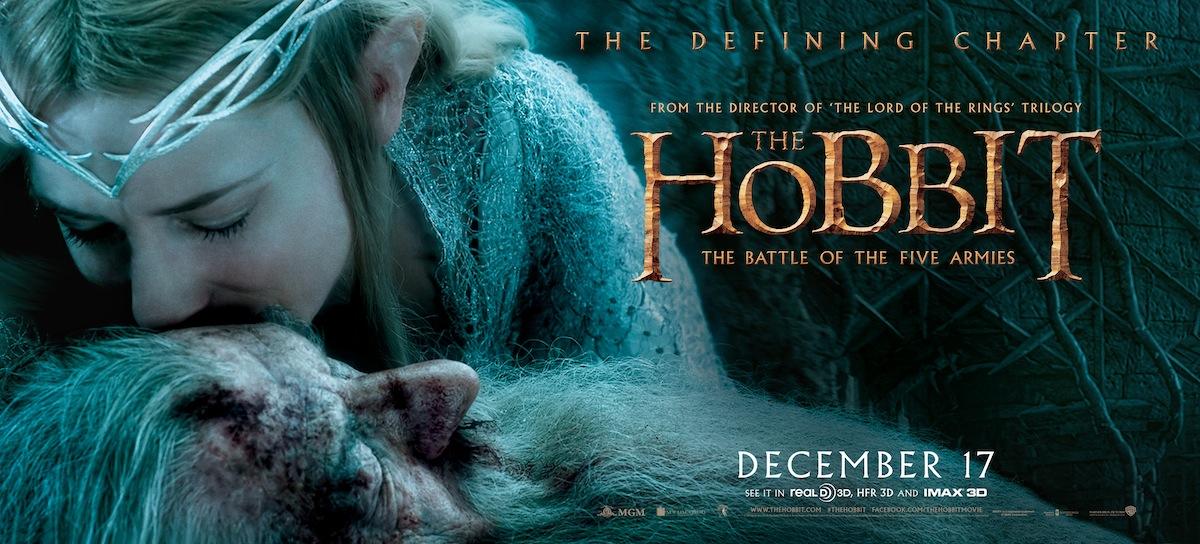
A series of movie posters has been released in recent days for the upcoming release of Peter Jackson's The Hobbit: The Battle of the Five Armies on December 17, 2014. My favorite of the posters so far is this one featuring Galadriel and Gandalf:


Exactly why the Lady of Lothlorien has come to the Misty Mountain I do not know (she does not in the book), nor do I know how grievous are Gandalf's wounds in Jacksons' film. Of the wounds of Gandalf, Tolkien says:
It was not long before Bilbo was set down before a tent in Dale; and there stood Gandalf, with his arm in a sling. Even the wizard had not escaped without a wound; and there were few unharmed in the host.
It will be interesting, to say the least, to see what "adaptations" Jackson and company have devised for this third installment. I am still somewhat cautiously hopeful (is that language guarded enough?) that after the great disappointment that was The Hobbit: The Desolation of Smaug (which I still have not purchased, nor intend to) some corrections to the story will be made.

I still think the second "the" is quite unnecessary, which would be why Tolkien himself did not employ it.  He describes the beginning of the battle with these words:
So began a battle that none had expected; and it was called the Battle of Five Armies, and it was very terrible. Upon one side were the Goblins and the Wild Wolves, and upon the other were Elves and Men and Dwarves.
Still, if anyone can film a battle involving five armies, it is Jackson, and maybe only Jackson.

28 April 2014

Thoughts on the title change of Jackons' third Hobbit movie

Sir Peter Jackson recently announced that the third installment of his cinematic adaptation of J.R.R. Tolkien's The Hobbit will no longer be subtitled There and Back Again but The Battle of the Five Armies. Shaun Gunner of The Tolkien Society agrees with this change, as do I (though I think it should be The Battle of Five Armies, without the second unnecessary "the"), and suggests it is partly for the sake of profits, which is likely true.

I knew the The Hobbit: The Desolation of Smaug did well in theaters but not as well as The Hobbit: An Unexpected Journey. Gunner, though, notes something rather important to the movie studio that I had not known before:
This is particularly salient in light of the fact that the second Hobbit film grossed $67 million less than the first (highly unusual in itself), that both films failed to take more at the box office than The Return of the King (and that’s not even factoring in inflation), and that The Desolation of Smaug fell behind Iron Man 3, Frozen and Despicable Me 2 in box office takings for 2013.

Here we have to ask what Gunner did not: Why were the revenues from The Desolation of Smaug so much less than An Unexpected Journey? It cannot be because Tolkien fans no were Tolkien fans; rather, I submit ticket sales were so low because they are more Tolkien fans than Jackson fans.

I am happy to say that I am part of the reason The Desolation of Smaug did not do as well as An Unexpected Journey; the first movie I saw four times in the theater (in a growing attempt to determine if I liked it, which I partly did, given that it is not Tolkien's The Hobbit)  and the second only twice, so greatly did I dislike it; what is more, I own An Unexpected Journey on DVD/Blu Ray, but I have not even considered buying The Desolation of Smaug because it so little resembles the work of the subcreator of Middle-earth.

If the studios, as Gunner suggests, are concerned about increasing their profits, which I'm sure they are, they would do well to convince Jackson to do what he can to repair much of the harm he and his writers did to the story in the many and unnecessary departures from the actual text. The changes, as I wrote in my review, feel forced and contrived and do help but hinder the story. These changes are the reason I only saw the movie twice and never considered buying it.

There is some small hope that The Battle of the Five Armies will more closely resemble the actual story, though it will be impossible to correct the many departures and additions made in the film. If Jackson and company are concerned about their revenue from the third installment, they would do well to heed this advice.

When The Hobbit: The Battle of the Five Armies is released in theatres, I will go see it, more out of some bizarre curiosity than anything else; I have no real confidence in the third installment. However, if it it proves better than the second installment, I may say it more than once.

14 December 2013

A review of The Desolation of Smaug: Middle-earth no longer feels real

Thursday evening, with some trepidation, I watched The Hobbit: The Desolation of Smaug (in English, with Italian subtitles).  If memory serves, the last movie I saw in the theaters before The Desolation of Smaug was The Hobbit: An Unexpected Journey.

Since The Hobbit is my favorite of Tolkien's works, my excitement at the release of An Unexpected Journey was very high, admittedly too high.  Having left An Unexpected Journey both frustrated and angry, I went to see The Desolation of Smaug with one caveat continually running through my mind: This is Jackson's The Hobbit, not Tolkien's.  This remains undoubtedly true for The Hobbit: The Desolation of Smaug; it is Jackon's, not Tolkien's.

The many - and drastic - departures from, and additions to, the story of Tolkien this time did not anger me, in no small part because I had prepared myself and fully expected to become angry (if you love the book, you should do the same); I'm glad I prepared myself so, because I left The Desolation of Smaug feeling somewhere in between disappointment and ambivalence.  I'm not still not sure which it is.

As I ponder my reactions to the film, two thoughts return again and again.  First, it seems to me that Jackson has tried far too hard to directly connect The Hobbit to The Lord of the Rings.  The Desolation of Smaug, when not filled with ridiculous fight scenes, is much darker and more menacing the Tolkien's book, and not for the better.  Much of the menace seems forced, in no small part because it is not present in the book.

Second, when you read the book you know that you are reading fantasy but it feels as though it actually happened, that you are reading a bit of history.  Tolkien's style of writing draws you - gently and with great skill - further and deeper into the story and you feel a personal connection with the characters.  The Desolation of Smaug lacks both this feeling of reality and the personal involement with the story, which results in Middle-earth no longer feeling real.

POTENTIAL SPOILER ALERT:

There is no grace or dignity about the elves of Mirkwood.  Though Tolkien described them as "more dangerous and less wise" than their kin, which the movie notes, he also said they "are not a wicked people," but in The Desolation of Smaug Thranduil seems a wicked king.

The innuendo between Fili and Tauriel does nothing whatever to advance the story, except to drag it further away from the text, and is entirely unnecessary.

This loss is achieved in no small way through the battle sequences.  On the one hand, you have Legolas balancing himself on the heads of two dwarves in two barrels moving in the small rapids of a river as orcs shoot arrows at him and throw themselves at him, yet he never loses his balance.  On the other hand, you have Tauriel - who is herself a complete fiction - single-highhandedly going after a army of orcs without receiving so much as a scratch.  It's all too much and, frankly, borders on the unbelievable and reminded me far too much of Hidden Tiger, Crouching Dragon, which I thought immensely stupid.  If the unbelievability weren't enough, the scene with Bombur in the barrel was simply cartoonish and ridiculous, though enjoyed by the Italian audience.


I was pleasantly surprised to find that the many changes visible in the various trailers were not as horrible as I expected them to be; however, the unforeseen changers in Lake Town and under the Lonely Mountain are so far removed from anything that Tolkien wrote that as I left the theater I actually wondered: Did even 50% of The Desolation of Smaug come from Tolkien?  I don't think so.

To make matters worse, the immense alterations from the text do not actually increase the suspense of the plot, nor are they necessary for dramatic emphasis, as the writers argued with their changes to the text of The Lord of the Rings, most of which I am able to see their point when it comes to a movie version; however, I cannot understand the changes they have chosen to make here.

IT IS NOT ALL BAD

So as not to end on a negative note, I have three positive takeaways from the film.  First, the juvenile humor, so present in An Unexpected Journey is mostly gone from The Desolation of Smaug, with the exception of the innuendo between the elf and the dwarf.

Second, the dragon Smaug has been magnificently rendered and is the best dragon I have ever seen in a movie; he is most impressive and is alone worth the cost of a ticket.

Third, once again, Howard Shore has brilliantly composed the soundtrack of the film and will certainly make our ears glad once again with the forthcoming soundtrack to There And Back Again.

02 January 2013

A Review of The Hobbit: An Unexpected Journey

Over the past several weeks many of you have asked my opinion of Peter Jackson's recently released The Hobbit: An Unexpected Journey.

Naturally, I saw the film at the opening show and spent most of the movie both frustrated and angry.  Consequently, I have thus far refrained from offering my thoughts because I realized fairly quickly that my expectations were perhaps too high.  This is a common problem with me and I'm told I would be much happier if I simply lowered my expectations of myself and of others (but that isn't likely to happen).

Be that as it may, I wanted to wait until I saw the film a second time, with my expectations lowered, before offering a review of the first of Jackson's three-part installment of the journey of Bilbo Baggins.

Let me begin by saying that if you have not read J.R.R. Tolkien's The Hobbit, or at least did not read it attentively, you will very much enjoy An Unexpected Journey (unless you somehow missed the fact that this is only part one of three).  The acting, the costumes and sets, the CGI, and the cinematography all combine in a glorious fashion.  Let me also say that the soundtrack composed by Howard Shore is, once again, superb.

Jackson's An Unexpected Journey has a decidedly different feel than his trilogy of the Lord of the Rings.  Precisely what this different feel is, I cannot say, except that it feels somehow heavier and more serious.

Whereas the first part of Tolkien's book has a certain whimsical feel, Jackson's movie is missing this same whimsy.  Attempts are made to insert it in different spots throughout the film, though they don't seem as effective as Tolkien's original and feel somewhat forced.

For whatever reason, Jackson and his team made several changes to the story that, to my mind, do not help the movie but will only serve to frustrate Tolkien fans.  While I acknowledge the team did the same with the Lord of the Rings, the changes to The Hobbit are more noticeable to me - and more substantial - perhaps because it is my favorite of Tolkien's books.  I probably shouldn't have re-read the book the week the movie was released (I clearly didn't learn my lesson with Prince Caspian).

For instance, in the book, Bilbo is surprised and flustered when the Dwarves begin arriving, but in the movie he seems angry from the very moment the first dwarf arrives.  Tolkien writes of Bilbo, "He had a horrible thought that the cakes might run short, and then he - as the host: he knew his duty and stuck to it however painful - he might have to go without."  This sense of honor is somewhat lacking in the depiction of Bilbo in the film.

Several scenes in the movie were significantly altered from those in book: the trolls (how they are turned to stone), for one, and the wargs (which makes Bilbo more heroic than he was at that moment), for another, and the arrival of Thorin (which doesn't really have any impact), for a third.

In terms of the flow of a movie, particularly for those not familiar with the book, I can understand why such changes were deemed appropriate (though I do not like them).  One change I do not understand is the lack of colored hoods belonging to the dwarves (Tolkien goes to great length to point them out).

Some scenes in the film seem to have been shot for no other reason than to impress audiences watching in 3-D (the encounter with the stone giants and the escape from the tunnels of the Great Goblin, come to mind).

All that being said, I did enjoy the movie on the second viewing and expect I'll enjoy it all the more with a third viewing.

By far, the best scene in the film was Riddles in the Dark (though a riddle was curiously omitted). The CGI begind Gollum is a visual treat, stunning and captivating, and the way the riddles were asked and answered was simply brilliant, a job very well done.

Some have said the movie is too long.  I do not think it is too long, but an intermission would be helpful; movie theatre seats aren't the most comfortable things around, but then, as Tolkien would say, "adventures are not all pony-rides in May sunshine."

While The Hobbit: An Unexpected Journey isn't what I had hoped it would be - perhaps unreasonably - it is a good film and I look forward to watching The Hobbit: The Desolation of Smaug and The Hobbit: There and Back Again.

The movie, as someone has said, is not Tolkien's The Hobbit, but rather Jackson's The Hobbit.  Be that as it may, Jackson's film is leading me once again back into the book, which is no small gift or treat.

01 March 2012

Another Hobbit video

A little over two months ago, the good folks at The Hobbit Blog - the official blog of the forthcoming movies The Hobbit: An Unexpected Journey and The Hobbit: There and Back Again - posted their fifth Production Video, On Location.

At the time, we were promised a subsequent video, which was finally released today: Production Video, On Location (Part 2).

Enjoy! Amidst the troubling news of the day we need something to lift our spirits.