Showing posts with label Movies. Show all posts

20 July 2015

Joy and Sadness, Pixar and Tolkien

Earlier today I shared Chris Hazell's review of Pixar's Inside Out in which he reflected on God's gift of sadness.

A few moments ago I saw this quote from J.R.R. Tolkien on Twitter:
The quote seemed familiar to me, but I could not quite place it; at the very least, I knew it certainly sounded like Tolkien.

After inquiring, I learned it is not a direct quote, but a conflation of a few lines from The Return of the King. After Pippin pledges his fealty to Denethor, the Steward of Gondor, the hobbit and Gandalf reflected on Pippin's action and on what might yet come:
'Are you angry with me, Gandalf?' [Pippin] said, as their guide went out and closed the door. 'I did the best I could.'

'You did indeed!' said Gandalf, laughing suddenly; and he came and stood beside Pippin, putting his arm about the hobbit's shoulders, and gazing out of the window. Pippin glanced in some wonder at the face now close beside his own, for the sound of that laugh had been gay and merry. Yet in the wizard's face he saw at first only lines of care and sorrow; though as he looked more intently he perceived that under all there was a great joy: a fountain of mirth enough to set a kingdom laughing, were it to gush forth.
We might say that Gandalf's joy was something like a volcano, just waiting to erupt. With how many of us is this the case?

Something similar might be said of every melancholic person. Externally, what is seen is sadness, or at least the impression of sadness, but as Inside Out shows us, this is no bad thing. Hazell puts it this way:
The film masterfully explores the danger of avoiding sadness and exhausting joy, a theme we can see in our culture without much eye straining—an inordinate drive to secure emotional happiness at all costs, avoiding, ignoring, or destroying all obstacles that could hinder it. Yet, as we witness in the film, there is a necessary “growing up” that reveals not only the benefit of sadness, but also the inescapable need for it to allow a deeper sense of richness in our lives and, paradoxically, a more lasting joy.
Far too many people today are - it might be said - obsessed with the outward appearance of joy, but interiorly they are bereft of joy; we have become, as a society, so uncomfortable with sadness, a necessary and life-giving emotion, that we would rather fake being happy than acknowledge we are sad. We refuse to be led by sadness to a joy beyond imagining.

As one simple example of this, the most common thing I hear from parishioners is this: "You need to smile more," or some variation of it. These are the ones so concerned with exterior joy that they do no see what Pippin saw under Gandalf's care and sorrow. I do not have a natural smile on my face and if I were to walk around smiling it would not be a sincere smile.

This, however, does not mean that I do not know joy. It means, rather, that my joy is, like Gandalf's, hidden within sorrow and those who know how to look will see it; these are the ones who say to me, "You have a beautiful smile." I've always taken this to mean that my smile is sincere; sincere smiles are always beautiful.

I do not think my joy can set a kingdom laughing, but it can certainly set a room laughing, but only after people let sadness lead them to the joy waiting to burst forth.

Pixar teaches us the importance of sadness

A few weeks ago, I saw Pixar's newest movie Inside Out with my brother and his family. It is a movie I found deeply moving and its focus on the interplay between Joy and Sadness I found intriguing.

I knew the movie was on to something because, well, it just felt right. The important role of sadness seemed comfortable and natural, and rang true with what my melancholic personality knows and values. While society today tells us to avoid sadness at all costs, we melancholics often feel quite at home in sadness (which is not the same as depression).

Still, I've been pondering for sometime the best way to put these reactions, thoughts, and feelings into words, but without much success. However, I'm happy to say that Chris Hazell at Word on Fire has done this for me in his review, "Inside Out" and God's Gift of Sadness:
Pixar gets it right. And perhaps more than just a necessity, sadness may be one of the greatest gifts for which we thank God in the life to come. For in our sadness—in our suffering—we can experience the joy of knowing God’s unending mercy and love for us.
Be sure to read the whole thing and don't be afraid of sadness.

20 January 2015

Academy recognizes the worsening of Jackon's films of The Hobbit

It is no secret that I am not fond of Sir Peter Jackson's cinematic adaptation of J.R.R. Tolkien's classic book of The Hobbit, though I still very much enjoy Jackson's adaptation of The Lord of the Rings. In fact, with each new edition to Jackson's trilogy of The Hobbit, it is my opinion that the quality of the production continually declined. I am, apparently, not the only one who thinks so.

In fact, The Hobbit: The Battle of the Five Armies received only one Oscar nomination (for "Achievement in Sound Editing"), whereas The Hobbit: The Desolation of Smaug received three nominations and The Hobbit: An Unexpected Journey received four nominations.

In my review of An Unexpected Journey, I noted that the movie has a "decidedly different feel" than Jackson's The Lord of the Rings trilogy. This was an unfortunate decision on Jackson's part which not only cost him the gratitude of many fans, but maybe also a few Oscar nominations and even wins.

The Tolkien Society compared Jackson's nominations and wins for his two Tolkien trilogies:
  • The Lord of the Rings: The Fellowship of the Ring – 13 nominations, 4 wins (second-highest number of nominations ever)
  • The Lord of the Rings: The Two Towers – 6 nominations, 2 wins
  • The Lord of the Rings: The Return of the King – 11 nominations, 11 wins (joint highest number of wins ever – shared with Ben-Hur and Titanic)
  • The Hobbit: An Unexpected Journey – 4 nominations, 1 win
  • The Hobbit: The Desolation of Smaug – 3 nominations, 0 wins
  • The Hobbit: The Battle of the Five Armies – 1 nomination
Personally, I'm not sure The Battle of the Five Armies was worth even one nomination.

15 October 2014

A news round up - 15 October 2014

Here are few items of news you might have missed:
  • The U.S. Department of Justice created a Facebook page under the name of a woman and with pictures taken from her cell phone  - without her knowledge or permission - to help, they say, in criminal investigations. She is now suing the government for a breach of privacy and is seeking more than $250,000 in damages.
  • The budget deficit of the U.S. federal government has now fallen to just $486,000.000,000. This is down from a budget deficit of more than $1,000,000,000,000 in President Obama's first term and after hitting a record $1,400,000,000,000 in 2009. This fall of the budget deficit is, I suppose, good news. Still, I wouldn't mind a personal budget like this.
  • I'm not sure how I managed to miss this one until today, but a prisoner in Santa Fe is suing the state of New Mexico because his First Amendment freedom to practice Satanism is not being respected.
  • The tallest cow in the world - standing at 6'4" - lives in Orangeville, Illinois (I didn't know where it was, either).

14 December 2013

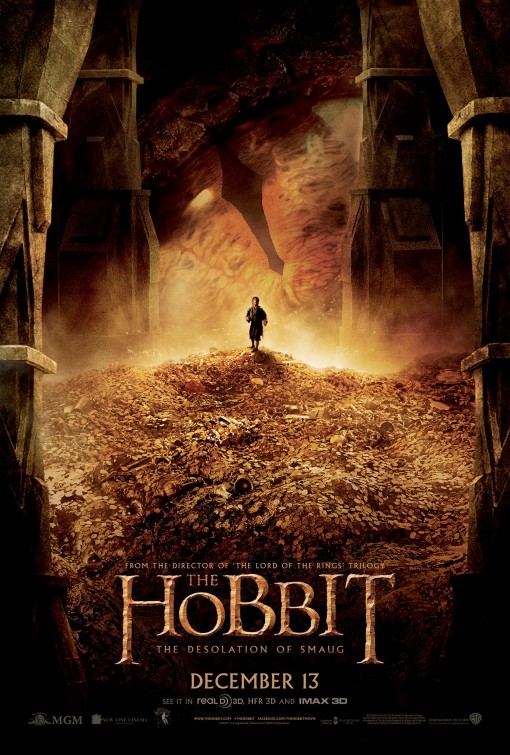
A review of The Desolation of Smaug: Middle-earth no longer feels real

Thursday evening, with some trepidation, I watched The Hobbit: The Desolation of Smaug (in English, with Italian subtitles).  If memory serves, the last movie I saw in the theaters before The Desolation of Smaug was The Hobbit: An Unexpected Journey.

Since The Hobbit is my favorite of Tolkien's works, my excitement at the release of An Unexpected Journey was very high, admittedly too high.  Having left An Unexpected Journey both frustrated and angry, I went to see The Desolation of Smaug with one caveat continually running through my mind: This is Jackson's The Hobbit, not Tolkien's.  This remains undoubtedly true for The Hobbit: The Desolation of Smaug; it is Jackon's, not Tolkien's.

The many - and drastic - departures from, and additions to, the story of Tolkien this time did not anger me, in no small part because I had prepared myself and fully expected to become angry (if you love the book, you should do the same); I'm glad I prepared myself so, because I left The Desolation of Smaug feeling somewhere in between disappointment and ambivalence.  I'm not still not sure which it is.

As I ponder my reactions to the film, two thoughts return again and again.  First, it seems to me that Jackson has tried far too hard to directly connect The Hobbit to The Lord of the Rings.  The Desolation of Smaug, when not filled with ridiculous fight scenes, is much darker and more menacing the Tolkien's book, and not for the better.  Much of the menace seems forced, in no small part because it is not present in the book.

Second, when you read the book you know that you are reading fantasy but it feels as though it actually happened, that you are reading a bit of history.  Tolkien's style of writing draws you - gently and with great skill - further and deeper into the story and you feel a personal connection with the characters.  The Desolation of Smaug lacks both this feeling of reality and the personal involement with the story, which results in Middle-earth no longer feeling real.

POTENTIAL SPOILER ALERT:

There is no grace or dignity about the elves of Mirkwood.  Though Tolkien described them as "more dangerous and less wise" than their kin, which the movie notes, he also said they "are not a wicked people," but in The Desolation of Smaug Thranduil seems a wicked king.

The innuendo between Fili and Tauriel does nothing whatever to advance the story, except to drag it further away from the text, and is entirely unnecessary.

This loss is achieved in no small way through the battle sequences.  On the one hand, you have Legolas balancing himself on the heads of two dwarves in two barrels moving in the small rapids of a river as orcs shoot arrows at him and throw themselves at him, yet he never loses his balance.  On the other hand, you have Tauriel - who is herself a complete fiction - single-highhandedly going after a army of orcs without receiving so much as a scratch.  It's all too much and, frankly, borders on the unbelievable and reminded me far too much of Hidden Tiger, Crouching Dragon, which I thought immensely stupid.  If the unbelievability weren't enough, the scene with Bombur in the barrel was simply cartoonish and ridiculous, though enjoyed by the Italian audience.


I was pleasantly surprised to find that the many changes visible in the various trailers were not as horrible as I expected them to be; however, the unforeseen changers in Lake Town and under the Lonely Mountain are so far removed from anything that Tolkien wrote that as I left the theater I actually wondered: Did even 50% of The Desolation of Smaug come from Tolkien?  I don't think so.

To make matters worse, the immense alterations from the text do not actually increase the suspense of the plot, nor are they necessary for dramatic emphasis, as the writers argued with their changes to the text of The Lord of the Rings, most of which I am able to see their point when it comes to a movie version; however, I cannot understand the changes they have chosen to make here.

IT IS NOT ALL BAD

So as not to end on a negative note, I have three positive takeaways from the film.  First, the juvenile humor, so present in An Unexpected Journey is mostly gone from The Desolation of Smaug, with the exception of the innuendo between the elf and the dwarf.

Second, the dragon Smaug has been magnificently rendered and is the best dragon I have ever seen in a movie; he is most impressive and is alone worth the cost of a ticket.

Third, once again, Howard Shore has brilliantly composed the soundtrack of the film and will certainly make our ears glad once again with the forthcoming soundtrack to There And Back Again.

04 August 2008

Molokai: The Story of Father Damien

Someone posted the trailer to the film Molokai: The Story of Father Damien on YouTube:


It's not the best quality of captures, but you get the idea.

03 August 2008

An excellent film

From the opening credits with the beautifully haunting melody of Lux aeterna (Eternal Light), Molokai: The Story of Father Damien is a gripping account of the life of the leper-priest.

Filmed on location on Molokai and Oahu, director Paul Cox and his international cast of excellent actors masterfully draws the viewer into the life and times of those in the leper colony. The inclusion in the cast of patients at Kalaupapa adds additional realism and humanity to the film.

The performance of David Wenham (who played Faramir in The Lord of the Rings) most movingly portrays the compassionate love and zeal of Father Damien. He is to be well commended for his work, as are the other members of the cast and crew.

The costumes and sets of this movie leave nothing to be desired.

Molokai should be a part of every Catholics film library and from it he will derive much inspiration.

The trailer for the film may be viewed here.