22 October 2013

Bishop speaks clearly as efforts to protect marriage continue

A protest rally was held Tuesday at Illinois capitol in Springfield for so-called "marriage equality" and members of the Rainbow Sash Movement had planned to pray and protest in the Cathedral of the Immaculate Conception:
The Rainbow Sash Movement is calling for silent prayer to begin 4:30PM just before the 5:15PM Mass at the Cathedral of the Immaculate Conception. A rosary for Marriage Equality will be said in silence. By standing up in the Cathedral you will indicate you are there to pray the rosary for Marriage Equality. Let us come together as a spiritual family in prayer after the March.
Naturally, that prompted a clear response from His Excellency the Most Reverend Thomas John Paprocki, Bishop of Springfield in Illinois (with my emphases):

The Rainbow Sash Movement has encouraged Roman Catholics to come to Springfield to "have a loud Catholic presence for marriage equality." They have announced plans to gather at the Cathedral of the Immaculate Conception at 4:30 p.m. just before the 5:15 p.m. Mass to stand in the Cathedral and indicate that they are there to pray the rosary for "marriage equality."

It is blasphemy to show disrespect or irreverence to God or to something holy. Since Jesus clearly taught that marriage as created by God is a sacred institution between a man and a woman (see Matthew 19:4-6 and Mark 10:6-9), praying for same-sex marriage should be seen as blasphemous and as such will not be permitted in the cathedral.

People wearing a rainbow sash or who otherwise identify themselves as affiliated with the Rainbow Sash Movement will not be admitted into the cathedral and anyone who gets up to pray for same-sex marriage in the cathedral will be asked to leave.

Of course, our cathedral and parish churches are always open to everyone who wishes to repent their sins and ask for God's forgiveness [video here].
The State Journal-Register reports that police were present outside the Cathedral prior to the evening Mass, presumably as a precaution:
Police cars were parked near the church in the hour leading up to Tuesday’s Mass, and one officer could be seen standing within the main entryway doors.
In the same report, the SJR notes that one member of the Rainbow Sash Movement entered the Cathedral - without wearing a sash - and did not cause a scene.

About 12 additional votes are still needed in order for the Illinois House to pass SB 10, the so-called (despite the grave threats it poses to religious liberty) Religious Freedom and Marriage Fairness Act, which has already passed in the Senate by a vote of 34-21.

Please, make every effort to attend Wednesday's Defend Marriage Lobby Day at the capitol and ask your Representative to vote no on SB 10 in favor of religious liberty.

Update: A friend who went to pray in the Cathedral at 4:30 p.m. said "the whole thing wound up being a non-event," which is good to know.
The Rainbow Sash Movement has encouraged Roman Catholics to come to Springfield to "have a loud Catholic presence for marriage equality." They have announced plans to gather at the Cathedral of the Immaculate Conception at 4:30 p.m. just before the 5:15 p.m. Mass to stand in the Cathedral and indicate that they are there to pray the rosary for "marriage equality."
It is blasphemy to show disrespect or irreverence to God or to something holy. Since Jesus clearly taught that marriage as created by God is a sacred institution between a man and a woman (see Matthew 19:4-6 and Mark 10:6-9), praying for same-sex marriage should be seen as blasphemous and as such will not be permitted in the cathedral.
People wearing a rainbow sash or who otherwise identify themselves as affiliated with the Rainbow Sash Movement will not be admitted into the cathedral and anyone who gets up to pray for same-sex marriage in the cathedral will be asked to leave.
Of course, our cathedral and parish churches are always open to everyone who wishes to repent their sins and ask for God's forgiveness.
- See more at: http://dio.org/communications/press-releases348-statement-regarding-planned-rainbow-sash-event-at-cathedral.html#sthash.z4wLUPS7.dpuf

21 October 2013

Cars and Tolkien

When the automobile was first introduced to the populace, we were told that it would free us up to spend more time with family and friends.  As might have been expected, this promise turned out to be quite false (much as when we were told that computers would do away with paperwork).  The automobile simply made it both easier and faster to get from one point to another and, in effect, made it easier to do more things in the same span of time.

The older I get - and the more Hobbit-like I become - I increasingly question the good of the automobile.  It first started when I visited Mackinac Island where cars are not allowed.  For short distances on the island, your feet suffice; for longer distances, horse-drawn carriages suffice.

When I first I rode on one of these carts, I was deeply moved by the rocking motion - which I found soothing - as the horse gently pulled us along and by the pace at which we moved.  Everything was slowed and allowed greater attention to be paid to the beauty of the trees and the pleasantness of the company of friends.

I couldn't help but wonder then how much more peaceful the world might be without cars.  Certainly it would be more difficult, but it would - seemingly - be more peaceful.  Simply consider the additional time spent not going anywhere, or at least not very far.  Consider also the length of time which would be required for longer journeys, time that could be used taking in beauty and visiting with family and friends who would accompany you.

Perhaps it's nothing more than a romantic nostalgia (for lack of a better phrase) for a manner of life that never was.  And perhaps it might also be true.

At any rate, today I stumbled upon a quote from J.R.R. Tolkien, whose distaste for industrialization is legendary, that matches well with my thoughts on the car:
The motor-car attracts, because it enables people to live far away from their noisome and inhuman 'works', or to fly from their depressing dormitories to the 'country'. But it cheats: for the motor-factories, and their subsidiaries (garages, repair-shops, and pumps), and the cars themselves, and their black and blasted roads, devour the 'country' like dragons. This is the splendid gift of a magician: he offers to a caged bird that has defiled its cage and perch - what? - a little length of chain so that it can flap to a near-by twig and foul that. Magnificent! This is freedom! And to make the chain hundreds of the magician's prisoners sweat like motorlocks. This is the Real Life that is so beneficial to the University of Oxford. It might seem simpler to clean the bird-cards.
Having been without a vehicle now since the middle of July, I am finding that I have not really missed it. It's been nice to travel by foot and by train (and twice in someone else's car).

20 October 2013

Illinois Senate uncertain of morality of marriage

With the Illinois General Assembly soon returning to Springfield, the Chicago Tribune published an article yesterday looking at the possibility of the legislature passing SB 10, the so-called Religious Freedom and Marriage Fairness Act in the coming weeks.

Lawmakers in favor of same-sex "marriage" always speak of such legislation as "the right thing to do" and yet they also recognize that passing such a bill will likely harm their re-election efforts:
The key hurdle is timing. Lawmakers will start filing re-election paperwork at the end of November, so casting a vote for gay marriage now would leave a month or so for challengers opposed to it to gather enough signatures to get on the March primary election ballot.
This is precisely why the bill did not muster enough votes in the last session (and why the General Assembly passed the so-called Religious Freedom Protect and Civil Union Act in the "lame duck" session when their re-elections were not at risk).  It simply shows that the legislators are uncertain as to the "right thing" to do because, one might argue, deep down they fully understand the difficulties this bill places on religious liberty.

N.B.: If you're in Illinois, be sure to attend the Defend Marriage Lobby Day and speak with your elected representatives.  Tell you Senator to vote "No" on SB10.

17 October 2013

A reminder for Illinoisans

I hope those of you in Illinois marked your calendars last month when I passed on news of the Defend Marriage Lobby Day, which will take place at the capitol on October 23rd.

If you didn't mark your calendar, you can still make plans to attend.

DrPepper, t-shirts, a good question, and homework

I was visiting with one of the priests here at the Casa Santa Maria a few minutes ago.  As we talked, he noticed an opened can of DrPepper sitting on my table (I bought 15 cans yesterday afternoon at the only store in all of Rome that sells DrPepper) and he asked if he could have a look at it.

(Incidentally, I just noticed that on the DrPepper web site you can now order your own unique t-shirt using the DP slogan, "I'm a ..." with the DrPepper logo and fill in the "..." with what you like.  I tried one with "I'm a hobbit, in all but size".  I liked the look and will have to give it some thought.  If you have Peppers in your life, these would make great fun and inexpensive gifts!)

The cans that I buy come from the United Kingdom and so have a somewhat different look than the cans sold in the United States of America, though the maroon color remains a distinct aspect:


As he examined the can he said in a declaratory style: "A sparkling fruit flavour soft drink".  Thinking it an apt description of the King of Beverages, I agreed, and then realized he read it from the can.

(If you're curious, the cans cost 55 pence in the U.K., hence the 55p.)

This phrase prompted me to take a closer look at the can.  I was surprised to see that each can has only 42 calories, compared to 150 in the U.S. and only 10.3 grams of sugar, compared to, if memory serves, 39 in the U.S.  There is no high fructose corn syrup, the flavor is enhanced, and the caffeine level seems the same.

At any rate, I also noticed another phrase on the can, which made me laugh: "what's the worst that could happen?"  I don't know, but at the moment the best that can happen is it will help me study Latin and the general norms of canon law.

15 October 2013

Catholic services forbidden on military base, Protestant services continue; priest sues

The Reverend Ray Leonard, a Roman Catholic priest, was recently contracted to provide pastoral care at Kings Bay Naval Submarine Base.  However, he has been forbidden to provide pastoral care during the partial government shutdown though he wishes to do so completely free, though others have not been so forbidden, as CNN reports:
Leonard also claims "members of religions, other than the Roman Catholic religion, have been afforded access to the chapel to engage in religious exercise in conformity with their respective faiths."
The notice from chapel staff says, "Protestant services will continue to be held in the Subase chapel Sundays @ 1030. We apologize for the inconvenience" [more].
Frankly, this is simply outrageous.  The headline should have read: "Catholic services forbidden, Protestant services allowed".  To those who deny my claims that there is an coming persecution of Catholics in the United States of America, how do you explain this?  It cannot be simply an oversight.  Why this important piece of information comes at the bottom of the article and not at the top is beyond my understanding.


Because the free exercise of Father Leonard's religious liberty has clearly been violated, he has filed a law suit with the assistance of the Thomas More Law Society.

In his affidavit, Father Leonard provides what might be termed a "money quote":
In China, I was disallowed from performing public religious services due to the lack of religious freedom in China. I never imagined that when I returned home to the United States, that I would be forbidden from practicing my religious beliefs as I am called to do, and would be forbidden from helping and serving my faith community.

14 October 2013

Paprocki establishes legal group to assist the poor

His Excellency the Most Reverend Thomas John Paprocki, Bishop of Springfield in Illinois, announced yesterday at the annual meeting of the Catholic Lawyers Guild the formation of Caritas Legal Services to provide legal assistance to the poor through the aid of a $1.5 million donation.

The pro-bono group "will not provide assistance in criminal cases. It will provide help in a broad range of civil matters including legal guardianship and custody, child support, disability benefits, domestic violence, foreclosure and eviction, landlord/tenant disputes, debt relief, adoption, immigration and others."


When he made the announcement, he noted that "it is fundamentally unfair and unjust to deprive the poor of the legal protection for their lives that wealthy persons enjoy."

The State Journal-Register provides a few details as to the operations of Caritas Legal Services:
The program will be administered through Catholic Charities and provide assistance through eight Catholic Charities regional offices in Springfield, Carlinville, Alton, Decatur, Granite City, Quincy, Mattoon and Effingham.
A panel of volunteer lawyers with expertise in various areas of civil law is being recruited to provide the free assistance. A program coordinator will be hired to visit the regional offices and 28 counties of the diocese to provide intake on client cases. The coordinator will interview and assess clients and then match them with an appropriate volunteer attorney for representation [more].
At the same time, Bishop Paprocki announced the creation of the Lex Cordis Endowment Campaign to assist the work of Caritas Legal Services.  "We need people to stand with us in this noble cause," he said, "of giving a voice to the voiceless and empowering the powerless."

The formation of Caritas Legal Services continues the work Bishop Paprocki began when he was a priest of the Archdiocese of Chicago and established what is now the Chicago Legal Clinic in 1981 and now has eight locations.

13 October 2013

Pope Francis: God asks us to trust and obey

The Holy Father Pope Francis delivered an excellent and challenging homily yesterday when he consecrated the world to the Immaculate Heart of Mary.  It is one certainly worth reading and reflecting upon, not just now but time and time again.

The text of his homily follows, with my emphases:
In the Psalm we said: “Sing to the Lord a new song, for he has done marvellous things” (Ps 98:1).
Today we consider one of the marvellous things which the Lord has done: Mary! A lowly and weak creature like ourselves, she was chosen to be the Mother of God, the Mother of her Creator.
Considering Mary in the light of the readings we have just heard, I would like to reflect with you on three things: first, God surprises us, second, God asks us to be faithful, and third, God is our strength.
1. First: God surprises us. The story of Naaman, the commander of the army of the king of Aram, is remarkable. In order to be healed of leprosy, he turns to the prophet of God, Elisha, who does not perform magic or demand anything unusual of him, but asks him simply to trust in God and to wash in the waters of the river. Not, however, in one of the great rivers of Damascus, but in the little stream of the Jordan. Naaman is left surprised, even taken aback. What kind of God is this who asks for something so simple? He wants to turn back, but then he goes ahead, he immerses himself in the Jordan and is immediately healed (cf. 2 Kg 5:1-4). There it is: God surprises us. It is precisely in poverty, in weakness and in humility that he reveals himself and grants us his love, which saves us, heals us and gives us strength. He asks us only to obey his word and to trust in him.
This was the experience of the Virgin Mary. At the message of the angel, she does not hide her surprise. It is the astonishment of realizing that God, to become man, had chosen her, a simple maid of Nazareth. Not someone who lived in a palace amid power and riches, or one who had done extraordinary things, but simply someone who was open to God and put her trust in him, even without understanding everything: “Here I am, the servant of the Lord; let it be with me according to your word” (Lk 1:38). That was her answer. God constantly surprises us, he bursts our categories, he wreaks havoc with our plans. And he tells us: Trust me, do not be afraid, let yourself be surprised, leave yourself behind and follow me!
Today let us all ask ourselves whether we are afraid of what God might ask, or of what he does ask. Do I let myself be surprised by God, as Mary was, or do I remain caught up in my own safety zone: in forms of material, intellectual or ideological security, taking refuge in my own projects and plans? Do I truly let God into my life? How do I answer him?
2. In the passage from Saint Paul which we have heard, the Apostle tells his disciple Timothy: Remember Jesus Christ; if we persevere with him, we will also reign with him (cf. 2 Tim 2:8-13). This is the second thing: to remember Christ always – to be mindful of Jesus Christ – and thus to persevere in faith. God surprises us with his love, but he demands that we be faithful in following him. We can be unfaithful, but he cannot: he is “the faithful one” and he demands of us that same fidelity. Think of all the times when we were excited about something or other, some initiative, some task, but afterwards, at the first sign of difficulty, we threw in the towel. Sadly, this also happens in the case of fundamental decisions, such as marriage. It is the difficulty of remaining steadfast, faithful to decisions we have made and to commitments we have made. Often it is easy enough to say “yes”, but then we fail to repeat this “yes” each and every day. We fail to be faithful.
Mary said her “yes” to God: a “yes” which threw her simple life in Nazareth into turmoil, and not only once. Any number of times she had to utter a heartfelt “yes” at moments of joy and sorrow, culminating in the “yes” she spoke at the foot of the Cross. Here today there are many mothers present; think of the full extent of Mary’s faithfulness to God: seeing her only Son hanging on the Cross. The faithful woman, still standing, utterly heartbroken, yet faithful and strong.
And I ask myself: Am I a Christian by fits and starts, or am I a Christian full-time? Our culture of the ephemeral, the relative, also takes it toll on the way we live our faith. God asks us to be faithful to him, daily, in our everyday life. He goes on to say that, even if we are sometimes unfaithful to him, he remains faithful. In his mercy, he never tires of stretching out his hand to lift us up, to encourage us to continue our journey, to come back and tell him of our weakness, so that he can grant us his strength. This is the real journey: to walk with the Lord always, even at moments of weakness, even in our sins. Never to prefer a makeshift path of our own. That kills us. Faith is ultimate fidelity, like that of Mary.
3. The last thing: God is our strength. I think of the ten lepers in the Gospel who were healed by Jesus. They approach him and, keeping their distance, they call out: “Jesus, Master, have mercy on us!” (Lk 17:13). They are sick, they need love and strength, and they are looking for someone to heal them. Jesus responds by freeing them from their disease. Strikingly, however, only one of them comes back, praising God and thanking him in a loud voice. Jesus notes this: ten asked to be healed and only one returned to praise God in a loud voice and to acknowledge that he is our strength. Knowing how to give thanks, to give praise for everything that the Lord has done for us.
Take Mary. After the Annunciation, her first act is one of charity towards her elderly kinswoman Elizabeth. Her first words are: “My soul magnifies the Lord”, in other words, a song of praise and thanksgiving to God not only for what he did for her, but for what he had done throughout the history of salvation. Everything is his gift. If we can realize that everything is God’s gift, how happy will our hearts be! Everything is his gift. He is our strength! Saying “thank you” is such an easy thing, and yet so hard! How often do we say “thank you” to one another in our families? These are essential words for our life in common. “Sorry”, “excuse me”, “thank you”. If families can say these three things, they will be fine. “Sorry”, “excuse me”, “thank you”. How often do we say “thank you” in our families? How often do we say “thank you” to those who help us, those close to us, those at our side throughout life? All too often we take everything for granted! This happens with God too. It is easy to approach the Lord to ask for something, but to go and thank him: “Well, I don’t need to”.
As we continue our celebration of the Eucharist, let us invoke Mary’s intercession. May she help us to be open to God’s surprises, to be faithful to him each and every day, and to praise and thank him, for he is our strength. Amen.

Ministry of military chaplains still a legal question

Following Friday's vote by the United States Senate to strengthen a resolution from the United States House of Representatives that allows Catholic priests and others to minister to the spiritual needs of the members of the military on military bases during the partial government shutdown, the Archdiocese for the Military Services issued a statement that said, in part:
The amended resolution has been sent back to the House for further consideration and possible final passage. The congressional action follows publication of an op-ed by Mr. Schlageter bringing public attention to the shutdown’s impact on the Catholic military population. Pending final action, the contract priests remain on furlough.
The same statement included a quote from His Excellency the Most Reverend Timothy P. Broglio, Archbishop for the Military Services:
It seems beyond the pale of belief that elected officials are taking so long to resolve this denial of constitutional rights to the men and women in uniform.  It is not a controversial issue, but merely a lacuna in an old law that could be fixed to respond to current situations.  I continue to hope for the good will of those in Congress and the Administration.
It took the Senate a week to vote on the resolution, though I cannot imagine why it should have taken so long to vote after the House had already approved it 400-1.  Please encourage your Representative to call for a swift vote on this amended resolution, so important for the free exercise of religion in our nation.

If you are yet unaware of this situation, please follow the links above.

They stood afar off: Saint Bonaventure on the Ten Lepers

In much of the Catholic world this weekend many will hear a moralizing homily on the proper disposition of gratitude to God for his many blessings, a theme derived in part from the passage of the Gospel of Saint Luke that will be heard this weekend.

Saint Bonaventure, though, in reflecting on this moment in the life of the Lord Jesus took a different approach and chose to focus instead on the fact that the ten lepers "stood at a distance from him and raised their voices" (Luke 17:12-13).

In this gesture of the lepers the Seraphic Doctor notes several things:
Lest they be found reprehensible in the majestic presence of Jesus Christ, who is the great king and the just judge, they demonstrate in the verse proposed above that they presented their petitions discreetly and prudently, for first they demonstrated their most religious nature in a gesture of cautious reserve, because they were filled with fear.  Second, they demonstrated the deepest devotion with a tribute of praise, because they were invoking the principle of human salvation.  Third, they demonstrated the greatest prudence in the formulation of a petition, because they concerned the weakness of their own infection.
First, they had a religious gesture of reserve, because they were filled with humble fear that kept them far away.  They did not come forward presumptuously like the proud, but instead they reverently stood afar off like the humble.  Second, they offered a devout tribute of praise, because they were invoking the principle of salvation with a fervent cry; whence they lifted up their voice from within, and with evident desire, were crying: Jesus, who alone is interpreted as salvation.  Third, they had a petition of discrete intention, because they were concerned with the weakness of their own infection without being shamed by the display; and on this account they added: have pity on us, since we are all certainly infected with the disease of leprosy.  In fact they were not ashamed to manifest their weakness to everyone.
It says, therefore: They stood afar off, where the religious gesture of reserve is commended in the person who first remains steadfast in humility by deploring the committed sins; second, remains steadfast in strength by overcoming diabolical temptations; third, remains steadfast in perseverance by seeking eternal rewards (Sermon 40.1-2).

12 October 2013

California Governor vetoes bill extending statute of limitations against Church but not against public schools

A short time ago California legislators sent Senate Bill 131 to the desk of Governor Jerry Brown that would lift the statute of limitations in sexual abuse cases against children involving Catholic priests, but the same legislation would not the lift that statute in cases of sexual abuse against minors involving others:

The current bill from Sen. Jim Beall, D-San Jose, would have lifted the statute of limitations for a group of alleged victims who are 26 or older and missed the previous window [the statute of limitations had already been lifted in such cases in 2002] to file lawsuits because of time and age restrictions.

Catholic Church leaders, including the Diocese of Monterey, and representatives of other organizations in opposition, such as private schools and the State Alliance of YMCAs, said the proposal to allow claims is unfair because it does not allow accusers to sue public institutions [more].
Governor Brown courageously and rationally vetoed the legislation for the very reason the Church and other organizations opposed its passage.  In his veto statement he said:
This bill does not change a victim's ability to sue a perpetrator.  This bill also does not change the significant inequity that exists between private and public entities.  What this bill does do is go back to the only group, i.e. private institutions that have already been subjected to the unusual "one year revival period" and makes them, and them alone, subject to suit indefinitely.  This extraordinary extension of the statute of limitations, which legislators chose not to apply to public institutions, is simply too open-ended and unfair.
The discrimination between public and private institutions in California law has a long history and allows victims to sue the Catholic Church but not the public school system, a history which Governor Brown explores in his statement and calls "unreasonable, if not shocking."

Senate passes and strengthens resolution protecting religious freedom of Catholic priests

The United States Senate voted on Friday to allow priests contracted with the United States military to celebrate the Sacraments on military bases during the partial government shutdown without fear of fines or imprisonment.  The vote, much to my surprise, passed without objection and strengthened the the resolution of the United States House of Representatives:
The Senate measure, approved by voice vote, includes minor changes by Armed Services Committee Chairman Carl Levin, D-Mich., who sought to clarify the House-passed bill. Levin added provisions stating that the availability of religious services and clergy were "important to the morale and well-being of many members of the armed forces and their families."
He also included a provision that said it was Congress' hope that Defense Secretary Chuck Hagel determines "that contractor clergy provide necessary support to military personnel and would therefore be covered under the appropriations made available" under a law that pays the troops despite the shutdown.
Sen. Bob Casey, D-Pa., welcomed the vote, saying on Friday that "all service members should have the opportunity to worship, and no one should make that more difficult" [more].
This is excellent news and is an encouraging sign in the face of mounting threats to the freedom of religion in the United States.

However, one troubling situation remains in a comment made by the Associated Press' Donna Cassata in the above cited article:
Democrats repeatedly have argued that if House Republicans would allow a vote on a Senate-passed bill to reopen the government, suspension of military death benefits and any obstacles for military chaplains would be resolved.
While this claim may well be true, what it ignores is the simple that never before have Catholic priests - or other chaplains - been so threatened during a partial government shutdown.  As such, this is not simply - regardless of the spin - about a Republican refusal to fully fund the government; it is much deeper and more complicated than that and suggests a tightening of the governmental arm on the American people, which is not simply a grave threat to religious liberty but to the general liberty once enjoyed in the United States of America.
 

Worshipping Animals, or Man at Play

The Scriptures frequently summon all of creation to give praise to God and for our purposes this morning one selection, the final verse of the Psalms, will be sufficient:
Let everything that breathes praise the LORD! Praise the LORD (Psalm 150:6)!
We know that the highest form of praise which the Church can offer to God is the Holy Mass in which the sacrificial love of Christ Jesus is re-presented to the Father. Indeed, the Eucharist "is the culmination both of God’s action sanctifying the world in Christ and of the worship men offer to Christ and through him to the Father in the Holy Spirit" (Eucharisticum mysterium, 6, emphasis mine, quoted in the Catechism of the Catholic Church, 1325).

This being the case, we don't often think of the animals participating at the Mass, though sometimes the medievals did, even if only as a bit of fun.

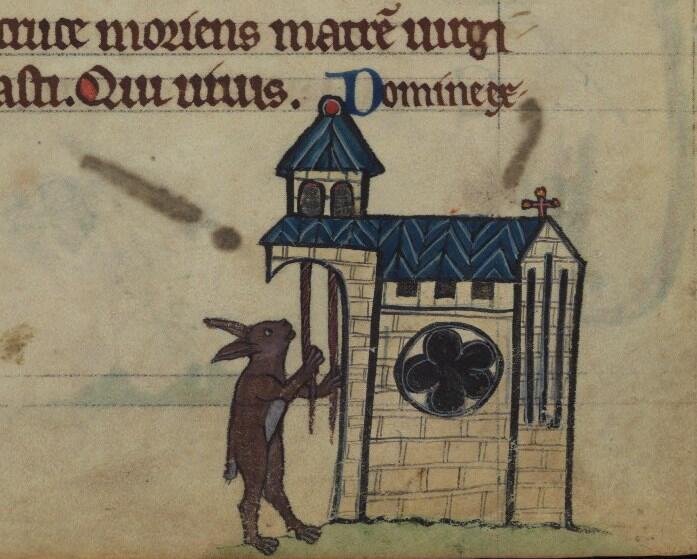
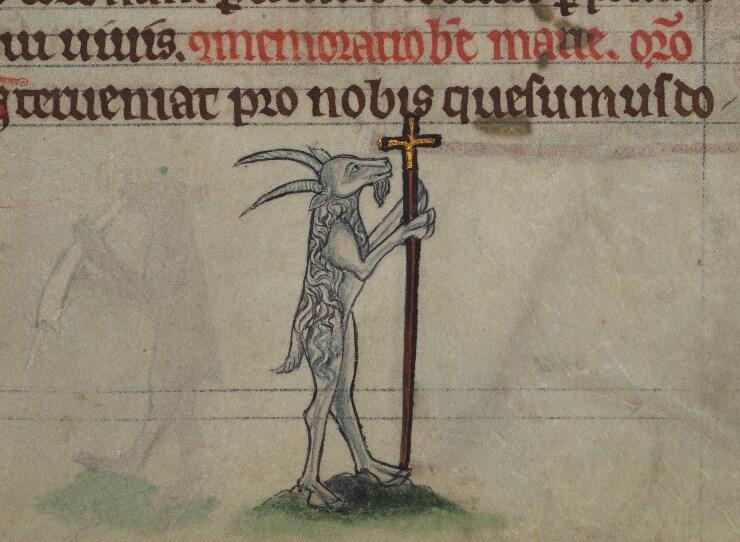
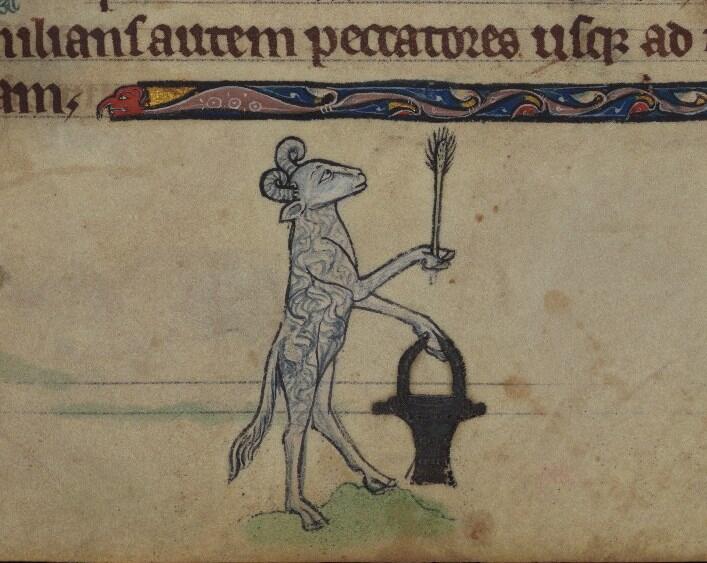
I mention all of this simply because Damien Kempf has been sharing such images (from Walter MS 102, from A.D. 1300) on his Twitter feed which greatly amuse me, as I hope they will you:

A rabbit calls creation to worship with the tolling of bells.
A rooster with the thurible (the incense), though someone needs to teach him how to make it smoke.
A goat with the processional cross (which should now be a crucifix).
A ram ready for the sprinkling rite.
These images demonstrate a quality of the Middle Ages that I have always found endearing: there is a light-heartedness to them that shows the medievals often did not take themselves too seriously.  They remind me of the notion of the homo ludens, the "playing man" or the "grave-merry man".

Plato said that "fun and gravity [seriousness] are sisters" (Epistulae, 6) and in the Book of Sirach we read, "Leave in good time and do not be the last; go home quickly and do not linger.  Amuse yourself there, and do what you have in mind, but do not sin through proud speech" (Sirach 32:11-12).  In our more enlightened days in which we take ourselves far too seriously, we often forget these words.  Even Saint Thomas Aquinas kept these words in mind when he wrote, "Therefore, unmitigated seriousness betokens a lack of virtue because it wholly despises play, which is a necessary for a good human life as rest is" (Eth. ad Nic., IV, 16, 854).

This concept of the man at play is masterfully explored in Hugo Rahner's, S.J., excellent book simply titled Man at Play (New York: Herder and Herder, 1967).  In it, he describes the homo ludens as:
a man with an easy gaeity of spirit, one might almost say a man of spiritual elegance, a man who feels himself to be living in invincible security; but he is also a man of tragedy, a man of laughter and tears, a man, indeed, of gentle irony, for he sees through the tragically ridiculous masks of the game of life and has taken the measure of the cramping boundaries of our earthly existence.
And so, only one who can fuse these two contradictory elements into a spiritual unity is indeed a man who truly plays.  If he is only the first of these two things, we must write him down as a frivolous person who has, precisely, played himself out.  If he is only the second, then we must account him as one who cannot conquer despair.  It is the synthesis of the two things that makes the Homo ludens, the "grave-merry" man, the man with a gentle sense of humour who laughs despite his tears, and finds in all earthly mirth a sediment of insufficiency.  This grave-merriness - the wonderful "humour" has been worn so threadbare, has indeed been so grossly misused - is something suspended between heaven and earth (27-28).
In our time, we tend between one or the other extreme, a boor or a buffoon; only rarely do you find the two intermingled and when you do, you often find a saint (or at least a saint in the making).

Rahner sums up his description of the man at play thusly:
The man who truly plays is, therefore, first of all, a man in whom seriousness and gaiety are mingled; and, indeed, at the bottom of all play lies a tremendous secret.  We had some intimation of it, surely, when we were considering the creative play of God.  All play - just as much as every task we set ourselves to master with real earnestness of purpose - is an attempt to approximate to the Creator, who performs his work with the divine seriousness which its meaning and purpose demand, and yet with the spontaneity and effortless skill of the great artist he is, creating because he wills to create and not because he must (28).
It should be obvious that the playing of man is not simply about entertainment but is also of tremendous spiritual importance.  So it as the Saint Gall wrote, "Lo, under the gentle / vine, O Christ / the whole Church / plays in peace" and the great Romano Guardini wrote of the Mass wrote of the liturgy as a divine game.  Saint Bede the Venerable recognized this centuries before when he preached that "to the eyes of the beholder the person appears to come out of the baptismal font the same as he went in, and all that is done seems no more than a piece of play" (Homiliae, II, 12).


This is indeed true; it is a game, but as we normally think of games.  In one of his hymns on the Cross, Saint Bede sang, "It is as play for the faithful / to enjoy thy embraces / for thou begettest such great joys / and openst the gates of heaven" (Hymni, 13).

Deep within our hearts is a desire to be always at play.  As one example of this, simply consider the refusal of the modern world to grow old, the makeup and hair dyes, the face lifts and surgeries all performed to give the appearance of youth, however false.

The religious man, like all men,
hopes for freedom, rest, release from all the preoccupations of mind, for untroubled gladness of soul; he longs to be once more like a child, a child in utter security, and, like a child, to play; he hopes, in a word, for that complete heartsease that will allow even his body, freed now from the burden of its earthly life, to move and sway to the measures of a heavenly dance (60).
Because in the Liturgy, and especially in the Eucharist, we are united with the heavenly Liturgy, worship and praise is the man at play truly plays (CCC, 1326).

So it is that Rahner can say,
Man redeemed has one more become a child, even as he was at the time of his earthly birth and of his begetting out of the Church's primal sacrament [Baptism].  A child once more, he plays....
The child in man desires to play - and the final answer to that longing, the answer of truth to all our searchings, is the word of him who being himself the Word, became a little child: "Unless you become as little children, you shall not enter into the kingdom of heaven" (Matthew 18:3).  That is why the streets of the heavenly city will be full of playing children and the Ancient of Days, whose face is forever young, will never cease to say to men: "Ite et ludite" [Go and play] (63-64).

11 October 2013

What annoucement should be made before Holy Communion?

Over at In the Light of the Law, Dr. Ed Peters has a helpful piece about what sort of announcement should or should not be made prior to the reception of Holy Communion.  Among the points he raises, he rightly notes that
one should NOT encourage, as an alternative to reception of Communion, “coming forward with arms crossed for blessing”. Receiving a blessing is not an “alternative” to receiving holy Communion (any more than being handed a raincoat in a hurricane is an ‘alternative’ to be admitted to a storm shelter) and, moreover, such a rite is an intrusion into the liturgy forbidden by Canon 846 § 1. I’ve addressed that liturgical abuse here.
Some years ago (in 1996) the United States Conference of Catholic Bishops approved and adopted a set of Guidelines for the Reception of Holy Communion, which many people have either completely forgotten or somehow altogether missed them.  The Bishops ordered that these guidelines "are to be included in missalettes and other participation aids published in the United States" (if you look you'll find them, generally on the inside front cover) and noted that the guidelines: "seek to remind all those who may attend Catholic liturgies of the present discipline of the Church with regard to the sharing of eucharistic communion" (emphases mine).

Knowing that I would have both non-Catholics and Catholics who might not be properly disposed to received Holy Communion (a good guide for which can be found in the USCCB's Happy Are Those Who Are Called To His Supper), I included these guidelines in the program used at the "first Mass" I celebrated in my home parish.  I cannot remember seeing the guidelines included elsewhere, though they certainly should be.

Making greater use of these guidelines will not further alienate people from the Church, especially those coming from denominations with "open communion," but will rather explain why the Church teaches what she does about the Sacrament of the Altar:
We welcome our fellow Christians to this celebration of the Eucharist as our brothers and sisters. We pray that our common baptism and the action of the Holy Spirit in this Eucharist will draw us closer to one another and begin to dispel the sad divisions which separate us. We pray that these will lessen and finally disappear, in keeping with Christ’s prayer for us “that they may all be one” (Jn 17:21).
Because Catholics believe that the celebration of the Eucharist is a sign of the reality of the oneness of faith, life, and worship, members of those churches with whom we are not yet fully united are ordinarily not admitted to Holy Communion. Eucharistic sharing in exceptional circumstances by other Christians requires permission according to the directives of the diocesan bishop and the provisions of canon law (canon 844 § 4).
I can't imagine anyone being offended at such words, unless he is already inclined to be offended.  Indeed, I have made similar announcements (and ones for Catholics either living in a state of sin or who simply have not kept the 1-hour fast) and have only received words of gratitude for the explanation, which has been found quite sensible.

10 October 2013

Street preachers arrested for disturbing the peace

For some time now I have been raising cautions about what certainly seems to be a gradual but steady move to a coming persecution of Christians - and of Catholics in particular - in the United States of America.  As might be expected, there are some who agree with my assessment and some who do not and claim I am simply unwarranted.

That being said, I was quite surprised to learn that three members - including the pastor, Aaron Brummitt, of Lighthouse Baptist Church in Springfield, Missouri were arrested this past Friday for disturbing the peace when they preached in a public park, though they seem to have violated no legal ordinances.

This isn't the first time Brummitt has had difficulties with the police as his preaching has drawn previous complaints of disturbance.

On Friday, when the police moved to confiscate Brummitt's sound equipment he sat on an amp another of the preachers refused to part with a speaker.  According to a police spokewoman:
The lack of verbal and physical cooperation is what led to the arrests, but the situation began because of complaints received in the area.We stand behind the actions our officers needed to take.
Brummitt is to stand trial in December.

Ordinarily I'm not one to support street preachers because they often make gross over-generalizations and presume no one they encounter has a relationship with Jesus Christ. These two realities of their preaching, in addition to others, make them rather ineffective.

However, since it seems they did not violate any law their arrest is rather troubling.  If the volume of their sound system disturbs someone's peace - which I don't know it would - it's time to reconsider the local ordinance and question if 75 decibels is too low a threshold rather than arresting someone.

09 October 2013

Man's best friend is ... a person?

For as long as I can remember I have been a great lover of dogs.  In fact, I can't remember meeting a dog I haven't liked.  I've even been known to say that, with a little jesting, when I visit someone's home I first pet the dog, then look at their books, and then talk with the person (a human, in this case), in that order.  And once I start talking with the people I am visiting, I am usually petting their dog the entire time.

I bring this up because the New York Times has published a letter to the editor by George Burns who, after studying MRIs of dogs' brains argues that "dogs are people, too."

Based on his studies, he concludes:
But now, by using the M.R.I. to push away the limitations of behaviorism, we can no longer hide from the evidence. Dogs, and probably many other animals (especially our closest primate relatives), seem to have emotions just like us. And this means we must reconsider their treatment as property.
One alternative is a sort of limited personhood for animals that show neurobiological evidence of positive emotions. Many rescue groups already use the label of “guardian” to describe human caregivers, binding the human to his ward with an implicit responsibility to care for her. Failure to act as a good guardian runs the risk of having the dog placed elsewhere. But there are no laws that cover animals as wards, so the patchwork of rescue groups that operate under a guardianship model have little legal foundation to protect the animals’ interest.
If we went a step further and granted dogs rights of personhood, they would be afforded additional protection against exploitation. Puppy mills, laboratory dogs and dog racing would be banned for violating the basic right of self-determination of a person.
I fully expect a great many people will hop on board his suggestion, but I will not be one of them.  And of those who hop on board with him, how many would also support the Personhood Amendment or other legislation that seeks to protect the lives of unborn human beings from the horror of abortion?

08 October 2013

Step by deliberate step - UPDATED

Those who pay attention to the behavior of their fellow human beings know one thing that seems always to be case: little by little you can get people to tolerate almost anything, regardless of how extreme it may be, if only you begin with something small.

As a classic, tragic, and deplorable example of this reality we need only look to Hitler's Germany.  We know how horrifically it ended with the concentration camps, but do you know how it began?  The execution of the Jews did not happen all at once but one step at a time, gradually and purposefully.

It began in 1933 with the burning of books that were written by Jews or books against the Nazi party.  On the surface of things, this may not seem like anything too significant (by which I mean that one wouldn't normally think this action would lead to an orchestrated effort to exterminate the Jews), but it proved something to Hitler: If the German people would tolerate this, they would tolerate more and he could go another step further.

So it was that attacks were made - seemingly at random - on Jewish persons and property.  The fact that the German people did not immediately defend the Jews proved something to Hitler: If the German people would tolerate this, they would tolerate more and he could go another step further.

So it was that the police and the courts no longer defended the Jews.  The fact that this did not overly concern the Germans proved something to Hitler: If the German people would tolerate this, they would tolerate more and he could go another step further.

So it was that Hitler continued in his plans, one incremental step at a time, next holding a boycott of Jewish businesses, then positioning the SA outside Jewish shops, then slaughtering kosher animals, then creating the Department of Racial Hygiene, then excluding Jewish students from certain university exams, then excluding Jews from military service, and on and on it went, including banning Jews from public parks and swimming pools.  Little by little the Jews lost their freedom, one step at a time.

In the full view of the German people and, indeed, of the world - what began with the burning of books led, step by deliberate step, to the concentration camps where so many of the Jews were executed because far too many people simply stood by silently and watched it all escalate as they tolerated each step.

Admittedly, this is an extreme example of the principle I started with and other examples perhaps more suitable could be here employed, but extreme examples often serve to best illustrate principles.  This same principle has been called by others the "frog in hot water" effect, because a frog does not notice if the temperature of the water he is in is slowly and incrementally increased; not noticing, he will remain in the ever hotter water until he is boiled to death.

Before I continue, let me make a some things abundantly clear:
  1. I am not equating President Obama with Adolf Hitler;
  2. I do not think President Obama will launch a persecution of the Jews; and,
  3. I do not think President Obama will create concentration camps.

That being said, I do think there is an important lesson for us here.

I am greatly troubled by a set of circumstances happening in the United States of America to which the vast majority of Americans seem quite oblivious and all in relation to the partial government shutdown (except for the 8th), all of which I am watching from Rome:
  1. an elderly couple in Nevada was forced out of their home and cannot return until after the shutdown is lifted; 
  2. World War II veterans have been threatened with arrest if they visit the World War II memorial;
  3. a portion of the ocean has been closed by the administration;
  4. one restaurant owner was given 24 hours to vacate his restaurant; 
  5. Catholic priests have been threatened with arrest if they celebrate the Sacraments on military bases (as I previously high-lighted), though this situation seems to be remedied, at least for now (though it still hasn't gone before the Senate or been approved by the President) [it seems contracted clergy are not essential to the military but mechanical bulls apparently are];
  6. veterans of the Vietnam War were arrested at the Vietnam Wall because they were there reading the names of the fallen after curfew;
  7. a group of senior citizens who went to see Old Faithful in Yellowstone National Park were locked inside the Old Faithful Inn with armed guards outside to prevent them seeing the geyser during the partial government shutdown; and,
  8. drones, which already fly over some parts of the U.S.A. and other parts of the world, may soon be able to fire on their own without direct human command (which cannot possible end well).
[UPDATE: While the U.S. military can someone manage to buy mechanical bulls during the shutdown, it can't afford to bury 4 dead soldiers.  It's a very bizarre and pathetic world where mechanical bulls are deemed "essential" but burying the dead is not.]

If the American people tolerate all of this, they will tolerate more and yet a further can - and likely will - be taken.  And then another, and another, and another, until the liberty which has been a hallmark of the United States of America will be no more.  To be sure, the gradual removal of freedom cannot be attributed solely to any one person and to think so is a grave mistake.

What is more: a large rally in favor of immigration reform was held yesterday on the Washington Mall at which eight members of Congress were arrested, despite the fact the same national park is closed.

[UPDATE 2: Yesterday (October 14, 2013) it was reported that Catholic services at Kings Bay Naval Submarine Base have been forbidden during the partial government shutdown, but that Protestant services are allowed to continue.  If this isn't a clear sign of anti-Catholicism, I don't know what is.]


While I acknowledge that the last of these is not be directly tied to the ones preceding, it is not unreasonable to be a little concerned.  Likewise, taken individually, each of numbers 1 through 7 may not seem terribly significant, but taken together they certainly serve to indicate what I suspect is just a beginning test to see what the American people will tolerate.

Step by deliberate step, freedom can slowly - or quickly - be taken away.  How much are you willing to tolerate, how many steps are you willing to allow to be taken, how much freedom are you willing to hand over?

When I left for Rome I knew I was leaving the United States at a good time, but I wondered if there would be much left to which I would return.  Time will tell.