08 October 2013

What is it that guides us?

A few years back when I was appointed Priest Secretary and Master of Ceremonies to the Bishop I sadly fell behind in reading the homilies, messages, and addresses of His Holiness Benedict XVI.  However, I have kept the issues of L'Osservatore Romano which I am slowly making my way through, in part to continue my collection of some of my favorite quotes from the Pope Emeritus at A Beggar for Love.

This morning I his words when he visited Benin in November of 2011 (I told you I was behind).  As I read through the various addresses, I was particularly struck by these words:
It is the crucified and glorious face of Christ which ought to guide us, so that we may witness to his love for the world.
He addressed these words to the Bishops of Benin to remind them of their principle task as shepherds of the Lord's flock, but they are words no less suitable for you and for me.  How different would our lives be if we began each morning contemplating the image of Crucified Love?

Each of us surely has a favorite depiction of the crucifixion of Christ Jesus (if not, now is as good a time as any to search for one), be it a crucifix - however simple or decorated - hung on the wall, or a painting from an altar piece, or an illumination from an ancient manuscript.  I have always been partial to images from the Middle Ages; whether they be in stone, on fresco, wood, or page matters little to me.

Without doubt, however, my favorite is the image so greatly loved by Saints Francis and Clare, the crucifix of San Damiano:


In a profound way, it encapsulates Pope Benedict's reminder, as well as what he said only two days later: "Christ reigns from the Cross and, with his arms open wide, he embraces all the peoples of the world and draws them into unity."

Yes, let us always "look upon him whom they" - whom we - "have pierced," let us allow his love to reach deep into our hearts, and let us look upon the world with his own love (John 19:37, cf. Zechariah 12:10).

06 October 2013

Tomorrow it begins

Tomorrow, the memorial of Our Lady of the Rosary, classes will, at long last, begin at the Pontifical Gregorian University (and, I believe, at all of the other Pontifical universities in Rome) where I will begin my studies in canon law.  This will be the 463rd academic year since the founding of the Gregorian University.

It should be prove to a most interesting time, given that classes will be taught in Italian (though not all of the professors are Italian) and the exams and papers can be taken and written in English (as most of the professors also speak and read English).

After spending a good deal of time today putting the class schedule in my calendar, I'm beginning to think that the most difficult aspect of the year will be keeping track of the schedule itself.  As with many things in Italy, the schedule is not consistent.  For example, for the first five weeks of the semester I will have no classes on Tuesdays; for the middle six weeks of the semester I will have no classes on Wednesdays; and for the remaining three weeks of the semester I will again have no classes on Tuesdays.  To make things more complicated yet, the classes themselves do not always meet at the same or even on the same day of the week.  And then there's also the fact the some classes finish before the semester ends only to replaced by new classes that do not meet during anything that might resemble the previous time slot.


It has been repeatedly said to me that "Ma Greg [as she is affectionately known] eats her young".  We shall see if this will prove to be true.  Thus far, I have found the Greg pleasant, even if frustrating on account of its typical Italian organization (the simple act of registering for classes took a little over a week).

Throughout the course of the first semester I will be taking the following courses:
  • General Norms I;
  • Faithful in General, Laity;
  • Sanctifying Office: Sacraments, Except Holy Orders and Marriage;
  • General Norms: Administrative Practice;
  • Worship and Sacrament of Penance, Administrative Practice;
  • History of Canon Law, Institutions, Sources and Sciences;
  • Methodology I; and
  • Latin Language I (which will, thanks be to God, be taught in English)
Throughout the year I will aim to keep the wise advice of Saint Bonaventure, who said: "Do not extend yourself beyond the point the mind can grasp, but neither remain short of it."  For your continued prayers in this regard I will be most grateful.

A new church in Ridgeway, and it looks like a church!

On the 28th of February, 2012, a tornado went through the town of Ridgeway, Illinois and destroyed St. Joseph church, leaving in its aftermath an image of hope for the high altar itself was left intact:


Soon construction on a new church dedicated to Saint Kateri Tekakwitha will begin, thanks to the dedicated work of Father Steven L. Beatty, Administrator, and those entrusted to his pastoral care (the parish of St. Kateri Tekakwitha, which he administers, seems to be comprised of what were once four separate parishes, with their churches remaining in use).

Certainly the planning and fundraising for the construction of a new church is a daunting task, and finding good architects for the task, especially in rural Illinois, is now easy task, either.  Even so, constructing a fitting edifice for the worship of the Triune God is possible.

Once complete, the new church will look something like this:


I know Father Beatty is pleased and I'm sure his parishioners are, as well.

05 October 2013

Representative Enyart: Resolution allowing military to exercise freedom of religion "did nothing for the troops"

Many of you asked an excellent question following yesterday's vote of the United States House of Representatives on a resolution introduced by Mr. Doug Collins (R-Georgia) that would allow military chaplains to minister on military bases during the partial government shut down (have you noticed how the designation keeps changing?) without fear of fines or imprisonment, namely, why did Mr. William Enyart (D-Illinois) vote against it?

It is a question I wondered when I first learned that only member of the House of Representatives voted against the resolution, in effect voting against the freedom of religion guaranteed by the First Amendment.

The Representative has posted the following answer to his web site (with my emphasis):
Day care centers on military bases are closed.  Commissaries on military bases are closed. Military support workers are furloughed. Of course I want chapels open, but what about our military families who have no place to send their children and are forced to buy family essentials off base?  

The bill I voted against is a prime example of the hypocrisy we see every day in Washington DC.  This bill did nothing for the troops. All it does is provide political cover for people who won’t do their jobs.  And that’s the Congress.

I was elected and sent to Washington DC to get a job done. Standing idly by while our government is shut down and Southern Illinoisans are being hurt, is NOT leadership.
The resolution did nothing for the troops?! Representative Enyart clearly does not understood the fundamental importance of religious liberty.

As His Holiness Benedict XVI reminded us in his Message for the 44th World Day of Peace:
Without the acknowledgement of his spiritual being, without openness to the transcendent, the human person withdraws within himself, fails to find answers to the heart's deepest questions about life's meaning, fails to appropriate lasting ethical values and principles, and fails even to experience authentic freedom and to build a just society.
What is more:
...the laws and institutions of a society cannot be shaped in such a way as to ignore the religious dimension of its citizens or to prescind completely from it.  Through the democratic activities of citizens conscious of their lofty calling, those laws and institutions must adequately effect the authentic nature of the person and support its religious dimension.  Since the latter is not a creation of the state, it cannot be manipulated by the state, but must rather be acknowledged and respected by it.

BREAKING: House approves resolution to allow chaplains to minister during shut down

N.B.: This post has been updated since the initial posting.

The United States House of Representatives voted today to allow military chaplains to minister to the members of the armed forces on military during the government "shut down."

Representative Doug Collins (R-George) introduced the resolution which was approved by a vote of 400-1, with 30 no votes; Representative Bill Enyart (D-Illinois) - a retired General - was the only member to vote against the resolution.  Of those not voting, 16 are Republicans and 14 are Democrats.

If your Representative voted in favor of the resolution, please be certain to thank him or her and be sure to encourage your Senators to also vote in favor of it!

Now we will see what the United States Senate will do with the legislation.

Update:

His Excellency the Most Reverend Timothy P. Broglio, Archbishop for the Military Services, upon hearing of the vote of the House, issued the followed statement:
Military personnel enjoy, like all Americans, the First Amendment guarantee of the ‘Free Exercise’ of religion. In the current political climate, however, nothing can be taken for granted. I am grateful to Representative Collins and the many other House members who recognized the importance of passing this resolution, which reflects the seriousness with which the American people take their Free Exercise rights. It can only be hoped that the members of the US Senate will act decisively in order to favor the same First Amendment rights.

U.S. House of Reps to vote on religious liberty

I came across this morning the Message of His Holiness Benedict XVI for the 44th World Day of Peace in which he wrote on the subject of religious freedom, both what it is and what it requires.

If you follow the work of John L. Allen, Jr., you already know how religious freedom is at stake throughout the world with the increasing persecution of Christians globally.  Yet even in the United States of America, there are signs of movement - slow and deliberate - toward an ever greater restriction on religious liberty that could well, if not halted, lead to a persecution of Christians.

Though it has largely been forgotten, such a state was once common for Catholics in the early days of the American Colonies (there is a reason why Maryland was established as a colony where Catholics could - mostly - practice their faith in freedom) and continued into the twentieth century.  The history of anti-Catholicism in the United States, from the days of the founding until now, are well explored in Anti-Catholicism in America: The Last Acceptable Prejudice by Mark S. Massa, S.J., which everyone should read.

Today, the religious liberty in the United States of America enters a new chapter with the government "shut down."  With the actions of the federal government in barricading national monuments and memorials that are otherwise wide open (which were never closed during previous government shut downs) and threatening visitors - even World War II veterans - with arrest, it is not out of the realm of possibility to think a priest would be arrested for celebrating Mass on a military base, as Steve Skojac pointed out yesterday at Catholic Vote:
But now there’s a story just coming to light that takes things even further. According the Archdiocese for Military Services, GS and contract priests (who are paid by the federal government as independent contractors in places where there aren’t enough active-duty priests to meet the needs of Catholics in military service) are being forbidden from celebrating Mass, even on a volunteer basis [more].
As one might expect, his claim was quickly challenged by those who said priests either would not or could be arrested for celebrating the Sacraments on military bases during the shut down, so he continued with his investigation and found the answer to be yes, according to the law itself:
So the short answer is yes, these priests can be arrested if they defy the furlough and say Mass on base. They can be charged, imprisoned, and fined. Will they be? Let’s hope not. But the threat alone is enough to cause sufficient concern [more].
Thankfully a few legislators picked up on this grave possibility and recognized the blatant threat to religious liberty it posed, and the likelihood that it could well happen under this administration (never before has it been a concern, but never before have the monuments and memorials been closed and barricaded during a shutdown, either, or sites that do not belong to the government).  Anything is possible, especially given this administration's history of changing even settled law to suit its own purpose. If the Administration is willing to arrest 90 year-old veterans who visit their memorial, it will certainly give serious thought to arresting priests who celebrate the Sacraments.

Today, Saturday, October 5th, the United States House of Representatives will vote to allow military chaplains - including Catholic priests - to minister to the members of the military on bases without threat of fines or imprisonment.  In effect, the House will vote to grant religious liberty to the members of the armed forces.

On this vote rests much of the future of the nation; today we will see if the House of Representatives values, honors, respects, and protects the freedom of religion guaranteed by the First Amendment.

If the Representatives do and prove it by approving the legislation, we will see if the United States Senate values, honors, respects, and protects the freedom of religion guaranteed by the First Amendment.

If the Senators do and prove it by approving the legislation, we see if the President of the United States values, honors, respects, and protects the freedom of religion guaranteed by the First Ammendment.

If the bill fails in the House or in the Senate, or if it is vetoed by the President, the United States of America will not be the same country I left in the middle of July.

Please, contact your Representative and Senators immediately and urge them to vote "yes" on this important and historic vote.

Religious freedom is of vital importance to the health and stability of a nation because, as Benedict XVI said, it "expresses what is unique about the human person, for it allows us to direct our personal and social life to God, in whose light the identity, meaning and purpose of the person are fully understood.  To deny or arbitrarily restrict this freedom is to foster a reductive vision of the human person; to eclipse the public role of religion is to create a society which is unjust, inasmuch as it fails to take account of the true nature of the human person; it is to stifle the grown of the authentic and lasting peace of the human family (emphasis in original).

What is more, "respect for essential elements of human dignity, such as the right to life and the right to religious freedom, is a condition for the moral legitimacy of ever social and legal norm."

04 October 2013

Pope Francis to Saint Francis: Teach us to remain before the Cross

Vatican Radio has provided an English translation of the full text of the homily delivered only a few minutes by His Holiness Pope Francis in Assisi.  I'm not sure what happened during the interregnum but the Holy See has been quite swift at providing English translations during the pontificate of Pope Francis.

At any rate, the Holy Father's words follow, with my emphases:
I give you thanks, Father, Lord of heaven and earth, for you have hidden these things from the wise and understanding, and revealed them to babes” (Mt 11:25).

Peace and all good to each and every one of you! With this Franciscan greeting I thank you for being here, in this Square so full of history and faith, to pray together.

Today, I too have come, like countless other pilgrims, to give thanks to the Father for all that he wished to reveal to one of the “little ones” mentioned in today’s Gospel: Francis, the son of a wealthy merchant of Assisi. His encounter with Jesus led him to strip himself of an easy and carefree life in order to espouse “Lady Poverty” and to live as a true son of our heavenly Father. This decision of Saint Francis was a radical way of imitating Christ: he clothed himself anew, putting on Christ, who, though he was rich, became poor in order to make us rich by his poverty (cf. 2 Cor 8:9). In all of Francis’ life, love for the poor and the imitation of Christ in his poverty were inseparably united, like the two sides of a coin.

What does Saint Francis’s witness tell us today? What does he have to say to us, not merely with words – that is easy enough – but by his life?

1. His first and most essential witness is this: that being a Christian means having a living relationship with the person of Jesus; it means putting on Christ, being conformed to him.

Where did Francis’s journey to Christ begin? It began with the gaze of the crucified Jesus. With letting Jesus look at us at the very moment that he gives his life for us and draws us to himself. Francis experienced this in a special way in the Church of San Damiano, as he prayed before the cross which I too will have an opportunity to venerate. On that cross, Jesus is depicted not as dead, but alive! Blood is flowing from his wounded hands, feet and side, but that blood speaks of life. Jesus’ eyes are not closed but open, wide open: he looks at us in a way that touches our hearts. The cross does not speak to us about defeat and failure; paradoxically, it speaks to us about a death which is life, a death which gives life, for it speaks to us of love, the love of God incarnate, a love which does not die, but triumphs over evil and death. When we let the crucified Jesus gaze upon us, we are re-created, we become “a new creation”. Everything else starts with this: the experience of transforming grace, the experience of being loved for no merits of our own, in spite of our being sinners. That is why Saint Francis could say with Saint Paul: “Far be it for me to glory except in the cross of our Lord Jesus Christ” (Gal 6:14).

We turn to you, Francis, and we ask you: Teach us to remain before the cross, to let the crucified Christ gaze upon us, to let ourselves be forgiven, and recreated by his love.

2. In today’s Gospel we heard these words: “Come to me, all who labour and are heavy laden, and I will give you rest. Take my yoke upon you and learn from me, for I am gentle and lowly in heart” (Mt 11:28-29).

This is the second witness that Francis gives us: that everyone who follows Christ receives true peace, the peace that Christ alone can give, a peace which the world cannot give. Many people, when they think of Saint Francis, think of peace; very few people however go deeper. What is the peace which Francis received, experienced and lived, and which he passes on to us? It is the peace of Christ, which is born of the greatest love of all, the love of the cross. It is the peace which the Risen Jesus gave to his disciples when he stood in their midst and said: “Peace be with you!”, and in saying this, he showed them his wounded hands and his pierced side (cf. Jn 20:19-20).

Franciscan peace is not something saccharine. Hardly! That is not the real Saint Francis! Nor is it a kind of pantheistic harmony with forces of the cosmos… That is not Franciscan either; it is a notion some people have invented! The peace of Saint Francis is the peace of Christ, and it is found by those who “take up” their “yoke”, namely, Christ’s commandment: Love one another as I have loved you (cf. Jn 13:34; 15:12). This yoke cannot be borne with arrogance, presumption or pride, but only with meekness and humbleness of heart.

We turn to you, Francis, and we ask you: Teach us to be “instruments of peace”, of that peace which has its source in God, the peace which Jesus has brought us.

3. “Praised may you be, Most High, All-powerful God, good Lord… by all your creatures (FF, 1820). This is the beginning of Saint Francis’s Canticle. Love for all creation, for its harmony. Saint Francis of Assisi bears witness to the need to respect all that God has created, and that men and women are called to safeguard and protect, but above all he bears witness to respect and love for every human being. God created the world to be a place where harmony and peace can flourish. Harmony and peace! Francis was a man of harmony and peace. From this City of Peace, I repeat with all the strength and the meekness of love: Let us respect creation, let us not be instruments of destruction! Let us respect each human being. May there be an end to armed conflicts which cover the earth with blood; may the clash of arms be silenced; and everywhere may hatred yield to love, injury to pardon, and discord to unity. Let us listen to the cry of all those who are weeping, who are suffering and who are dying because of violence, terrorism or war, in the Holy Land, so dear to Saint Francis, in Syria, throughout the Middle East and everywhere in the world.

We turn to you, Francis, and we ask you: Obtain for us God’s gift of harmony and peace in this our world!

Finally, I cannot forget the fact that today Italy celebrates Saint Francis as her patron saint. The traditional offering of oil for the votive lamp, which this year is given by the Region of Umbria, is an expression of this. Let us pray for Italy, that everyone will always work for the common good, and look more to what unites us, rather than what divides us.

I make my own the prayer of Saint Francis for Assisi, for Italy and for the world: “I pray to you, Lord Jesus Christ, Father of mercies: Do not look upon our ingratitude, but always keep in mind the surpassing goodness which you have shown to this City. Grant that it may always be the home of men and women who know you in truth and who glorify your most holy and glorious name, now and for all ages. Amen.” (The Mirror of Perfection, 124: FF, 1824).

Saint Francis, God's servant

We can come to the conclusion, without any doubt, that this messenger of God - so worthy to be loved by Christ, imitated by us and admired by the world - was God's servant Francis, if we consider the height of his extraordinary sanctity.  For even while he lived among men, he imitated angelic purity so that he was held up as an example for those who would be perfect followers of Christ. 

We are to hold this firmly and devoutly because of his ministry to call men to weep and mourn, to shave their heads, and to put on sackcloth, and to mark with a Tau the foreheads of men who moan and grieve, signing them with the cross of penance and clothing them with his habit, which is in the form of a cross.

But even more is this confirmed with the irrefutable testimony of truth by the seal of the likeness of the living God, namely of Christ crucified, which was imprinted on his body not by natural forces or human skill but by the wondrous power of the Spirit of the living God.

- Saint Bonaventure

Egidio Flamini's "Nella Tomba di San Francesco"


To Assisi, to learn from Saint Francis to recognize Jesus

 One comes to Assisi to learn from St Francis the secret of recognizing Jesus Christ and experiencing him. This is what Francis felt about Jesus, according to what his first biographer narrates: "He always carried Jesus in his heart. Jesus on his lips, Jesus in his ears, Jesus in his eyes, Jesus in his hands, Jesus in all his other members.... Rather, finding himself travelling often and meditating on and singing of Jesus, he would forget that he was travelling and would invite all creatures to praise Jesus" (cf. 1 Cel II, 9, 115). Thus, we see that communion with Jesus also opens the heart and eyes to creation.
In a word, Francis was truly in love with Jesus. He met him in the Word of God, in the brethren, in nature, but above all in the Eucharistic Presence. Concerning this he wrote in his Testament: "In this world, I see nothing corporally of the same Most High Son of God except in his Most Holy Body and Most Holy Blood" (cf. 2 Test. 10).

Christmas at Greccio expresses the need to contemplate him in his tender humanity as a baby (cf. 1 Cel I, 30, 85-86).

The experience of La Verna, where he received the stigmata, shows the degree of intimacy he had reached in his relationship with the Crucified Christ. He could truly say with Paul: "For me to live is Christ" (Phil 1: 21).

If he rids himself of everything and chooses poverty, the reason for all of this is Christ, and only Christ. Jesus is his all: he is enough!

Exactly because he is of Christ, Francis is also a man of the Church. From the Crucifix of San Damiano he heard the direction to repair the house of Christ, which is precisely the Church.

There is an intimate and indissoluble relationship between Christ and the Church. To be called to repair it certainly implies, in the mission of Francis, something that is his own and original. At the same time, this duty, after all, was none other than the responsibility that Christ attributes to every baptized person. To every one of us he also says: "Go and repair my house".

We are all called to repair in every generation the house of Christ, the Church, anew. And only by doing this does the Church live and become beautiful. And as we know, there are many ways to repair, to edify, to build the house of God, the Church. One also edifies through the different vocations, from the lay and family vocation, to the life of special consecration, to the priestly vocation. 

- His Holiness Benedict XVI

Persecution: The unreported catastrophe of our time

The persecution of Christians throughout the world is occurring with greater frequency every day, though you may not know if from what you see in the much of the media today.  Writing for The Spectator, John L. Allen, Jr. recently wrote on what he calls "the unreported catastrophe of our time":
Imagine if correspondents in late 1944 had reported the Battle of the Bulge, but without explaining that it was a turning point in the second world war. Or what if finance reporters had told the story of the AIG meltdown in 2008 without adding that it raised questions about derivatives and sub-prime mortgages that could augur a vast financial implosion?
Most people would say that journalists had failed to provide the proper context to understand the news. Yet that’s routinely what media outlets do when it comes to outbreaks of anti-Christian persecution around the world, which is why the global war on Christians remains the greatest story never told of the early 21st century.
Throughout the remained of the article, Allen, who is one of the few reporters actually paying attention to this tragedy, provides a country-by-country in various parts of the world, which is well worth reading.  After providing these accounts of an increasing global persecution over the past several years, Allen asks why this remains largely  unreported:
Why are the dimensions of this global war so often overlooked? Aside from the root fact that the victims are largely non-white and poor, and thus not considered ‘newsmakers’ in the classic sense, and that they tend to live and die well off the radar screen of western attention, the global war also runs up against the outdated stereotype of Christianity as the oppressor rather than the oppressed.
Say ‘religious persecution’ to most makers of cultured secular opinion, and they will think of the Crusades, the Inquisition, Bruno and Galileo, the Wars of Religion and the Salem witch trials. Today, however, we do not live on the pages of a Dan Brown potboiler, in which Christians are dispatching mad assassins to settle historical scores. Instead, they’re the ones fleeing assassins others have dispatched.
If you've ever attempted to alert others to the reality of what is happening to our brothers and sisters in so much of the world, you'll know he's correct.

Please, read the entire article, fast and pray for the persecuted, and help to spread the news.

The article is written in connection to the publication of Allen's latest book, The Global War on Christians: Dispatches from the Front Lines of Anti-Christian Persecution, which I hope to be able to find in Rome.

03 October 2013

Francis, conformed to Christ in life and in death

In all things he wished to be conformed to Christ crucified, who hung on the cross poor, suffering and naked.  Therefore at the beginning of his conversion, he stood naked before the bishop, and at the end of his life, naked he wished to go out of this world.

He enjoined the friars assisting him, under obedience and charity, that when they saw he was dead, they should allow his naked body to lie on the ground for the length of time it takes to walk a leisurely mile.

O, he was truly the most Christian of men, for he strove to conform himself to Christ and to imitate him perfectly - while living to imitate Christ living, dying to imitate Christ dying, and after death to imitate Christ after death - and he merited to be honored with the imprint of Christ's likeness!

- Saint Bonaventure

Welcome, my sister death!

This evening I went to the Chiesa dei Santi XII Apostoli - the church of the Twelve Holy Apostles, where are buried Saints Philip and James the Less - (which is entrusted to the Order of Friars Minor, Conventual) for the celebration of Vespers and the Transitus.  The Transitus recalls Saint Francis of Assisi's embrace of "our Sister Bodily Death, from whom no living man can escape" (The Canticle of Brother Sun, 12).

They put up all the lights for Saint Francis of Assisi.

The observance of the death of Il Poverello took place in the midst of Evening Prayer, after the reading and before the Magnificat.  It consisted of a homily on the life of Saint Francis, a reading of the account of his death as recorded by Tomaso de Celano in his Second Life, which was interspersed with a few hymns and Psalm 142.  The following account was read for us:
Overcome by the grave illness that put an end to his suffering, he [Francis] had himself placed naked on the naked ground, so that in the final hour in which he was given to the enemy to be assailed, he could battle naked against his naked adversary....
The Saint then turned the palms of his hands towards heaven, magnifying his Christ who was allowing him to ascend to Him free of any burden.  And to show himself a true imitator of Christ, his God in all things, right to the end he loved the brothers and sons, whom he had loved from the beginning.
He summoned all the brothers who were present and with words of comfort to ease the pain they would feel over his death and with fatherly affection, he exhorted them to love God.  He spoke at length about patience and the observance of poverty, counseling the Holy Gospel above all other principles.  All the brothers surrounded him and, starting with his vicar, he stretched his right hand over them and laid his hand on the head of each one.  "Farewell, all my sons," he said.  "Live in the fear of God and remain with Him forever.  And since temptation will come and tribulation is already approaching, happy are those who persevere in the work they have begun.  As for me, I am hastening to God, to whose grace I entrust all of you."  Then he blessed the brothers who were present as well as all the ones spread throughout the world and those who would come after them until the end of time...

As the desolate brothers wept bitterly, the holy Father had some bread brought to him.  He blessed it, broke it and gave each one of them a piece to eat.  He also had them bring the book of the Gospel and asked them to read him the Gospel according to John, from the passage that starts: Before the feast of Passover, etc. [John 13:1].  He recalled the most holy last supper that the Lord celebrated with his disciples.  Indeed, he did all this to commemorate that venerable institution and to demonstrate the love that he bore for the brothers.
After that, the few days that remained until his death were spent by him in hymns of praise and he invited his most beloved companions to praise Christ together with him.  Then, singing as well as he could, he burst out with the Psalm that goes "With a loud voice I cry out to the Lord, with a loud voice I beseech the Lord" [Psalm 142:2].
With several verses that he had already composed on another occasion, he also summoned all creatures to praise God, urging them to love Him.  He even urged death, terrible and painful to everyone, to sing praise and, going happily to meet it, he received it like a welcome guest, saying, "Welcome, my sister death!"
...To the doctor, he said, "Come, brother doctor, go ahead and tell me that I'm near death, which will be like the door to life for me!"  To the brothers he said, "When you see that I'm about to pass away, place me naked on the ground, just as you saw me the day before yesterday, and once I'm dead, leave me lying there for the time it takes to walk a mile unhurriedly.
At last the final hour arrived in which, since all of Christ's mysteries had been accomplished in him, he blessedly ascended to God (Second Life, 214-216).
Francis faced his death without fear - going so far as even to welcome death - because he knew that he had already experienced the first death in the waters of baptism; what is more, he knew the power  of that death over him was already broken.  "We were indeed buried with him through baptism into death," writes Saint Paul, "so that, just as Christ was raised from the dead by the glory of the Father, we too might live in newness of life" (Romans 6:4).

We so often fear death either because we know that we are not living in a right relationship with God or because we forget that "if, then, we have died with Christ, we believe that we shall also live with him" (Romans 6:8).

Saint Francis understand this well; he knew that having already died with Christ that the "second death" could do him no harm (The Canticle of Brother Sun, 13).  He wanted to pass quickly through the door to life, through Sister Bodily Death, to hasten to death, so as to be received by him who is Life (cf. John 14:6).

In our modern and enlightened era, it may seem an odd thing - even a bit morbid or macabre - to celebrate the death of a man.  It would seem an ever more bizarre thing for someone to say, "Welcome, sister death!"

As we celebrate that life - and the death - of Saint Francis of Assisi, let us ask him to intercede for us, to teach us to repent of our sins and to confess them so as to be reconciled with God, so that at the end of our earthly lives we, too, might exclaim, "Welcome, my sister death!"

02 October 2013

A missed opportunity to encourage priestly vocations

Tomorrow morning forty-one men from the Pontifical North American College will be ordained to the Order of the Diaconate by the invocation of the Holy Spirit and the imposition of hands by His Eminence James Cardinal Harvey, Archpriest of the Basilica of St. Paul Outside the Walls.  The ordinandi were present this morning at the General Audience with His Holiness Pope Francis, as reported by the Catholic News Service via Twitter:
Following the address of the Holy Father, it is customary for a brief summary of his remarks to be read in a number of various languages at the conclusion of which various delegations of pilgrims are mentioned and greeted specifically.

This morning, the greetings of the Holy Father were extended as follows in English, as reported by Vatican Radio:
Dear Brothers and Sisters: In the Creed, we confess our faith that the Church is “holy”. But how can we say that the Church is holy when she is all too evidently made up of sinners? Saint Paul helps us to see things aright when he tells us that “Christ loved the Church and gave himself up for her, to make her holy” (Eph 5:25-26). The Church is inseparably one with Christ, and the dwelling place of the Holy Spirit. It is not ourselves, or our merits, which make the Church holy, but God himself, through the infinite merits of Christ’s sacrifice on the Cross. God calls all of us, as sinners, to be redeemed, renewed and made holy in the communion of the Church. So the Church constantly welcomes everyone, even the greatest sinners, to trust in God’s offer of loving mercy, and to encounter Christ in the sacraments of Penance and the Eucharist. Let us not be afraid to respond to Christ’s call, to trust in the working of the Holy Spirit and to pray and strive for that holiness which brings true joy to our lives.
I cordially greet the members of the delegation from the International Centre for Interreligious and Intercultural Dialogue in Vienna. I also welcome the Buddhist visitors from Japan, including the delegations from the Tendai denomination and the Nakano Dharma Center of Rissho Kosei-kai. Upon all the English-speaking pilgrims and visitors present at today’s Audience, including those from Scotland, Benin, Australia, India, Japan, Canada and the United States I invoke God’s blessings of joy and peace!
Papal greetings were extended to visiting Buddhists, but not to forty-one men about to receive Holy Orders?  Why?

In his interview with Eugenio Scalfari and published yesterday in  La Repubblica, Pope Francis said:
It also happens to me that when I meet a clericalist, I suddenly become anti-clerical. Clericalism should not have anything to do with Christianity.
If, by "clericalism" the Holy Father meant the manner in which certain clerics - by no means all - act that demonstrates a belief on their part that they deserve preferential treatment simply because they are clerics, I cannot disagree with him.  But are these forty-one men all clericalists?  It seems rather unlikely.

Be that is it may, greeting these forty-one men as a collective group - which would have been customary in the pontificates of his predecessors - does not smack of such clericalism; rather, it could have been used as a profound opportunity to thank them for their generosity, to encourage them to live humbly and to strive for ever-greater holiness, and to be men of prayer who genuinely care for each member of the Lord's flock.  At the same time, it would have been an excellent moment for the Holy Father to encourage others to listen for the call of the Lord and to respond generously and with courage.

This is what precisely what the Pope-Emeritus Benedict XVI said last year to those about to be ordained, when he said to them:
I also welcome students from the Pontifical North American College, who are to be ordained deacon tomorrow. Dear Ordinands, always be faithful heralds of the Gospel and generous witnesses to the love of Christ! Upon you and your loved ones, and indeed upon all present, I invoke God’s abundant blessings. Thank you!
Why the men were not greeted this year I do not understand; a simple moment to promote and encourage vocations to the ordained ministry, necessary for the Sacraments of Penance and of the Eucharist to which Pope Francis called each of us in his address today, was missed.

Tolkein: Guardian Angels, the personalized care of God not plump ladies with swan-wings

It often happens that when an infant or a young child dies, the bereaved are comforted by their family and friends with such statements as, "Now you have a guardian angel in heaven." The bereaved already have Guardian Angels in heaven, as the Lord Jesus himself makes clear in Matthew 18:10, but they are not the ones who have recently died.  The deceased remain human beings and never become angels, though he or she could certainly be an intercessor for the bereaved before the Throne of God.

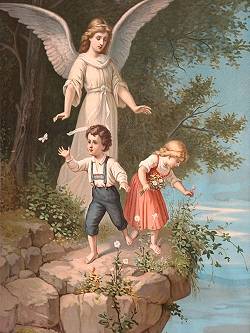
When thinking of Guardian Angels, people have all sorts of notions as to what they are, most of which involve either a small man dressed in white with wings and harp standing on the right shoulder and arguing with a devil (often weakly), such as this:


Or perhaps some schmaltzy and sentimental image, such as this:


Rarely does anyone envision a Guardian Angel as who, you know, can actually be a guard, such as this:


While we are on the topic of the depictions of angels, we should note that angels, in fact, have no bodies; they are pure intellect. We show them in the form of human beings to indicate their intelligence and free will and with wings to symbolize their swiftness in carrying out God's commands.

It is, I suspect, the above conceptions of angels that led J.R.R. Tolkien to write to his son, Christopher, on the 8th of January in 1944, J.R.R. Tolkien urging him to "remember your guardian angel. Not a plump lady with swan-wings!"


In another letter, written between the 7th and the 8th of November of the same year, the elder Tolkien relates to the same son an experience he while participating in the Forty Hours Devotion in the church of St. Gregory:
I perceived or thought of the Light of God and in it suspended one small mote (or millions of motes to only one of which was my small mind directed), glittering white because of the individual rays issuing from the Light, but the mere existence of the mote and its position in relation to the Light was in itself a line, and the line was Light). And the ray was the Guardian Angel of the mote: not a thing interposed between God and the creature, but God's very attention itself, personalized.  And I do not mean 'personified', by a mere figure of speech according to the tendencies of human language, but a real (finite) person. Thinking of it since - for the whole thing was very immediate, and not recapturable in clumsy language, certainly not the great sense of joy that accompanied it and the realization that the shining poised mote was myself (or any other human person that I might think of with love) - it has occurred to me that (I speak diffidently and have no idea whether such a notion is legitimate: it is at any rate quite separate from the vision of the Light and the poised mote( this is a finite parallel to the Infinite. As the love between the Father and Son (who are infinite and equal) is a Person, so the love and attention of the Light to the Mote is a person (that is both with us and in Heaven): finite but divine: i.e. angelic.
Despite his fumbling language to describe this experience (such moments of grace are always difficult to relate), Tolkien describes the Guardian Angels as "God's very attention, personalized," though he was not sure if he was correct in this description.

Sixty-seven years late, Pope Benedict XVI would describe the Guardian Angels as "ministers of the divine care for every human being" (Angelus Address, 2 October 2011).  Tolkien's description of the Guardian Angels was both profound and correct.

30 September 2013

Friends and rain

Since my arrival in the Eternal City I have twice had the opportunity to visit with friends from the Diocese of Springfield in Illinois who were in Rome for one reason or another and to dine with them.

The first such visit was with two couples from the Diocese who are Knights and Dames of the Equestrian Order of the Holy Sepulchre of Jerusalem who came for the International Pilgrimage.  When I went to have dinner with them at their hotel I walked through the streets of Rome in the rain.

Today I was able to have lunch with one of the Hospital Sisters of St. Francis who was visiting Rome with a group of pilgrims from the Hospital Sisters Health System and today I walked through the streets of Rome in the rain to meet her.

Today, though, was no ordinary rain; it was just shy of a deluge:


You cannot see the dome of the Basilica of St. Peter clearly because of the rain.

Tomorrow I am to have lunch with another friend and a couple of other friends are to arrive later this week.  I'm beginning to wonder if every meal with friends will also be accompanied by rain.  I certainly hope not!

Walking through Rome in the rain does carry one major benefit: tourists apparently melt if they get wet and so are nowhere to be found.  However, rather than dodging tourists, pedestrians must instead carefully pick their path through the streams and lakes that form in the streets of the Rome.  It has been confirmed for me that it is impossible to walk in the rain in Rome without thoroughly drenched, whether one has an umbrella and poncho or no.

26 September 2013

Saints Cosmas and Damian in Art

Today being the memorial of Saints Cosmas and Damian, two brothers who were known as the "moneyless ones" because of their refusal to accept payment for the medical services out of love for Christ, I decided to visit the basilica in Rome dedicated to their memory and to pray for their intercession.

(When he entered the Congregation of the Sacred Hearts of Jesus and Mary and of the Perpetual Adoration of the Blessed Sacrament of the Altar, young Joseph DeVuester chose the name Damien in honor of this martyr.

Here are few images depicting the lives - or, more precisely, the martyrdom - of the two saints:


If the paintings don't make sense, read the legend.

Prayers for persecuted Christians

Following the plea made yesterday of His Holiness Pope Francis for Christians to pray for their persecuted brothers and sisters throughout the world, I thought it might be helpful to post a few prayers that you can pray either alone or with your family and friends.

The Mass for Persecuted Christians

The liturgical texts of the Church are always a good place to begin when looking for prayers.  The Roman Missal provides the following prayers:
Collect

O God, who in your inscrutable providence
will that the Church  to the sufferings of your Son
grant, we pray, to your faithful who suffer for your name's sake
a spirit of patience and charity,
that they may be found true and faithful witnesses
to the promises you have made.
Through our Lord Jesus Christ, your Son,
who lives and reigns with you in the unity of the Holy Spirit,
one God for ever and ever.

Prayer Over the Offerings

Receive, we ask, O God,
the prayers and sacrificial gifts we offer in humility
and grant that those who suffer persecution
for their faithful service to you
may rejoice to be united to the sacrifice of Christ your Son
and may know that their names are written in heaven
among the company of the elect.
Through Christ our Lord.

Prayer After Communion

By the power of this Sacrament, O Lord,
confirm your servants in the truth
and grant to your faithful who suffer tribulation
that, as they follow your Son in bearing their cross,
they may, in every trial, glory in the name of Christian.
Through Christ our Lord.
Talk with your priest about your concern for the persecuted Church and about your desire to prayer for them.  Ask him to offer this Mass with some frequency.

A Prayer for Persecuted Christians

The branch of the Pontifical Foundation Aid to the Church in Need in the United Kingdom provides the following prayer:
Father in Heaven, you make your sun shine
on good and bad alike.
Your Son Jesus Christ died for us all
and in his glorious Resurrection
He still retains the five wounds of his Passion.
With his divine power he now sustains
all those who suffer persecution and martyrdom
for the sake of their fidelity
to the faith of the Church.
Merciful and mighty Father,
do not allow Cain to return again to murder
helpless Abel, innocent Abel.
May persecuted Christians around the world
remain, like Mary, their Mother,
together at the foot of the cross
of Christ the Martyr.
Comfort those menaced by violence
and those oppressed by uncertainty.
May your Holy Spirit of love
make fruitful the witness and the blood
of those who die forgiving.
Amen.
A Papal Prayer Intention

Pope Francis' missionary prayer intention for the month of September 2013, to which we should all join our prayers, is as follows:
That Christians suffering persecution in many parts of the world may, by their witness, be prophets of Christ's love.
Though the month of September is nearly complete, we could certainly continue to hold this intention in our heats, especially as we pray the Rosary and pray before the Blessed Sacrament.

A Prayer for One's Enemies

One of the prayers of Saint Thomas More will be especially helpful for those who are themselves persecuted for the name of Jesus Christ:
Almighty God,
have mercy on N
and on all that bear me evil will and would me harm,
and on their faults and mine together,
by such easy, tender, merciful means,
as thine infinite wisdom best can devise;
vouchsafe to amend and redress
and make us saved souls together in heaven,
where we may ever live and love together
with thee and thy blessed saints, O glorious Trinity,
for the bitter passion of our sweet Savior Christ.
Amen.
A Difficult Search

Finding prayers specifically for persecuted Christians and for their persecutors has proven - rather surprisingly - difficult.  I have intentionally not provided prayers for specific regions or countries where persecution occurs, nor have I provided prayers simply for peace in general terms.

Are you aware of other prayer for the persecuted and their oppressors?  If so, would you kindly provide a link to the prayer or the text of the prayer and the person from whom it comes?  Thanks!

A Suggestion

Because we are often forgetful and become too easily absorbed in our own affairs, it might be helpful to print out the Holy Father's question and put it somewhere you will be certain to see it each day: on the refrigerator, the bathroom mirror, the dining room table, the dashboard of your car, your desk at work, in your daily prayer book, etc. (you could do the same with one or more of the above prayers). In doing so, you will be continually called to prayer.

Now, lest we forget, Pope Francis' question:
How many of you pray for Christians who are persecuted? Ask yourselves, do I pray for that brother or sister who’s in difficulty for confessing their faith?

25 September 2013

Is Pope Francis really considering a female cardinal?

There is an article making its way through the internet which confidently claims that "Pope Francis contemplates a female cardinal."

There are two clear reasons we can be certain this article is absolute rubbish.

The first is found in the article's opening words: "It's not a joke."  Let's be honest: If an article begins in such a way, it is, in fact, a joke and lacks any foundation in reality.

The second is found in a claim of Dr. Phylis Zagano, who is an advocate of the ordination of women to the diaconate (and whose claims I refuted some years ago, I admit, rather snarkily).

In discussing Dr. Zagano's claims, the author, Juan Arias from Rio de Janiero, claims that "any woman who is appointed deaconess can indeed become a cardinal without having to change canonical law."

In point of fact, this runs quite contrary to the Code of Canon Law, specifically canon 351 § 1, which reads:
The Roman Pontiff freely selects men to be promoted as cardinals, who have been ordained at least into the order of the presbyterate and are especially outstanding in doctrine, morals, piety, and prudence in action; those who are not yet bishops must receive episcopal consecration.
As I said, the article is rubbish. This article is yet another reason why you cannot and should not trust secular reports on the life of the Church.

Pope: How many of you pray for Christians who are persecuted?

The increasing persecution of Christians - both Catholic and otherwise - across the globe is a matter of great concern to me, as long time readers of these pages will know.  Yesterday, after a hiatus of far too-long a time, I resumed blogging at Persecution Watch to help highlight and draw attention to the attacks that our brothers and sisters face in so many parts of the world.

It has always saddened me greatly that so many Christians in the United States of America - and other countries, as well - know far more about television programs such as Dancing with the Stars or Honey Boo Boo (all the while claiming to have no time to help in the parish or even to pray) than they do about the deplorable plight that growing numbers of Christians face each day.

This lamentably reality is also close to the heart of the Holy Father Pope Francis, who today bluntly asked those gathered for his General Audience today in St. Peter's Square:
How many of you pray for Christians who are persecuted? Ask yourselves, do I pray for that brother or sister who’s in difficulty for confessing their faith?
I have every confidence that he would desire to ask this question of each one of us, of you and of me.

John Allen, Jr. provides today a succinct summary of the current situation of the world that so many are content to ignore:
According to the International Society for Human Rights in Frankfurt, Germany, 80 percent of all acts of religious discrimination in the world today are directed against Christians.

The Center for the Study of Global Christianity in the United States estimates that over the last decade, an average of 100,000 Christians have died each year in what the center calls a “situation of witness,” meaning for motives related to their faith.
Though some experts regard that estimate as inflated, it works out to an average of 11 Christians killed each hour throughout the past decade.
Each of us must fast and pray in solidarity with those who are members with us of the Body of Christ.  We cannot be indifferent!