16 February 2013

Renouce or resign? And more of my thoughts

As you might expect, Bishop Paprocki and I have discussed the recent and jolting announcement of His Holiness Pope Benedict XVI several times during this past week.

The Holy Father made his announcement one year and two days after Bishop Paprocki's ad limini pilgrimage, on which I was privileged to accompany him and meet Pope Benedict.


Last evening he sent to me his thoughts on the use of the words "resignation," "renouncement," and "adbdication" as they relate to to the intention of the Holy Father in light of the Code of Canon Law:
The official English translation of the Code of Canon Law translates “renuntiatio” in canon 332 as “resignation,” so I am sticking with “resign” rather than ”renounce” and certainly not “abdicate.” I think that “renounce” is a literal but not necessarily accurate translation of “renuntio,” and since the Pope spoke in Latin, it is a question of translation. Parallel passages in canon law regarding bishops and pastors use the word “renuntiatio,” but we never speak of a bishop sending in his letter of “renunciation” when he turns 75 or a pastor “renouncing” his office. So my interpretation as a canon lawyer is “resignation” as the proper translation of “renuntiatio” in this context.
Over the past couple of days I have noticed the shift from the use of the word "resign" to the word "renounce" to describe what Pope Benedict XVI will do at 8:00 p.m. Roman time on February 28th. Though I also started to use the term "renounce" based on the views of others, I did not like the connotations that come with that term in English.

Bishop Paprocki's view seems to me to make more sense.  Though it doesn't make it easier to understand the Holy Father's decision, which I know he has made after much prayer and in good conscience, it does make it at least a little easier to accept.

As the Bishop and I talked about this difference in terms this afternoon, it occurred to me that there is within me not so much a logical difficulty but an emotional one with the Holy Father's design to resign the office of the Supreme Pontiff.

While I have no difficulty in accepting the resignation of Bishops from their Sees (though it does seem a bit odd to me), I have great difficulty in accepting the resignation of the Bishop of Rome or, more to it, in accepting the resignation of this Bishop of Rome, of Benedict XVI.  Again, what I am struggling - that may be too strong of a word - with is not an intellectual difficulty but an emotional one.

It is no exaggeration for me to say that referring to Pope Benedict XVI as one "like a father" to me does not come close enough to the truth of the affection I have for him.  Throughout his papacy, as ever before, he has shown us the way to Jesus Christ not only through the simple profundity of his words, but also through the example of his simple humility. 

Very obviously Pope Benedict is an introvert at heart, and a very strong introvert at that, so strong, in fact, that he refers to his books as his "friends."  As an introvert myself, whose introverted tendencies seem to be strengthening as I grow older and who also considers his books to be friends, I feel a particular spiritual connection with him.  Viewed in this way, I can well understand his decision, but that does not make it easy to accept.

He was elected to the See of Peter a few weeks before Archbishop George J. Lucas ordained me a Priest of Jesus Christ.  Consequently, I watched with great interest Pope Benedict XVI learn not only what it meant to be the Bishop of Rome, but also how to allow his personality to impact his ministry as the Successor of Saint Peter, perhaps in a way that only a fellow introvert could do.

As I wastched him, I, too, was learning a similar lesson; I was learning what it meant to be a priest (the seminary cannot teach you everything) and how to allow my personality to impact my ministry.  Looking back, I can say that spent the first year of my priesthood learning what a priest does; the second year learning what it meant that I am a priest; and the third year learning who my parishioners were.  In this mostly uncouncious process, I learned a great deal by watching Pope Benedict XVI; all you have to do is look at early videos of the Holy Father and compare them to more recent videos to see what I mean.

Watching the various liturgical celebrations of Pope Benedict XVI, I grew in the ars celebrandi, the art of celebrating the liturgy, and without doing so consciously I began to "pick up" some of his liturgical style.  Reading his homilies and addresses my relationship with the Lord deepend and I learned how to preach to the Gospel.  For these great gifts, I am deeply indebted to him and I will miss him very much.

I do not consider myself a "JPII priest" (with all due respect and devotion to the late and Blessed Holy Father) but a "BXVI priest," and I have considered myself so from the day I was ordained.  If it were any other Bishop of Rome resigning his office, I honestly don't think I would be experiencing this emotional difficulty; from Benedict XVI I have received so much which I cannot adequately repay him, though I will do what I can by remembering him in my prayers.

May the Lord bless him and keep him.  May the Lord turn his face him and be gracious to him.  May the Lord make his countenance shine him and give him peace.  Amen!

15 February 2013

USCCB urges prayers for religious freedom and conscience protection

Today being Friday, let us remember that the United States Conference of Catholic Bishops have issued to us a Call to Prayer: Pledge to Fast for the intention of Life, Marriage, and Religious Liberty in these United States of America.

The passage of the so-called Religious Freedom and Marriage Fairness Act yesterday by the Illinois Senate is a clear reminder of the necessity for us to raise fervent prayers to God and to work diligently to safeguard our freedoms.

Today's intention from the USCCB is:
For our President, legislators, judges, and all in service to the common good, that through the gift of heavenly wisdom they may work to uphold religious freedom and conscience protection for all.
Brother priests, please use this intention at Mass today, and perhaps this weekend, as well.   This would also be a good intention to remember throughout the day.

14 February 2013

Illinois Senate approves redefinition of marriage

A few moments ago the Illinois Senate approved the redinition redefinition of marriage - in mockery of actual married love and in a great falsehood.

The so-called Religious Freedom and Marriage Fairness Act passed by a vote of 34 to 21.

It took nine months after the passage of the so-called Religious Freedom Protection and Civil Union Act before the religious liberty of Catholic Charities was stripped away when we were forced out of foster care and adoption services even though we were promised - on the floor of the Senate - that the bill would in no way affect foster care and adoption services.

Somehow I don't expect it will take so long this time around, though I do hope I am incorrect in my assessment.

And to think that two years the Illinois legislators assured us that they would not in the future push for "gay marriage" because the Civil Union Act afforded them all the rights they deserved.  One lie on top of another on top of another.

13 February 2013

Paprocki: Love never encourages sin

In view of tomorrow's hoped for vote on the so-called Religious Freedom and Marriage Fairness Act, His Excellency the Most Reverend Thomas John Paprocki, Bishop of Springfield in Illinois, issued the following statement (with my emphases):
This Valentine’s Day the Illinois State Senate is scheduled to vote on redefining marriage. As the Bishop of the Catholic Diocese of Springfield in Illinois, I strenuously object to this legislation and hope our elected officials will see the value marriage contributes to the common good of our society.

We would do well to remember the color red is associated with St. Valentine’s Day because Valentine died as a martyr on February 14, about the year 270. Valentine was a holy priest in Rome, who assisted the martyrs in the persecution under Emperor Claudius II. This Valentine’s Day we would also do well to focus on a more authentic understanding of the word “love.” Love never encourages sin or leads a person further into sin, but seeks instead to help others live a holy life. As St. Valentine demonstrated, love seeks to lead us further away from sin and closer to the truth.

In this spirit, the Church defends true marriage because she knows that such marriage is a fundamental human good that has God—not the state, not human convention—as its author. The Church has always, does now, and will forever proclaim and defend true marriage as a fundamental human good that unites one man and one woman in a unique sharing of the whole of their lives. True marriage has been recognized from time immemorial as worthy of recognition and support from civil society, but such support in no way makes the definition of marriage dependent upon politics or civil law.

The Church hopes all civil servants will serve the common good and avoid acting contrary to that common good, especially in regard to basic institutions that, like marriage, are fundamental to the well-being of the whole society and her members. In a special way, the Church expects this of Catholics who have been called to the dignity and responsibility of public service. Catholics who propose or promote the legal establishment of marriage as something other than the union of one man and one woman harm the common good of society, as known by reason, and set themselves against the settled teaching of the Church.

The Catholic Church has great love and compassion for those who experience same-sex attraction and offers pastoral help for people dealing with this condition to help them live a life of chastity. This is a separate issue, however, from the definition of marriage as a natural institution between a man and a woman committed to an exclusive and life-long relationship open to the potential to bring new life into the world.
Whether the bill will be brought to vote tomorrow, I do not know.  The politicians have been rather quiet about it since the Bishop's spoke out together so clearly.

Saints Thomas More and John Fisher, pray for us!

Homily - 13 February 2013 - Ash Wednesday

Dear brothers and sisters,

As we enter today into this season of penitence, we cry out with King David, “Be merciful, O God, for we have sinned” (Psalm 51:3).  Hearing the Apostle’s plea to “be reconciled to God,” we come with bowed heads and implore the Lord to spare us (II Corinthians 5:20; cf. Joel 2:17).

We know that the mercies of the Lord are greater than any of our sins.  Why is it, then, that we place such an emphasis on our sins today and throughout the season of Lent?

Saint Augustine teaches us that “sin is not a desire for evil, but a forsaking of good” (On True Religion, 14.27).  In forsaking what is good, we forsake the Good, we forsake God.

Reflecting on the consequences of sin, Saint Bonaventure teaches us: 
 
Because all sin implies movement away from the changeless Good and toward a perishable good; and movement away from the changeless Good means forsaking supreme power, truth, and goodness; and movement toward a perishable good means loving that good excessively: therefore, by losing original justice, man incurred weakness, ignorance, malice, and concupiscence. 

Again, by forsaking the changeless Good in favor of a perishable good, man becomes unworthy of both.  Hence, by losing original justice, man in his earthly life loses peace of the body, and is made to suffer in many ways from decay and death; and at the end of his life is deprived of the vision of eternal light, losing the beatific glory in both his body and his soul (Breviloquium, III.5.4-5). 

An example will help to illustrate with the Seraphic Doctor means by this.

One warm summer day, I was returning home from a visit with a few friends.  I stopped at a gas station and, after filling up, went inside the store to pay.  As soon as I walked through the door, the cashier said to me, “Will you watch the store?  I need to use the restroom?”  I was a bit surprised, but I agreed.


As waited for her to return, my eyes caught sight of a Snickers ice cream bar, one of the greatest delectables known to man.  A thought occurred to me: I could take that bar and nobody would ever know about it.  I justified the thought in three ways: 1). I was doing her a favor and it is good to be rewarded; 2). It was a hot day and the ice cream would cool me down a bit; and, 3). I was hungry, and we all know that “Snickers really satisfies.”
 
If you haven't had one, you should.  But not today; it's a day of fast.
Certainly it is good to be rewarded for kind acts; it is good to be cooled on a hot day; and it is good to have our hunger satisfied, but it is never good to obtain these lesser goods by committing a sin.  I was tempted to obtain three lesser goods by forsaking that which is fully good, the moral law.  For the record, not only did I not take the ice cream bar, but I also did not buy one as a small penance.)

In this Year of Faith, Pope Benedict XVI has called us to “an authentic and renewed conversion to the Lord” (Porta Fidei, 6).  If we are to return to the Lord with our whole hearts, it is good for us to remember that we are dust and that to dust we shall one day return (cf. Joel 2:2).

Because of our sin we are indeed unworthy of the Lord, but in his great love for us he does not wish us to remain so.  Whoever comes before the Lord freely confessing his sins with a desire to make amends for them will be forgiven and, by God’s grace, be made worthy of him.

Let us, then, seek to examine our consciences honestly and by the light of the Holy Spirit.  We know that, as Saint Bonaventure says, “sin consists in either omitting what divine law prescribes, or committing what it forbids” (Breviloquium, III.8.2).  The Lord Jesus has told us that the heart of the law is love.  “This is my commandment,” he says, “love one another as I love you” (John 15:12).  We must ask the Holy Spirit to help us see the many ways we have failed to love both God and neighbor, the times we have forsaken that which is truly good.

Let us ask the Lord to make us worthy of himself by renewing within us a desire for God.  Today, ever more intently, we beg the Lord: “Give me back the joy of your salvation, and a willing spirit sustain in me” (Psalm 51:14).  Amen.

Paprocki: Focus on demands of love

 
By the way, the color red is associated with St. Valentine’s Day because Valentine died as a martyr. Valentine was a holy priest in Rome, who assisted the martyrs in the persecution under Claudius II. He was apprehended, and sent by the emperor to the prefect of Rome, who, on finding all his promises to make him renounce his faith ineffectual, commanded him to be beaten with clubs, and afterwards, to be beheaded, He was executed on February 14, about the year 270. So instead of celebrating some sort of syrupy sentimentality, I suggest that St. Valentine’s Day focus more on the sacrifices that true love demands of us.
 
- Bishop Thomas John Paprocki

12 February 2013

The Pope's last Mass?

The Catholic News Agency currently has a story with the terribly misleading and false lede that the "Pope's last Mass will be on Ash Wednesday in St. Peter's".  A Catholic news service should, frankly, know better.

The Mass which the Holy Father will celebrate tomorrow in St. Peter's Basilica - as opposed to the usual church of St. Sabina on Ash Wednesday - will not be his last Mass, but his last public Mass.  The difference between the two is not insignificant.

Because he is and will remain a priest even after his renouncment of the See of Peter, Benedict will continue to offer the Holy Mass, but in a more private setting, presumably with those will see to his care and consecrated women in the convent to which he will retire.

A Novena for the Pope

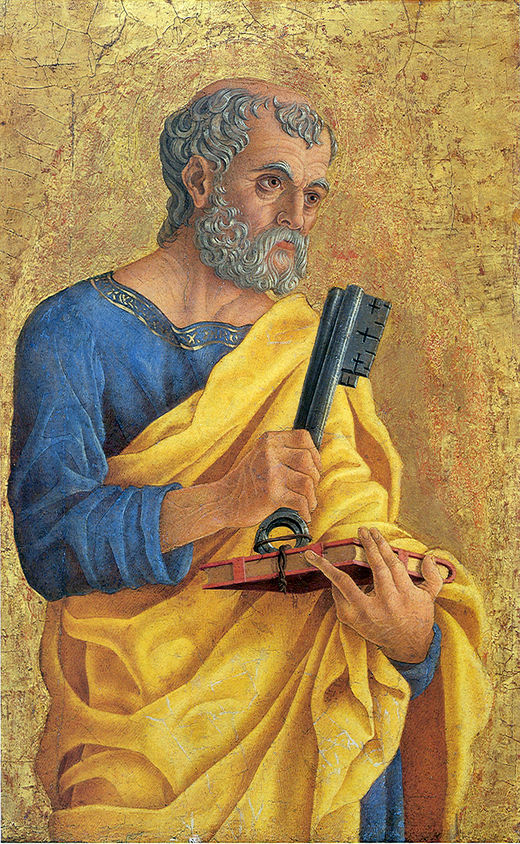
One of the priests with whom I live kindly sent along the following Novena to St. Peter, Apostle to be prayed from February 13th through February 21st, the vigil of the Feast of the Chair of Saint Peter the Apostle "in thanksgiving to God for the pontificate of Pope Benedict XVI, for the Sacred College of Cardinals who will name his successor, and for the Church."

Please consider joining us in praying it.  It has been approved for private devotion and prayer.
 
+In the Name of the Father, and of the Son, and of the Holy Spirit. Amen.

O Holy Apostle, because you are the Rock upon which Almighty God has built His church; obtain for me I pray you, lively faith, firm hope and burning love; complete detachment from myself, contempt of the world, patience in adversity, humility in prosperity, recollection in prayer, purity of heart, a right intention in all my works, diligence in fulfilling the duties of my state of life, constancy in my resolutions, resignation to the will of God and perseverance in the grace of God even unto death; that so, by means of your intercession and your glorious merits, I may be worthy to appear before the chief and eternal Shepherd of souls, Jesus Christ, Who with the Father and the Holy Spirit lives and reigns for ever. Amen. 

Litany of St. Peter, Prince of the Apostles

NOTE: This litany is approved for private devotion and prayer.

Lord, have mercy. Christ, have mercy. Lord, have mercy.
Christ, hear us. Christ, graciously hear us.

God the Father of Heaven, Have mercy on us.
God the Son, Redeemer of the world, Have mercy on us.
God the Holy Ghost, Have mercy on us.
Holy Trinity, One God, Have mercy on us.

Holy Mary, Mother of God, pray for us.

Queen conceived without Original Sin, pray for us.

Queen of Apostles, pray for us.

Saint Peter, pray for us.

Prince of the Apostles, pray for us.

St. Peter, to whom were given the keys of the Kingdom of Heaven, pray for us.

St. Peter, so ardent for the glory of Christ, pray for us.

St. Peter, whose heart was pierced with one look from Jesus, pray for us.

St. Peter, who ceased not to grieve for having denied the Son of God, pray for us.

St. Peter, whose cheeks were furrowed by a stream of tears which flowed to the end of thy life, pray for us.

St. Peter; who cried out, “Lord, Thou knowest that I love Thee,” pray for us.

St. Peter, bound in chains for Christ, pray for us.

St. Peter, delivered from prison by an Angel, pray for us.

St. Peter, who rejoiced to suffer for Christ, pray for us.

St. Peter, whose very shadow healed the sick, pray for us.

St. Peter, whose voice even the dead obeyed, pray for us.

St. Peter, that we may have a constant and mutual charity among ourselves, pray for us.

That we may taste and see more and more how sweet is the Lord, pray for us.

That we may be zealous in loyalty to thy successor, the present Vicar of Christ, pray for us.

That we may help, at least by prayer, to restore to the unity of thy Holy See the scattered sheep, pray for us.

That we may be prudent and watchful in prayer, pray for us.

That we may die the death of the just, pray for us.

V. Let the mercies of the Lord give glory to him,
R. And His wonderful works to the children of men.
V. Pray for us, Saint Peter the Rock,
R. That we may be worthy of the Vicar of Christ.

Let Us Pray:
 
O Lord Jesus Christ, Who upon blessed Peter, Thine Apostle, didst bestow the pontifical power of binding and loosing, and didst give to him the keys of the Kingdom of Heaven, grant that his intercession may ensure our deliverance from the bondage of sin, Thou Who livest and reignest with the Father and the Holy Ghost, ever one God, world without end. Amen.

Appended Novena Prayers for the Holy Father:

Each day of this Novena pray: 1 Our Father, 3 Hail Marys, & 1 Glory Be.

V:   Let us pray for our Pope Benedict.

R:   May the Lord preserve him, and give him life, and make him blessed upon the earth, and deliver him not up to the will of his enemies.

V.   Thou art Peter,

R.   And upon this Rock, I will build My Church.

Let us Pray:
 
Almighty and everlasting God, have mercy upon your servant, Benedict, our Sovereign Pontiff, and guide him in your goodness on the way of eternal salvation; so that, with the prompting of your grace,  he may desire what pleases you and accomplish it with all his strength. Through Christ Our Lord. Amen.

V. Mother of the Church,
R. Pray for us.
V. St. Peter,
R. Pray for us.

11 February 2013

A Prayer for the Pope

Adapted from one composed by Pope Leo XIII:
O Lord, we are the millions of believers, humbly kneeling at Your feet and begging You to preserve, defend and save the Sovereign Pontiff, Benedict XVI, for many years. He is the Father of the great fellowship of souls and our Father as well. On this day, as on every other day, he is praying for us also, and is offering unto You with holy fervor the sacred Victim of love and peace.
Wherefore, O Lord, turn Yourself toward us with eyes of pity; for we are now, as it were, forgetful of ourselves, and are praying above all for him. Unite our prayers with his and receive them into the bosom of Your infinite mercy, as a sweet savor of active and fruitful charity, whereby the children are united in the Church to their Father. All that he asks of You this day, we too ask it of You in unison with him.
Whether he weeps or rejoices, whether he hopes or offers himself as a victim of charity for his people, we desire to be united with him; nay more, we desire that the cry of our hearts should be made one with his. Of Your great mercy grant, O Lord, that not one of us may be far from his mind and his heart in the hour that he prays and offers to You the Sacrifice of Your blessed Son. At the moment when our venerable High Priest, holding in His hands the very Body of Jesus Christ, shall say to the people over the Chalice of benediction these words: "The peace of the Lord be with you always," grant, O Lord, that Your sweet peace may come down upon our hearts and upon all the nations with new and manifest power. Amen.

Paprocki: Pope Benedict has moved and inspired us

His Excellency the Most Reverend Thomas John Paprocki, Bishop of Springfield in Illinois, issued the following statement today concerning the announcement of the intention of His Holiness Pope Benedict XVI to resign his office:
Today we join Catholics and all people of good will in thanking His Holiness, Pope Benedict XVI, for the gift of his ministry to the church and the world.
Though this morning's announcement of his resignation was a surprise, we can surely understand and admire the pope's courage in facing his frailties.  His humility and concern for the people he has pastored are a sign of great love for the church. 
Throughout his life, he has been a defender of the truth and a voice for the poor.  He has been an advocate for peace among nations as well as a promoter of respect for God's creation in nature.  His writings have moved us and his words have inspired us. 
On a personal level, I am particularly grateful to Pope Benedict for his having appointed me to serve here as Bishop of the Diocese of Springfield in Illinois. 
To our Holy Father, I join with the people of this diocese in offering our prayers and best wishes during these last days of his pontificate and for a tranquil retirement. 
We also ask that the Holy Spirit guide the church in the coming weeks as we prepare for the election of the new pope. 
Thank you.
After reading his statement, Bishop Paprocki answered questions from the local media.  I will post more on this either late tonight or tomorrow morning.

A common bond

When Pope Benedict XVI visited the tomb of his predecessor Pope Saint Celestine V on 29 April 2009, he left behind a gift: His pallium, the woolen symbol of the office of a metropolitan archbishop:


Five months and a few days after his election to the See of Peter, Pope Saint Celestine V resigned his office on 13 December 1294 after a few tumultuous months.  Some were grateful for the his resignation and others despised him for it.  Nevertheless, he is a Saint and his entry in the Roman Martyrology on May 19 reads:
At Castrum Fumorense near Alatri in Lazio, the birth of Saint Peter Celestine, who, when leading the life of a hermit in Abruzzo, being famous for his sanctity and miracles, was elected Roman Pontiff as an octogenarian, assumed the name Celestine V, but abandoned his office that same year and preferred to return to solitude.
The circumstances of Pope Celestine's resignation are quite different from those of Pope Benedict's resignation.  Celestine proved to be an man incapable of governing well; Benedict has proven to be the opposite.  Both Pontiffs, however, have shown themselves to be saintly; Celestine has already been canonized and I hope one day for Benedict to also be canonized.

At the time of Pope Benedict XVI's touching gesture in Aquila, some read into it an indication that the present Holy Father also had intentions of one day resigning his office.  It was certainly a curious gesture, since the Pope did not leave a pallium at the other tombs of his predecessors when he visited them, but I thought little of it; it seems I, and many others, was quite mistaken.

I will be grateful for Benedict's prayers for the Church following his resignation and I hope he will continue to write; there is still much he can teach us.

Let us continue to pray for His Holiness, that his time of retirement may be tranquil and serene; the Lord's beast of burden has surely earned his rest.

A decision of great importance

As the world woke this morning to news of Pope Benedict XVI's decision yesterday to resign his office as Bishop of Rome, effective February 28, 2013 at 8:00 p.m. Roman time, shock and sadness set into the hearts of many, including me.
 
L’Osservatore Romano
Many have asked how the Pope can "simply" resign and step aside.  To be sure, this decision was not made lightly but only "after having repeatedly examined my conscience before God."

At 85 years of age, His Holiness is feeling the effects of these years in a great way and is aware of the limitations his advanced age is placing upon his ministry.  Indeed, his health, he says, "has deteriorated in me to the extent that I have had to recognize my incapacity to adequately fulfill the ministry entrusted to me."

We should pay special attention to the emphasis he uses: He is not resigning to suit his own desires, but for the good of the Church.  As it has always been throughout his life, so it remains: His first concern is for the Church.
Then-Cardinal Ratzinger concluded his book Milestones: Memoirs: 1927-1997, published in 1997, with a moving reflection on the bear of St. Corbinian, which he has included in his coat of arms.  He wrote of the bear:
The story has it that, on the way to Rome, a bear tore the saint's horse to pieces.  Then Corbinian reprimanded the bear sternly for its crime and as a punishment loaded on it the pack that the horse had been carrying.  The bear had to haul the pack all the way to Rome, and only there was it released by the saint.  The bear weighed down with the saint's burden reminded me of one of Saint Augustine's meditations on the Psalms.  In verses 22 and 23 of Psalm 72(73), he saw expressed botht he burden and the hope of his life.  What he finds in these verses and then comments is like a self-portrait, made before the face of God, and therefore not just a pious thought but an exegesis of his life and light upon his road.

What Augustine writes in this connection became for me a portrayal of my own destiny.  ....

He had chosen the life of a scholar, but God had chosen to make him into a "draft animal" - a good, sturdy ox to pull God's cart in this world...

The laden bear that took the place of Saint Corbinian's horse, or rather donkey - the bear that became his donkey against its will: Is this not an image of what I should do and of what I am?  "A beast of burden I have become for you, and this is just the way for me to remain wholly yours and always abide with you."
This profound words demonstrate the heart of the man who was taken from his academic learning - which he greatly loved - and was made a Bishop, an Archbishop, a Cardinal, and now a Pope.  He is a man of great humility and sacrifice.

The above words should be remembered with the words he spoke shortly after his election to the See of Peter when he addressed a group of German pilgrims:
When, little by little, the trend of the voting led me to understand that, to say it simply, the axe was going to fall on me, my head began to spin. I was convinced that I had already carried out my life's work and could look forward to ending my days peacefully. With profound conviction I said to the Lord: Do not do this to me! You have younger and better people at your disposal, who can face this great responsibility with greater dynamism and greater strength.
Over the course of these past seven years I have learned more from Pope Benedict XVI than I could ever put into words.  As I newly-ordained priest, I remember watching the newly-elected Pope.

I watched this introverted man learn how to speak to the crowds and to allow some of his personality to flow into his Petrine ministry as I sought to learn how to do the same in my priestly ministry.

I remember pouring over his homilies and addresses to learn how to proclaim the Gospel in our day and I used - and still do use - many of his words in my homilies and addresses.

There is something about this man that has deeply touched my heart.

Many have asked how the Pope  can "simply" resign and step aside. 

The possibility of a papal resignation is foreseen in canon law:
Can. 332 §1. The Roman Pontiff obtains full and supreme power in the Church by his acceptance of legitimate election together with episcopal consecration. Therefore, a person elected to the supreme pontificate who is marked with episcopal character obtains this power from the moment of acceptance. If the person elected lacks episcopal character, however, he is to be ordained a bishop immediately.
 
§2. If it happens that the Roman Pontiff resigns his office, it is required for validity that the resignation is made freely and properly manifested but not that it is accepted by anyone.
Though the resignation of a Pope is rare, it is not altogether unheard of.  Of the 265 Successors of Saint Peter, 4 have resigned:
Pope Gregory VI in 1046
Pope Celestine V in 1294 
Pope Gregory XII in 1415
Who the fourth is, I do not know.  Soon Pope Benedict XVI will become the fifth Pope to resign.

Following his resignation, he will move to Castel Gandalfo, the summer residence of the Popes, for "a period of prayer and reflection."  He will not take part in the conclave to elect his successor.

Other questions remain, most notably two that come to my mind:
  1. What will he be called?
  2. What will he do?
As to what he will be called, I do not know.  He is presently called the Pope because he is the Bishop of Rome.  Will he be Bishop-emeritus of Rome? Will he simply be called Benedict XVI or even again Joseph?  I do not know.

As to what he will do, I do not expect we will see much of him in his retirement, a thought that saddens me.  I do, though, think he will continue to work on a book or two (at least I hope he will!).

As I look to what the future will hold, I will miss his genuine smile and the gentleness of his voice.  I wish him well and thank him not only for his courageous ministry, but his courageous and humble decision to resign his office before he may become incapacitated.  May God bless him with joy and peace and provide us with another such shepherd!


BREAKING: Pope to resign Feb. 28, 2013

This morning the Holy Father Pope Benedict XVI announced his intention to resign his office on Thursday, February 28, 2013:
Dear Brothers, I have convoked you to this Consistory, not only for the three canonizations, but also to communicate to you a decision of great importance for the life of the Church. After having repeatedly examined my conscience before God, I have come to the certainty that my strengths, due to an advanced age, are no longer suited to an adequate exercise of the Petrine ministry. I am well aware that this ministry, due to its essential spiritual nature, must be carried out not only with words and deeds, but no less with prayer and suffering. However, in today’s world, subject to so many rapid changes and shaken by questions of deep relevance for the life of faith, in order to govern the bark of Saint Peter and proclaim the Gospel, both strength of mind and body are necessary, strength which in the last few months, has deteriorated in me to the extent that I have had to recognize my incapacity to adequately fulfill the ministry entrusted to me. For this reason, and well aware of the seriousness of this act, with full freedom I declare that I renounce the ministry of Bishop of Rome, Successor of Saint Peter, entrusted to me by the Cardinals on 19 April 2005, in such a way, that as from 28 February 2013, at 20:00 hours, the See of Rome, the See of Saint Peter, will be vacant and a Conclave to elect the new Supreme Pontiff will have to be convoked by those whose competence it is. 
Dear Brothers, I thank you most sincerely for all the love and work with which you have supported me in my ministry and I ask pardon for all my defects. And now, let us entrust the Holy Church to the care of Our Supreme Pastor, Our Lord Jesus Christ, and implore his holy Mother Mary, so that she may assist the Cardinal Fathers with her maternal solicitude, in electing a new Supreme Pontiff. With regard to myself, I wish to also devotedly serve the Holy Church of God in the future through a life dedicated to prayer.  
From the Vatican, 10 February 2013
Let us remember His Holiness in our prayers.

09 February 2013

Mere words, or deeply held belief

Pope Benedict XVI, in his Apostolic Letter Porta Fidei, has described the purpose of this Year of Faith in this words:
To rediscover the content of the faith that is professed, celebrated, lived and prayed, and to reflect on the act of faith, is a task that every believer must make his own, especially in the course of this Year (9).
Pondering the words of the Creed, and delving deeply into their riches, is an excellent way to keep the Holy Father's admonition.

With this in mind, I offer you this video from Outside Da Box, which I hope you will seriously consider as you prepare for Sunday Mass:

08 February 2013

Friday Prayer Intention

The United States Conference of Catholic Bishops have issued to the faithful a Call to Prayer: Pledge to Fast for the protection of life, marriage, and religious liberty.  The faithful are asked to join the Bishops in prayer and fasting each Friday through the Solemnity of Our Lord Jesus Christ, King of the Universe (November 24, 2014).

Each Friday, the USCCB will send an e-mail to text reminder to those who have signed the pledge with a particular intention.  Today's intention, written by His Excellency the Most Reverend Kevin Rhoads, Bishop of Fort Wayne-South Bend and Chairman of the USCCB Committee on Laity, Marriage, Family Life, and Youth, is:
For a greater reverence for the gift of marriage and family in our nation and for the healing of those suffering from troubled or broken marriages, especially children.
Please, join our shepherds in prayer and fasting today for a greater recognition of the real beauty and truth of marriage that joins one man to one woman in love until death.

She had hope because she had God

Today, Holy Mother Church rejoices in the life of Saint Josephine Bakhita (ca. 1869-1947), a Saint with whom I think we should all become well acquainted.

In his encyclical Spe salvi, Pope Benedict XVI offered a brief and moving summary of her life (with my emphases):
The example of a saint of our time can to some degree help us understand what it means to have a real encounter with this God for the first time. I am thinking of the African Josephine Bakhita, canonized by Pope John Paul II. She was born around 1869—she herself did not know the precise date—in Darfur in Sudan. At the age of nine, she was kidnapped by slave-traders, beaten till she bled, and sold five times in the slave-markets of Sudan. Eventually she found herself working as a slave for the mother and the wife of a general, and there she was flogged every day till she bled; as a result of this she bore 144 scars throughout her life. Finally, in 1882, she was bought by an Italian merchant for the Italian consul Callisto Legnani, who returned to Italy as the Mahdists advanced. Here, after the terrifying “masters” who had owned her up to that point, Bakhita came to know a totally different kind of “master”—in Venetian dialect, which she was now learning, she used the name “paron” for the living God, the God of Jesus Christ. Up to that time she had known only masters who despised and maltreated her, or at best considered her a useful slave. Now, however, she heard that there is a “paron” above all masters, the Lord of all lords, and that this Lord is good, goodness in person. She came to know that this Lord even knew her, that he had created her—that he actually loved her. She too was loved, and by none other than the supreme “Paron”, before whom all other masters are themselves no more than lowly servants. She was known and loved and she was awaited. What is more, this master had himself accepted the destiny of being flogged and now he was waiting for her “at the Father's right hand”. Now she had “hope” —no longer simply the modest hope of finding masters who would be less cruel, but the great hope: “I am definitively loved and whatever happens to me—I am awaited by this Love. And so my life is good.” Through the knowledge of this hope she was “redeemed”, no longer a slave, but a free child of God. She understood what Paul meant when he reminded the Ephesians that previously they were without hope and without God in the world—without hope because without God. Hence, when she was about to be taken back to Sudan, Bakhita refused; she did not wish to be separated again from her “Paron”. On 9 January 1890, she was baptized and confirmed and received her first Holy Communion from the hands of the Patriarch of Venice. On 8 December 1896, in Verona, she took her vows in the Congregation of the Canossian Sisters and from that time onwards, besides her work in the sacristy and in the porter's lodge at the convent, she made several journeys round Italy in order to promote the missions: the liberation that she had received through her encounter with the God of Jesus Christ, she felt she had to extend, it had to be handed on to others, to the greatest possible number of people. The hope born in her which had “redeemed” her she could not keep to herself; this hope had to reach many, to reach everybody.

07 February 2013

Happy 535th birthday, Saint Thomas More!

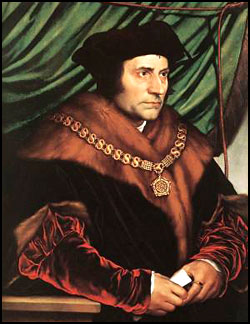
Five hundred and thirty-five years ago today a man was born who strove to be ever faithful to his king, but first to his God: Saint Thomas More.

His fidelity was challenged by King Henry VIII's own attempt to redefine marriage, after a sort, by simply doing away with an actual matrimonial bond he contracted.  Saint Thomas thus found it necessary both to defend marriage and his own religious liberty.

It takes no stretch of the imagination to recognize the odd parallels between sixtheenth centry England the twenty-first century America, where another and altogether different attempt to redefine marriage is taking place which places our religious liberty at risk.

Let us this day, then, seek the intecession of Saint Thomas More, the patron of statesmen, that by his example and prayers the minds of lawmakers may be opened to the truth and their hearts may be converted:
O Glorious St. Thomas More, Patron of Statesmen, Politicians, Judges and Lawyers, your life of prayer and penance and your zeal for justice, integrity and firm principle in public and family life led you to the path of martyrdom and sainthood. Intercede for our Statesmen, Politicians, Judges and Lawyers, that they may be courageous and effective in their defense and promotion of the sanctity of human life - the foundation of all other human rights. We ask this through Christ our Lord.  Amen.
You might also pray today the Litany of St. Thomas More.

Call to Prayer: Pledge to Fast

As challenges against what is authentically human continue to mount in these United States of America, the United States Conference of Catholic Bishops have called upon the faithful to "offer their Friday acts of sacrifice and penance, and particularly to abstain from meat and fast on Fridays until Christ the King Sunday (November 24, 2013), for the intention of the protection of Life, Marriage, and Religious Liberty."

In his Message for Lent 2009, Pope Benedict XVI reflected on the value and efficacy of fasting:
In our own day, fasting seems to have lost something of its spiritual meaning, and has taken on, in a culture characterized by the search for material well-being, a therapeutic value for the care of one’s body. Fasting certainly bring benefits to physical well-being, but for believers, it is, in the first place, a “therapy” to heal all that prevents them from conformity to the will of God. In the Apostolic Constitution Pænitemini of 1966, the Servant of God Paul VI saw the need to present fasting within the call of every Christian to “no longer live for himself, but for Him who loves him and gave himself for him … he will also have to live for his brethren“ (cf. Ch. I). Lent could be a propitious time to present again the norms contained in the Apostolic Constitution, so that the authentic and perennial significance of this long held practice may be rediscovered, and thus assist us to mortify our egoism and open our heart to love of God and neighbor, the first and greatest Commandment of the new Law and compendium of the entire Gospel (cf. Mt 22, 34-40).
 
The faithful practice of fasting contributes, moreover, to conferring unity to the whole person, body and soul, helping to avoid sin and grow in intimacy with the Lord. Saint Augustine, who knew all too well his own negative impulses, defining them as “twisted and tangled knottiness” (Confessions, II, 10.18), writes: “I will certainly impose privation, but it is so that he will forgive me, to be pleasing in his eyes, that I may enjoy his delightfulness” (Sermo 400, 3, 3: PL 40, 708). Denying material food, which nourishes our body, nurtures an interior disposition to listen to Christ and be fed by His saving word. Through fasting and praying, we allow Him to come and satisfy the deepest hunger that we experience in the depths of our being: the hunger and thirst for God [more].
We sometimes forget that just as every Sunday is seen by the Church as a sort of "little Easter," so every Friday is seen as a sort of "little Good Friday."  It is important for us to call to mind the great mercy the Lord has shown us from his Cross and to perform penance to demonstrate our sorrow for sin and our desire to be turn away from sin and be faithful to the Gospel.

Saint Francis of Assisi who so often urged those who listened to his preaching to "perform worthy fruits of penance" (cf. Luke 3:8), wrote:
Blessed are those who die in penance, for they shall be in the kingdom of heaven.  Woe to those wo do not die in penance, for they shall be the children of the devil whose works they do, and they shall go into the eternal fire.  Beware and abstain from every evil and persevere in good till the end [The Second Version of the Letter to the Faithful, 25; The Earlier Rule, 7-9].
Please, heed the call of our Bishops and fast and prayer in an intentional manner imploring the Lord for the conversion of hearts and minds.

06 February 2013

I'm not an economist, but...

The United States Postal Service announced today that, effective August 5, 2013 (sometimes I really wonder how government agencies choose dates for such things) will cease delivering first class mail on Saturdays, though delivery to post office boxes will continue.

The move is expected to save the Post Office some $2,000,000,000 next year, a small sum, really, considering the $16,000,000,000 the agency lost last year, and especially given the reality that the cost of running the Postal Service is unlikely to otherwise decrease next year.  This move seems to be nothing more than a bandaid.

When he made the announcement this morning, Postmaster General Patrick Donahoe said, "America's mailing habits are changing and so are their shipping habits.  People will say this is a responsible decision. It makes common sense."

Let me be one who says this defies common sense.

I am not an economist but even I know that as the price of postage continues to rise, people are less likely to send a letter - or anything else through the mail.  They will opt for e-mail or Facebook, instead, and some might even walk - or even drive - the letter to the addressee themselves (I've personally made use of each of these options).

Now that mail will not be delivered on Saturdays is yet another reason - in addition to the continuous rising costs - why people will make even less use of the postal system.

Think of it this way: If you mail a card on Thursday, the recipient will not receive it until Monday.  In the grand scheme of things, this may not be a bid deal, but some people like to send birthday cards to people so the card arrives on the birthday itself (or perhaps the day before).  With the new change in delivery, this will become more difficult.

I am not sure whether mail would continue to be sorted on Saturdays to aid delivery on Mondays; if not, this will simply add one more day's delay into the delivery time so that a card mailed on Thursday may not arrive on Tuesday.  With this speed of delivery, frankly, what's the point?

There are changes that could be made, including closing small facilities (though this brings a different set of difficulties with it).  One simply change would be to drop the cost of postage.  As postage goes down, more people are likely to make use of the postal system.

Given the current of cost of postage, I am more inclined to e-mail documents to retreatants, for example, than I am to put physical papers in the mail to them.  I prefer to actually mail physical papers to people, but the cost is prohibitive.  This does not help the postal system.  And now that the mail take even longer to reach the addressees, I will be even less likely to use the postal system.  This change, I am sure, will only lead to further decreases in revenues for the postal system.

According to respondents to a Wall Street Journal poll, I am in the minority when I say that I will miss Saturday mail delivery.  There is something nice about sitting down with the mail on a quiet Saturday morning.  I enjoy waiting for the mail to arrive and look forward to it.

For several years now I've wondered what a company like UPS or FedEx or DHL could do home delivery of letters and cards, and not just packages.  Perhaps we will soon find out.

In honor of the day


The only reason for my being killed is that I have taught the doctrine of Christ. I thank God it is for this reason that I die. I believe that I am telling the truth before I die. I know you believe me and I want to say to you all once again: Ask Christ to help you become happy. I obey Christ. After Christ's example, I forgive my persecutors. I do not hate them. I ask God to have pity on all, and I hope my blood will fall on my fellow men as a fruitful rain.

- Saint Paul Miki
 
Capello tip to Catholic Fire.

The ars celebrandi, Marini style

More often than not, the work of the Master of Ceremonies goes largely unnoticed, and this is as it should be.  The Master of Ceremonies should really simply blend into the background, as it were.  His task is to be the unseen guiding hand of those involved in the liturgical celebration.

Even so, every now and again a Master of Ceremonies may have a particular moment to shine, as in the recent case of Monsignor Guido Marini, the Master of Pontifical Liturgical Celebrations.  You've likely seen his face before, even if you did not take any notice of him or know his name.

I've often looked to his example in my work as Priest Secretary and Master of Ceremonies to the Bishop.  I must say: I am particularly impressed with his reaction to a ligurgical mishap that took place last Saturday in the Basilica of Saint Peter in Rome when the Holy Father Pope Benedict XVI celebrated Mass for the Feast of the Presentation of the Lord:


Precisely what happened, I cannot quite make out.  It seems to me, though, that upon reaching the altar Pope Benedict XVI, for one reason or another, let go of the pastoral staff.  Thankfully, Msgr. Marini has a quick eye and swift reflexes.

What most impresses me about the entire situation is not so much that Msgr. Marini was able to save the staff from banging to the ground, but that he handed it back to the Holy Father as though nothing at all had ocurred.  Indeed, the Pope seems to take no notice whatever.

Whenever something goes wrongly in a liturgical celebration, the Master of Ceremonies should never overreact.  Rather, he should remain calm - at least externally - and draw as little attention to the situation as possible.  He should move in such a way as to quietly make up for whatever has gone poorly.  Everything should be done with an eye to the ars celebrandi, to the art of celebrating.

Thank you, Msgr. Marini, for a job very well done indeed!

05 February 2013

Same-sex "marriage" bill passes Executive Committee

The Illinois Senate Executive Committee approved - along partisan lines - the so-called Religious Freedom and Marriage Fairness Act (SB10) and Senate President John Cullerton (D-Chicago) hopes to pass the Act on St. Valentine's Day, in what can only be called a great distortion of authentic love:
"Same-sex couples want to marry," sponsoring Sen. Heather Steans said, "for the same reason we all do: For the common respect, commitment to families, the obligation and the benefits that come with marriage."  
Steans, also a Democrat from Chicago, shepherded a similar bill to the floor just after New Year's - in the final days of the last General Assembly - but scuttled a floor vote when she couldn't count on enough votes. She said a change in the language makes it clear that churches and other houses of worship will not be obligated to solemnize gay unions. But Republicans remain concerned that religious organizations will be sued over shutting their doors to same-sex celebrations. 
Sen. Dale Righter, through his questioning of the legislation's supporters, was able to establish that those institutions' obligations are covered by the state's human rights law. The gay-marriage measure doesn't address the responsibilities of any place deemed a "public accommodation," and Righter, R-Mattoon, said the matter won't be settled until expensive and time-consuming lawsuits are settled. 
"Now we have to evaluate what public accommodations are for purposes of whether or not churches would be required to allow same-sex couples to use their facilities," he said [more].
 
When the Illinois Legislature passed the so-called Religious Freedom Protection and Marriage Fairness Act, we were told, on the floor of the House, that the new law would not affect adoptions and foster care.  Within a year, Catholic Charities was forced out of adoption and foster care services.

If you actually think that this new legislation will not affect the religious freedom of those who recognize the truth that marriage can only be contracted between a man and a woman, you are willfully turning a blind eye to history.

Please, contact your State Senator and Represtentive and ask them to protect your religious liberty by voting "No" on SB10.

01 February 2013

Illinois to approve same-sex "marriage" on Valentine's Day?

The Chicago Sun-Times reports that Illinois Senate President John Cullerton (D-Chicago) hopes to vote on the so-called Religious Freedom and Marriage Fairness Act on February 14, 2013, Valentine's Day.  This would be just one more way that authentic love is distorted and made quite false.

The legislation, sponsored by two other Chicago Democrats - Senator Heather Steans and Representative Greg Harris, failed to have the legislation voted on during the recently concluded "lame duck" session, but seem eager to have it voted into the law in this new session.

Whereas in the lame duck session, Senator Steans attempted to pass the Act as an amendment to the Nursing Home Care Act and to a piece of legislation dealing with automobile rentals, this time the Act is a bill in its own right: SB0110.

President Cullerton hopes to pass the Act out of committee next week.

Please, folks, if you have not contacted your State Senator and Representative, there is not time to lose.  Urge your elected representatives to vote "no" on SB0110.

His Excellency the Most Reverend Thomas John Paprocki has argued wisely and well against the Religious Freedom and Marriage Fairness Act simply on the grounds of the legislative history and the philosophical tradition upon which our country has been built.  Please, re-read his letter and pass it on to your friends, or listen to the Bishop himself:


Update: The Catholic Conference of Illinois posted the following update on its Facebook page on February 1st at 4:19 p.m.:
Illinois Senate President John Cullerton wants to pass redefinition of marriage legislation -- now SB 10 -- on Valentine's Day. SB 10 is currently a "shell" bill -- it's empty -- but is up for a committee vote on Tuesday. Shell bills are easily amended -- like with redefinition of marriage language. Look up and call your state senator on Monday, asking him/her to vote "no" on redefinition of marriage.


Life Advocacy Days in Springfield to be held April 8-12

The Bishops of the Dioceses of Illinois are inviting the faithful to participate in Life Advocacy Days, the purpose of which, writes the Most Reverend Thomas John Paprocki, Bishop of Springfield in Illinois, in a February 1st letter, "will be to make our voices heard regarding legislation in conflict with Catholic teaching and belief."

Sponsored by the Catholic Conference of Illinois, the Life Advocacy Days will begin on the Feast of the Annunciation, April 8th, and run through April 12, 2013.  A special lobby day at the Capitol will be held on April 10th, beginning at 10:00 a.m.

To help mark the Life Advocacy Days, Bishop Paprocki has called for special prayers on the Feast of the Annunciation: "perhaps a Holy Hour, Mass for Blessing Unborn Children, a parish rosary, etc."

Father Stephen A. Thompson has written a written a prayer for the Life Advocacy Days, which His Excellency has asked be printed in parish bulletins during the months of March and April:

Gracious and merciful God, we ask that you send your Spirit among us to guide us and direct us in order to inspire all of our political leaders to advance the culture of life in their duty to uphold the common good for all the people they serve. 
You sent your Son Jesus to teach us how to pray, how to serve you in obedience and how to be the people you are calling us to be. 
You inspire us each and every day to appreciate the gifts you bestow upon us and to use them to change the hearts and minds of all people. 
The most precious gift you have given to us is the gift of life and you call us to be good stewards of all your creation. 
Help us to cultivate a spirit of prayer and of reconciliation for the  lack of due diligence in protecting the most vulnerable among us; the children who are forgotten, abandoned and thought of as an inconvenience to the welfare  of societies. 
Inspire all those in public office to protect the dignity of the unborn and those who are living who are deemed unfit to receive our care. 
Help us to receive your wisdom so that we may know how best to serve you and your people. 
We ask this through Christ our Lord.
Bishop Paprocki stresses that "it is critical that all our voices be heard."

Please, join in this important effort and keep an eye on your parish bulletin for more information as the Life Advocacy Days draw closer.

31 January 2013

A March for Life re-cap

This past Friday I traveled by bus with 228 other pilgrims - mostly youth - from the Diocese of Springfield in Illinois to Washington, D.C. to participate in the March for Life.  In addition to our four buses and two vans, I know that at least two other vans and four other buses went to the March for Life from the Diocese.


Aside from one incident in which the bus on which I was riding was clipped by a semi (thanks be to God, only the outside mirror was scuffed), it may have been the smoothest pilgrimage to the March for Life I have been on yet.  I really could not have asked for a better group of pilgrims.

We arrived in Washington, D.C. later than planned because the weather we drove through slowed our travel across the country.  With this in mind, we went straight to the Basilica of the National Shrine of the Immaculate Conception to join some 13,000 of the faithful for the Vigil Mass Thursday night.

Naturally, the Basilica filled quickly as the afternoon progressed.  When I made my to the Crypt Chapel where the seminarians, deacons, priests, and seminarians vest for Mass, I could tell there were more people in attendance than in previous years.  In years past, the time before the Mass is a good opportunity to visit with priests that I don't get to see throughout the year.  This year, though, there were so many people downstairs it made it difficult to find the priests I know.

After the Mass, the priests often sneak out a side door and walk down the front steps of the Basilica on our way to our buses.  In years past, it was easy to walk down the steps at the buses without fighting through our a crowd.  This year, though, there were several crowds to fight through.

The next morning I celebrated Mass for my group of pilgrims at St. Peter's on Capitol Hill (you can read my homily here).  The staff of the parish has been very welcoming and hospitable to us for many years now.  Several smaller groups of pilgrims from the Diocese also joined us for the Mass.

After the Mass we made our way to the national mall and waited for the March for Life to begin.  We somehow managed to take our places in the "line up" in such a way that we found ourselves toward the beginning of the March.


As we neared the Supreme Court building, I began to see a great number of police officers lining both sides of the street, which I did not remember seeing in previous years.  As we turned toward the Supreme Court building I saw a dozen officers or more standing on the steps, the sight of which gave me some surprise.

The closer we marched to the Supreme Court I became more aware of the reason for the heavy police presence: some forty pro-abortion demonstrators standing on the sidewalk in front of the Supreme Court.  Without a doubt, this is largest number of abortion supporters I have every seen at the March for Life and the first time I remember seeing them there.

What especially struck me about their presence was the striking difference between the two groups of people.  On the one hand were some 650,000 people marching peacefully in support of life, who were praying, singing, and laughing on their way.  On the other hand were some forty people yelling and screaming with great anger and hatred at those who disagreed with them.  We simply walked past them.

After the March we toured Ford's Theatre before having supper at Union Station.  The next day we visiting Arlington Cemetery, the Holocaust Museum, and the Smithsonian Institution before hopping back on the buses to make our way home.

For several years now the group I travel with has been wearing red and white striped scarves to help us keep an eye on the members of our group.  The scarves have led some to call us "the Waldos," a nickname we enjoy.  The scarves also serve as a useful way for other people we know to find us, though this year Sr. Karolyn, F.S.G.M. could not find us.  She sent the following note:
I looked for you at the March but amazingly did not run into ANYONE from Springfield.  I was even carrying a Dr. Pepper to give you.
I knew those Sisters of St. Francis of the Martyr St. George were fantastic!

But though Sr. Karolyn could not find us, Imagine Sisters found her and took a picture of her (on the right) and two of her Sisters singing "God Bless America":


The picture was used as the cover image on their Facebook page.  Be sure to "like" them.