Showing posts with label Selfies. Show all posts

12 January 2016

Mumbai declares No Selfie Zones

As men, women, and children throughout the world fall more in love with themselves and become even more thoughtless as they take selfies so that other people can admire them, we have seen selfie sticks banned in museums, at music festivals, and at sporting events.

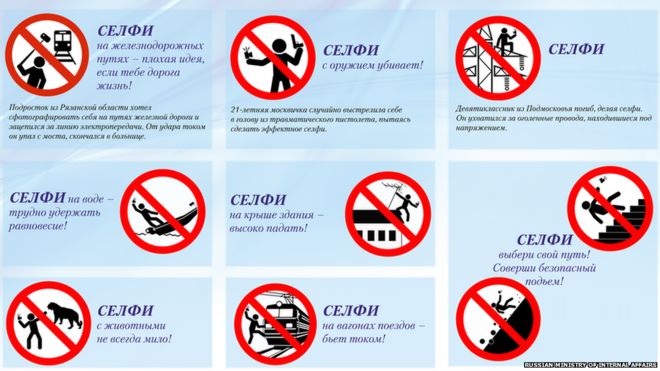
This thoughtlessness and self-absorption has reached such a high level that the Russian government has created an infographic on the safe use of selfie sticks.

In an even greater effort to protect the self-absorbed, unthinking hordes, the city of Mumbai, in preparation for the Hindu festival of Kumbh Mela, has created selfie free zones after an 18-year-old woman drowned last week while taking a selfie:
Signs saying "no selfie zone" can be seen around the two festival sites in the city, which is the capital of Maharashtra state.
Mumbai police spokesperson Dhananjay Kulkarni told the BBC that the places where taking selfies was risky included Bandra Bandstand, Sion Fort and Worli Fort, all places popular with tourists.

"The police will now approach the city's municipality to prevent accidents at such spots due to people taking selfies. The municipality may deploy life guards and install warning signs," Mr Kulkarni said. 

The police warning follows Saturday's incident when three girls trying to take a selfie near the sea in the Bandra area fell into the water.

One of them drowned and her body is yet to be recovered [more].
What does it say about modern humanity that such zones and warnings are even necessary?

12 December 2015

Selfies, the Jubilee of Mercy, and the purpose of churches

Each time I step outside of the walls of the Casa Santa Maria to walk anywhere in the Eternal City, I am all but guaranteed to see at least three people taking selfies within ten minutes, which gives me plenty to reflect on the philosophical underpinnings behind the selfie.

I've written several times about the inherent narcissism of the selfie (which has been confirmed by science) and even asked if our churches should look more like sporting events because, among other things, they are banning the use of the selfie-stick. All of this hit home in a new and profoundly tragic way Thursday afternoon in the Basilica of St. Peter in which people were taking selfies with their extended arms and with those narcissisticks.

In the Preface of the Mass for the Dedication of a Church and Altar, Holy Mother Church prays with these words:
Truly this is an exalted place,
where the Sacrifice of Christ is ever offered in mystery,
where perfect praise is rendered to you
and redemption flows forth for us.
We see in these words that the primary purpose of a church building is to render praise to God, both because of the sacred rites it is built to house and because the building itself directs our attention toward God. Consider, then, what happens when a selfie is taken in a church.

The church building itself says to us, "Look to God!" A selfie says to others, "Look at me!" Taking selfies inside an edifice built to the glory of God seeks to usurp that glory - however unconsciously - for the individual, finite human being whose glory will, in the end, come to nothing apart from God.

Now, some of you might be saying that I'm simply reading too much into this and that there really isn't anything wrong with taking selfies, not even inside a church. The majority of people taking selfies used this as a background for their faces:


The church calls us to reflect and entrust ourselves to the merciful love of God, especially during this Extraordinary Jubilee of Mercy. Indeed, the Holy Father Pope Francis has invited us to enter into this year of grace "with eyes fixed on Jesus and his merciful gaze" to "experience the love of the Most Holy Trinity" (Misericordiae Vultus, 8), not with our eyes fixed on ourselves.

As I watched people fix their eyes - and the eyes of others - on themselves, I was reminded of how much we are in need of the Lord's mercy.

01 November 2015

On the ridiculous vanity of selfies and desiring the applause of multitudes

What comes to your mind when you read this tweet sent out yesterday by the Holy Father Pope Francis?
When I first read these words yesterday, I immediately thought of selfies. The self-absorption of the selfie mentality surely keeps at least some distance between the one taking a selfie and God. Furthermore, anyone taking a selfie certainly looks ridiculous doing so.

Someone on Facebook or Twitter yesterday (regrettably, I cannot remember who or where) described these words of Pope Francis as a papal condemnation of selfies, but this (also regrettably) cannot be true because the Holy Father routinely takes selfies with people both young and old. In fact, a few months ago Pope Francis described selfies as "another culture," adding, "I respect it." Even so, he thinks only teenagers should take selfies, though he did not explain why.

I agree with Pope Francis that there is something of a growing selfie culture, but - unlike the Holy Father - it is one I do not respect. Why? Because the selfie culture is the height of vanity! The vain selfie culture is especially dangerous because most people taking selfies simply do not see their vanity for what it is.

G.K. Chesterton describes vanity as "a much wiser and more vigorous thing than pride." Vanity, he goes on to say, 
is social - it is almost a kind of comradeship; pride is solitary and uncivilized. Vanity is active; it desires the applause of infinite multitudes; pride is passive, desiring only the applause of one person, which it already has. Vanity is humorous, and can enjoy the joke even of itself; pride is dull, and cannot even smile.
A short while later, after reflecting a bit more on vanity, the Apostle of Common Sense wisely notes in his customary style:
Thinking about himself will lead to trying to be the universe; trying to be the universe will lead to ceasing to be anything. If, on the other hand, a man is sensible enough to think only about the universe, he will think about it in his own individual way. He will keep virgin the secret of God; he will see the grass as no other man can see it, and look at a sun that no man has ever known.
Here I am reminded of the words Antoine Saint-Exupéry has the Little Prince address to a bunch of roses:
"You're not at all like my rose. You're nothing at all yet," he told them. No one has tamed you and you haven't tamed anyone. You're just the way my fox was. He was just a fox like a hundred thousand others. But I've made him my friend, and now he's the only fox in all the world."

And the roses were humbled.

"You're lovely, but you're empty," he went on. "One couldn't die for you. Of course, an ordinary person would think my rose looked just like you. But my rose, all on her own, is more important than all of you together, since she's the one I've watered. Since she's the one I put under the glass. Since she's the one I sheltered behind a screen. Since she's the one for whom I killed the caterpillars (except the two or three for butterflies). Since she's the one I listened to when she complained, or when she boasted, or even sometimes when she said nothing at all. Since she's my rose."
The blunt words of the Little Prince may sting and humble and sound harsh, but they do so because they are true. The rose was the Little Prince's precisely because he looked outside of himself and around at the universe and not at himself; she was his because he was not vain (nor was he proud).

As selfie takers seek the attention of so many people through their "Look-at-me-and-not-at-the-things-or-people-around-me!" photographs, how much of the world are they missing? How much of the world are they helping and encouraging others to miss, as well? 

With their inherent ego-centrism, selfies blurr the image of the universe all around us through which God wishes to speak to us and demonstrate his love for us. The selfie misses this beauty and so distances us from God.

In the Beatitudes, the Lord Jesus does not condone vanity, but rather he encourages its very opposite by commending those who are meek (see Matthew 5:5). Let us, then, beg the Lord for the grace to be meek that we may draw all the nearer to God, indeed, even before his throne, there to cry out continuously, "Salvation belongs to our God who sits upon the throne, and to the Lamb" (Revelation 7:10)!

07 July 2015

Russian government teaches people how to safely take selfies

As the scourge of the selfie and the selfie stick continues to grow, the Russian government has launched a "Safe Selfie" campaign after several people were recently injured while taking pictures of themselves:
An illustrated booklet has been issued warning people about dangerous selfie scenarios, including snapping a photo while halfway up an electricity pylon, standing in front of an oncoming train, or while in the company of a wild animal. Police officers will also hold selfie-safety lessons at schools, according to the ministry.
The authorities say several recent incidents involving young people could have been avoided. In May, a 21-year-old woman survived accidentally shooting herself in the head while posing for a selfie with a gun in Moscow. There have also been several cases of children being electrocuted while taking selfies on top of railway carriages [more].
If this does not demonstrate the stupidity of selfies, I don't know what does or will. As museums and amusement parks (including Disney) throughout the world, rather than attempting to teach people how to take selfies safely, maybe governments should simply ban selfies. Who knows, maybe it would help diminish the self-absorption of modern man.

09 June 2015

Selfie sticks made a tourist's visit to Rome less pleasant

I don't know who Natasha Leggero is, but the ever-present selfie stick throughout the Eternal City made her vacation in Rome not as pleasant as she would have hoped. She's quite right when she told Jimmy Fallon there are "not enough people to accommodate all the selfie sticks for sale":


With the recent arrest of 44 members of the Roman mafia (and another 20-some still under investigation), Wanted in Rome reported that the number of illegal sidewalk vendors - especially those of selfie sticks - has noticeably diminished:

It looks like, after the latest Mafia Capitale arrests, all illegal vendors have disappeared from the centre of Rome. Fourth day in a row we've been checking. A coincidence?
Posted by Wanted in Rome on Monday, June 8, 2015

This is, I think, good news. Of course, the selfie stick vendors would go away would lose even a little of their self-absorption and stop taking selfies in the first place; there's nothing wrong with having a picture with you or me not in it.

(If someone how you've missed them in the past, you can read my thoughts on the selfie in these posts.)

Having been away in Manoppello this past weekend, I haven't been out and about in the streets of Rome in a few days. I hope the illegal sellers are still gone this evening, though, because I'll be showing one of my former soccer players around the city.

23 May 2015

Pizza Hut and selfie stick abuse

I've always enjoyed eating at Pizza Hut, not only because I like the pizza but also probably because Pizza Hut reminds me of my childhood. I am, after all, one of that generation who participated in the Book It! program to earn free personal pan pizzas just for reading books I already planned to read. It was a win-win situation.

Now, though, I have another reason to like Pizza Hut. Not only has the pizza franchise released a new commercial in which it mocks people who take selfies - those "egotastic specimens of visual self-obsession" - and selfie sticks in general, warning of the effects of the dangers of selfie stick abuse.

This commercial is perfect and spot on:


Well done, Pizza Hut, well done!

18 May 2015

A use for selfie sticks?

I've been showing several different groups of friends around the Eternal City, with a few more groups yet to arrive in the coming days. Though the friends have come in different groups and do not know each other, one thing has remained constant in our wanderings through the streets of Rome: selfie stick sellers.

Of all of the illegal sellers of stolen goods, the selfie stick sellers are, by far, the most obnoxious. Whereas the sellers of knock-off purses, various wooden items from Africa, and cell phone chargers and power adapters set up their "wares" on main sidewalks and benches, they tend not to approach you as you walk by. The selfie stick sellers, though, walk right up to you, put their selfie stick right in front of you, and say, "Selfie, selfie?" Every. Single. Time.

There are dozens of selfie stick sellers throughout the city moving about in packs, so it isn't just one of them of shoving a narcisstick in front of you, but three, or four, or even five. All within a forty feet span of sidewalk or road. Even if I walk through the streets alone, wearing my cassock, and listening to my iPod, still they shove their selfie sticks in my face thinking for some unfathomable reason that I might want one of these stupid things so emblematic of how far society has fallen.

I mention all of this today only because someone sent a cartoon to me via Twitter:
My disgust of selfie sticks is, by now, well known, and I admit to laughing when I saw the comic.

Though I've never thought about hitting someone using a selfie stick, I have thought about buying one to carry with me through the city. Then, when one of the selfie stick sellers sticks their sticks right in front of me, I could take mine out of my pocket and beat them with it. That seems to me to be the only legitimate use for a selfie stick, though, admittedly, it isn't likely morally right. (I have no plans of doing so.)

If I suffer the selfie stick sellers well, I suppose I could assist a great many souls in Purgatory. So far, I'm afraid I haven't suffered them well and, though I would like to suffer them well, I don't see it happening any time soon. Such is the nature of my own sinfulness.

27 April 2015

No phones, no selfie sticks, and a dress code - should our churches look more like major sporting events?

A few weeks ago I asked if golf was more sacred than church when the Augusta National banned cell phones at the golf tournament. 

Three years ago I asked a similar question about tennis when Wimbledon introduced a dress code for its members. Today I learned that Wimbledon has now joined the growing list of places where selfie sticks - a.k.a. wands of idiocy or narcisticks - are banned:
The ticketholders' guide said: "In common with many other major sports and entertainment events and cultural attractions, the championships will not allow selfie sticks into the grounds."

The devices have already been banned at some museums and sports grounds.

A spokesman for the club told the Sunday Times the move was brought in partly because of the "nuisance value" but "primarily so it doesn't interfere with spectators' enjoyment" [more].
I've long been a critic of the great devotion that so many people give to sports. How many of your friends can rattle off the roster of their favorite team going back decades, but cannot list even the Twelve Apostles? It isn't so much that sports are bad, but they people too much importance on them and devote too little to what really matters. It won't matter in eternity who won, say, the World Series in 1953, to pick a random year, but it might help to be able to recognize the brother of Simon Peter.

Even so, I'm beginning to wish more of our churches looked more like a major sporting event, at least those seeking to bring back a sense of public decency and respect for others, if not for God.

Before anyone objects to churches instituting dress codes and claiming that Jesus only cares that I'm there, I've answered these objections before: here, here, here, here, here, here, and here.

10 April 2015

The royal family on selfies

It came as a bit of a surprise to me when I learned a day or two ago that His Royal Highness Prince Harry and I agree in our assessment of selfies.

When a young Australian requested - seemingly more than once - that he take a selfie with her, Prince Harry said to her, "Seriously, you need to get over it. I know you're young. Selfies are bad."

Prince Harry, though, is not the only member of the royal family with a dislike of selfies. Her Royal Majesty The Queen said last year she finds selfies "strange" and "disconcerting," and regards them as bad manners.

I, for one, could not agree more.

29 March 2015

Selfie sticks now banned alongside weapons

Last month I shared with you the welcome news that museums around the world slowly began to ban selfie sticks for fear that paintings and artifacts might be damaged or destroyed by self-absorbed selfie takers.

Today I am happy to share with you the welcome news that festivals across the United States of America are also beginning to ban selfie sticks for fear of injury to other human beings of whom the ego-centric selfie takers fail to take notice:
In anticipation of their festival which stars [sic] April 10th, Coachella's organizers have announced that "Selfie sticks / Narcissists" are now a prohibited item, along with chains, explosives, and knives. Lollapalooza, a huge summer fest that takes place in Grant Park, Chicago, has also issued a warning to any revellers looking to bring their selfie sticks this year [more].
This is certainly a step in the right direction.

Pope Francis, Palm Sunday, and shameless selfies

I'm not shy about making known my belief that selfies and selfie sticks epitomize a self-absorbed mentality which is growing ever more pervasive around the world or that at least is losing its shame. Such ego-centrism is clearly demonstrated by pictures such as this one retweeted by Patrick Madrid:

What's more important, the photographer or the tragedy?

This bizarre and shameless self-absorption was recently demonstrated in New York following the gas explosion in the East Village, which led the New York Post to publish a critical article under the headline, "Heartless visitors mug for selfies at East Village blast site," and this cover image:
In his homily for Palm Sunday, His Holiness Pope Francis compared the way of Jesus with the way of the world:
This is God’s way, the way of humility. It is the way of Jesus; there is no other. And there can be no humility without humiliation.

Following this path to the full, the Son of God took on the “form of a slave” (cf. Phil 2:7). In the end, humility also means service. It means making room for God by stripping oneself, “emptying oneself”, as Scripture says (v. 7). This – the pouring out of oneself - is the greatest humiliation of all.

There is another way, however, opposed to the way of Christ. It is worldliness, the way of the world. The world proposes the way of vanity, pride, success… the other way. The Evil One proposed this way to Jesus too, during his forty days in the desert. But Jesus immediately rejected it. With him, and only by his grace, with his help, we too can overcome this temptation to vanity, to worldliness, not only at significant moments, but in daily life as well [more].
How do selfies not represent the other way, the way of the world, that way that is not that of Jesus?

12 March 2015

Additional evidence of the stupidity of selfies?

It seems that my great dislike - even disgust - of selfies has found another justification, this time from shoplifting Italian teenagers:
The first teenager was tracked down and the three were taken in for questioning by police, where they made the audacious request for a selfie with police officers as a souvenir of their first arrest.

Perhaps unsurprisingly, police did not grant their request. The three face charges for shoplifting [more].
I'm tempted to ask if taking selfies makes people stupid, or if it's the other round, but it's an answer that I probably don't to know.

19 February 2015

What's wrong with the #ashtag?

Though I belong to a small - and perhaps decreasing - minority, I have not kept my thoughts regarding selfies secret (see posts here, here, and here), thoughts which have been all but confirmed by science.

You can imagine, then, my great wonder at the United States Conference of Catholic Bishops would support something so inane and self-referential as the #ashtag, for the second year in a row, even going so far as to reward it:
It seems to me the epitome of encouraging narcissism and contradicting the spirit of the Gospel proclaimed just before the imposition of ashes wherein the Lord Jesus says, "Take care not to perform righteous deeds in order that people may see them" (Matthew 6:1). The very purpose of the #ashtag is to be seen!

Still, as I pondered this contradiction before Ash Wednesday and throughout the day yesterday, I could not quite come up with the words to describe my concerns, but I am happy to see that David Henson, who blogs on Patheos at Edges of Faith, found them:
These churches, leaders or organizations aren’t encouraging people to receive ashes as part of the liturgy, as a way to enter into Lent, or as a way to ponder our mortality or the sobering reminder that we are dust and will return to dust.

Rather, they are implicitly encouraging people to come to church in order to post of selfie. It fetishizes ashes. It centers the purpose of ashes in the public consumption of photos and social media rather than in reminding us of our mortality. The systemic push within the church for Ash Wedneday selfies is an exercise in whistling past graveyards. That’s the unfortunate context of the call to “get your #Ashtag.”
Henson rightly concludes that "the Church is in danger of stripping its rituals of their solemnity and meaning for the fleeting, ephemeral popularity of a social media event" [more].
 
Henson and I and a few others are certainly in the minority, but those who resist the ego-centric secular culture frequently are.

15 February 2015

Musuems are banning selfie sticks - Hooray!

My strong dislike of "selfies" is no secret (especially since I've blogged about here and here and here); I find them to be a natural consequence of a narcissistic and ego-centric society. As I've written previously:
To my mind, the prominence of the selfie indicates, in a way perhaps more clearly than any other, the great ego-centrism of our own day. It says: "Look at me! Why are you looking elsewhere?! Pay attention to me!" It is, I think, a consequence of the desire today to be famous; not for having actually done something worthwhile or important, but simply for the sake of being famous. The beautiful things all around me, whether of nature or of man, the other people around me, why would you want to look at any of that or at them?
At the same time, the selfie demonstrates the great disconnectedness of modern people. It was not that long ago that a person would easily stop a passerby and ask him or her to take a picture. Living now in a city filled with tourists - especially this week - lots of selfies are taken (even of groups) every day and when I offer to take a picture for a person or group so that the picture will actually be decent (if not good), people seem quite surprised that I would trouble myself with them. One wonders what happened to living in a society. Sometimes it seems we are all simply hermits wandering about each other.
Imagine my delight, then, when I learned that museums across the United States of America are banning visitors from making use of the so-called "selfie stick," a pole that attaches to a camera to allow the user to take a picture of himself from a distance (while looking foolish, friendless, and anti-social in the process).


Why the ban? It's largely because those who take selfies - especially with the selfie stick - are generally oblivious to the people and things around them:
Art museums have watched this development nervously, fearing damage to their collections or to visitors, as users swing their sticks with abandon. Now they are taking action. One by one, museums across the United States have been imposing bans on using selfie sticks for photographs inside galleries (adding them to existing rules on umbrellas, backpacks, tripods and monopods), yet another example of how controlling overcrowding has become part of the museum mission.
[snip]

“From now on, you will be asked quietly to put it away,” said Sree Sreenivasan, the chief digital officer at the Met. “It’s one thing to take a picture at arm’s length, but when it is three times arm’s length, you are invading someone else’s personal space.”

The personal space of other visitors is just one problem. The artwork is another. “We do not want to have to put all the art under glass,” said Deborah Ziska, the chief of public information at the National Gallery of Art in Washington, which has been quietly enforcing a ban on selfie sticks but is in the process of adding it formally to its printed guidelines for visitors.

Last but not least is the threat to the camera operator, intent on capturing the perfect shot and oblivious to the surroundings. “If people are not paying attention in the Temple of Dendur, they can end up in the water with the crocodile sculpture,” Mr. Sreenivasan said. “We have so many balconies you could fall from, and stairs you can trip on.”
I, for  one, applaud this move and would encourage the general banning of selfie sticks across civil society, but I've been accidentally assaulted by them in the streets of Rome on a few occasions.

I can think of only one good use for a selfie stick, which does not in any way involve the taking of a selfie. A few weeks ago I was taking pictures of the Arch of Constantine, which is considerably taller than I am, and thought a selfie stick might be useful for taking pictures of things above your head. But since you wouldn't be able to see what you were taking a picture of, they wouldn't actually be all that helpful.

11 January 2015

My thoughts on the "selfie" confirmed by science

Researchers at Ohio State University have found that men who post "selfies" may be both narcissistic and psychopathic:
The research, published in the journal of Personality and Individual Differences, looked at 800 men between the ages of 18-40 who completed an online survey about how many photos they posted on social media, and another questionnaire looking at their personality traits.

It also found men who edited their selfies before posting them were more likely to have traits of narcissism but editing selfies was not linked to psychopathic traits.

I didn't need to conduct a study to reach this same conclusion back in April.

And people wonder why the first psychologists and therapists where Catholic priests, nuns, and monks. You don't need a study to reach these conclusions; you simply need to know something about human nature.

04 May 2014

Selfies at graduation? What happened to living in a society?

A few days after my critique on selfies, one of our seminarians wrote to tell me he wrote a paper on "dealing with alienation in the modern world" and used my comments "to talk about alienation today." I'm grateful for the inclusion and a bit surprised by it; my blog has been referenced in papers before, but not for a topic like this.

He also sent along a link to an article at Everyday Feminism titled, "Selfies and Misogyny: The Importance of Selfies as Self-Love." The title alone clearly demonstrates my claim that "the selfie indicates, in a way perhaps more clearly than any other, the great ego-centrism of our own day."

Yesterday morning I read with interest that both the University of South Florida and Bryant University have asked their graduates not to take selfies as they shake hands and receive their diplomas (that such a request even has to be made is baffling).

One of the graduates from the University of South Florida is quoted in the article:
"I didn't think it was that big of a deal," she said as she posed on campus in her cap and gown for some early graduation pictures. "But I don't want to be disrespectful."
Give that statement some thought. The fact that didn't think taking a selfie on stage in a ceremony that is intended to be marked with some dignity shows how little respect she - and others like her - has for those around her. That her taking a selfie might inconvenience others or take away from the ceremony never occurred to her. There are, after all, official photographers and family and friends with cameras in attendance to capture a better record of the moment than a selfie could ever hope to do.

To be sure, I am not criticizing her as a person (her desire to be respectful is commendable), but rather the utter thoughtlessness with which so many in her generation - and the generation ahead of her and, regrettably, behind - live their lives. In effect, life is about me and those around me aren't all that important.

It is high time we remembered that we live in a society and that other people exist around me and matter. It is time to consider what effect our actions will have others and simply the effect they have on ourselves.