Showing posts with label Annunciation. Show all posts

08 December 2015

The Immaculate Conception, the lovable, venerable, and honorable one

Today Holy Mother Church honors great Mother of God, Mary, most holy, because of the singular grace granted her in her immaculate conception in light of the response she would give to the Archangel Gabriel.

When he came to her, the heavenly messenger said to the Blessed Virgin Mary, "Hail, full of grace! The Lord is with you" (Luke 1:28), addressing her not by her name, but by a title.

Harley MS 2952 f. 126
In his Commentary on the Gospel of Luke, the Seraphic Doctor, reflecting on these words, sees in them that Mary is lovable, venerable, and honorable:
And in his salutation the angel captures the good will of Mary, stirs up her confidence in him, and manifests reverence. For he shows her to be commendable because of the fullness of goodness, and therefore lovable; to be commendable because of her dignity, and therefore venerable; to be commendable because of the grandeur of her praise, and therefore honorable. And because of these three qualities she has been designated by the ark of the covenant (1.46).
In the Preface of today's Mass, the Church recogizes Mary "to be for your people an advocate of grace and a model of holiness." It is because of her holiness that the Immaculate Conception is lovable, venerable, and honorable. By holding fast to her example and entrusting ourselves to her prayers, may we be found to be the same.

25 March 2015

Tolkien Reading Day: The beauty, majesty, and simplicity of friendship

The Tolkien Society has chosen friendship as the theme for this twelfth annual Tolkien Reading Day. I was unaware of this theme when I offered my suggestions for Tolkien Reading Day last week and so wish to offer a few thoughts on this theme which is so prevalent throughout the Professor's writings.

The friendship of hobbits

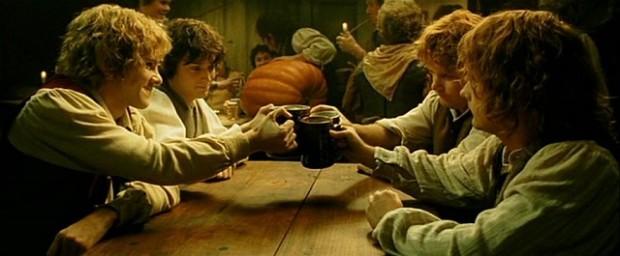
The theme of friendship in Tolkien's writings is perhaps best encapsulated in the four companions from the Shire: Frodo Baggins, Samwise Gamgee, Meriadoc Brandybuck, and Peregrin Took.


After the hobbits have finally arrived at Frodo's new home at Crickhollow, we read this in Chapter V - titled "A Conspiracy Unmasked" - of Book I:
'Well!' said Frodo at last, sitting up and straightening his back, as if he had made a decision. 'I can't keep it dark any longer. I have got something to tell you all. But I don't know quite how to being.'

'I think I could help you,' said Merry quietly, by telling you some of it myself.'

'What do you mean?' said, Frodo looking at him anxiously.

'Just this, my dear old Frodo: you are miserable, because you don't know how to say good-bye. You meant to leave the Shire, of course. But danger has come on you sooner than you expected, and now you are making up your mind to go at once. And you don't want to. We are very sorry for you.'
Thinking he kept everything about his departure quiet and the details of his quest hidden, Frodo is a bit taken aback at this and feels betrayed by his friends and says, "But it does not seem I can trust anyone."
Sam looked at him unhappily. 'It all depends on what you want,' put in Merry. 'You can trust us to stick to you through thick and thin - to the bitter end. And you can trust us to keep any secret of yours - closer than you keep it yourself. But you cannot trust us to let you face trouble alone, and go off without a word. We are your friends, Frodo. Anyway: there it is. We know most of what Gandalf has told you. We know a good deal about the Ring. We are horribly afraid - but we are coming with you; or following you like hounds.
'And after all, sir,' added Sam, 'you did ought to take the Elve's advice. Gildor said you should take them as was willing, and you can't deny it.'

'I don't deny it,' said Frodo, looking at Sam, who was now grinning. 'I don't deny it, but I'll never believe you are sleeping again, whether you snore or not. I shall kick you hard to make sure.

'You are a set of scoundrels!' he said, turning to the others. 'But bless you!' he laughed, getting up and waving his arms, 'I give in. I will take Gildor's advice. If the danger were not so dark, I should dance for joy. Even so, I cannot help feeling happy; happier than I have felt for a long time. I had dreaded this evening.'

'Good! That's settled. Three cheers for Captain Frodo and company!' they shouted; and they danced around him. Merry and Pippin began a song, which they had apparently got ready for the occasion.
Within the friendship of these four hobbits, are not reminded of that famous passage in the Book of Sirach regarding friendship? Sacred Tradition has preserved this wisdom for us:
A faithful friend is a sturdy shelter:
he that has found one has found a treasure.
There is nothing so precious as a faithful friend,
and no scales can measure his excellence.
A faithful friend is an elixir of life;
and those who fear the Lord will find him.
Whoever fears the Lord directs his friendship aright,
for as he is, so is his neighbor also (Sirach 6:14-17).
It might be said that Frodo, Sam, Merry, and Pippin took these words to heart: "Forsake not an old friend, for a new one does not compare with him" (Sirach 9:10).

Even at "the end of all things," the four hobbits clung to their friendship and remained steadfastly loyal to each other. In this, they provide a clear example for each of us to keep in our friendships.

The friendship of Jesus

The friendship shared among the four hobbits can be seen as something of a reflection of the friendship God shares with men (the analogy, of course, going so far as it goes). What do I mean?

On the night he gave himself up for us, the Lord Jesus said to those gathered with him in the upper room:
This is my commandment, that you love one another as I have loved you. Greater love has no love than this, that a man lay down his life for his friends. You are my friends if you do what I command you. No longer do I call you servants, for the servant does not know what his master is doing; but I have called you friends, for all that I have heard from my Father I have made known to you. You did not choose me, but I chose you and appointed you that you should go and bear fruit and that your fruit should abide; so that whatever you ask the Father in my name, he may give it to you. This I command you, to love one another (John 15:12-17).
"I have called you friends," he says and indeed he has.

When he spoke to the "many thousands of the multitude" who had gathered around him to encourage them in the persecutions that would befall him, Jesus addressed them as "my friends" (Luke 12:1, 4).

In calling us his friends, in bestowing upon us his divine friendship, the Lord Jesus shows the greatness of his condescension towards us by using a word of equality.

From what the Lord himself has said, his friendship must be reciprocated by us. It is not enough to simply call him a friend; rather the proof of our friendship is shown in our deeds; it is shown in the manner and depth of our love for the brethren. As Benedict XVI has said:
Not only does God love us with a depth and an intensity that we can scarcely begin to comprehend, but he invites us to respond to that love. You all know what it is like when you meet someone interesting and attractive, and you want to be that person’s friend. You always hope they will find you interesting and attractive, and want to be your friend. God wants your friendship. And once you enter into friendship with God, everything in your life begins to change. As you come to know him better, you find you want to reflect something of his infinite goodness in your own life. You are attracted to the practice of virtue. You begin to see greed and selfishness and all the other sins for what they really are, destructive and dangerous tendencies that cause deep suffering and do great damage, and you want to avoid falling into that trap yourselves. You begin to feel compassion for people in difficulties and you are eager to do something to help them. You want to come to the aid of the poor and the hungry, you want to comfort the sorrowful, you want to be kind and generous. And once these things begin to matter to you, you are well on the way to becoming saints. (Address to Pupils, 17 September 2010).
Jesus - who is our "Teacher and Lord" and, yes, our friend - has not forsaken us; we must not forsake him, either, for what greater friend, what greater treasure, can we have than he?

Within the friendship of the four hobbits we can well learn something of what it means to reciprocate friendship, about sticking close through thick and thin, even to the bitter end. More importantly, though, we can learn something from the saints, and especially from the Blessed Virgin Mary.

 The friendship of Mary

The Book of Sirach, as we saw, speaks of a faithful friend as a treasure. If this is so, then Mary, even before the greeting of the Archangel Gabriel, was a friend of God. Saint Bernard of Clairvaux puts it this way:
Do you wonder why Nazareth, a small town, should be made illustrious by the messenger of such a king, and such a messenger? A great treasure is hidden in this little town - hidden, I say, from humans, not from God. Is Mary not God's treasure? Wherever she is, his heart is there also. His eyes are on her; everywhere he looks upon the lowliness of his handmaiden (Sermon Three on the Annunciation of the Lord, 7).
Mary is the faithful friend of God - his treasure - because she was unwilling to forsake him even at the bitter end. Rather, as Benedict XVI wrote in his The Infancy Narratives, "It is Mary's obedience that opens the door to God;" it is Mary's obedience that makes her the friend of God, according to the words of her Son: "You are my friends if you do what I command you."

We see also in Mary the second reciprocal aspect of friendship with the Lord that must be expressed through the love of the brethren. "From Mary," wrote Benedict XVI, "we can learn what true com-passion is: quite unsentimentally assuming the sufferings of others as one's own."

Perhaps this is why Tolkien wrote that "all my own small perception of beauty both in majesty and simplicity is founded" upon Our Lady (Letter 142, To Robert Murray, S.J.). What is there that is more beautiful, majestic and simple than friendship, both among men and with God? 

Friendship is beautiful in that it is a treasure. Friendship is majestic in that God names us his equals. And friendship is simple in its unwavering loyalty.

Why Nazareth?


The Church of the Annunciation, Nazareth
The angel Gabriel was sent by God to a town of Galilee called Nazareth. Do you wonder why Nazareth, a small town, should be made illustrious by the messenger of such a king, and such a messenger? A great treasure is hidden in this little town - hidden, I say, from humans, not from God. Is Mary not God's treasure? Wherever she is, his heart is there also. His eyes are on her; everywhere he looks upon the lowliness of his handmaiden.

Is the Only-Begotten of God the Father familiar with heaven? If he is familiar with heaven he is familiar with Nazareth too. How should he not be familiar with his homeland? How should he not know his heritage? He claims heaven from his father, Nazareth from his mother, as he testifies that he is both son and Lord of David. The heaven of heavens belongs to the Lord, but the earth he has given to the children of men.

Let us allow him, then, the necessary possession of both, since he is not only Lord but also Son of Man. Hear then how as Son of Man he claims the earth but also is related to it as a bridegroom. The flowers have appeared on our earth. No one disputes that Nazareth means flower. The flower from the root of Jesse loves his flowery homeland, and the flower of the field and the lily of the valleys feed gladly among the lilies.

Beauty, sweetness, and the hope of fruit, a threefold gift, commend the flowers. God regards you, too, as a flower, and he is well pleased with you if you do not lack the beauty of an honorable way of life, the fragrance of a good reputation, and the intention of gaining a future reward. The fruit of the Spirit is eternal life.

- Saint Bernard of Clairvaux

25 October 2011

To emulate Gabriel

Currently I am in Indianapolis visiting our seminarians at Bishop Simon Brute College Seminary. While they are away at classes I have answered a good bit of e-mail and am working my way through the current issue of Speculum: A Journal of Medieval Studies.

In it, Susanna Fein has an interesting article titled, "Mary to Veronica: John Audelay's Sequence of Salutations to God-Bearing Women.". She says,
In late-medieval Christianity, Christ's human nature and the saints' proximity were beliefs deeply ingrained in the conceptual world of the faithful."

In our own day, we would do well to recover this conceptual world; it is, after all, reality.

In speaking to the saints, she says,
Such a poem is more than a prayer, however: because utterance of the first Ave allowed Jesus to be made flesh, salutation commemorates a core doctrine of medieval piety. When Gabriel enunciated, "Ave Maria gratis plena" (Hail Mary full of grace), God's Word entered Mary and grew in her womb. The form ( of addressing saints) is therefore modeled on hallowed utterance. Ave. A momentous word, marks the moment of Christ's incarnation and carries salvific import. In an exemplum preached by John Mirk, Mary is said to feel the thrill of her Son playing in her body whenever one utters the Ave phrase, "God is with thee.". Second only to the Paternoster ( Our Father) among all prayers, the Ave Maria is the premiere way to address Mary. To say "Ave" is to emulate Gabriel. Take up your rosary, then, in this month of October and emulate the Archangel.

26 March 2007

Homily - 26 March 2007

Dear brothers and sisters in Christ: may the Lord give you peace!

With exultant hearts do we gather today to celebrate this most magnificent of moments in salvation history. Today the Archangel Gabriel announces the Good News of victory:

You will conceive in your womb and bear a son, and you shall name him Jesus. He will be great and will be called Son of the Most High, and the Lord God will give him the throne of David his father, and he will rule over the house of Jacob forever, and of his Kingdom there will be no end (Luke 1:31-33).
Hearing these blessed words of so worthy a messenger should lift our hearts to heaven with great joy because in these words we know that “God is with us!” (Isaiah 8:10).

In his Angelus Address Yesterday, Pope Benedict XVI pointed out that

The annunciation, narrated at the beginning of the Gospel of St. Luke, is a humble human event, hidden – no one saw it, no one knew about it but Mary – but at the same time decisive for the history of humanity.”[1]
The profound humility of this event is made abundantly clear when we consider the one who brought this announcement to the Blessed Virgin of Nazareth.

The name Gabriel means “Strength of God” and in this way we come to realize that the strength of God is not overwhelming power and force, but is instead humble love. The One who will sit upon the throne of David does not announce his presence with blasts of trumpet or the pounding of the drum. The King of heaven and earth does not arrive with an army of angels to defend him. Rather, he comes quietly and peacefully to a quiet, out of the way village. He invites Mary to receive him and, when she agrees, he dwells within her.

Is this not the beauty of today’s celebration? Out of his supreme and infinite love, God has chosen to do the unimaginable and the unexpected: he has chosen to become man, born of a Virgin. The Second Person of the Blessed Trinity humbled himself and took on our flesh, saying to the Father, “Behold, I come to do your will” (Hebrews 10:7). In this way, Mary’s “yes” echoes that of Christ. “The Son’s obedience is reflected in the Mother’s and thus, by the meeting of these two ‘yeses,’ God was able to take on a human face.”
[2]

To the gracious invitation of the Lord given through Gabriel, Mary responded, “Behold, I am the handmaid of the Lord. May it be done to me according to your word” (Luke 1:38). Her fiat, her yes, though, does not end with her some two thousand years ago. “Mary’s reply to the angel is extended in the Church, which is called to make Christ present in history, offering its own availability so that God might continue to visit humanity with his mercy.”
[3]

This, then, brings us to the particular significance of this Solemnity for this parish on this, our patronal feast day. Today, through Mary’s cooperation with the Lord, the Word of God takes flesh within her womb. Thus, “Mary tells us why church buildings exist: they exist so that room may be made within us for the Word of God; so that within us and through us the Word may also be made flesh today.”
[4]

Every parish exists as the primary place to encounter Christ Jesus, in word and in sacrament. Since 1870 the faith has been strong in this area, nourished by the Scriptures and by the Sacramental life of the Church. Here in this parish Jesus invites us to open our hearts to him and to receive him, to make a dwelling within us for the Son of God.

This is the beauty of the love of God: he desires to dwell not only within Mary, but within each of us. He dwells within us when we open ourselves to the Word of God and receive him in the Holy Eucharist, hidden under the appearance of humble bread and wine. In this way we renew the “yes” of Jesus and of Mary. In this way we encounter “him whom they have pierced,” and we become one with him (John 19:37).

As we celebrate today the announcement of salvation to Mary ever Virgin, let us give thanks to Almighty God for the many blessings he has bestowed upon us through this parish. Let us give thanks for the gift of faith that has been handed down through so many generations. Let us give thanks to God for our ancestors who, like Mary, said yes to the Lord and followed after him, giving us an example to follow. As we give thanks, let us invite him into our lives and seek to live always and everywhere for him alone. Amen.

[1] Pope Benedict XVI, Angelus Address, 25 March 2007.
[2] Ibid.
[3] Ibid.
[4] Ibid., Homily, 10 December 2006.