The friendship of hobbits
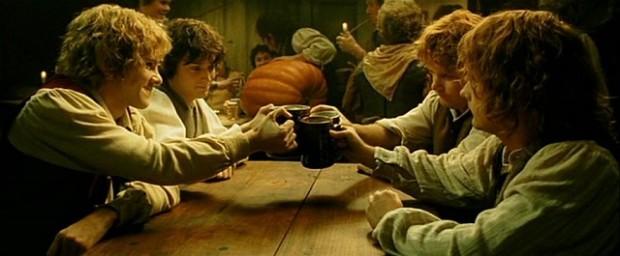
The theme of friendship in Tolkien's writings is perhaps best encapsulated in the four companions from the Shire: Frodo Baggins, Samwise Gamgee, Meriadoc Brandybuck, and Peregrin Took.
After the hobbits have finally arrived at Frodo's new home at Crickhollow, we read this in Chapter V - titled "A Conspiracy Unmasked" - of Book I:
'Well!' said Frodo at last, sitting up and straightening his back, as if he had made a decision. 'I can't keep it dark any longer. I have got something to tell you all. But I don't know quite how to being.'
'I think I could help you,' said Merry quietly, by telling you some of it myself.'
'What do you mean?' said, Frodo looking at him anxiously.
'Just this, my dear old Frodo: you are miserable, because you don't know how to say good-bye. You meant to leave the Shire, of course. But danger has come on you sooner than you expected, and now you are making up your mind to go at once. And you don't want to. We are very sorry for you.'
Thinking he kept everything about his departure quiet and the details of his quest hidden, Frodo is a bit taken aback at this and feels betrayed by his friends and says, "But it does not seem I can trust anyone."
Sam looked at him unhappily. 'It all depends on what you want,' put in Merry. 'You can trust us to stick to you through thick and thin - to the bitter end. And you can trust us to keep any secret of yours - closer than you keep it yourself. But you cannot trust us to let you face trouble alone, and go off without a word. We are your friends, Frodo. Anyway: there it is. We know most of what Gandalf has told you. We know a good deal about the Ring. We are horribly afraid - but we are coming with you; or following you like hounds.
'And after all, sir,' added Sam, 'you did ought to take the Elve's advice. Gildor said you should take them as was willing, and you can't deny it.'
'I don't deny it,' said Frodo, looking at Sam, who was now grinning. 'I don't deny it, but I'll never believe you are sleeping again, whether you snore or not. I shall kick you hard to make sure.
'You are a set of scoundrels!' he said, turning to the others. 'But bless you!' he laughed, getting up and waving his arms, 'I give in. I will take Gildor's advice. If the danger were not so dark, I should dance for joy. Even so, I cannot help feeling happy; happier than I have felt for a long time. I had dreaded this evening.'
'Good! That's settled. Three cheers for Captain Frodo and company!' they shouted; and they danced around him. Merry and Pippin began a song, which they had apparently got ready for the occasion.
Within the friendship of these four hobbits, are not reminded of that famous passage in the Book of Sirach regarding friendship? Sacred Tradition has preserved this wisdom for us:
A faithful friend is a sturdy shelter:
he that has found one has found a treasure.
There is nothing so precious as a faithful friend,
and no scales can measure his excellence.
A faithful friend is an elixir of life;
and those who fear the Lord will find him.
Whoever fears the Lord directs his friendship aright,
It might be said that Frodo, Sam, Merry, and Pippin took these words to heart: "Forsake not an old friend, for a new one does not compare with him" (Sirach 9:10).
Even at "the end of all things," the four hobbits clung to their friendship and remained steadfastly loyal to each other. In this, they provide a clear example for each of us to keep in our friendships.
The friendship of Jesus
The friendship shared among the four hobbits can be seen as something of a reflection of the friendship God shares with men (the analogy, of course, going so far as it goes). What do I mean?
On the night he gave himself up for us, the Lord Jesus said to those gathered with him in the upper room:
This is my commandment, that you love one another as I have loved you. Greater love has no love than this, that a man lay down his life for his friends. You are my friends if you do what I command you. No longer do I call you servants, for the servant does not know what his master is doing; but I have called you friends, for all that I have heard from my Father I have made known to you. You did not choose me, but I chose you and appointed you that you should go and bear fruit and that your fruit should abide; so that whatever you ask the Father in my name, he may give it to you. This I command you, to love one another (John 15:12-17).
"I have called you friends," he says and indeed he has.
When he spoke to the "many thousands of the multitude" who had gathered around him to encourage them in the persecutions that would befall him, Jesus addressed them as "my friends" (Luke 12:1, 4).
In calling us his friends, in bestowing upon us his divine friendship, the Lord Jesus shows the greatness of his condescension towards us by using a word of equality.
From what the Lord himself has said, his friendship must be reciprocated by us. It is not enough to simply call him a friend; rather the proof of our friendship is shown in our deeds; it is shown in the manner and depth of our love for the brethren. As Benedict XVI has said:
Not only does God love us with a depth and an intensity that we can
scarcely begin to comprehend, but he invites us to respond to that love.
You all know what it is like when you meet someone interesting and
attractive, and you want to be that person’s friend. You always hope
they will find you interesting and attractive, and want to be your
friend. God wants your friendship. And once you enter into friendship
with God, everything in your life begins to change. As you come to know
him better, you find you want to reflect something of his infinite
goodness in your own life. You are attracted to the practice of virtue.
You begin to see greed and selfishness and all the other sins for what
they really are, destructive and dangerous tendencies that cause deep
suffering and do great damage, and you want to avoid falling into that
trap yourselves. You begin to feel compassion for people in difficulties
and you are eager to do something to help them. You want to come to the
aid of the poor and the hungry, you want to comfort the sorrowful, you
want to be kind and generous. And once these things begin to matter to
you, you are well on the way to becoming saints. (Address to Pupils, 17 September 2010).
Jesus - who is our "Teacher and Lord" and, yes, our friend - has not forsaken us; we must not forsake him, either, for what greater friend, what greater treasure, can we have than he?
Within the friendship of the four hobbits we can well learn something of what it means to reciprocate friendship, about sticking close through thick and thin, even to the bitter end. More importantly, though, we can learn something from the saints, and especially from the Blessed Virgin Mary.
The friendship of Mary
The Book of Sirach, as we saw, speaks of a faithful friend as a treasure. If this is so, then Mary, even before the greeting of the Archangel Gabriel, was a friend of God. Saint Bernard of Clairvaux puts it this way:
Do you wonder why Nazareth, a small town, should be made illustrious by the messenger of such a king, and such a messenger? A great treasure is hidden in this little town - hidden, I say, from humans, not from God. Is Mary not God's treasure? Wherever she is, his heart is there also. His eyes are on her; everywhere he looks upon the lowliness of his handmaiden (Sermon Three on the Annunciation of the Lord, 7).
Mary is the faithful friend of God - his treasure - because she was unwilling to forsake him even at the bitter end. Rather, as Benedict XVI wrote in his The Infancy Narratives, "It is Mary's obedience that opens the door to God;" it is Mary's obedience that makes her the friend of God, according to the words of her Son: "You are my friends if you do what I command you."
We see also in Mary the second reciprocal aspect of friendship with the Lord that must be expressed through the love of the brethren. "From Mary," wrote Benedict XVI, "we can learn what true com-passion is: quite unsentimentally assuming the sufferings of others as one's own."
Perhaps this is why Tolkien wrote that "all my own small perception of beauty both in majesty and simplicity is founded" upon Our Lady (Letter 142, To Robert Murray, S.J.). What is there that is more beautiful, majestic and simple than friendship, both among men and with God?
Friendship is beautiful in that it is a treasure. Friendship is majestic in that God names us his equals. And friendship is simple in its unwavering loyalty.