Showing posts with label Immaculate Conception. Show all posts

07 December 2022

Homily - On the Immaculate Conception and the Year of the Eucharist

The Solemnity of the Immaculate Conception

Opening of the Diocesan Year of the Eucharist

Dear brothers and sisters,

As we celebrate this great solemnity of the Blessed Virgin Mary under her title of the Immaculate Conception, we, as a Diocesan Church, are entering into a Year of the Eucharist. This Year of the Eucharist is intended, in part, to commemorate the one hundredth anniversary of the translation of the seat of the Diocese from Alton to Springfield. But, more importantly, it is Bishop Paprocki’s desire that this Year of the Eucharist will strengthen the faithful for humble and courageous evangelical witness in our communities.

It is fitting that we begin this Year of the Eucharist today because, as Pope Saint John Paul II said, “If we wish to rediscover in all its richness the profound relationship between the Church and the Eucharist, we cannot neglect Mary, Mother and model of the Church.”[1] Indeed, “Mary can guide us towards this most holy sacrament, because she herself has a profound relationship with it.”[2]

It is true to say we do not see Mary’s relationship with the Eucharist explicitly stated in the Sacred Scriptures, but it can certainly be deduced from what we find in them. The Evangelists do not tell us Mary was present at the Last Supper but, as a devout Jew, why would she not have been present at the Passover celebrated by her Son? Even if she were not, we know she was present at the early celebrations of the Mass. For example, we know that, after the Ascension of her Son into heaven, the Apostles gathered together for prayer, “together with the women and Mary the mother of Jesus” and that when the early Church gathered, “they held steadfastly to the apostles’ teaching and fellowship, to the breaking of bread and to the prayers” (Acts 1:14; 2:42).

There is, however, a more profound way we can discern the Eucharistic devotion of the Immaculate Conception. The Lord Jesus issued a great command at the Last Supper, one which the Church has never failed to keep: “Do this in memory of me” (Luke 22:19). This word, “do,” is an important one and has a particular meaning we may easily overlook. “In most languages, the word, ‘do, make’ has a wide range of meanings; one of its frequent uses in the Old Testament means to offer sacrifice, as appears in many texts.”[3] As an attentive reader of the Scriptures, Mary would have known this.

When we hear Jesus’ command to “do this in memory of me,” how can we not also hear Mary’s command to “do whatever he tells you” (John 2:5)?

With the same maternal concern which she showed at the wedding feast of Cana, Mary seems to say to us: “Do not waver; trust in the words of my Son. If he was able to change water into wine, he can also turn bread and wine into his body and blood, and through this mystery bestow on believers the living memorial of his Passover, thus becoming the ‘bread of life.’”[4]

Mary’s command always leads us to the command of her Son.

Perhaps even more profoundly, it is not unreasonable to say that “Mary lived her Eucharistic faith even before the institution of the Eucharist, by the very fact that she offered her virginal womb for the Incarnation of God’s Word.”[5] Indeed, Mary was preserved from every stain of original sin from the moment of her conception because God knew she would consent to conceive the Son of God in her womb. As Mary’s obedient faith allowed her to share in the Redemption of her Son even before his death of the Cross, so, too, did she live a Eucharistic faith before the Last Supper.

The great mystery of Christmas, which we will celebrate in a few weeks, is, of course, intimately connected with the mystery of the Annunciation. As we heard in the Gospel today, that was when the Archangel Gabriel told Mary she would conceive the “Son of the Most High” “in the physical reality of his body and blood, thus anticipating within herself what to some degree happens sacramentally in every believer who receives, under the signs of bread and wine, the Lord’s body and blood” (Luke 1:32).[6] Whenever we gather to worship the Eucharistic Lord, “we are asked to believe that the same Jesus Christ, Son of God and Son of Mary, becomes present in his full humanity and divinity under the signs of bread and wine.”[7]

Mary is, for each of us, not only “an advocate of grace,” but also “a model of holiness,” in fact, the greatest model of holiness after her Son.[8] In this Year of the Eucharist, may the Immaculate Conception, patroness of this Diocese, pray for us and teach us anew that the Lord Jesus gave us the Eucharist so that, like Mary’s, our lives might become nothing less than a continual hymn of praise to God in, with, and through, her Son.[9] Amen.


[1] Pope Saint John Paul II, Ecclesia de Eucharistia, 53.

[2] Ibid.

[3] Mitch Pacwa, S.J., The Eucharist: A Bible Study Guide for Catholics (Huntington, Indiana: Our Sunday Visitor, Inc., 2013), 38.

[4] Pope Saint John Paul II, Ecclesia de Eucharistia, 54.

[5] Ibid., 55.

[6] Ibid.

[7] Ibid.

[8] Roman Missal, Preface for the Solemnity of the Immaculate Conception.

[9] Cf. Pope Saint John Paul II, Ecclesia de Eucharistia, 58.

08 December 2021

Homily - The Solemnity of the Immaculate Conception - 8 December 2021

The Solemnity of the Immaculate Conception

Dear brothers and sisters,

Whenever Mother Church requires our attendance at the Holy Mass on a holy day of obligation, someone inevitably asks why. Why does the Church oblige to attend Mass on certain days that are not Sundays on pain of mortal sin?

Without intending to be too simplistic in answering such a question, the Church obliges us, using the authority of the keys entrusted to Saint Peter and his successors, because it is good for us and for our salvation. It is good for us because it is helpful to stop and reflect on certain key aspects of salvation history and their relation to us here and now. To this answer, I can well imagine an objection being raised: What does the Immaculate Conception have to do with us?

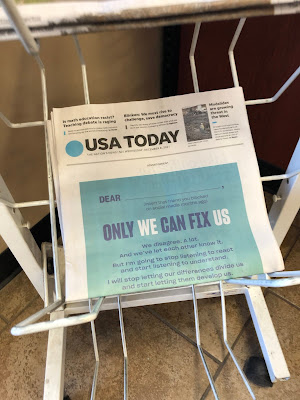
Consider this headline I read this morning on the front page of a national newspaper: “ONLY WE CAN FIX US.” The headline, of course, is blatantly false, even given one of the leads into the article: “I will stop letting our differences divide us and start letting them develop us.” While the attempt of the article to encourage mutual dialogue between opposing views is an admirable and necessary goal, the premise that “only we can fix us” could not be more wrong.


This notion lies at the heart of the entire Enlightenment project’s attempt to abandon and jettison and banish religion from public life. This notion still lies at the heart of the progressive movement today. The thinking is that if we just set up these policies and forbid those practices or ways of thinking the world will be just dandy and we will get along as bosom buddies. Anyone who pays attention to the world and to human nature, fallen as it is, knows that this is not true. These ideas fall flat because they refuse to take into account the reality of sin and its consequences in each of our hearts.

We hear the result of sin very clearly in the account of the Fall of Adam and Eve and how quickly they are to refuse to accept accountability for their actions: Adam blames Eve and Eve blames the serpent and the serpent earlier blamed God. It was a great game of passing the buck, which really hasn’t diminished after these many generations. But already then at the beginning of human history there is the great promise to undo this blame game: “I will put enmity between you and the woman, and between your offspring and hers; he will strike at your head, while you strike at his heel” (Genesis 3:15).

The woman, ultimately, is the Blessed Virgin Mary and the prophesied offspring is Christ Jesus through whom we are called to be “holy and without blemish” before God the Father (Ephesians 1:4). It is because of her offspring that Mary received the singular grace of being conceived immaculate, of being conceived without the stain of original sin. Because Mary would consent to the will of the Father conceive the Second Person of the Trinity within her womb through her marvelous response to the Archangel Gabriel, “May it be done to me,” she was conceived immaculately (Luke 1:38).

Mary knew she was to conceive the Messiah and so she knew what the angel said to Joseph, namely that the Child conceived by her would “save his people from their sins” (Matthew 1:21). Mary knew she could not save herself; she knew she could not fix herself. Only God Almighty could preserve her from every stain of sin.

This is why, Pope Francis said, Mary was “greatly troubled” at the Archangel’s greeting to her. The Holy Father asked,

How is Mary’s heart? Having received the highest of compliments, she is troubled she [sic] because she hears addressed to her what she has not attributed to herself. In fact, Mary does not credit prerogatives to herself, she does not hold claim to anything, she accounts nothing to her own merit. She is not self-satisfied, she does not exalt herself. For in her humility, she knows she receives everything from God. Therefore, free from herself, she is completely directed toward God and others. Mary Immaculate does not look to herself. This is true humility; not looking to oneself, but looking toward God and others.[1]

Mother Church obliges us to attend the Holy Mass today to remind us that you and I cannot fix ourselves, no matter what the headlines say.

Mary did not sin, though she certainly knew its effects; even so, Mary was in need of a Savior, and it was because of him that she received that prevenient grace, that grace coming before the Death and Resurrection of her Son, that she was conceived without the stain of the original sin. Mary received the fruit of her Son’s sacrifice before anyone else and was truly holy and without blemish before him.

You and I, however, do sin, in ways both large and small; this cannot be denied. Though we have been cleansed of the original sin in the waters of Baptism, its effects still remain with us; we still have a tendency toward sin. But if we know follow the example of Mary, if we entrust ourselves completely to the will of God, we, with her, can be made holy and without blemish before God. But we cannot do this on our own; only God can do it in us.

Let us, then, not be afraid to break with society and freely acknowledge that we cannot fix ourselves; let us instead entrust ourselves entirely to the merciful love of God, who in Christ Jesus, who “chose us in him, before the foundation of the world, to be holy and without blemish before him” (Ephesians 1:4). “And when we are assailed by the doubt that we cannot succeed, the sadness of not being adequate, let us allow the Madonna to look on us with her ‘eyes of mercy’, for no one who asked for her help has ever been abandoned!”[2] Amen.


[1] Pope Francis, Angelus Address, 8 December 2021.

[2] Ibid.

13 December 2018

Homily - 8 December 2018 - The Solemnity of the Immaculate Conception

The Solemnity of the Immaculate Conception

Dear brothers and sisters,

What is it that so distinguishes the Blessed Virgin Mary from us? The obvious answer is that none of us has physically given birth to the Son of God, but there is something greater yet that distinguishes her from us. The fundamental difference between the Mother of God and us is found in obedience. We, like our first parents, very often disobey the Lord God and look upon him as a rival; we do not like our creaturely status and are thus prone to harbor an antagonism against the Creator and to strive against his will (cf. Genesis 3:6). Mary, on the other hand, delights in her status as a creature and recognizes the love of the Creator for her – and for all of us – and simply says to him, “May it be done” (Luke 1:38).

Reflecting on the reality of our lives, the celebrated author and Christian apologist C.S. Lewis once said that obedience

appears to me more and more the whole business of life, the only road to love and peace – the cross and the crown in one … What indeed can we imagine Heaven to be but unimpeded obedience. I think this is one of the causes of our love of inanimate nature, that in it we see things which unswervingly carry out the will of their Creator, and are therefore wholly beautiful: and though their kind of obedience is infinitely lower than ours, yet the degree is so much more perfect that a Christian can see the reason that the Romantics had in feeling a certain holiness in the wood and water.[1]

The Romantics, of course, such as Henry David Thoreau and Walt Whitman, took this too far, but that is a conversation perhaps for another day. The forest is beautiful because the trees and streams do what they were created to do, and in so doing they glorify God. The sunset is beautiful because the sun and the clouds and the sky do what they were created to do. The natural world is beautiful because it is obedient.

The great J.R.R. Tolkien once said it is upon the Blessed Virgin Mary that “all my own small perception of beauty both in majesty and simplicity is founded.”[2] The great beauty of Mary which has captivated so many artists and poets through the centuries is found in her beauty; she is eminently beautiful because she willingly and lovingly obeyed the will of God in all things. This is why Saint Irenaeus of Lyons said, “The knot of Eve’s disobedience was loosed by the obedience of Mary.”[3]

We know that through the disobedience of Adam and Eve, our first parents, sin and death entered into Creation and the original righteousness with which the Creator created was lost. Saint Paul tells us that “as by one man’s disobedience many were many sinners, so by one man’s obedience many will be made righteous” (Romans 5:19).

If Jesus is the new Adam, then salvation is not just about saving sinners from the fires of hell. It is about undoing the effects of the Fall of Adam and Eve… What does any of this have to do with Mary? The answer is simple: If Jesus is the new Adam, then who is the new Eve? According to the book of Genesis, Adam is not the only human being created by God and placed in the Garden of Eden. Moreover, Adam does not bring sin and death into the world alone. As Adam’s partner, Eve plays an essential role in bringing about the fall of humankind.[4]

So, too, does Mary play an essential role in bringing about the redemption of humankind, and of all of Creation. This is why Saint Augustine says that “through woman, poison was poured upon man, in order to deceive him, but salvation was poured out upon man from a woman, that he might be reborn in grace.”[5] So great is the honor of the new Eve, of the Blessed Virgin Mary, that she “Mary benefited first of all and uniquely from Christ’s victory over sin: she was persevered from all stain of original sin and by a special grace committed no sin of any kind during her whole earthly life.”[6]

Here it is good to ask what we mean by the original sin, what it is that we are subject to, but Mary is not. If we are honest, we know that

…a contradiction exists in our being. On the one hand every person knows that he must do good and intimately wants to do it. Yet at the same time he also feels the other impulse to do the contrary, to follow the path of selfishness and violence, to do only what pleases him, while also knowing that in this way he is acting against the good, against God and against his neighbor. In his Letter to the Romans St Paul expressed this contradiction in our being in this way: "I can will what is right, but I cannot do it. For I do not do the good I want, but I do the evil I do not want" (7:18-19). This inner contradiction of our being is not a theory. Each one of us experiences it every day. And above all we always see around us the prevalence of this second will. It is enough to think of the daily news of injustice, violence, falsehood and lust. We see it every day. It is a fact.[7]

By the singular grace of her Immaculate Conception, Mary was free from all stain of this original sin, but we, of course, are not.

We celebrate this great Solemnity of the Immaculate Conception in the midst of Advent as we are preparing for the Second Coming of Christ Jesus for two reasons. The first is rather obvious: nine months from today, on September 8th, we will celebrate the Nativity of the Blessed Virgin Mary. The second reason is a bit more profound: Mary provides for us a shining example of obedience to the will of God.

Tomorrow, we will hear Saint John the Baptist cry out, “Prepare the way of the Lord” (Luke 3:4; cf. Isaiah 40:3)! Mary teaches us to prepare the way of the Lord; we do so by complete and loving obedience to his command, by loving God and neighbor above all else, even more than myself. Let us, then, ask her to intercede for us and to shine a light upon the darkness of our hearts, so that, by confessing our sinful disobedience of God, “we may be delivered from all our faults.”[8] Then, with the Immaculate Conception, we will be able to “sing joyfully to the Lord” when at last he comes (Psalm 98:3). Amen.


[1] C.S. Lewis, Letter to Alan Griffiths. In Philip Zaleski and Carol Zaleski, The Fellowship: The Literary Lives of the Inklings: J.R.R. Tolkien, C.S. Lewis, Owen Barfield, Charles Williams (New York: Farrar, Straus, and Giroux, 2016), 250.
[2] J.R.R. Tolkien, Letter to Robert Murray, S.J., 2 December 1953. In Humphrey Carpenter, ed., The Letters of J.R.R. Tolkien (Boston: Houghton Mifflin Company, 2000), 172.
[3] Saint Irenaeus of Lyons, Against Heresies, 3.22.4. In Brant Pitre, Jesus and the Jewish Roots of Mary: Unveiling the Mother of the Messiah (New York: Image, 2018), 34.
[4] Brant Pitre, Jesus and the Jewish Roots of Mary: Unveiling the Mother of the Messiah (New York: Image, 2018), 15-16.
[5] Saint Augustine of Hippo, Sermon 51.3. In Brant Pitre, Jesus and the Jewish Roots of Mary, 35.
[6] Catechism of the Catholic Church, 411.
[7] Pope Benedict XVI, General Audience Address, 3 December 2008.
[8] Roman Missal, Prayer over the Offerings for the Solemnity of the Immaculate Conception.

08 December 2016

Homily - 8 December 2016 - The Solemnity of the Immaculate Conception

The Solemnity of the Immaculate Conception

Dear brothers and sisters,

Every good parent or teacher makes use – from time to time – of an uncomfortable question to point out the wrongdoing of a child or pupil. Is this not what the Lord God did today when he “called out to the man and asked him, ‘Where are you’” (Genesis 3:9)? It cannot be held that God did not know Adam’s physical location; to make such a claim of the omniscient Creator would be absurd. It is, rather, as Saint Ambrose says: the Lord poses “not a question, but a reproof.”[1] It is as if God asks of Adam, “From what condition of goodness, beatitude and grace … have you fallen into this state of misery? You have forsaken eternal life. You have entombed yourself in the ways of sin and death.”

The Church’s tradition calls this forsaking of eternal life the original sin by which

man preferred himself to God and by that very act scorned him. He chose himself over and against God, against the requirements of his creaturely status and therefore against his own good. Constituted in a state of original holiness, man was destined to be fully “divinized” by God in glory. Seduced by the devil, he wanted to “be like God,” but “without God, before God, and not in accordance with God.”[2]

It is this same forsaking of eternal life, this same original sin, that each one of us has inherited from Adam and Eve, our first parents. This is why Saint Paul says that “sin came into the world through one man and death through sin, and so death spread to all men because all men have sinned” (Romans 5:12).

If we spend even a small amount of time considering our own sinfulness, we know the effects of this original sin all too well. “It is a deprivation of original holiness and justice, but human nature has not been totally corrupted: it is wounded in the natural powers proper to it; subject to ignorance, suffering, and the dominion of death; and inclined to sin.”[3] It is this inclination toward sin from which each of us suffers and why Saint Augustine famously called us walking fomes peccati, walking tinderboxes of sin.[4]

This seems to us a strange message to hear as we find ourselves in the midst of our preparations for Christmas. We expect to hear a more hopeful and joyful message, forgetting that “oft hope is born, when all is forlorn.”[5] The truth of our fallen and sinful condition lies at the heart of the Archangel Gabriel’s announcement to the Blessed Virgin Mary: “Behold, you will conceive in your womb and bear a son, and you shall name him Jesus” (Luke 1:31). When Gabriel spoke to Saint Joseph, he told the husband of Mary to name her child Jesus “for he will save his people from their sins” (Matthew 1:21).

The Archangel’s announcements to both Saint Joseph and to Holy Mary come as the great and long-awaited prophecy which the Lord God said that vile and wicked serpent: “I will put enmity between you and the woman, and between your offspring and hers” (Genesis 3:15). Christ Jesus, the offspring of Mary, the second Eve and whose Birth we celebrate at Christmas, struck at the serpent and defeated him with the weapon of the Cross. This is why Saint Paul says “as one man’s trespass led to the condemnation for all men, so one man’s act of righteousness leads to acquittal and life for all men” (Romans 5:18). The message of our sinful condition, then, and of our salvation from it in Christ, lies at the heart of the Advent message; to ignore this salvation from sin and death, is to rob Christmas of its beauty, of its wonder, and of its joy.

Today we celebrate a foundational aspect in the life of one of those whom Jesus saved from sin as we give thanks to God for the Immaculate Conception of the Blessed Virgin Mary. It was not until 1854 that Mother Church finally defined what had long been held and believed by the faithful when Pope Pius IX solemnly declared, “the Blessed Virgin Mary, in the first instant of her conception, was, by a unique grace and privilege of Almighty God in view of the merits of Jesus Christ, the Savior of the human race, preserved exempt from all stain of original sin.”[6] Because of her role as the Mother of God and in order to prepare a worthy ark for the Word made Flesh, “Mary benefited first of all and uniquely from Christ’s victory over sin: she was persevered from all stain of original sin and by a special grace committed no sin of any kind during her whole earthly life.”[7] It is this preservation from original sin and from its effects that the Church calls Mary’s “previent grace,” the grace given to Mary before her acceptance of the divine plan because she accepted the divine plan.[8] Mary, then, “is not merely the greatest of the saints but something altogether different and unique.”[9]

You and I, of course, have not been so graced. The Lord still calls out to us, asking, “Are you trapped in the imagined godlikeness that the serpent falsely promised you?”[10] His simple question, “Where are you?” is really an invitation for us “to make admission of [our] faults” and be reconciled to God so we might lift our eyes towards him and gaze upon the beauty of his face.[11]

Like Adam and Eve, we are often hesitant to admit our sin to the Lord; we hide from him and so deprive ourselves of his presence. But the Lord, in his infinite mercy, does not abandon us; rather, he sent his Son, born of the Virgin Mary, to call out to us, “From what condition of goodness, beatitude and grace … have you fallen into this state of misery? You have forsaken eternal life. You have entombed yourself in the ways of sin and death. Let me lead you forth into the kingdom of light” (cf. Colossians 1:13).

Mary shows us how to listen to the call of the Lord, how to give a generous response to him, and how to entrust ourselves entirely to the Lord’s loving mercy so that we might no longer live in a miserable condition. In these days of Advent, she calls us to place ourselves “within the orbit of her holy life.”[12] She desires to enfold us within the mantle of her love and to look upon us as our Mother (cf. John 19:27). It is within the orbit of Mary’s holy life that the disciple of Jesus wishes to enter; “here he wants to dwell, to breathe, to become quiet, and to receive comfort and strength to continue his life with renewed courage.”[13] Let each of us strive to wait with Mary so that we might welcome her Child when he comes and say with her, “May it be done to me according to your word” and live a life “holy and without blemish before him” (Luke 1:38; Ephesians 1:4). Amen.


[1] Saint Ambrose of Milan, De Paradiso, 14.70. In Ancient Christian Commentary on Scripture, Old Testament Vol. I: Genesis 1-11. Andrew Louth, ed. (Downers Grove, Illinois: Inter Varsity Press, 2001), 84.
[2] Catechism of the Catholic Church, 398. Emphasis original.
[3] Catechism of the Catholic Church, 405.
[4] Saint Augustine of Hippo, De Continentia, 3.
[5] J.R.R. Tolkien, The Return of the King: Being the Third Part of The Lord of the Rings, 5.9, (Boston: Houghton Mifflin Company, 1994), 859.
[6] Pope Pius IX, Ineffabilis Deus.
[7] Catechism of the Catholic Church, 411.
[8] Roman Missal, Prayer Over the Offerings of the Mass for Solemnity of the Immaculate Conception of the Blessed Virgin Mary.
[9] Romano Guardini, The Art of Praying: The Principles and Methods of Christian Prayer. Leopold of Loewenstein-Wertheim, trans. (Manchester, New Hampshire: Sophia Institute Press), 155.
[10] Saint Ephrem the Syrian, Commentary on Genesis, 2.26.1. In Ancient Christian Commentary on Scripture, Old Testament Vol. I, 84.
[11] Saint John Chrysostom, Homilies on Genesis, 17.22. In ibid., 85.
[12] Romano Guardini, The Art of Praying, 159.
[13] Ibid.