Showing posts sorted by relevance for query ponderables from the poverello. Sort by date Show all posts

14 March 2013

Habemus Papam! Five Thoughts

By now you've certainly heard that we have a Pope, Francis.  Many of you have been asking my thoughts about the new Bishop of Rome.  Yesterday being a busy day I didn't really have anything to offer, but now I might.

First, it really doesn't matter what I think one way or the other.  Whether I approve of his election or not does not change the fact that he is the Supreme Pontiff and that we owe to him a filial devotion and obedience and we should remember him in our prayers each day.  We should all remember this.

Second, I don't really know anything Pope Francis' background except what I've been able to read since yesterday afternoon.  John Allen's piece on him seems to be the best I've read so far.


The media - as might be expected - has been making a big deal about his extraordinary care for the poor by trying to juxtapose it against his defence of the teachings of Jesus Christ, as if social justice could should be separated from right belief.  In reality, Pope Francis is simply a man who strives to follow faithfully after Jesus Christ by both holding to the truth and serving the least brethren of the Lord.  There is in this a great lesson for us all.

Third, many are, I think, over exaggerating the displays of his personal humility by stressing such things as his "shunning" - not my word - of some of the papal regalia (at least for the time being).  In time he may began to use more of the symbols of his office, or he may not; we do not know.  All of this can be a sign of his own humility but this does not mean - as many seem to be suggesting - the wearing of the full pontificals indicates a lack of humility.  Anyone who has met His Holiness Benedict XVI - who made frequent use of the full papal vesture - knows him to be a man of genuine humility.  I do hope Pope Francis will follow the example of Pope Benedict XVI, but he must be his own man.

In this regard, I often think of the words of Pope Saint Pius X who hated the regalia of his used but made use of it nevertheless.  To one friend he wrote: "Look how they have dressed me up."  To another, he wrote, "It is certainly a penance to be forced to accept all these practices.  They lead me about surrounded by soldiers like Jesus when he was seized in Gethsemane."  To dislike the trappings so much and still to wear them, that shows no less humility than not wearing the trappings; to my mind, it demonstrates a greater humility.  There are times when each of us has to do things we would rather not do simply because they fitting.

To be sure, I do not write the above as a judgment of Pope Francis, nor do I condmen him; please don't take it as such.  He must do what he feels is best.  On this matter there can be a cordial disagreement that need not lessen unity.

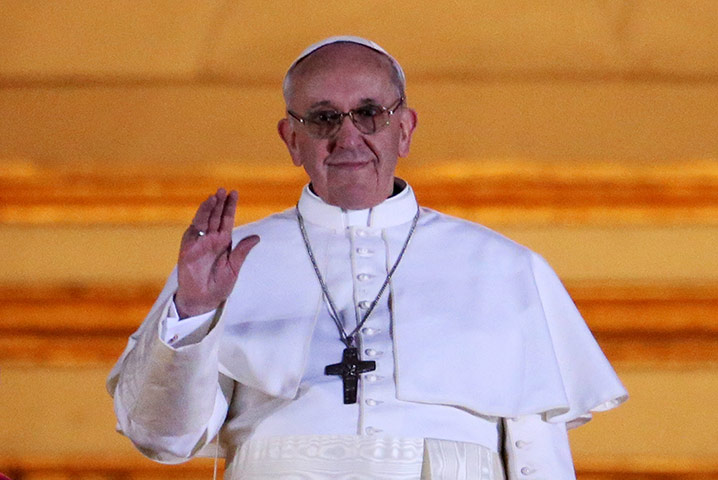
Fourth, what immediately struck me as he walked out on the loggia to greet the world was the look on his face.  He seemed to desire to be anywhere else in the world.  He look stunned and terrified, really.

He did not wave.  He did not smile.  He simply stood there.

When he was appointed Auxiliary Bishop of Beunos Aires, he took as his episcopal motto miserando atque eligendo ("lowly and yet chosen").  As he stood motionless on the balcony looking out upon the faithful the sincerity of these words was most evident.  He knows himself to be unworthy of so lofty an office and for this reason I think he will be a fine Universal Pastor.

But when the time came for him to smile and to speak to the people, both his smile and his words were genuine and from the heart.
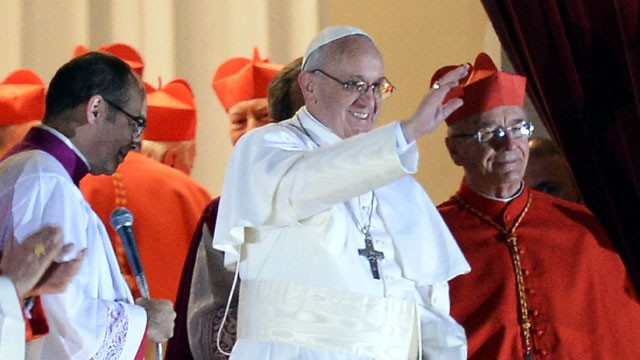

He is, it seems, a quiet man who would rather fade away into the background; his new office will not really allow him to do that.  I am glad he said accepto and hope the Lord will give him many consolations in the days and years to come.

Fifth, his name.  For years now people have asked me what name I would choose when I am elected Pope.  Confident that this will never happen, I have always said I would choose to be called Pope Francis (meaning the First).  Now I suppose I will not be able to do that.

Longtime readers of this blog will now of my deep love for and devotion to Saint Francis of Assisi and the Pope's choosing of this name is fitting occassion for me to resume what was once a daily feature on this blog: Ponderables from the Poverello, daily quotes from Saint Francis.

I hope that Pope Francis will lead people to learn more about the Poverello and to discover the animal-loving gentle hippy image is far from the reality (Emily Stimpson has a good post on this).

From yesterday forward, we will no longer be able to speak of "our Holy Father Francis" with reference simply to the thirteenth Saint who renounced his father's wealth to embrace Lady Poverty and the Cross; now, we will have to be specific: Do we mean the man from Assisi or the man who is the Successor of Saint Peter?  Things could be tricky for a while in Franciscan circles.

To His Holiness Pope Francis, I pledge my willing obedience and filial devotion, and I promise a remembrance in my prayers.

28 January 2010

Benedict on Francis

Pope Benedict XVI frequently mentions the saints in his writings and speeches, with Saint Francis of Assisi perhaps receiving more mention than the rest of the saints, with the exception of the Mother of God. Imagine my delight then when I read His Holiness' audience address which he delivered yesterday on "the figure of Francis, a 'giant' of holiness, who continues to fascinate very many people of every age and every religion."

His address is simply too good not to post in it's entirety (with my emphases and comments):

"A son is born to the world." With these words, in the Divine Comedy (Paradiso, Canto XI), the greatest Italian poet, Dante Alighieri, alludes to Francis' birth, which occurred at the end of 1181 or the beginning of 1182, in Assisi. Belonging to a wealthy family -- his father was a textile merchant -- Francis enjoyed a carefree adolescence and youth, cultivating the chivalrous ideals of the time. When he was 20 he took part in a military campaign, and was taken prisoner. He became ill and was released. After his return to Assisi, a slow process of spiritual conversion began in him, which led him to abandon gradually the worldly lifestyle he had practiced until then.

Striking at this time are the famous episodes of the meeting with the leper -- to whom Francis, getting off his horse, gave the kiss of peace; and the message of the Crucifix in the little church of San Damiano. Three times the crucified Christ came to life and said to him: "Go, Francis, and repair my Church in ruins." This simple event of the Word of the Lord heard in the church of San Damiano hides a profound symbolism. Immediately, St. Francis is called to repair this little church, but the ruinous state of this building is a symbol of the tragic and disturbing situation of the Church itself at that time, with a superficial faith that does not form and transform life, with a clergy lacking in zeal, with the cooling off of love; an interior destruction of the Church that also implied a decomposition of unity, with the birth of heretical movements. [Sadly, much of this ruinous condition of the Church is present in our own day. Too few people truly allow the faith to form their lives; rather, their faith is simply an after thought and is never allowed to shape and inform every aspect of their lives. Too many clergy are still lacking in zeal. There is still a cooling off of love. And there is certainly a decomposition of unity among Christians. Would that the Lord give us another Saint Francis for our own day! Would that we look to the Poverello and learn from him!]

However, at the center of this Church in ruins is the Crucified and he speaks [as he is and does even today]: he calls to renewal, he calls Francis to manual labor to repair concretely the little church of San Damiano, symbol of the more profound call to renew the Church of Christ itself, with his radical faith and his enthusiastic love for Christ.

This event, which probably occurred in 1205, makes one think of another similar event that happened in 1207: the dream of Pope Innocent III. He saw in a dream that the Basilica of St. John Lateran, the Mother Church of all churches, was collapsing and a small and insignificant religious supported the church with his shoulders so that it would not collapse. It is interesting to note, on one hand, that it is not the Pope who helps so that the church will not collapse, but a small and insignificant religious, whom the Pope recognizes in Francis who visited him. Innocent III was a powerful Pope, of great theological learning, as well as of great political power, yet it was not for him to renew the Church, but for the small and insignificant religious: It is St. Francis, called by God.

On the other hand, however, it is important to note that St. Francis does not renew the Church without or against the Pope, but only in communion with him [this central aspect of the life of Saint Francis is too little understood today]. The two realities go together: the Successor of Peter, the bishops, the Church founded on the succession of the Apostles and the new charism that the Holy Spirit created at this moment to renew the Church. True renewal grows together.

Let us return to St. Francis' life. Because his father Bernardone reproved him for excessive generosity to the poor, Francis, with a symbolic gesture, and before the bishop of Assisi, stripped himself of his clothes, thus intending to renounce his paternal inheritance: As at the moment of creation, Francis had nothing, but only the life that God gave him, and into whose hands he entrusted himself. Then he lived as a hermit until, in 1208, another fundamental event took place in the journey of his conversion. Hearing a passage of the Gospel of Matthew -- Jesus' discourse to the Apostles sent on mission -- Francis feels he is called to live in poverty and to dedicate himself to preaching. Other companions associated themselves to him and, in 1209, he went to Rome, to submit to the Pope the project of a new form of Christian life [Here we see him living out his desire to always be in communion with the Pope and through him the entire Church]. He was given a paternal reception by the great Pontiff who, enlightened by the Lord, intuited the divine origin of the movement awakened by Francis. The Poverello of Assisi had understood that every charism given by the Holy Spirit is placed at the service of the Body of Christ, which is the Church; hence, he always acted in full communion with the ecclesiastical authority. In the life of saints there is no opposition between a prophetic charism and the charism of government and, if some tension is created, they must wait patiently for the times of the Holy Spirit.

In reality, some historians in the 19th century and also in the last century tried to create behind the Francis of tradition, a so-called historical Francis, just as there is a desire to create behind the Jesus of the Gospels, a so-called historical Jesus. Such a historical Francis would not have been a man of the Church, but a man linked immediately only to Christ, a man who wished to create a renewal of the people of God, without canonical forms and without the hierarchy. The truth is that St. Francis really had a very immediate relationship with Jesus and with the Word of God, which he wished to follow sine glossa, exactly as it is, in all its radicalism and truth. It is also true that initially he did not have the intention of creating an order with the necessary canonical forms, but, simply, with the Word of God and the presence of the Lord, he wished to renew the people of God, to call them again to listening to the Word and to literal obedience to Christ. Moreover, he knew that Christ never is "mine" but always is "ours," that "I" cannot have Christ and "I" cannot reconstruct against the Church, his will and his teaching -- but only in communion with the Church, built on the succession of the Apostles, is obedience to the Word of God also renewed [Now you have your answer to the question, "Is Jesus your personal Lord and Savior?" You can answer either honestly, saying, "No; he is the Lord and Savior" or sarcastically, saying, "Yes, he's mine, all mine, and you can't have him!" though I daresay the latter won't be of much help].

It is also true that he did not intend to create a new order, but only to renew the people of God for the Lord who comes. But he understood with suffering and pain that everything must have its order, that even the law of the Church is necessary to give shape to renewal and thus he really inserted himself totally, with the heart, in the communion of the Church, with the Pope and the bishops. He knew always that the center of the Church is the Eucharist, where the Body and Blood of Christ are made present. Through the priesthood, the Eucharist is the Church. Where priesthood, and Christ and communion of the Church go together, only there does the Word of God also dwell. The true historical Francis and the Francis of the Church speaks precisely in this way also to non-believers, to believers of other confessions and religions.

Francis and his friars, ever more numerous, established themselves in the Porziuncola, or church of Saint Mary of the Angels, sacred place par excellence of Franciscan spirituality. Also Clare, a young lady of Assisi of a noble family, placed herself in Francis' school. Thus the Second Franciscan Order originated, that of the Poor Clares, another experience destined to bear outstanding fruits of sanctity in the Church.

The successor of Innocent III, Pope Honorius III, with his bull "Cum dilecti" of 1218, also upheld the singular development of the first Friars Minor, who were opening their missions in several countries of Europe, and even in Morocco. In 1219 Francis obtained permission to go to speak with the Muslim Sultan Melek-el-Kamel in Egypt, and also to preach the Gospel of Jesus there. I want to underline this episode of the life of St. Francis, which is very timely. At a time in which there was under way a clash between Christianity and Islam, Francis, armed deliberately only with his faith and his personal meekness, pursued with efficacy the way of dialogue. The chronicles tell us of a benevolent and cordial reception by the Muslim Sultan. It is a model that also today should inspire relations between Christians and Muslims: to promote a dialogue in truth, in reciprocal respect and in mutual understanding (cf. "Nostra Aetate," 3).

It seems, then, that in 1220 Francis visited the Holy Land, thus sowing a seed that was to bear much fruit: his spiritual sons, in fact, made of the places in which Jesus lived a privileged realm of their mission. With gratitude I think today of the great merits of the Franciscan Custody of the Holy Land.

Returning to Italy, Francis entrusted the government of the order to his vicar, Friar Pietro Cattani, while the Pope entrusted the order, which continued gathering more followers, to the protection of Cardinal Ugolino, the future Supreme Pontiff Gregory IX. For his part the founder, totally dedicated to preaching, which he carried out with great success, wrote a Rule, later approved by the Pope.

In 1224, in the hermitage of La Verna, Francis saw the Crucified in the form of a seraphim and from the encounter with the crucified seraphim, he received the stigmata; he thus became one with the crucified Christ: a gift, hence, which expresses his profound identification with the Lord.

Francis' death -- his transitus -- occurred on the evening of Oct. 3, 1226, at the Porziuncola. After blessing his spiritual sons, he died, lying on the naked earth. Two years later Pope Gregory IX inscribed him in the register of saints. A short time later, a large basilica was raised in Assisi in his honor, still today a destination for very many pilgrims, who can venerate the tomb of the saint and enjoy Giotto's frescoes, a painter who illustrated in a magnificent way the life of Francis.

It has been said that Francis represents an alter Christus, he was truly a living icon of Christ. He was even called "Jesus' brother." Indeed, this was his ideal: to be like Jesus; to contemplate the Christ of the Gospel, to love him intensely and to imitate his virtues. [This, I think, is the great appeal of Saint Francis for so many, even if they do not quite recognize it.] In particular, he wished to give a fundamental value to interior and exterior poverty, teaching it also to his spiritual sons. The first Beatitude of the Sermon on the Mount -- blessed are the poor in spirit for theirs is the Kingdom of Heaven (Matthew 5:3) -- found a luminous fulfillment in the life and in the words of St. Francis.

Truly, dear friends, the saints are the best interpreters of the Bible; they, incarnating in their lives the Word of God, render it more than attractive, so that it really speaks to us. Francis' witness, who loved poverty to follow Christ with dedication and total liberty, continues to be also for us an invitation to cultivate interior poverty to grow in trust of God, uniting also a sober lifestyle and detachment from material goods.

In Francis, love for Christ is expressed in a special way in adoration of the Most Blessed Sacrament of the Eucharist. In Franciscan sources one reads moving expressions, such as this: "The whole of humanity fears, the whole universe trembles and heaven exults, when on the altar, in the hand of the priest, there is Christ, the Son of the living God. O wonderful favor! O sublime humility, that the Lord of the universe, God and Son of God, so humbles himself as to hide himself for our salvation, under the low form of bread" (Francis of Assisi, Scritti, Editrici Francescane, Padua, 2002, 401) [That is one of my favorite quotes of Saint Francis].

In this Year for Priests, it pleases me also to recall a recommendation addressed by Francis to priests: "When you wish to celebrate Mass, certainly in a pure way, carry out with reverence the true sacrifice of the most holy Body and Blood of our Lord Jesus Christ" (Francis of Assisi, Scritti, 399).

Francis always showed great deference to priests, and recommended that they always be respected, even in the case when, at the personal level, they are not very worthy. He cherished, as motivation for this profound respect, the fact that they have received the gift of consecrating the Eucharist. Dear brothers in the priesthood, let us never forget this teaching: the holiness of the Eucharist asks us to be pure, to live in a consistent way with the mystery we celebrate.

From the love of Christ is born love of people and also of all God's creatures. Here is another characteristic trait of Francis' spirituality: the sense of universal fraternity and love for Creation, which inspired his famous Canticle of Creatures. It is a very timely message. As I reminded in my recent encyclical "Caritas in Veritate," the only sustainable development is one that respects Creation and does not damage the environment (cf. No. 48-52), and in the Message for the World Day of Peace of this year I underlined that also the building of a solid peace is linked to respect for creation. Francis reminds us that in creation is displayed the wisdom and benevolence of the Creator. In fact, nature is understood by him as a language in which God speaks with us, in which reality becomes transparent and we can speak of God and with God.

Dear friends, Francis was a great saint and a joyful man. His simplicity, his humility, his faith, his love of Christ, his kindness to every man and woman made him happy in every situation. In fact, between sanctity and joy there subsists a profound and indissoluble relation. A French writer said that there is only one sadness in the world: that of not being saints, that is, of not being close to God. Looking at St. Francis' witness, we understand that this is the secret of true happiness: to become saints, close to God!

May the Virgin, tenderly loved by Francis, obtain this gift for us. We entrust ourselves to her with the same words of the Poverello of Assisi: "Holy Virgin Mary, there is no one like you born in the world among women, daughter and handmaid of the Most High King and heavenly Father, Mother of our Most Holy Lord Jesus Christ, spouse of the Holy Spirit: pray for us ... to your most holy favorite Son, Lord and Master" (Francis of Assisi, Scritti, 163).
For more of Pope Benedict on Saint Francis, you can read again the words he spoke during his pilgrimage to Assisi.
It may be time to revive my series from many years ago, the Ponderables from the Poverello.

02 August 2007

Ponderables from the Poverello

On the Franciscan calendar, today is the Feast of Our Lady of the Angels of Portiuncula. The Franciscan breviary gives the following description for the day:

Our Seraphic Father Francis in keeping with his special love for the Blessed Virgin was especiall fond of the chapel of Saint Mary of the Angels known as the Portiuncula. It was here in the designs of Divine Providence that he started the Order of Friars Minor, inaugurated the Order of the Poor Clares and brought his sojourn on earth to its holy end. In this chapel according to tradition our Holy Father obtained the famous indulgence which the Supreme Pontiffs confirmed and extended to many other churches. On account of the many blessings confered here the celebration of a liturgical feast was granted for this day which marks the anniversary of the dedication of this chapel.
And now, even though we've used it before, today's ponderable from the Provello:

See to it, my sons, that you never leave this place. If you are driven out by one door return by the other for this is truly a holy place and God's dwelling. Here when we were few teh Most High increased our number; here he enlightened the hearts of his poor with the light of his own wisdom; here he inflamed our wills with the fire of his love. he who prays here with devout heart will obtain his request, and he who offends here will be punished more severely. Therefore, my sons, consider the place of God's dwelling worthy of all honor and with all your hearts, with loud cries of joy and thanksgiving praise the Lord in this place.

27 October 2007

Ponderables from the Poverello

See, daily He humbles Himself (cf. Philippians 2:8) as when He came from “the royal throne” (Wisdom 18:15) into the womb of the Virgin; daily He comes to us in a humble form; daily He comes down from the bosom of the Father (cf. John 1:18) upon the altar in the hands of the priest.

- Admonition I.14

11 September 2007

Ponderables from the Poverello

Pause and reflect, for the day of death is approaching (cf. Genesis 47:29). I beg you, therefore, with all possible respect, not to forget the Lord or turn away from His commandments by reason of the cares and preoccupations of this world, for all those who are oblivious of Him and turn away from His commands are cursed (cf. Psalm 118:21) and will be totally forgotten by Him (Ezekiel 33:13). And when the day of death does come, everything which they think they have will be taken from them (cf. Luke 8:18). And the wiser and more powerful they may have been in this world, so much greater will be the punishment they will endure in hell (cf. Wisdom 6:7).


-Letter to the Rulers of the Peoples, 2-5

24 June 2007

Ponderables from the Poverello

And we humbly beseech the glorious Mother, the Most Blessed Mary ever-Virgin, blessed Michael, Gabriel and Raphael and all the choirs of the blessed Seraphim, Cherubim, Thrones, Dominations, Principalities, Powers, Virtues, Angels, Archangels, blessed John the Baptist, John the Evangelist, Peter, Paul and the blessed Patriarchs, Prophets, [Holy] Innocents, Apostles, Evangelists, Disciples, Martyrs, Confessors, Virgins, blessed Elijah and Enoch, and all the Saints, who were and will be and are, for the sake of Thy love, to return thanks to Thee on behalf of these things, as pleases Thee, the Highest True God, eternal and living, with Thy most dear Son, Our Lord Jesus Christ, and the Holy Spirit, the Paraclete, "unto the ages of ages" (Rev. 19:3). "Amen. Alleluia" (Rev. 19:4).

05 October 2007

Links from the Blogosphere

Thomas at American Papist is looking for good desktop wallpaper themed around World Youth Day. He's especially looking for one with a countdown timer.

Father Stephanos reminds us of the distinction between monks and friars.

Nicholas over at Phat Catholic has a continuing series of daily thoughts from Saint Francis de Sales (I will be getting back to Ponderables from the Poverello).

The Shrine of the Holy Whapping has a great episcopal photo caption that references one of the greatest cartoons of all time.

Andrew at Unam Sanctam has a fine post on Saint Francis of Assisi.

08 December 2007

Ponderables from the Poverello

There are many who busy themselves solely with advancing their learning and are concerned with that and that only. If they preach to the people and then learn that some of them have been edified or converted to penitence, they get puffed up, or they flatter themselves because of the works which actually others have done. Because of the prayers of the holy brothers, the Lord had done the work of edifying and converting to penitence which these men think they had done by their words. Those holy brothers don’t know what they have accomplished, because it is God’s will that they remain unaware of it, lest they become proud. These are my Knights of the Round Table! They are the brothers who go and hide themselves in the wilderness or in secluded places so that they can give themselves the more assiduously to prayer, and weep for their own sins and the sins of others.

09 August 2007

Ponderables from the Poverello

If you wish to be converted to Christ along with your people, I will most gladly stay with you for love of him. But if you hesitate to abandon the law of Mahomet for the faith of Christ, then command that an enormous fire be lit and I will walk into the fire along with your priests so that you will recognize which faith deserves to be held as the holier and more certain. If you wish to promise that if I come out of the fire unharmed, you and your people will come over to the worship of Christ, then I will enter the fire along. And if I shall be burned, you must attribute it to my sins. But if God’s power protects me, you will acknowledge Christ the power and wisdom of God as true God and the Savior of all (I Cor. 1:24; John 17:3, 4:42).

–St. Francis in St. Bonaventure, The Life of St. Francis 9.8.

22 June 2007

Ponderables from the Poverello

Hail, holy Lady,

most holy Queen,
Mary, Mother of God,
ever Virgin;

chosen by the most holy Father in heaven,
consecrated by him,
with his most holy beloved Son
and the Holy Spirit, the Comforter.


On you descended and in you still remains
all the fulness of grace
and every good.


Hail, his Palace.
Hail, his Tabernacle.
Hail, his Robe.
Hail, his Handmaid.
Hail, his Mother.


And Hail, all holy Virtues,
who, by the grace
and inspiration of the Holy Spirit,
are poured into the hearts of the faithful
so that, faithless no longer,
they may be made faithful servants of God
through you.

-Saint Francis of Assisi

15 October 2007

Ponderables from the Poverello

Strip the altar of the Virgin and take the decorations away if there is no other way to assist the needy. Believe me, she will be much happier to see her Son's Gospel observed and her own altar bare than to see the altar fully adorned but her Son scorned. The Lord will then take care of sending someone who will give the Mother what she has lent to us.

- St. Francis of Assisi, in Tomaso de Celano, The Second Life II.67

29 November 2007

Ponderables from the Poverello

Blessed are those who die in penance, for they shall be in the kingdom of heaven.

Woe to those who do not die in penance, for they shall be the children of the devil whose works they do, and they shall go into eternal fire.

Beware and abstain from every evil and persevere in good till the end.


- The Earlier Rule, XXI.7-9

14 December 2007

My top ten posts

A Catholic Mom in Hawaii has tagged me for a most difficult meme: the "My Top Ten" Meme. Those chosen are to select their ten best posts. My selections, in no particular order, are:
  1. Spending your life
  2. The Hand of Providence?
  3. What does it mean to 'subsistit in'?
  4. Are you a Kingdom or a Communion Catholic?
  5. The call of the Lord came to me thus
  6. Ingredients symbolize divine blessing
  7. Cinematic wisdom
  8. Homily, 26 August 2007
  9. Ponderables from the Poverello (series)
  10. Where have all the copes gone?

If you want to do this meme, but consider yourself tagged. I do warn you, however, that it is more difficult than even the book meme.

I realize that my readers might well have chosen other posts for my top ten; I'd be interested in learning what posts you might propose for my top ten.

28 November 2007

Ponderables from the Poverello

You are holy, Lord, the only God, You do wonders.
You are strong.
You are great.
You are the most high.
You are the almighty King.
You, Holy Father, the King of heaven and earth.
You are Three and One, Lord God of gods;
You are good, all good, the highest good,
Lord, God, living and true.
You are love, charity.
You are wisdom;
You are humility;
You are patience;
You are beauty;
You are meekness;
You are security;
You are inner peace;
You are joy;
You are our hope and joy;
You are justice;
You are moderation,
You are all our riches,
You are enough for us.

-The Praises of God, 1-4

13 September 2007

Ponderables from the Poverello

And I beg the sick brother to give thanks to the Creator for everything; and whatever the Lord wills for him, he should desire to be that, whether healthy or sick, since all those whom God has predestined for everlasting life (cf. Acts 13:48), He instructs by means of the afflictions of punishment and sickness and the spirit of repentance. As the Lord says: I correct and punish those whom I love (cf. Revelation 3:19).

10 December 2007

Ponderables from the Poverello

The devil is sly and clever. Thanks to God's mercy and grace he hasn't the power to harm my soul. to attack me, he hampers the doings of my body. He keeps me from sleeping and then won't let me stay up to pray either. This is his way of hindering my devotion and stifling the joy of my heart, and getting me to complain about my ailments.

08 August 2007

Ponderables from the Poverello

Know, brothers, that poverty is the special way to salvation, as the stimulus of humility and the root of perfection, whose fruit is manifold but hidden. This is the Gospel’s treasure hidden in a field; to buy this we should sell everything, and in comparison to this we should spurn everything we cannot sell.

– St. Francis in Bonaventure, The Life of St. Francis 7.1.

11 July 2007

Ponderables from the Poverello

It is well for those who die repentant; they shall have a place in the kingdom of heaven. Woe to those who die unrepentant; they shall be children of the devil whose work they do, and they shall go into everlasting fire. Be on your guard and keep clear of evil, standing firm to the last.

-The Rule of 1221, 21

13 August 2007

Ponderables from the Poverello

When a servant of God receives a divine visitation in prayer, he should say: ‘Lord, you have sent this consolation from heaven to me an unworthy sinner and I entrust it to your keeping because I feel that I am a robber of your treasure.’ When he returns from his prayer, he should show himself as a poor man and a sinner, as if he had obtained no new grace.

– St. Francis in St. Bonaventure, The Life of St. Francis 10.4.

31 July 2007

Ponderables from the Poverello

Take a corpse and put it where you will! You will see that it does not resist being moved, nor murmur about its position nor protest when it is cast aside. If it is placed on a throne, it will not raise its eyes up, but cast them down. If it is clothed in purple, it will look twice as pale. This is a truly obedient man. He does not judge why he is moved; he does not care where he is placed; he does not insist on being transferred. If he is raised to an office, he retains his customary humility. The more he is honored, the more unworthy he considers himself.

– St. Francis of Assisi in Bonaventure, The Life of St. Francis 6.4