Happy birthday, Holy Father!
Ad multos annos! Vivas! Gloriosque annos, vivas! Ad multos annos, gloriosque annos, vivas, vivas, vivas!


He had lived all alone in his hut, suffering privations which are almost unbelievable and yet are true. For his recreation he now and then played chess with himself. The Indians are nosy as children, and they became even more inquisitive when they heard loud talking inside his hut (perhaps he was praying his Breviary alout), although they knew that he was all alone with his house-cat. So they once spied on him, and when they saw him sitting at his chess-board with all those curious figures, they were firmly convinced that the Black-robe (better, the Brown-robe) was a sorcerer. Naturally, they did not want to have any more dealings with him, and so the Father hand to leave (To Reverend Joseph Lappe, Drolshagen, Germany, from St. Louis, December 23, 1883).
Dear Brothers and Sisters,
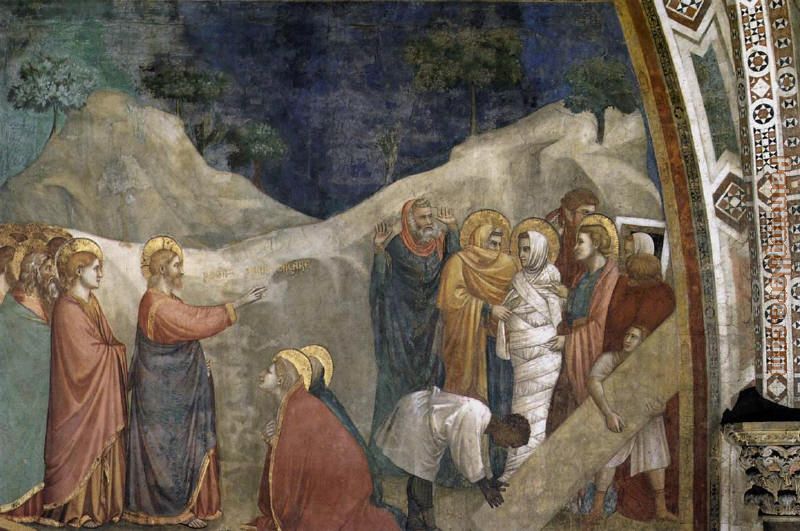
In our Lenten journey we have reached the Fifth Sunday, characterized by the Gospel of the resurrection of Lazarus (Jn 11: 1-45). It concerns the last "sign" fulfilled by Jesus, after which the chief priests convened the Sanhedrin and deliberated killing him, and decided to kill the same Lazarus who was living proof of the divinity of Christ, the Lord of life and death. Actually, this Gospel passage shows Jesus as true Man and true God. First of all, the Evangelist insists on his friendship with Lazarus and his sisters, Martha and Mary. He emphasizes that "Jesus loved" them (Jn 11: 5), and this is why he wanted to accomplish the great wonder. "Our friend Lazarus has fallen asleep, but I go to awaken him out of sleep" (Jn 11: 11), he tells his disciples, expressing God's viewpoint on physical death with the metaphor of sleep. God sees it exactly as sleep, from which he can awaken us. Jesus has shown an absolute power regarding this death, seen when he gives life back to the widow of Nain's young son (cf. Lk 7: 11-17) and to the 12 year-old girl (cf. Mk 5: 35-43). Precisely concerning her he said: "The child is not dead but sleeping" (Mk 5: 39), attracting the derision of those present. But in truth it is exactly like this: bodily death is a sleep from which God can awaken us at any moment.
This lordship over death does not impede Jesus from feeling sincere "com-passion" for the sorrow of detachment. Seeing Martha and Mary and those who had come to console them weeping, Jesus "was deeply moved in spirit and troubled", and lastly, "wept" (Jn 11: 33, 35). Christ's heart is divine-human: in him God and man meet perfectly, without separation and without confusion. He is the image, or rather, the incarnation of God who is love, mercy, paternal and maternal tenderness, of God who is Life. Therefore, he solemnly declared to Martha: "I am the resurrection and the life; he who believes in me, though he die, yet shall he live, and whoever lives and believes in me shall never die". And he adds, "Do you believe this?" (Jn 11: 25-26). It is a question that Jesus addresses to each one of us: a question that certainly rises above us, rises above our capacity to understand, and it asks us to entrust ourselves to him as he entrusted himself to the Father. Martha's response is exemplary: "Yes, Lord; I believe that you are the Christ, the Son of God, he who is coming into the world" (Jn 11: 27). Yes, O Lord! We also believe, notwithstanding our doubts and darkness; we believe in you because you have the words of eternal life. We want to believe in you, who give us a trustworthy hope of life beyond life, of authentic and full life in your Kingdom of light and peace.We entrust this prayer to Mary Most Holy. May her intercession strengthen our faith and hope in Jesus, especially in moments of greater trial and difficulty.
Jesus told her, “I am the resurrection and the life; whoever believes in me, even if he dies, will live, and everyone who lives and believes in me will never die. Do you believe this?”I do not think that I had head the short form of this passage before last evening and when I heard it, it was jarring. I must have made - in my great bewilderment - quite a contortion of my face because several people looked at me with questioning looks.
She said to him, “Yes, Lord. I have come to believe that you are the Christ, the Son of God, the one who is coming into the world.”
He became perturbed and deeply troubled, and said, “Where have you laid him?” (John 11:25, 33b-34).
 The journey there mostly followed Interstate 72, the most tedious 100 mile stretch of pavement on the continent, and gave the time to consider the forty-one mile flight of Martha Jane Tolton from slavery on the farm near St. Peter's church with her three young children. It is one thing to read about such an escape to freedom and imagine it in one's mind, but quite another to actually see the terrain she must have trod.
 |
| The entrance to the church yard of St. Peter church, Brush Creek, Missouri. |
 |
| The tree-lined drive leading to St. Peter's church, Brush Creek, Missouri. |
 |
| St. Peter church, Brush Creek, Missouri, the site at which Father Tolton was baptized. |


 |
| The Tolton pilgrims with many of the local residents of Brush Creek, Missouri after Mass in St. Peter church. |
 |
| Bishop Gaydos, the owners of the site of the Elliott farm, Cardinal George, Bishop Perry and Bishop Paprocki. |
My greatest pleasure is to go there [the cemetery] to say my beads, and meditate on that unending happiness which so many of them are already enjoying.
Praised be You, my Lord,through our Sister Bodily Death,
from whom no living man can escape.
Woe to those who die in mortal sin.
Blessed are those whom death will
find in Your most holy willl,
for the second death shall do them no harm.
 |
| Bishop Paprocki walks amidst the slave cemetery at Brush Creek, Missouri. |
 |
| Bishop Paprocki prays at the tombs of his predecessors Bishops Baltes and Juncker. |

EFFINGHAM — Three years ago two young teachers at George Washington High School, on Chicago’s South side, volunteered to start a track and cross country program at the inner-city school.Well done! Keep it up, STA!
No money was allotted for the program in the school’s budget, the school did not have a track, its neighborhood was considered too dangerous to run through, and door-to-door fund-raising was not feasible in the area.
Still teachers Kristen Kennedy and Jennifer Reed had 50 GWHS students show up for an informational meeting on starting a program. None had running shoes.
When Michael Mitchell, JV girls basketball coach at St. Anthony High School in Effingham heard about Kennedy and Reed’s efforts, he reached out to help, spear-heading efforts to get St. Anthony’s students involved.
Now three years later, St. Anthony’s, with support from the Effingham community, has donated more than 200 pairs of shoes and more than $1,000 for the George Washington track and cross country program.
A jeans day fund-raiser held last month at the Effingham school brought in 80 pairs of gently used running shoes and over $600 in cash for the GWHS athletes.
On Saturday, April 9, GWHS students were to be St. Anthony’s guests at a noon track meet in Effingham. Parent volunteers from St. Anthony’s were to provide a meal for athletes from both schools.
Your Eminence, my brother bishops, priests, religious sisters,friends of Father Tolton:
Welcome to Brush Creek.
I am grateful to be able to be with you and to come with you on this holy pilgrimage. This truly is where it all began: where Father Tolton was born, where he was baptized.
While the State of Missouri remained in the Union, it had areas, of course, that abided by that institution of slavery. In fact, in this part of Missouri still bears the moniker, “Little Dixie.”
It’s been almost four hundred years since the first slaves were brought to the Virginia colony, beginning that dreadful service of trade in sugar, rum and human beings.
But we come here, and we stand on holy ground. But it is not made holy - obviously - by what we human beings do; it is made holy by God’s grace. The history of how it all began for Augustus Tolton is important especially now as we introduce his Cause to be recognized for veneration throughout the Universal Church.
Blessed Pope John XXIII called the family, “the cradle of priestly and religious vocations.” And this - with God’s grace - we see that at work, and we want to learn more and more - as we can - about that mystery taking place, taking place here.
When you look at it, as I said, it is a work of God. God has to remove whatever we may look at as insurmountable obstacles. We see that in the first reading.
This pilgrimage is taking place in the midst of the Lenten pilgrimage of the Universal Church. And you know, the pasch of Jesus, it echoes the pasch of Israel and we seek each year, especially in this holy season, to more make it our own pasch.
Over the years, the hymns and preachings of the divines of the African-American community forged in, I guess what you could call the lectio divina of their enslaved forebears, have identified very closely with this paschal drama that highly resonates with Israel enslaved and God’s power and might - that drama reached across the centuries, it buoyed up a people with no other reason to hope, nowhere else to turn. When you look at it, the true human condition of all of us, just very write large.
As we ponder the mystery of God’s grace, manifested in the heroic virtue of the life of Father Augustus Tolton, we are very fortunate, I think, to have these Scripture readings leading us to Jesus and Moses today.
When you think about it, this place was the beginning of Augustus Tolton’s exodus. So, in a way, I can also say to you: Welcome to Egypt.
What a wise, brave example we have in Moses. Here in this reading we just heard from the Book of Exodus, these people have just broken the Covenant with God. They made this molten image and worshipped. The Commandments, so newly given, they specifically forbid this action. This event could be the whole end of the story.
The Sinai Covenant, you see, where Moses got the Ten Commandments on Mount Sinai, it is a conditional Covenant. God says, if you keep my Covenant, you will be my people. And the Covenant is now shattered. They haven’t even left Sinai!
But Moses, as the 106th Psalm says, Moses stands in the breach. God proposes starting all over, but this courageous leader, uses three arguments to change God’s mind.
First, he reminds God how much effort he took to get that people out of Egypt. Second, he says to God, “What will the Egyptians say? They’ll ruin your reputation.” Finally, he invokes that unconditional Covenant God made with Abraham to make his descendants as numerous as the stars. And then the most amazing thing happens: God relents; God changes the divine mind; God renews the Covenant.
Here we find the first new Covenant. Remember, the people are still at Sinai. Whatever happens here it becomes the model for what we can expect in the future. This hope had to play a powerful role in the life of Father Tolton, from his early years in servitude; his flight from servitude; the desert experience of so many obstacles and adversaries; the daily struggle with the human condition manifested himself and all those he was called to serve in his holy priestly vocation.
Mindful of the example and, yes, the concern, and intercession, that we can expect from Father Tolton on our behalf this very day, in this our day, we, too, must ask ourselves: What will happen when the people break, when we break, the covenant with God in the future? We expect God to renew it again. We expect - and hope - for the liberating power of his grace manifested in his outstretched arm.
I believe this can be a special part of our intercession for the assistance of Father Tolton as we seek more and more to probe his heroic life. And today, with this Eucharistic celebration of the New Covenant, may we be filled with lively gratitude to our merciful God for all this grace, for the great Communion of Saints that surrounds us and assists us, especially for the great gift that God has given us in the person of Augustus Tolton. Once again: Welcome to Egypt.
QUINCY, ILL. -- Tri-States visitors crossed the Mississippi River and back to the Gem City in the name of sainthood Thursday.KHQA-TV has a video interview with Father Joseph Zimmerman, OFM, here.
Representatives of the Archdiocese of Chicago, Springfield and Jefferson City, Missouri continued their pilgrimage to further the sainthood cause for Father Augustus Tolton.You'll recall he was the nation's first black Catholic priest.
Thursday morning, bishops and the area's cardinal traveled to Brush Creek, Missouri where Tolton was born to slave parents.
They visited the Mississippi River at Hannibal, where the Tolton family crossed the river to escape slavery in the 19th Century.
The group then visited the Dr. Robert Eels home this afternoon, which was a part of the underground railroad.
Dr. C. Vanessa White is a professor of spirituality at Catholic Theological Union in Chicago. She said, "One thing I want to ask is that what's needed now is prayer, to pray for the cause of Father Augustus Tolton."
It could take several years before we know whether Father Tolton will officially become a saint.
[I]t is hard to be a lay Catholic in Saudi Arabia because you have to have a very deep background in your faith. You cannot have copies of the Gospel in your home. You cannot have a rosary. You cannot have contact with your Christian friends as a community; you can have Christian friends, you can frequent the foreign communities but you are prohibited from talking about your faith … In other Islamic countries Friday is a holiday so Mass as a community [is allowed], but not on Sunday because Sunday is considered a working day; but even this is not the case in Saudi Arabia.Let us pray for our persecuted brothers and sisters in the Muslim world and give thanks to God for the freedoms we enjoy and so often take for granted.
A Sangamon County Circuit Court judge on Tuesday struck down a 6-year-old state rule that required Illinois pharmacies to dispense emergency contraception [which works as an abortifacient; there's a reason it's called "Plan B": plan A didn't work].
Judge John Belz ruled in favor of two pharmacy owners — Luke Vander Bleek of Morrison and Glenn Kosirog of Wheaton — who didn’t want to dispense or stock “morning-after” pills or help patients obtain them elsewhere.
“We’re thrilled,” Mark Rienzi, a Catholic University law professor and one of the pharmacy owners’ lawyers, said after the ruling. “The law of Illinois and the law of the United States make it clear that people can enter the health-care profession without having to check their conscience or religion at the door.”
Robyn Ziegler, spokeswoman for Illinois Attorney General Lisa Madigan, said, “We’re disappointed with the ruling [that isn't surprising]. There is a compelling need for emergency contraceptives to be available at all licensed pharmacies in Illinois.”
The pharmacy owners, both of whom are pharmacists, oppose emergency contraception on religious grounds.
Even though lawyers for the state argued otherwise, Belz ruled that pharmacies and pharmacists are protected by the Illinois Healthcare Right of Conscience Act, as well as the First Amendment to the U.S. Constitution, when they refuse to perform services on moral grounds.
The rule first was put in place by former Gov. Rod Blagojevich after state officials received complaints that pharmacists were refusing to fill prescriptions for emergency contraception, commonly sold under the brand name “Plan B.”
Belz wrote in his ruling that the state Right of Conscience Act “was designed to forbid the government from doing what it aims to do here: coercing individuals or entities to provide healthcare services that violate their beliefs.”
Vander Bleek and Kosirog believe emergency contraception can cause what they view [nevermind the reality] to be an abortion when the medicine prevents a fertilized egg [an embryo] from implanting in a woman’s uterus [which would be one of an abortion].
Emergency contraception can be used to prevent pregnancy up to 120 hours after unprotected sex, though it is more effective the sooner it is taken. The medicine most often works by delaying the release of an unfertilized egg into a woman’s fallopian tube.
The medicine is different from the “abortion pill,” which causes a fertilized egg to dislodge from the uterus [but not by much].
The Illinois attorney general’s office plans to appeal Belz’s ruling, which the judge hasn’t yet extended to apply to all pharmacies in the state.
Vander Bleek, 47, a Catholic, owns pharmacies in Morrison, Sycamore and Genoa. Kosirog, 51, who identified himself as a Christian [Catholics are the first Christians] and believes that life begins at conception, owns a Chicago pharmacy.
Belz wrote that that state provided “no evidence of a single person who ever was unable to obtain emergency contraception because of a religious objection. … Nor did the government provide any evidence that anyone was having difficulties finding willing sellers of over-the-counter Plan B, either at pharmacies or over the Internet.”
Belz added that the state conceded that any health impact from the pro-life pharmacy owners’ religious objections “would be minimal.”
 His Excellency the Most Reverend Joseph N. Perry, Postulator of the Cause of Canonization of Father Augustus Tolton, will visit Quincy this Wednesday and Thursday for the canonical examination of the grave of the Servant of God in St. Peter's cemetery.
A man with a paralyzed leg who visited Lourdes in 2002 regained the use of his leg and subsequently made a 1,000-mile pilgrimage to Santiago de Compostela.
“In the name of the Church, I publicly recognize the ‘remarkable’ character of the healing from which Serge François benefited at Lourdes on April 12, 2002,” said Bishop Emmanuel Delmas of Angers after a team of 20 doctors examined the case and determined that the healing was “sudden, complete, [and] unrelated to any particular therapy.”
“This healing can be considered a personal gift from God to man, as an event of grace, as a sign of Christ the Savior,” the bishop added.
Great River TEC
611 South 22nd Street
Quincy, Illinois 62301
A new History Channel documentary features rare glimpses of the Pope relaxing at home, sipping his "favourite treat" Fanta Orange, watching TV and playing the piano, reports the dailymail.co.uk.As I recall, there was a German video some years back that already showed us these "new" images. I know I posted this video, but I can't seem to find it now.
The Holy Father made the unprecedented move of allowing television cameras into his inner sanctum in Vatican City – and the resulting footage sheds rare light on his little-known personal domain.
During the History Channel documentary called Secret Access: The Vatican, Pope Benedict is shown for perhaps the first time taking his daily 7am mass in his private chapel.
The cameras also follow the Pope as he travels outside of the country on a chartered Alitalia jet with seats taken out for extra leg room, as two fighter jets escort the 747 for security.
Viewers learn that Pope Benedict "likes to kick back and watch the news' on television to help him relax".
One of his favourite pastimes is playing the piano and although he complains that his busy schedule rarely allows him time to do so, "Schubert can occasionally be heard emanating from the Papal apartments".
The Congregation for the Doctrine of the Faith has lifted all canonical sanctions on American woman, Norma Jean Coon, who took part in an “ordination” ceremony purporting to make her a deacon.[A word here has been removed that made no sense originally; I type random things at the end of a section I intend to block quote. I forgot to remove it and add a final thought; I apologize for the confusion if you saw the post prior to this message.]
Coon, formerly a member of the Roman Catholic Womenpriests organization, posted a message Feb. 8 on the Internet to renounce her “ordination,” Zenit notes.
In a new message on her site, Coon notes that “the Congregation for the Doctrine of the Faith has lifted any canonical sanctions that I incurred by attempting ordination as a deacon”.
“A letter from Bishop Robert Brom states that I may now return to the full practice of our Catholic faith. I have been very touched at the remarkable support of my actions and the prayers offered in my behalf during this trying time.
“I wish to thank all those who have prayed for me and for my family. The prayers and masses have been deeply appreciated. May Lent and Easter hold many blessings for you and your family,” Coon says.
Coon, a mother of five, participated in a ceremony in Santa Barbara attempting her ordination July 22, 2007
An Omaha pastor has ordered 250 sixth-, seventh- and eighth-graders frpm Nebraska’s largest Catholic grade school out of Mass because they weren’t singing loudly enough.Does this action help drive home the point of active participation? Perhaps. Does it help drive home the fact that such participation is first and foremost interior? Perhaps.
Incensed, the parents say they’re paying tuition so their kids can get Catholic instruction [technically, they're still getting "instruction;" it just isn't the sort they have in mind] — not for the kids to be denied Holy Communion during Lent, the World-Herald report.
Other parents, however, back the action of Father James Tiegs, pastor at St. Stephen the Martyr parish since 2004. They see him as a shepherd guiding the flock.
“If he thought that was necessary, my hat’s off for his courage,” said Bob Finger, who has a daughter in eighth grade at the southwest Omaha school.
However, an Omaha Archdiocese chancellor, Deacon Tim McNeil said that archdiocesan policy does not support the lesson.
“Trying to get children, or for that matter adults, to fully participate in the Mass is a 2,000-year-old issue in the church,” he said. “We would never suggest that 250 children be dismissed in the middle of Mass for not singing a song.”
 |
| The Baptismal record of Father Tolton. |

My dear friends in Christ:
On this Feast of Saint Patrick, I wish the entire Archdiocese of New York an abundance of God’s blessings. May our great patron saint intercede for us, obtaining from the Almighty Father all the graces that we need as disciples of His Son, Our Lord Jesus Christ!
Is there one particular grace which we can ask Saint Patrick to obtain for us? Might I suggest this year a return to the Sacrament of Penance? My fervent prayer for the Catholics of the Archdiocese of New York is that they will hear in the next weeks the beautiful, profound words of absolution pronounced in the confessional:
God the Father of mercies, through the death and resurrection of his Son, has reconciled the world to Himself, and sent the Holy Spirit among us for the forgiveness of sins. Through the ministry of the Church, may God grant you pardon and peace, and I absolve you of yours sins, in the name of the Father, Son and Holy Spirit.
How easily those words come to the lips of every priest; how ingrained they are in his mind; how deeply do they reside in his heart! The consoling, simple words of absolution are powerful beyond imagining!
To pronounce the sacramental absolution by which our sins are forgiven is one of primary reasons the Church and the priesthood exist. The Church is an instrument of mercy and reconciliation, for Christ Jesus, the Head of the Church, came to reconcile us to the Father. We call this sacrament “penance,” “confession,” or “reconciliation”. Call it what you will, the sacrament is essential for the life of the Catholic disciple. Every Catholic should be eager to hear those words; every priest should be eager to say them.
We have to be frank, though. Those words are not heard as often as they should be in the Church in New York. We can’t imagine Catholic life without the words of consecration – This is my body! This is my blood! Likewise Catholic life cannot be lived properly without the Sacrament of Penance. We need the forgiveness of our sins. We need the grace of this sacrament to grow in virtue.
Last year was my first Saint Patrick’s Day as Archbishop of New York, and I took advantage of our patronal feast to address a letter to the Archdiocese on the importance of Sunday Mass, Keeping the Lord’s Day Holy. I am grateful for the favourable reaction to my letter, with many priests and parishioners kindly telling me that it helped them think again about the gift of the Lord’s Day. That Sunday rest and Mass rightly orient all of our time toward our final goal as Christian pilgrims, the definitive Sabbath rest with the Lord Jesus in the company of all the saints in heaven.
This year I wish to address another fundamental part of our Catholic life which has been neglected by too many – both priests and parishioners – for too long. Given the coincidence of Saint Patrick’s Day with the season of Lent, I hope that my encouragement might bear fruit this Lent. Please God, this letter might encourage Catholics to keep the tradition of making a good confession before Easter.
Among priests one hears a joke in which a pastor tells his parishioners that he is terribly afraid of dying in the confessional. “Why?” they ask him. “Because no one would find me for days!” he replies. Another priest told me that, after six months in his new parish, he announced to the people that he was asking the bishop for a transfer. “You don’t need me. I’ve sat in the confessional for half-a-year, and nobody has come. You must all be saints. I want to serve sinners.” We can laugh, but I am afraid there is too much truth here. So in this Lent, on this Saint Patrick’s Day, I exhort the entire Archdiocese of New York: Experience the joy of forgiveness! Experience liberation from sin! Keep those confessionals busy! Keep your priests busy about the great work of dispensing the Lord’s mercy! Keep the Sacrament of Penance at the heart of Catholic life!
The Altar and the Confessional
Catholics the world over were both outraged and heartbroken by the massacre at the Syriac Catholic Cathedral in Baghdad last October. Terrorists, claiming to be part of a group called the “Islamic State of Iraq”, stormed the church during a Sunday evening Mass, and began to kill those present. Some 58 were murdered, and more than 70 injured. It reminded us that there are those so filled with hatred for Christ and His Church that they will kill Christians.
When the terrorists entered the church, Father Saad Abdal Tha’ir was offering Mass. Another priest, Father Waseem Tabeeh, came out of the confessional, and attempted to persuade the terrorists to let the people go, offering his life and that of Father Tha’ir in exchange. How courageous were these two young priests, Father Tha’ir only 32, and Father Tabeeh, 27! The killers rejected the plea for mercy, and both priests were then martyred. The last words of Father Tha’ir, who died before his own mother’s eyes, were, “Jesus, into thy hands I commend my spirit.”[1]
How can we not see here an image of the Lord’s own passion, His own words from the cross? The new martyrs of Baghdad have something to teach us about the Lord’s passion and the work of the Church. Is it not deeply moving to note that these two young priests were at the altar and the confessional at the moment of their supreme witness? The altar and the confessional are the two most important places in a priest’s life. Those two young priests died doing what every priest should live for – to offer the Holy Sacrifice of the Mass at the altar, and to forgive sins in the name of Jesus in the confessional.
According to one account of the massacre in Baghdad, a voice cried out in the midst of the horror, “We die? Okay, we die. But the Cross lives!” That speaker was immediately killed.[2]
Yes, between the altar and the confessional, amidst the blood of the martyrs, the Cross lives!
Holy Thursday, Easter, and the Priesthood
During Lent, of course, we prepare our hearts for Easter. Let’s fast-forward to the Gospel account of that first Easter evening in Jerusalem:
Jesus said to them again, “Peace be with you. As the Father has sent me, even so I send you.” And when he had said this, he breathed on them, and said to them, “Receive the Holy Spirit. If you forgive the sins of any, they are forgiven; if you retain the sins of any, they are retained.”(John 20:21-23)Here we have the institution of the Sacrament of Penance, the clear biblical witness that the Lord Jesus gives to His priests the authority to forgive sins. In Saint John’s Gospel, it is also at this moment that we see most clearly the institution of the priesthood. The gifted English convert, biblical scholar and preacher, Monsignor Ronald Knox, emphasized this point and links it back to the creative work of Genesis:
“How did our Lord institute the priesthood? When he had said this he breathed on them …. With one breath, God created the whole human family; with one breath, our Lord instituted the whole Christian priesthood. As man is a beast among beasts, so the priest is a man among men; he shares their passions, their weaknesses, their disabilities. And yet, when God breathes into the face of a priest, a new thing, in a sense, comes into being, just as when God breathed into the face of that clay image he had fashioned. It was a kind of second creation, when our Lord spoke those words in the Cenacle. It brought into the world a new set of powers, infinitely exceeding all that man had ever experienced, all that man could ever expect. It was a fresh dawn of life – supernatural life.”[3]
Monsignor Knox is bold to liken the events of Easter Sunday evening to a new creation, an outpouring of the Spirit equivalent to the very act of creation itself. Bold and true, for this is the grandeur of the priesthood in regard to the forgiveness of sins. Just as only God can create the universe out of nothing, only God can forgive sins. Only He has the power. Only He has the authority. And He gives it to His Church through the institution of the priesthood!
My brother priests, we should never lose our amazement and our gratitude at this gift. The Spirit called down upon us at our ordination is the same Spirit who hovered over the waters at the dawn of creation. We need that same Holy Spirit, for the work of forgiving sins is a work as astonishing as the creation of the world – a work we can only do because the Lord Jesus explicitly entrusted it to us. Just as we rightly look to the Last Supper and the Eucharist as the origin of our priesthood, we too should look to Easter Sunday and the Sacrament of Penance as constitutive of our identity. Just as it would be impossible to imagine our priesthood without the Eucharist, it is impossible to imagine our priesthood without the ministry of reconciliation in the confessional. Our priesthood exists for the Eucharist. Our priesthood exists for the forgiveness of sins.
When I was in Rome as a seminary rector, my barber use to tease me that neither he nor I would ever go out of business. Why? “There will always be hair,” he replied. “And there will always be sin.” Even he knew that the priesthood existed for the forgiveness of sins!
My fellow Catholics, reading the four Gospel accounts together, we can see that the Sacrament of Penance is not some kind of later invention, some afterthought, something leftover, something ancillary. Rather it belongs to the very heart of Christ’s saving and redeeming work. On the day that His passion begins, the Lord Jesus gave us the Eucharist and the priesthood. On the day of the resurrection, the Lord Jesus gave us the Sacrament of Penance and, as it were, completed the institution of the priesthood. All three sacraments are born from the heart of the Church in the Cenacle; all three are inserted into the heart of the redemptive and salvific work of Christ Jesus; all are three lie at the heart of the Catholic life in every age.
Indeed, the Cross lives between the altar and the confessional!
Realizing the Seriousness of Sin
If the Holy Eucharist and the Sacrament of Penance are at the very heart of the Christian life, why is the latter neglected? It is a lamentable characteristic of the Church’s life in our time. Almost thirty years ago, soon to be Blessed Pope John Paul II convoked a Synod of Bishops addressed to the very topic of Reconciliation and Penance in the Mission of the Church. The penetrating analysis of the Holy Father’s subsequent apostolic exhortation retains its force today. He wrote in 1984 that, in an age when God is pushed to the margins, the awareness of our need for forgiveness will diminish, for “the loss of the sense of sin is thus a form or consequence of the denial of God: not only in the form of atheism but also in the form of secularism.”[4]
We do not only observe a diminishing sense of sin in the secular culture around us. We find it in the Church herself. Perhaps it is an over-reaction to an earlier period, as the late Holy Father suggests:
“Some are inclined to replace exaggerated attitudes of the past with other exaggerations: From seeing sin everywhere they pass to not recognizing it anywhere; from too much emphasis on the fear of eternal punishment they pass to preaching a love of God that excludes any punishment deserved by sin; from severity in trying to correct erroneous consciences they pass to a kind of respect for conscience which excludes the duty of telling the truth.”[5]
Fair enough. Not everything was perfect decades ago when most Catholics routinely went to confession – perhaps too routinely. But whatever problems existed in the 1950s are now a half-century in the past, and subsequent generations have grown up without any knowledge of whatever excesses may have existed. They have indeed grown up without what belongs to them as part of the patrimony as Catholics – the liberating, joyful experience of God’s mercy in the sacrament of penance.
We receive the gift of mercy to the extent that we realize our need for it. We desire forgiveness only if we acknowledge the seriousness of sin. The recently-beatified Cardinal John Henry Newman expressed the magnitude of sin with his characteristic literary force:
“The Catholic Church holds it better for the sun and moon to drop from heaven, for the earth to fail, and for all the many millions on it to die of starvation in extremest agony, as far as temporal affliction goes, than that one soul, I will not say, should be lost, but should commit one single venial sin, should tell one wilful untruth, or should steal one poor farthing without excuse.”[6]
Do we think today that Blessed John Henry Newman is right? How many of us would argue that opposite – that a little sin here and there is no big deal? How many, both inside and outside of the Church, argue that a little sin here and there is worth this technological advance, or that public policy goal, or is an acceptable means to some desired end? As someone jokingly observed to me, “It’s the Lamb of God, not our culture, that’s supposed to take away the sins of the world!”
We just heard this past Sunday, the First Sunday of Lent, the account of the temptations of the Lord Jesus. Satan offers to Jesus all the kingdoms of the world if He would just bow down in worship. A little “devil worship” and Jesus would have the whole world! Wouldn’t that be more efficient than God’s own plan – the passion, death, resurrection, ascension, Pentecost, and two thousand years of evangelization? But no sin is worth even all the kingdoms of the world.
Blessed Cardinal Newman is only one in a tradition of saints who have spoken with great ferocity about the horror we should have for sin – including our own beloved Saint Patrick, who emphasized the essential role of penance in his conversion of Ireland.
We can speak so boldly about the horror of sin because the good news is that the Lord Jesus did not just die for sin in general, but for my sins, and yours. So our horror at sin should be accompanied by a serene confidence that forgiveness is ours should we ask for it with true contrition. Together with Saint Paul we can give thanks that where sin increases, grace abounds all the more (cf. Romans 5:20)! We’re not “hung-up” on guilt and sin; no, we’re obsessed with God’s mercy.
The World Speaks to Us of Our Sins
“In the midst of scandals, we have experienced what it means to be very stunned by how wretched the Church is, by how much her members fail to follow Christ. That is the one side, which we are forced to experience for our humiliation, for our real humility. The other side is that, in spite of everything, he does not release his grip on the Church. In spite of the weakness of the people in whom he shows himself, he keeps the Church in his grasp, he raises up saints in her, and makes himself present through them. I believe that these two feelings belong together: the deep shock over the wretchedness, the sinfulness of the Church – and the deep shock over the fact that he doesn’t drop this instrument, but that he works through it; that he never ceases to show himself through and in the Church.”[7]
Perhaps the trauma of the sexual abuse scandals has taught us again, in a most painful way, of the reality of sin. Pope Benedict XVI makes that point above in his recent interview book, Light of the World. Yet if we only see the wretchedness in the Church, the wretchedness in the world, the wretchedness in my own life, then we are condemned to discouragement, even to despair. We need to be shocked by our sins, as the Holy Father says, and also be shocked that Jesus keeps us in His hand. The Sacrament of Penance accomplishes this in a supreme way. We prepare for confession by examining our consciences – looking hard, as it were, at the wretchedness in our heart. Then we receive absolution of those sins, and through the ministry of the Church are invited once again to be shocked at the mercy of God!
At the height of the sexual abuse controversies last year, the Holy Father reminded us that repentance itself is a grace. It is not a burden to repent of our sins, but a blessing:
“Repentance is grace; it is a grace that we recognize our sin; it is a grace that we realize the need for renewal, for change, for the transformation of our being. Repentance, the capacity to be penitent, is a gift of grace. And I must say that we Christians, even in recent times, have often avoided the word penitence – it seemed to us too difficult. Now, under the attacks of the world that speak of our sins, we see that the capacity to repent is a grace. And we see that it is necessary to do penance, that is, to recognize what is wrong in our lives, open ourselves to forgiveness, prepare ourselves for pardon by allowing ourselves to be transformed.”[8]
Is that not exactly the case? That we have shied away from words like penance, repentance, contrition – even the basic reality of sin? We have failed to speak about them, and the now, as we have experienced so painfully, to our shame and embarrassment, we face the “attacks of the world that speak of our sins”. The attacks are real, and so too are our sins! The Christian should not wait for others to speak of his sin; we should confess it simply, repent sincerely, and be forgiven quickly!
A Confessional Culture
Funny enough, while ridiculing the Church for being “hung up” on sin and guilt, the world delights in speaking of sin, does it not? Not just the sins of priests and bishops, but of anyone who is prominent. Our culture has an almost perverse delight in detailing the sins and scandals of those in the public eye. And ordinary people are eager to get in on the action! We produce an entire genre of “reality shows” which put on public display much sinful behaviour that people should be embarrassed about, not celebrated for. Seems as if everybody’s “going to confession” except in the sacrament! There are a parade of talk shows in which the troubled and afflicted share their intimate secrets with a vast television audience. People use social networks to make available to all on the internet what should be treated with utmost discretion. We have a “confessional culture.”
It seems at every moment someone, somewhere is shouting for our attention, eager to confess from the rooftops what Catholics have the opportunity to whisper in the confessional. The “confessional culture” around us shouts itself hoarse for it can confess, but there is no absolution. Sin confessed but unredeemed either leads to despair or is trivialized. We see the despair in the vast anguish that fuels an enormous therapeutic industry. We see the trivialization in the celebrity scandals that become not occasions for averted eyes, but fodder for jokes.
Our culture does not need to be taught how to confess; it needs to discover where forgiveness can be found. Our culture does not need to further expose the stain of its sinfulness; it needs to discover the only One who can wash it away. We Catholics have the blessing of teaching our “confessional culture” about true mercy, but we cannot give what we do not have! I challenge the Catholics of the Archdiocese to make a good confession this Lent and then to tell one other person – perhaps a friend or relative or colleague who has been away from the sacraments for a long time – about the liberating joy of God’s mercy!
Young people have a special gift to share with us, for they often ask their priests to hear their confessions. Gatherings of Catholic youth often include confessions, for they have discovered the beauty of this sacrament. So do our wonderful newly arrived Catholics from Latin America, Asia, and Africa. Older generations, marked perhaps by bad experiences of routine or severe confessors, should listen to this witness of a new generation, for whom a sincere confession is a joy to be celebrated, not a duty to be grudgingly endured.
A Saint Patrick’s Day Plea to Priests
My dear brother priests, are there any of us who have not, at least at one point, marvelled at the heroic service of saints such as the Curé of Ars or Padre Pio? Are there any among us, who after hearing confessions even for just an hour, feel somewhat worn out and wonder how they could have done it for ten, twelve hours a day for years on end? In some of us our initial ardor for the Sacrament of Penance has cooled, and we have begun to doubt the saintly witness we once admired. I urge you to rekindle that early desire to heroic service in the confessional! The heroism of Saint John Vianney is relevant in the 21st century! The zeal of Padre Pio is needed today in New York! Be generous in scheduling time for confessions, and don’t be shy about letting people know that you too frequently receive the Sacrament of Penance, for we all are poor sinners.
The Curé of Ars faced a situation not altogether different from what we face. Listen to how our Holy Father describes his simple and powerful pastoral solution:
This deep personal identification with the Sacrifice of the Cross led [John Mary Vianney] – by a sole inward movement – from the altar to the confessional. Priests ought never to be resigned to empty confessionals or the apparent indifference of the faithful to this sacrament. In France, at the time of the Curé of Ars, confession was no more easy or frequent than in our own day, since the upheaval caused by the revolution had long inhibited the practice of religion. Yet he sought in every way, by his preaching and his powers of persuasion, to help his parishioners to rediscover the meaning and beauty of the sacrament of Penance, presenting it as an inherent demand of the Eucharistic presence. He thus created a “virtuous” circle. By spending long hours in church before the tabernacle, he inspired the faithful to imitate him by coming to visit Jesus with the knowledge that their parish priest would be there, ready to listen and offer forgiveness. Later, the growing numbers of penitents from all over France would keep him in the confessional for up to sixteen hours a day. It was said that Ars had become “a great hospital of souls.”… From Saint John Mary Vianney we can learn to put our unfailing trust in the sacrament of Penance, to set it once more at the center of our pastoral concerns.[9]
The center! The Cross, the altar and the confessional – all at the center of our identity as priests and our pastoral work!
A Saint Patrick’s Day Plea to All Catholics
Perhaps you are now thinking that this letter is too long! If so, take it as a sign of my eagerness to use all the persuasive power God has granted me in the service of a renewal of the Sacrament of Penance. If my words are not enough, listen to two of our most recent saintly shepherds.
“No individual Christian can grow in perfection, nor can Christianity gain in vigor, except it be on the basis of penance,” wrote Blessed Pope John XXIII, on the eve of the Second Vatican Council.[10] He certainly had no intention that the Sacrament of Penance would diminish after the Council; to the contrary, he desired its flourishing.
In a few weeks, Pope John Paul the Great will be declared blessed in Rome – on Divine Mercy Sunday. He died on that liturgical feast in 2005, as if to point the Church with his last breaths toward the mercy of God, experienced supremely in the Sacrament of Penance.
“It would be an illusion to want to strive for holiness in accordance with the vocation that God has given to each one of us without frequently and fervently receiving this sacrament of conversion and sanctification,” the late Holy Father taught.[11] Frequent and fervent!
Finally, I was struck by a plea from the newly-installed Archbishop of Los Angeles, José H. Gomez, who addressed the Sacrament of Penance in his first few weeks in his new archdiocese. Uniting myself to him then, as if to encourage Catholics from one end of our beloved country to another, I make his words my own to the faithful of the Archdiocese of New York:
I encourage you to make a good confession before Easter. Even if it has been a long time. Come home to our Father! Be reconciled to God through the ministry of his Church! Don’t wait to change your life! You can hope in our Father’s mercy. You can trust in his pledge of grace to help you lead a better life. In the early Church, they called confession the “second conversion in tears.” St. Peter wept in sorrow after denying Jesus, and in his mercy Christ spoke to him the tender words of his pardon and peace. In the sacrament, we too can hear these words![12]
Thanks for paying attention! A blessed Lent!
A blessed Feast of Saint Patrick to all!
+Timothy Michael Dolan
Archbishop of New York
Translation via Zenit.
Dear young people, dear friends!
I know that at the invitation of Cardinal André Vingt-Trois, the Archbishop of Paris, and of Cardinal Gianfranco Ravasi, the President of the Pontifical Council for Culture, you are gathered in great numbers in front of the Cathedral of Notre Dame in Paris. I greet all of you, together with our brothers and friends from the Taizé Community. I am grateful to the Pontifical Council for having taken up and extended my invitation to open a number of "Courts of the Gentiles" within the Church. This image refers to the vast open space near the Temple of Jerusalem where all those who did not share the faith of Israel could approach the Temple and ask questions about religion. There they could meet the scribes, speak of faith and even pray to the unknown God. The Court was then an area of separation, since Gentiles did not have the right to enter the consecrated area, yet Jesus Christ came to "break down the dividing wall" between Jews and Gentiles, and to "reconcile both to God in one body through the cross, thus putting to death that hostility in himself". In the words of Saint Paul, "He came and proclaimed peace..." (cf. Eph 2:14-17).
At the heart of the "City of Light", in front of the magnificent masterwork of French religious culture which is Notre Dame, a great court has been created in order to give fresh impetus to respectful and friendly encounter between people of differing convictions. You young people, believers and nonbelievers alike, have chosen to come together this evening, as you do in your daily lives, in order to meet one another and to discuss the great questions of human existence.
Nowadays many people acknowledge that they are not part of any religion, yet they long for a new world, a world that is freer, more just and united, more peaceful and happy. In speaking to you tonight, I think of all the things you have to say to each other. Those of you who are nonbelievers challenge believers in a particular way to live in a way consistent with the faith they profess and by your rejection of any distortion of religion which would make it unworthy of man.
Those of you who are believers long to tell your friends that the treasure dwelling within you is meant to be shared, it raises questions, it calls for reflection. The question of God is not a menace to society, it does not threaten a truly human life! The question of God must not be absent from the other great questions of our time.
Dear friends, you are challenged to build bridges between one another. Take advantage of this opportunity to discover, deep within your hearts and with serious arguments, the ways which lead to profound dialogue. You have so much to say to one another! Do not turn away from the challenges and issues before you!
I believe deeply that the encounter of faith and reason enables us to find ourselves. But all too often reason falters in the face of self-interest and the lure of profit, and is forced to regard the latter as the ultimate criterion. Striving for truth is not easy. But each of us is called to make a courageous decision to seek the truth, precisely because there can be no shortcut to the happiness and beauty of a life of genuine fulfillment. Jesus says as much in the Gospel: "The truth will make you free".
Dear young people, it is up to you, in your own countries and in Europe as a whole, to help believers and nonbelievers to rediscover the path of dialogue. Religions have nothing to hear from a just secularity, one that is open and allows individuals to live in accordance with what they believe in their own consciences.
If we are to build a world of liberty, equality and fraternity, then believers and nonbelievers must feel free to be just that, equal in their right to live as individuals and in community in accord with their convictions; and fraternal in their relations with one another. One of the reasons for this Court of the Gentiles is to encourage such feelings of fraternity, over and above our individual convictions yet not denying our differences. And on an even deeper level, to recognize that God alone, in Christ, grants us inner freedom and the possibility of truly encountering one another as brothers and sisters.
Our first step, the first thing we can do together, is to respect, help and love each and every human being, because he or she is a creature of God and in some way the road that leads to God. As you carry on the experience of this evening, work to break down the barriers of fear of others, of strangers, of those who are different; this fear is often born of mutual ignorance, skepticism or indifference. Work to create bonds with other young people, without distinction and keeping in mind those who are poor or lonely, unemployed, ill or on the margins of society.
Dear young people, what you can share is not only your experience of life, but also your approach to prayer. Believers and nonbelievers, as you stand in this court of the Unknown, you are also invited to approach the sacred space, to pass through the magnificent portal of Notre Dame and to enter the cathedral for a moment of prayer. For some of you this will be a prayer to a God you already know by faith, but for others it may be a prayer to the Unknown God. Dear young friends who are nonbelievers, as you join those who pray in Notre Dame on this day of the Annunciation of the Lord, open your hearts to the sacred texts, let yourselves be challenged by the beauty of the music and, if you truly desire it, let your deepest feelings rise towards the Unknown God.
I am happy to have been able to speak to you this evening for the inauguration of the Court of the Gentiles. I hope you will be able to join me for the other events to which I have invited you, especially the World Youth Day to be held in Madrid this coming summer. The God whom believers learn to know invites you to discover him and to find ever greater life in him. Do not be afraid! As you walk together towards a new world, seek the Absolute, seek God, even if for you he is the Unknown God. And may this God, who loves each and every one of you, bless you and keep you. He is counting on you to be concerned for others and for the future, and you can always count on him!