Showing posts with label St. Blaise. Show all posts

03 February 2014

Blessed by Blaise

After my visit this morning to the Armenian church of Saint Blaise (San Biagio here in Italy), a friend told me that the church of San Carlo ai Catinari (Saint Charles in Catinari) in Rome is in possession of relics of Saint Blaise.  With this in mind, I went out again after lunch into puddled streets of Rome as the rain fell yet again (some are beginning to question whether it will ever stop) to pray before a relic of the patron against illnesses of the throat.

I'd been inside the church several months ago but I had forgotten my previous visit.  The exterior is typical of a Roman church:

The interior is also rather typical of Roman churches and is presently undergoing a bit of restorative work (which also seems to be typical):


A relic of Saint Blaise had been set on the communion rail at the foot of the sanctuary before which the faithful were able to pray and seek the saint's intercession:


A temporary shrine to Saint Blaise had be set up in one of the side chapels and was comprised of an image of the saint, an oil lamp, flowers, and oranges and lemons (though I do not know why):


While I prayed before the relic a priest came out of the sacristy and went to the make-shift shrine, carrying some sort of a golden bowl covered with a red cloth.  I suspected he was going to offer the blessing of Saint Blaise:
Through the intercession of Saint Blaise, Bishop and martyr, may God deliver you from every disease of the throat and from every other illness.  In the name of the Father, and of the Son, and of the Holy Spirit.
Because I, too, wanted to receive this blessing, I went over to the side chapel where a small group of the faithful had gathered and which was growing.

The priest led us in seeking Saint Blaise's intercession and in thanking God for the example of his life, and afterwards he invited us to come forward to receive the blessing.

When I saw the priest did not have crossed candles with which to bless our throats, I realized what was in the golden bowl: another relic of Saint Blaise!

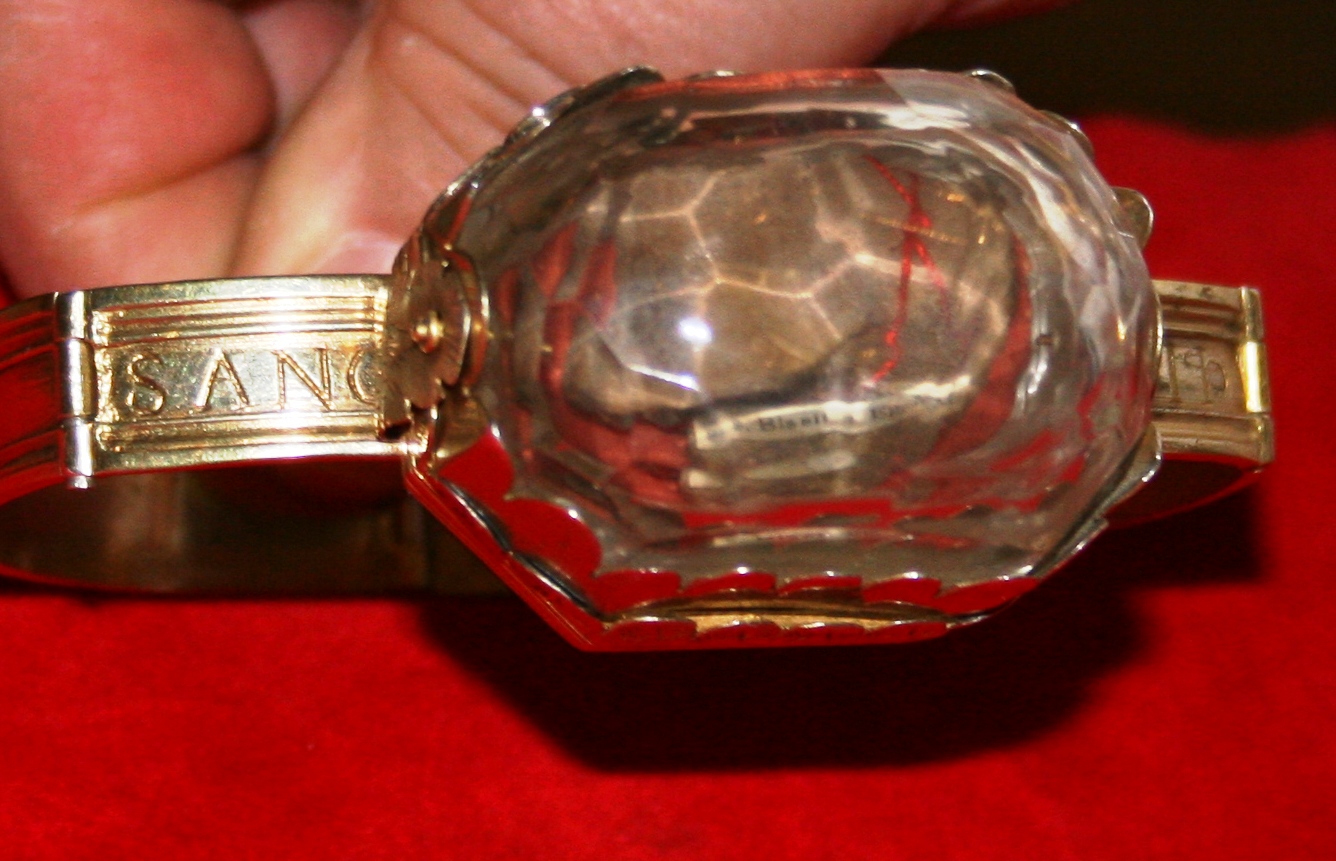
Google found this image of the relic for me
As you can somewhat see from the picture above, the relic is encased in what may be glass (though it didn't feel like glass) and attached to a golden ring.  The priest held the ring in his hand and touched the relic to our throats as he imparted the blessed and then invited us to kiss the relic.  This was simply more than I had hoped!

Life in Rome may be filled with various frustrations and - at present - bad weather, but unexpected happenings such as this more than make up for it!

A martyred Bishop, a pig, candles, and throats?

The early saintly Bishop and martyr of Sebaste, in Armenia, Blaise, has long been one of my personal favorites, no doubt because of the traditional blessing of throats that has become so closely associated with his feast.

Have you ever wondered why we generally use candles during the blessing of throats?  On the one hand, it makes little sense; but on the other hand, it seems perfectly logical.  To understand the connection of candles with Saint Blaise, a little history is necessary, as I delivered some years back in a homily:
We know Saint Blaise best as the patron of ailments of the throat, whose intercession we invoke in times of illness. He seems to have been the son of wealthy parents and a physician who became the Bishop of Armenia. When the persecutions of the Emperor Diocletian broke out, Blaise fled to a cave where he lived with the animals. He healed the wounds of the animals and they flocked around him. Hunters discovered Blaise surrounded by these animals and took him to the governor Agricolas. Refusing to renounce his Christian faith, Blaise was beheaded around the year 316, after having had his flesh torn apart by metal wool combs.

Before his death, Blaise is said to have miraculously healed a boy who was choking on a fish bone, thereby saving his life. This event gave rise to his patronage of the sick, and especially of the throat. But what about the candles used during his blessing?

As the hunters took Blaise to the governor they came upon a poor woman whose pig had been carried off by a wolf. Recognizing the Saint’s holiness, she begged him to restore the pig to her. Blaise commanded the wolf to give back the pig and it did. The pig was unharmed. In return for his kindness, the woman gave Blaise food and candles.

The episode of the healing of the boy was combined with that of the wolf to give us the blessing of Saint Blaise with the candles.

Why would this holy man of God allow himself to be torn apart by wool combs? Why would he willingly undergo such great pain when all he had to do to avoid the torture was renounce his faith?

Saint Blaise so modeled his life on the example of Jesus Christ as found in the Beatitudes that he knew the true source of happiness. He knew that blessedness is found in the Cross of Christ and so to him the Lord said:

Blessed are you when they insult you and persecute you and utter every kind of evil against you falsely because of me. Rejoice and be glad, for your reward will be great in heaven (Matthew 5:10).

Because Blaise took “refuge in the name of the Lord” in this life, he has now entered into one of the “many dwelling places” in the Father’s house (John 14:2). This martyr, who so powerfully united himself to Christ, stands before us a witness to hope, as one who lights the way to life with God, one of the many sign posts that God has given to us.
Though his relics are not enshrined in the Eternal City, there is an Armenian Catholic church dedicated in his honor.  Recognizing what will likely be only a short break in the near constant rain, I took a walk to visit the church and to ask his intercession.

By Roman standards, it is a small and simple building, both on the exterior and in the interior:


02 February 2008

Homily - 3 February 2008

When we examine the Beatitudes, Jesus’ pronouncements of blessedness, we see the characteristics of Jesus himself.

He who has no place to lay his head (cf. Matthew 8:20) is truly poor; he who can say, ‘Come to me … for I am meek and lowly in heart’ (cf. Matthew 11:28-29) is truly meek; he is the one who is pure of heart and so unceasingly beholds God. He is the peacemaker, he is the one who suffers for God’s sake. The Beatitudes display the mystery of Christ himself, and they call us into communion with him.[1]
For this reason Saint Paul tells us to “consider your own calling, brothers and sisters” (I Corinthians 1:26), reminding us that “it is due to him that you are in Christ Jesus” (I Corinthians 1:30). If, then, we are in Christ Jesus, we must become like him, each in the manner to which the Lord calls us.

In viewing the Beatitudes through the life of Christ, we come to know with certainty that what Saint Paul says is true:

God chose the foolish of the world to shame the wise, and God chose the weak of the world to shame the strong, and God chose the lowly and despised of the world, those who count for nothing, to reduce to nothing those who are something, so that no human being might boast before God (I Corinthians 1:27-29).
The wisdom of Christ is the Cross that even today is seen as great foolishness. Few today accept the wisdom of the Cross, that only in and through it can true and lasting happiness – true and lasting blessedness – be found.

Through the Cross we each become foolish, weak and lowly in the view of the world. Yet it is precisely the foolish, weak and lowly who can “take refuge in the name of the Lord” (Zephaniah 3:12).

For this reason the Beatitudes “are directions for discipleship, directions that concern ever individual, even though – according to the variety of callings – they do so differently for each person.”[2] In the coming season of Lent we will each have the opportunity to embrace the Cross in the manner to which we are called and so come to happiness, to blessedness.

Those who become foolish, weak and lowly recognize their need for the Savior and see in Christ Jesus he who is “righteousness, sanctification, and redemption” (I Corinthians 1:30). These are the “remnant in your midst” to whom the Church always looks as faithful disciples (Zephaniah 3:12). They are those who trust neither in themselves nor in their own power but trust completely in God. “They come with empty hands; not with hands that grasp and clutch, but with hands that open and give and thus are ready to receive from God’s bountiful goodness.”[3]

Let us turn our attention now to one of these Saints who modeled his life on the Beatitudes. If today were not Sunday Holy Mother Church would observe the Memorial of Saint Blaise, Bishop and Martyr, of whom we know precious little, as if to testify to his simplicity of heart.

We know Saint Blaise best as the patron of ailments of the throat, whose intercession we invoke in times of illness. He seems to have been the son of wealthy parents and a physician who became the Bishop of Armenia. When the persecutions of the Emperor Diocletian broke out, Blaise fled to a cave where he lived with the animals. He healed the wounds of the animals and they flocked around him. Hunters discovered Blaise surrounded by these animals and took him to the governor Agricolas. Refusing to renounce his Christian faith, Blaise was beheaded around the year 316, after having had his flesh torn apart by metal wool combs.

Before his death, Blaise is said to have miraculously healed a boy who was choking on a fishbone, thereby saving his life. This event gave rise to his patronage of the sick, and especially of the throat. But about the candles used during his blessing?

As the hunters took Blaise to the governor they came upon a poor woman whose pig had been carried off by a wolf. Recognizing the Saint’s holiness, she begged him to restore the pig to her. Blaise commanded the wolf to give back the pig and it did. The pig was unharmed. In return for his kindness, the woman gave Blaise some food and some candles.

The episode of the healing of the boy was combined with that of the wolf to give us the blessing of Saint Blaise with the candles.

Why would this holy man of God allow himself to be torn apart by wool combs? Why would he willingly undergo such great pain when all he had to do to avoid the torture was renounce his faith?

Saint Blaise so modeled his life on the example of Jesus Christ as found in the Beatitudes that he knew the true source of happiness. He knew that blessedness is found in the Cross of Christ and so to him the Lord said:

Blessed are you when they insult you and persecute you and utter every kind of evil against you falsely because of me. Rejoice and be glad, for your reward will be great in heaven (Matthew 5:10).
Because Blaise took “refuge in the name of the Lord” in this life, he has now entered into one of the “many dwelling places” in the Father’s house (John 14:2). This martyr, who so powerfully united himself to Christ, stands before us a witness to hope, as one who lights the way to life with God, one of the many sign posts that God has given to us.

Saint Blaise approached the Lord with open hands. He clutched neither at this life nor at the things of this world. Coming to Christ Jesus with open hands, he gave himself to the Lord so that he might receive the Lord in return. In this way Saint Blaise invites us to come to the Lord with open hands, humbly prepared to receive him with loving and joyful hearts.

Yet to do so requires that we empty our hands, that we recognize our dependence on the Lord for our every breath. If we come to the Lord clingy to anything but him, we have no room for him. Let us, then, empty our hands and come before the Lord. Amen.

[1] Joseph Ratzinger / Pope Benedict XVI, Jesus of Nazareth: From the Baptism in the Jordan to the Transfiguration, Adrian J. Walker, trans., (New York: Doubleday, 2007), 74.
[2] Ibid., 74.
[3] Ibid., 76.