The Holy Father yesterday, in his Wednesday general audience, compared Saint Bonaventure and Saint Thomas Aquinas.
The text of the address follows, via
Zenit, with my
emphases and
comments:
 Dear brothers and sisters,
This morning, continuing last Wednesday's reflection, I would like to reflect further with you on other aspects of the doctrine of St. Bonaventure of Bagnoregio. He is an eminent theologian, who merits being placed next to another very great thinker, his contemporary, St. Thomas Aquinas. Both scrutinized the mysteries of revelation, valuing the resources of human reason in the fruitful dialogue between faith and reason that characterized the Christian Middle Ages, making it a period of great intellectual liveliness, as well as of faith and of ecclesial renewal, often not sufficiently noted. Other similarities associate them: Both Bonaventure, a Franciscan, and Thomas, a Dominican, belonged to the Mendicant Orders that, with their spiritual freshness -- as I mentioned in preceding catecheses -- renewed the whole Church in the 13th century and attracted so many followers. Both served the Church with diligence, passion and love, to the point that they were invited to take part in the Ecumenical Council of Lyon in 1274, the same year in which they died: Thomas while he was going to Lyon; Bonaventure during the course of that same council. Also in St. Peter's Square the statues of the two saints are parallel, placed in fact at the beginning of the Colonnade starting from the facade of the Vatican Basilica: one in the left wing and the other in the right wing. Despite all these aspects, we can see in these two great saints two different approaches to philosophical and theological research, which show each one's originality and depth of thought. I would like to refer to some of these differences.
A first difference concerns the concept of theology. Both doctors asked themselves if theology is a practical or a theoretical, speculative science. St. Thomas reflects on two possible contrasting answers. The first says: theology is reflection on faith and the aim of faith is that man become good, that he live according to the will of God. Hence, the aim of theology should be to guide man on the just and good way; consequently it is, fundamentally, a practical science. The other position says: theology seeks to know God. We are the work of God; God is above our action. God operates just action in us. Hence it is essentially not of our doing, but of knowing God, not of our working. St. Thomas' conclusion is: theology entails both aspects: it is theoretical, it seeks to know God ever more, and it is practical: it seeks to orient our life to the good. But there is a primacy of knowledge: we must above all know God, then follows action according to God (Summa Theologiae Ia, q. 1, art.4). This primacy of knowledge in comparison with practice is significant for St. Thomas' essential orientation.
St. Bonaventure's answer is very similar, but the accents are different. St. Bonaventure has the same arguments in both directions, as St. Thomas does, but to respond to the question if theology is a practical or theoretical science, St. Bonaventure makes a threefold distinction -- hence he lengthens the alternative between theoretical (primacy of knowledge) and practical (primacy of practice), adding a third attitude, which he calls "sapiential" and affirming that wisdom embraces both aspects. And then he continues: Wisdom seeks contemplation (as the highest form of knowledge) and has as its intention "ut boni fiamus" -- that we become good, above all this: to become good (cf. Breviloquium, Prologus, 5). Then he adds: "Faith is in the intellect, in such a way that it causes affection. For example: to know that Christ died 'for us' does not remain knowledge, but becomes necessarily affection, love" (Proemium in I Sent., q. 3).
His defense of theology moves along the same line, that is of the rational and methodical reflection of faith. St. Bonaventure lists some arguments against engaging in theology, perhaps widespread also among some of the Franciscan brothers and present also in our time: reason empties faith, it would be a violent attitude toward the Word of God, we must listen to and not analyze the word of God (cf. Letter of St. Francis of Assisi to St. Anthony of Padua). To these arguments against theology, which demonstrate the dangers existing in theology itself, the saint responds: It is true that there is an arrogant way of engaging in theology, a pride of reason, which places itself above the Word of God. But true theology, the rational work of the true and good theology, has another origin, not the pride of reason. He who loves always wants to know more and better the one who is loved; true theology does not engage reason and its seeking motivated by pride, "sed propter amorem eius cui assentit" -- [but] "motivated by the love of him, to whom it has given its consent" (Proemium in I Sent., q. 2), and wishes to know the loved one better: this is the essential intention of theology for St. Bonaventure. Hence, in the end, determinant for St. Bonaventure is the primacy of love [as it is, I think, for Pope Benedict].
Consequently, St. Thomas and St. Bonaventure define in a different way man's ultimate destiny, his full happiness: for St. Thomas the supreme end, to which our desire is directed, is to see God. In this simple act of seeing God all problems find their solution: let us be happy, nothing else is necessary.
For St. Bonaventure, man's ultimate destiny is instead to love God, the encounter and the union of his love and our own. This is for him the most adequate definition of our happiness.
In this line, we could also say that the highest category for St. Thomas is the true, while for St. Bonaventure it is the good. It would be mistaken to see a contradiction in these two answers. For both the true is also the good, and the good is also the true; to see God is to love and to love is to see. It is a question therefore of different accents in an essentially shared vision. In both the accents have formed different traditions and different spiritualities and thus they have shown the fecundity of the faith -- one in the diversity of its expressions.
We return to St. Bonaventure. It is evident that the specific accent of his theology, of which I have given only one example, is explained from the Franciscan charism: the Poverello of Assisi, beyond the intellectual debates of his time, showed with his whole life the primacy of love [may the same be said of each of us!]; he was a living and enamored icon of Christ and thus made present, in his time, the figure of the Lord -- he convinced his contemporaries not with words, but with his life. In all St. Bonaventure's works, also the scientific works, of academia, one sees and finds this Franciscan inspiration; one notices, namely, that his thought starts from his encounter with the Poverello of Assisi. But to understand the concrete elaboration of the topic "primacy of love," we must also keep in mind another source: the writings of so-called Pseudo-Dionysius, a Syrian theologian of the 6th century, who concealed himself under the pseudonym of Dionysius the Areopagite, referring, with this name, to a figure of the Acts of the Apostles (cf. 17:34). This theologian had created a liturgical theology and a mystical theology, and had spoken amply of different orders of angels. His writings were translated into Latin in the 9th century; at the time of St. Bonaventure -- we are in the 13th century -- a new tradition was appearing, which sparked the interest of the saint and of the other theologians of his century. Two things in particular attracted the attention of St. Bonaventure:
1. Pseudo-Dionysius speaks of nine orders of angels, whose names he had found in Scripture and then systematized them, from the simple angels to the seraphim. St. Bonaventure interprets these orders of angels as steps for creatures drawing close to God. Thus they can represent the human journey, the ascent to communion with God. For St. Bonaventure there is no doubt: St. Francis belonged to the seraphic order, the highest order, to the choir of seraphim. That is, he was a pure fire of love. And so should the Franciscans be. But St. Bonaventure knew well that this last step of closeness to God cannot be inserted in a juridical ordering, but is always a particular gift of God. Because of this, the structure of the Franciscan Order is more modest, more realistic, but must, however, help the members to come ever closer to a seraphic existence of pure love. Last Wednesday I spoke about this synthesis between sober realism and evangelical radicalism in the thought and action of St. Bonaventure.
2. St. Bonaventure, however, found in the writings of Pseudo-Dionysius another element, for him even more important. Whereas for St. Augustine the intellectus, the seeing with reason and with the heart, is the ultimate category of knowledge, Pseudo-Dionysius takes still another step: in the ascent to God one can come to a point when reason no longer sees. But in the night of the intellect, love still sees -- it sees what remains inaccessible to reason. Love goes beyond reason, sees more, enters more profoundly into the mystery of God. St. Bonaventure was fascinated by this vision, which met with his Franciscan spirituality. Precisely in the dark night of the cross appears all the grandeur of divine love; where reason no longer sees, love sees. The conclusive words of his "Journey of the Mind to God," in a superficial reading, might seem an exaggerated expression of a devotion devoid of content; read, instead, in the light of the theology of the cross of St. Bonaventure, they are a clear and realistic expression of Franciscan spirituality: "If now you yearn to know how that happens (that is, the ascent to God), ask grace, not doctrine; desire, not the intellect; the groan of prayer, not the study of the letter; ... not light, but the fire that inflames everything and transports to God" (VII, 6). All this is not anti-intellectual and anti-rational: it implies the way of reason but transcends it in the love of the crucified Christ. With this transformation of the mysticism of Pseudo-Dionysius, St. Bonaventure is placed at the beginning of a great mystical current, which greatly raised and purified the human mind: it is a summit in the history of the human spirit.
This theology of the cross, born of the encounter between the theology of Pseudo-Dionysius and Franciscan spirituality, must not make us forget that St. Bonaventure also shares with St. Francis of Assisi the love of creation, the joy of the beauty of God's creation. I quote on this point a phrase of the first chapter of the "Journey": "He ... who does not see the innumerable splendors of creatures, is blind; he who is not awakened by so many voices, is deaf; he who for all these wonders does not praise God, is dumb; he who from so many signs does not rise to the first principle, is foolish" (I, 15). The whole of creation speaks in a loud voice of God, of the good and beautiful God; of his love.
Hence, for St. Bonaventure, all our life is a "journey," a pilgrimage -- an ascent to God. But with our own strength we cannot ascend to the loftiness of God. God himself must help us, must "pull" us on high. That is why prayer is necessary. Prayer -- so says the saint -- is the mother and origin of the ascent -- "sursum actio," action that takes us on high, Bonaventure says. Because of this, I conclude with the prayer, with which he begins his "Journey": "Let us pray, therefore and say to our Lord God: 'Lead me, Lord, on your way and I will walk in your truth. My heart rejoices in fearing your name'" (I,1).
When the Holy See has completed it's English translation, it will be available
here.

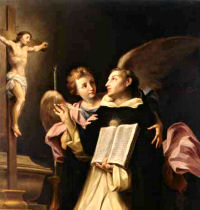 Toward the end of his life, Saint Thomas
Aquinas, one of the greatest minds the Church has ever known, was writing a
treatise on the Eucharist, struggling to complete it. In great frustration, the quiet man of God
threw his text at the foot of a crucifix, asking the Lord what he thought of
what he had written.
Toward the end of his life, Saint Thomas
Aquinas, one of the greatest minds the Church has ever known, was writing a
treatise on the Eucharist, struggling to complete it. In great frustration, the quiet man of God
threw his text at the foot of a crucifix, asking the Lord what he thought of
what he had written.
