Showing posts with label Preaching. Show all posts

30 October 2015

No, Saint Francis didn't say it!

An unfortunate anti-proverb - for lack of a better word - is frequently attributed to Saint Francis of Assisi: "Preach the Gospel at all times; use words when necessary" (or something along those lines; the exact wording changes from time to time), as we frequently see on internet memes.

Many people are quite of fond of these words because - let's be honest - they mean they do not have to really do anything to preach the Gospel; all they have to do is be a good person, which they generally already think they are. But if, as Saint Paul says, "faith comes from what is heard," these words attributed to the Poverello ring false (Romans 10:17).

It's curious that so many people like these supposed words of Francis, but also love so very much his preaching to the birds:


It's as if we are not supposed to preach the Gospel to human beings, but we are to preach it to animals. This, of course, is ludicrous.

Let us ask a simple question: How can one preach the Gospel without words? By holding the door for someone? Can an atheist not do that? By contributing to a food collection? Can a Buddhist not do that? There must be more to it than simple actions. This is why Saint Paul says, "If I preach the Gospel, this is no reason for me to boast, for an obligation has been imposed on me, and woe to me if I do not preach it (I Corinthians 9:16)! The same obligation has been imposed on every member of the baptized!

That Saint Francis never uttered the horrible words attributed to him has been repeatedly demonstrated (here is a post refuting it from 21 May 2009); nevertheless, it is frequently repeated even by those in Sacred Orders.

Writing today in The National Catholic Register, Glenn Stanton seeks to set the record straight yet again by reminding us of what Tomaso de Celano, the first biographer of Saint Francis, records about the holy man of God:
His first biographer, Thomas of Celano, writing just three years after Francis' death, quotes him instructing his co-workers in the Gospel thusly:

The preacher must first draw from secret prayers what he will later pour out in holy sermons; he must first grow hot within before he speaks words that are in themselves cold.

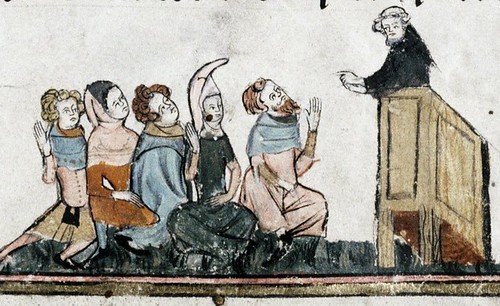
Our man clearly spent a great deal of time using his words when he preached, “sometimes preaching in up to five villages a day, often outdoors. In the country, Francis often spoke from a bale of straw or a granary doorway. In town, he would climb on a box or up steps in a public building. He preached to . . . any who gathered to hear the strange but fiery little preacher from Assisi.” He was sometimes so animated and passionate in his delivery that “his feet moved as if he were dancing.”

We must know that it's simply impossible to proclaim the Gospel without words and of course our good Francis knew this as well as any. The Gospel is inherently verbal, and preaching the Gospel is inherently verbal behavior [more].
If Saint Francis normally preached using words, why we would he tell others to preach - even if it were possible - without them?

29 April 2015

What is a boring homily?

The ever-witty Eye of the Tiber posted yesterday a new article about a new Catholic app, one that many likely wish actually existed:
The Vatican announced this morning that they have launched “CrapHom,” a new app for iPhone and Android that allows Catholics to view which local parishes will have the lamest homilies and which will have the least lame homilies [more].
The bit of satire comes only a few days after the Holy Father Pope Francis admonished a group of deacons he was about to ordain that their homilies not be "boring":
And this is the nourishment of the People of God; that your sermons are not boring; that your own homilies reach people's hearts because they come from your heart, because what you are saying is truly what you have in your heart [more].
This was not, of course, the first time His Holiness criticized preachers for preaching "boring" homilies. When he visited Assisi in October 2013, he said to a gathering of clergy, "Away with these never ending, boring homilies that no one understands. This is for you!" I'm not sure how many homilies actually meet those three characteristics. Not every long homily is boring and not every short homily is interesting, nor is every brief homily understandable.

Everyone - so far as I am aware - agrees that boring homilies should be avoided at all costs. The difficulty, though, comes in defining just what a boring homily actually is.

When the Homiletic Directory was released a few months ago, His Excellency the Most Reverend Arthur Roche, Secretary of the Congregation for Divine Worship and the Discipline of the Sacraments, said that within the homilies of Pope Francis "there is nothing boring. There is always something that challenges people. This is the point.” But I know plenty of people who are bored by challenging homilies, if for no other reason than they do not want to change and only want to be told that everything is fine.

Whenever I listen to a homily and see the preacher has a prepared text, I automatically listen with interest because I know he has taken time to consider what he will say. Others, though, see a prepared text and cringe because they find such texts boring and claim the preacher isn't preaching from the heart (because it is apparently impossible to put heartfelt words on paper).

Others find homilies in which the preacher tells a few jokes or shares personal stories to emphasize his point to be interesting. I, on the other hand, cringe when a preacher starts talking about himself and find such homilies rather tedious (which is maybe worse than being boring).

Each of us knows a boring homily when we hear one, but it would be impossible to define the characteristics of a boring homily. It might be possible to create some sort of a venn diagram describing the principle characteristics of boring homilies, but even this might not be so easy.

We too often forget that so much of what makes a homily boring is entirely subjective; if a person does not want to hear the Gospel, now matter how interesting others might find the homily, such a person will most always find it boring.

Saint Augustine was bored by many sermons of his day because of their lack of good rhetoric (as is often the case today). He found such a good use of rhetoric in the preaching of Saint Ambrose and was converted because of the beauty of his words. Even so, most people today would find the sermons of Saint Ambrose boring, the same sermons which converted Augustine.

Indeed, even in the earliest days of the Church there were those who found the preaching of others boring, even the preaching of the Apostle Paul:
On the first day of the week when we gathered to break bread, Paul spoke to them because he was going to leave on the next day, and he kept on speaking until midnight. There were many lamps in the upstairs room where we were gathered, and a young man named Eutychus who was sitting on the window sill was sinking into a deep sleep as Paul talked on and on. Once overcome by sleep, he fell down from the third story and when he was picked up, he was dead (Acts 20:7-9). 

Don't worry; Paul brought him back to life. Notice that it was only Eutychus who fell asleep; the others were, presumably, interested in Paul's words.

The quality of much preaching today is certainly in need of improvement, but I'm not sure focusing on making not boring is the answer; doing so runs the risk of striving to make them interesting, which too often falls to focusing on the preacher. We should seek instead to proclaim Jesus Christ; it would be hard to say that he is boring.

11 February 2015

UPDATED: Despite presentation Tuesday, Homiletic Directory not available until Thursday (but it is on the web site of the Diocese of Davenport)

At the very least, living in the Eternal City is rarely boring. In fact, it is often quite frustrating.

As is now well known, having been widely reported, the Congregation for Divine Worship and the Discipline of the Sacraments presented yesterday the new Homiletic Directory, which was signed last June. What took so long for the actual presentation is anyone's good guess.

During the presentation of the document, it was specifically noted that,
Translations into the principal languages have been undertaken by this Dicastery, while translations into other languages remain the responsibility of the concerned Conferences of Bishops. All things to the contrary notwithstanding.
Given that one of the principal languages is English, and since the news organ of the Holy See specifically announced that "the 'Homiletic Directory' is available both in English and Italian," I set out last evening to pick up a copy a that Vatican Bookstore before going to dinner with the priests and seminarians of the Diocese of Springfield in Illinois who are now in Rome.

When I entered the store, I was quite surprised not to see any copies of the Homiletic Directory (in either English or Italian). After looking around a bit more carefully with still no success, I asked one of the sales associates. She informed me that the Homiletic Directory is not actually available until Thursday. She did not offer a reason why.

By now, this should not at all have surprised me.

Yet it did.

Wouldn't this have been good to note during the actual presentation of the document? Isn't this detail worthy of inclusion in the news report?

Who presents a document before it is available? Where is the sense in this? Who thought this was a good idea? Is this just another Vatican media blunder?

The text - in any language - is not even available yet on the Vatican web site.

UPDATE 1: A link to the text of the Homiletic Directory was shared with me on Twitter. Though the text is not on the Vatican web site, it is on the web site of the Diocese of Davenport, thus making the entire situation all more bizarre and puzzling.

UPDATE 2: The text is also available on the web site of the Diocese of Lansing.

24 December 2010

A short homily?

Said Pope Saint Gregory the Great one Christmas day:

Because [by the Lord's bounty] I am going to celebrate the eucharist three times today, I can comment only briefly on the Gospel lesson. But [our Redeemer's] birthday compels me to say something, however short (Homily 7, in Forty Gospel Homilies).

Today I am tempted to follow his example, and likely will.

Because the churches of my three parishes are not quite large enough to hold all of the faithful who will attend - hopefully prayerfully and joyously - the Christmas celebrations in one Mass each, I am celebrating - God willing - five Masses for Christmas: 4:00 p.m., 7:00 p.m., 12:00 a.m., 8:00 a.m. and 10:30 a.m.

I had intended to preach three separate homilies: one at the two Vigil Masses, one at the Midnight Mass on the maxim "what is not assumed cannot be redeemed," and one at the Christmas Day Masses on the victorious Light of the World. I simply do not think I will have the strength to do so.

Pope Gregory would deliver a shorter sermon, but not lessen the ceremonies of the Liturgy. I will do as he has done.

14 December 2009

Standing or sitting? Chair or Ambo?

In my post over the weekend about the scaffolding in the sanctuary, I mentioned that "ordinarily I preach from the chair."

Peter, who blogs at Ubi Petrus, raised the following question:

I've only heard of Bishops preaching from the chair (or, in their case their Cathedra). Is this generally allowed for anyone or is it a special allowance given your health? I'm just curious as I've never seen it done before.
His is a question I thought others might as well.

According to the General Instruction of the Roman Missal, "the priest, standing at the chair or at the ambo itself or, when appropriate, in another suitable place, gives the homily" (n. 136).

Not only is it licit for a priest to preach from the chair, it would seem that the ordinary place from which to preach is the chair, even though most homilies are given today from the ambo.

Only rarely do I preach away from the chair or ambo, moving about as some priests do, since that would seem to be a series of suitable places and not one place. That, and it just drives me crazy; I hate having to follow someone moving about when I'm trying to listen to them and I know I am not the only one (I also know there are those who prefer a moving target).

The distinction that Peter raises, I think, rests on the posture of the priest who is preaching; is he sitting or standing?

A priest is to stand at the chair when he preaches. A Bishop, on the other hand, according to the Ceremonial of Bishops, "gives the homily seated in the chair (cathedra), unless he prefers some other place in order to be easily seen and heard by all" (n. 142).

We see, then, that priests preach standing while Bishops preach seated, in keeping with the ancient custom of teachers.

And then there is me.

This past April, I wrote to the Most Reverend George J. Lucas, now Archbishop of Omaha, requesting permission to preach while seated in the chair, on occassion, for reasons of health. At the time, my arthritis was acting up quite painfully in my hips and I am under no disillusion that the arthritis will go away any time soon.

His Excellency answered my request, saying, "I give you permission to preach the homily at Mass while seated, when you feel that this is necessary. I will leave that to your judgment." As I understand it, this permission remains in force, unless another Bishop should revoke it.

Prior to making my request to then-Bishop Lucas, I had already preached while seated two or three times because of my arthritis, hence the reason I wrote to him in the first place.

I find it much easier to preach while seated. It feels, to me, at least, more natural and I think my delivery comes across more easily, comfortably and enthusiastically.

I did preach from the ambo Saturday evening, but found I didn't like it at all and returned to the chair on Sunday morning. The ambo just seems to get in the way.

22 April 2009

Track meets and homilizing

This past Saturday I travelled with the track team to a meet in Pana, Illinois. We left Effingham about 7:30 a.m. (I think) and I returned to Effingham right about 4:00 p.m.

The track at the Pana high school is surrounded by a field of grass where the various teams set up camp, as it were, with tents and blankets. The whole scene reminded me of a fair, or a battle field (I often think in medieval terms).

The whole day proved to be a most enjoyable one. There is something about simply camping out all day that adds a light-hearted feel to the day.

The tent we had could be raised to two levels, one being half-way (about 3 feet high) and the other fully extended (high enough to walk under the tent). Naturally, we initially set it up high, but about an hour later one of the boys said something to the effect that it would be more fort-like if we lowered it, so we did. It was actually a pretty good idea because it also helped keep the sun out. I didn't think to take a picture of the tent, but this gives you a pretty good idea of what we did:


I always bring a camera to long events such as this because it adds one more distraction for the boys and another way to keep occupied.

I spent a good part of the day under the tent working on my homily for the Sunday Mass. It's a process that typically takes anywhere from two to five hours, depending on the readings and when or how thoughts occur to me for it.

The work usually begins on the preceeding Sunday afternoon. I read the coming Sunday's readings and then on Monday I read them again. The readings sort of perculate in my mind for a few days as I wait for some form of inspiration to hit me as I read through a few commentaries and other books.

This particular Saturday nothing really came to mind until I was sitting under that tent. Fortunately I brought my pad with me to start writing. As I wrote the notepad was passed around a few times and the boys offered their suggestions (all of which, I think, were rejected; they kept saying something about making it shorter, and shorter, and shorter).

I usually start out jotting down a few thoughts on paper, which at some point turn into sentences and a few paragraphs. Once I have my thoughts flowing I hop onto a computer and type what I've written, adding thoughts here and there.

Once the typed version nears completion I print it out and scribble all over it. After typing the new scribbles, I print it and scribble again, which then usually leads to the final version.

03 March 2009

Peace, joy and pancakes

Msgr. Georg Ratzinger, brother to Pope Benedict XVI, once said that life “can’t all be peace, joy and pancakes,” noting that one “has to expect resistance.”

His is a phrase that has long stuck with me and, in the past couple of days, has come to fore of my thoughts.

After Mass Sunday morning a parishioner confronted me in the aisle and upbraided me for my preaching. She argued few people get anything out of my homilies (whatever that should mean) and that I needed to put my text down and speak “from the depths of my pain to her pain” (how that would have connected to the readings of the day I do not know).

I mentioned to her that I know that many people very much enjoy my homilies because they tell me so after Mass, around town, through e-mail and Facebook and through other means. She disagreed.

I neglected to say – probably wisely – that her second claim was rather self-centered and that I could not simply speak directly to her but had to speak to a great number of people, each in different circumstances. At the same time, the point of a homily is not to talk about myself.

In addition to this, she was presumptuous enough to declare that the motivation with which I preach with a text was to let people know how much I know. When I disagreed with this audacious claim she retorted, “Yes, you do.” I simply turned and walked away, offering to meet with her another time. I don’t expect she’ll take me up on the offer, though it still stands, if a greater degree of civility will be given me.

In reality, I preach with a text to keep me on task and point. I have a great tendency to follow every tangent and generally forget where I came from or how the tangent came about in the first place. Preaching with such a tendency is not helpful, for such reason I use a text on Sundays and holydays.

Yesterday morning a letter was found for me in the lobby of the parish center. It, too, upbraided me for preaching with a text, telling me both that my homilies were poor but that I am also a good preacher (I’m confused about that and will hopefully respond to the letter later today).

The encounter on Sunday left me very upset for the rest of the day, despite the assurances of many people, most notably those in the RCIA. Monday’s letter did not help. Both the encounter and the letter started with a direct attack against me, both of which seemed to me and to others completely unwarranted. Both individuals seem angry that I do not speak directly to them. If they want me to do so they should simply contact me and I will do so.

Last night as I was considering all of this and remembering the words of Msgr. Ratzinger, one of the high school students sent me an instant message on Facebook. He began, saying [punctuation and capitalization added]:

Hey, what’s up?
That was a rockin’ homily Saturday night.
That was all I needed.

30 May 2008

Regretful reading

Do you ever regret something that you read that was truly moving and perfect?

In preparing for Sunday's homily I read a homily the Holy Father preached some time ago about building a house on rock.

This is not an uncommon practice for me. I often read what Pope Benedict XVI has said on passages on which I'll be preaching, with the aim of picking up a nugget or two to expound upon. Sometimes, though, there simply are no nuggets, only one beautifully crafted homily. In such sitations the only option I see is viable is to adapt the Pope's homily to my congregation.

This weekend, this will not be so easy because this weekend is Committment Weekend for the Built on Faith, Renewed in Hope campaign.

Parishioners across the Diocese will be asked to fill out pledge cards for the campaign (I'll blog more about this tomorrow sometime, I hope). Consequently, I wanted to preach a shorter homily than usual, but this homily of the Holy Father has captivated me.

Not only is it a longer homily than I wanted to preach this weekend, it's also a bit longer than my normal homilies, though I doubt anyone will notice (except those who aren't really listening anyway; and they're never happy).

I've tried to return to the homily that I started earlier in the week, but I can't bring myself away to the Pope's homily. Oh, what is a priest to do?

There must be a way to shorten the homily without losing its beauty... Saint Anthony, lend me your tongue!

25 April 2008

Plagiarized preaching?

There's an interesting - and very sad - story in Poland that apparently has parallels in the U.S., though I've not heard it yet.

Apparently some priests and Protestant ministers are being accused of plagiarism in the pulpit by "lifting" homilies and sermons that others have first preached.

The problem seems severe enough (?) that the Polish Bishops published a book, To Plagiarize or Not to Plagiarize, that seeks to show priests how to draw inspiration from other sermons without copying them word for word.

This entire "situation" is sheer nonsense!

Why did Saint Augustine of Hippo first record his sermons and disseminate them to his priests? Precisely so they would have something worthwhile to say while they preached!

Why did Saint Anthony of Padua write his sermons down? So they could be shared with other priests and used as a preaching tool (you could never simply preach his sermons as he really only gives strong outlines, and prayers).

Let's be honest. We know that the meaning of any one text of the Sacred Scriptures can never be exhausted, but because of that very same fact no one preacher can ever see the Scriptures from every angle. We need the help of others to help us see things more fully, more clearly, more profoundly. And sometimes it just so happens that another person can say something far better than I and so I use their words.

Now, in the text of my homilies, you'll notice that when I can I always give the appropriate references in a footnote (sometimes a quote comes to mind but I can't quite remember from whence it came), more for my future benefit than for any other reason (you never know when I might want that quote again).

When I preach the homilies I almost never make reference to the fact that what I am about to say is not my own. Why? Because the eyes of half of my congregation glaze over at the words, "So-and-so said..." (in whatever form I say them).

I'm not sure why, but when I start to quote from someone - anyone - a great number of people stop listening. When I, on the other hand, hear a preacher quote from another person I listen all the more intently, especially if the quoted person is a Saint or a Pope, because then it is clear that the priest has prepared his words and that his thoughts are not simply his own.

We have been given a Sacred Tradition and it is always comforting to me to fall back upon the faith of those who have gone before us, to learn from them and to hear their wisdom.

Let's be honest on another level: some priests and deacons simply are bad homilists. Why should they not use the words of another to rouse the people to faith? Simply because the words are not his own in no way implies that he does not believe them, that they do not convey the conviction of his heart. It would seem to show rather the opposite, that he cares so deeply that he wants to deliver a word to fan the flame of faith.

N.B.: If any priest or deacon wishes to use my homilies in full or in part, you have my permission to do so. They certainly aren't to the quality of St. Augustine or St. Anthony, but they may be helpful. That is why I post them.

If others who post their homilies or sermons on-line don't want others to use them, perhaps they shouldn't post them in the first place.

28 August 2007

The Paduan on preaching

Saint Anthony of Padua has a few excellent words on what people expect from homilies. Even though he spoke and wrote them some eight hundred years ago, he is still quite right:

Nowadays, preachers and congregations are so shallow that if a sermon is not full of polished and studied phrases [read "cliches"], and a dash of novelty [read "I'm OK, you're OK"], they are too critical to take any notice of it.

27 August 2007

Woe to me if I do not preach the Gospel...

Some of you have asked for the comments regarding, particularly, this past Sunday's homily. Only two have thus far come to me, both negative, one from someone who heard the homily and one from someone who has a lot of connections in town and is hearing quite a bit.

The gist of the comments, as I understand them since only two people actually came to me, can be boiled down to this: they are tired of the "doom and gloom," and that I keep preaching about things that have been the way they are "for generations."

Now, I don't exactly recall preaching doom and gloom, so I went back to look through the homilies that have I preached the past few weeks.

Three weeks ago was the homily I preached against underage drinking, especially against parents giving their underage children alcohol, resulting from a party being held for our outgoing college freshmen at the home of a set of parents. The Gospel happened to be the one about the thief breaking into the house. I remember saying that the thief, in this case, hadn't broken into the house, but was welcomed in through the front door to steal the purity of the youth! I made the connection with the baptism of their children, when parents are instructed: "See that the divine live which God gives him (her) is kept safe from the poison of sin, to grow always stronger in his (her) heart. If your faith makes you ready to accept this responsibility, renew now the vows of your own baptism" (Rite of Baptism, 93). I also said that the parents in this case simply handed their children the cup of the poison of sin and said, "Here, drink up. At least you're safe in my house."

Two weeks ago, using the Gospel where Jesus says, "Do you think that I have come to establish peace on the earth? No, I tell you, but rather division," as my springboard, I reminded the parishioners of who Jesus truly is. I also reminded them that nothing must come before Christ Jesus, not even our families.

This past Sunday, of course, I reminded the people that nobody should be receiving Holy Communion unless they have come spiritually prepared, again using the Gospel as my springboard.

Now, if these three topics are filled with "doom and gloom" it must be said that the Gospels themselves are nothing but doom and gloom!

It must be remembered that, as Chris Padgett likes to say, Jesus doesn't call us to a life of mediocrity. He requires that we make a decision either for or against him, and for this reason he says: "I wish you were either cold or hot. So, because you are lukewarm, neither hot nor cold, I will spit you out of my mouth" (Revelation 3:15-16). I would suggest that Jesus will treat those who have rejected him more favorably than those who remained apathetic toward him.

At any rate, I cannot help but recall the beautiful line from Saint Paul:

If I preach the gospel, this is no reason for me to boast, for an obligation has been imposed on me, and woe to me if I do not preach it! If I do so willingly, I have a recompense, but if unwillingly, then I have been entrusted with a stewardship. What then is my recompense? That, when I preach, I offer the gospel free of charge so as not to make full use of my right in the gospel (I Corinthians 9:16-18).
I refuse to water down the Gospel, because it is not mine to change or alter. I must proclaim the Gospel and I must do so in its entirety, which will sometimes mean that people will not like what they hear.

What I have preached should not disturb one who is faithful and who is doing what must be done by all who follow Christ. These faithful ones should be encouraged by what I say by recognizing that they are on the right path.

Those who are not living faithful lives will hear what I preach as offensive because they know it to be the truth.

One of the people that contacted me said this: "The kids love you. You talk to any kid, and they think you are a great guy!"

By kids, he meant high school students, and I would suggest without hesitation that they love me precisely because I am not afraid to speak the truth. I will not back down; I will not water it down. Simply consider one of the outgoing college freshmen's comments to me after my homily against the party: "That was awesome, Father!" even as several of the adults criticized me for it.
This afternoon at soccer practice one of the players and I got into a discussion about faith - as we often do - and asked, hypothetically, if he could become, say, a Baptist. I reminded him that if he did, because he knows the truth of the Catholic Church (he really does), his soul would be in grave jeopardy because by doing so he would reject Christ and his Church. His response was fantastic and left the team captain doubled over on his knees in laughter: "Father, if I never met you I probably wouldn't be going to Hell."

Now, by this he didn't mean that he truly believes he is going to Hell, nor did he mean that I am leading him astray. He is a faithful young man who wants very much to do what is right and to be faithful to Christ, but there is some truth in what he says. He is right because I don't shy away from opportunities to speak the truth, and in so doing I very often answer questions the kids have but haven't yet asked and so give them information that they hadn't yet had.

Some of the adults are apparently considering not coming back to Church if all I do is "preach at them." I simply speak the Gospel. When the Gospels turn to more "uplifting" themes, so will my homilies.

Incidentally, my homily this weekend will be about Time magazine's story on Blessed Teresa of Calcutta. (Rocco has two good posts on this here and here.)