18 November 2006

Spiritual Pilgrimage

The Knights of Columbus are sponsoring a spiritual pilgrimage with Pope Benedict XVI during the time of his upcoming visit to Turkey, November 28th - December 1st. His Excellency, the Most Revered William Lori, has composed a special prayer to be prayed each day of the pilgrimage:

Heavenly Father, from whom every family in heaven and on earth takes its name, we humbly ask that you sustain, inspire, and protect your servant, Pope Benedict XVI, as he goes on pilgrimage to Turkey – a land to which St. Paul brought the Gospel of your Son; a land where once the Mother of your Son, the Seat of Wisdom, dwelt; a land where faith in your Son’s true divinity was definitively professed. Bless our Holy Father, who comes as a messenger of truth and love to all people of faith and good will dwelling in this land so rich in history. In the power of the Holy Spirit, may this visit of the Holy Father bring about deeper ties of understanding, cooperation, and peace among Roman Catholics, the Orthodox, and those who profess Islam. May the prayers and events of these historic days greatly contribute both to greater accord among those who worship you, the living and true God, and also to peace in our world so often torn apart by war and sectarian violence.


We also ask, O Heavenly Father, that you watch over and protect Pope Benedict and entrust him to the loving care of Mary, under the title of Our Lady of Fatima, a title cherished both by Catholics and Muslims. Through her prayers and maternal love, may Pope Benedict be kept safe from all harm as he prays, bears witness to the Gospel, and invites all peoples to a dialogue of faith, reason, and love. We make our prayer through Christ, our Lord. Amen.
I encourage all of you to join with me and the Knights of Columbus in prayer for His Holiness.

Bishop Lucas on Thanksgiving

In his weekly column, "Grace and Mercy," the Most Reverend George J. Lucas gave consideration to the upcoming national holiday.

Noting that "prayer of thanksgiving is the type of prayer that most characterizes Catholic prayer," his Excellency said we give thanks "that all of creation is set free from sin and death by the death and resurrection of Christ." He continued:

This week we offer special thanks for the fruits of creation and for the truth that this world is being transformed by grace. We have our citizenship in heaven, as St. Paul tells us. Yet we live as fully as possible here, because this is where God has put us. To live fully in this world means to live in Christ, to be transformed by grace ourselves and to lead all of creation in a prayer of thanksgiving for the gifts of life and redemption. Each baptized person shares in the priesthood of Jesus Christ and is therefore able to speak a prayer of thanks to God in and through Christ, on behalf of all creation.

Any prayer of thanksgiving of ours will be shallow if we fail to take account of the burdens of our brothers and sisters, even as we count our own blessings. At a minimum, we must be aware that the peace and plenty which most of us enjoy this Thanksgiving are not the experience of so many. In particular, we must admit that peace and plenty are not ours by right, especially if they are had at the expense of others. A prayerful attitude of thanksgiving to God draws us out of ourselves and helps us see the world as God sees it.

On the State of the Parish Address

Two weeks ago I posted briefly about the State of the Parish address given by the pastor. In this week's issue of the Catholic Times is an article concerning the event.

An unexpected gift

Today in the mail I received the book Days of the Lord: The Liturgical Year: Volume I, Advent, Christmas, Epiphany. I have no idea why I received the book - it came with no note or letter - other than to assume that it is a gift from an anonymous friend (it seems to have come from someone's personal library by initials of WKR).

I have wanted this book - and the others in the series - for some time and so I say to you, my generous benefactor: Thank you!

17 November 2006

A little something to think about

His Holiness did it yet again by providing some rich food for thought at this past Wednesday Audience:

It is as if saying that the Holy Spirit, n amely, the Spirit of the Father and of the Son, becomes the soul of our soul, the most secret part of our being, from which rises incessantly to God a movement of prayer, of which we cannot even specify the terms. The Spirit, in fact, makes up for our deficiencies and offers the Father our adoration, along with our most profound aspirations. Obviously this calls for a level of great vital communion with the Spirit. It is an invitation to be ever more sensitive, more attentive to this presence of the Spirit in us, to transform it into prayer, to experience this presence and to learn in this way to pray, to speak with the Father as children in the Holy Spirit.

11 November 2006

Homily - 12 November 2006

Today Holy Mother Church presents for our consideration the story of two widows. Both women are quite poor and in dire circumstances. One we know has a young boy and neither has much money. Even so, the unexpected – and, in our estimation, the very foolish – was asked of these two women and in their responses we find for ourselves a very great challenge and the measuring rod of faith.

The first widow, and her son, clearly have eaten little or nothing for many days for she readily admits “we shall die” after they eat a small bite (I Kings 17:12). She has saved what little flour she had left as long as she could and when she can wait no longer the prophet Elijah requests her required hospitality. “Please bring me along a bit of bread,” he says to her, knowing full well, I expect, that she had none (I Kings 17:11). Nevertheless, the woman trusts in the generosity of the Lord who promised through his prophet: “The jar of flour shall not go empty, nor the jug of oil run dry” (I Kings 17:14). Through the Lord’s goodness, her flour and oil remain for an entire year, enough to feed her, the young boy, and the man of God; a remarkable feat by any standard. The widow gave everything she had to the Lord, through his prophet, and held nothing back and the Lord met all of her needs.

The second widow surely knew the story of the. When she entered the temple to offer alms for the poor and needy she gave no thought to herself but only to those worse off than she. Whereas the wealthy gave but a small portion of what was left -after they acquired everything they wanted - this beautiful widow “from her poverty, has contributed all she had, her whole livelihood” (Mark 12:44). Unlike the wealthy, the widow gave everything she had to the Lord and held nothing back and the Lord met all of her needs.

These two widows both knew that “the LORD keeps faith forever” (Psalm 146:7). Both could easily have withheld their offering and we would say they would be justified in doing so. We would commend them for being wise stewards of what little they had, but this Jesus does not do. He commends them and praises them not for their foolishness but rather for their great generosity and concern for others more than themselves.

In their poverty these two women depended upon the Lord for their sustenance and livelihood. They did not trust in their own ingenuity or cleverness, nor did they trust in what little wealth they had. In the midst of their difficulties they trusted not in themselves or in their own work, but in the Lord alone. Can the same be said of us?

There are many today who still try, as it were, to buy their way into heaven. They lack the love of the widows. You who are rich: do not trust in your wealth. The Lord will not be fooled.

If money could purchase such things, then the woman who deposited the two small copper coins would have received nothing very large. But since it was not money but rather her intention that prevailed, that woman received everything because she demonstrated firm conviction (Saint John Chrysostom, Homilies on Philippians).
The Lord Jesus did not praise the woman for her gift of money, but for her desire to give all that she had. In this way, she imitated Christ who gave himself completely to us, sparing not even his own life. In this way she is a model for us.

There are also many today who make no offering at all to the Lord, thinking their small gift will be of little or no account. Others think that the Lord will not provide all of their genuine needs if they foolishly give away their hard-earned money. They lack the faith of the widows. You who are poor: follow the example of these widows and remember the multiplication of the loaves and fish. The Lord can take a small gift freely given an make of it something truly great.

There are yet others today who consider their entrance into heaven assured simply because of themselves. They rightly make no great pretense about following Christ, but, wrongly, they make no great effort to follow Christ, either. They say to themselves,

I am a good person and have lived a good life. I haven’t killed anybody or committed adultery. I haven’t stolen a car or burned a house. I have nothing to worry about. I haven’t done anything really wrong. I don’t have any big sins.
All the while they say this they forget that they hate the person three pews away from them; they forget they are not open to God’s gift of life; they forget they live in sin with their boyfriend or girlfriend; they forget they do not meet the genuine needs of their employees or fulfill their duties at school or at work. All this they do and say, “I am a good person; what more does the Lord want?” The answer is simple: the Lord wants everything you have and everything you are.

What are you withholding from the Lord today, from him who gave everything for you? He desires your love. Will you give it to him? Your heart desires his love. Will you receive it today?

We might well ask: what enabled this widow to give away even her livelihood? I tell you, it was her love. She loved the Lord so very much and trusted so fully in him that she withheld not a thing from him but gave him everything. In this way she is a great challenge to us and a demonstration of what love truly is.


As the season of Advent draws ever closer, the season of giving also comes near. Solicitations in the stores and in the mail will increase in the coming weeks, as will our response to them. We have a tendency to throw in only a few coins here and a few coins there, all to avoid looking stingy by not dropping something in every kettle we see. Where is the love in this act? This is no act of love but of pride and arrogance. Let us then follow the example of this widow and offer to the Lord whatever he asks of us. Let us remember the words of Saint Paul: “If I give away all I have, and if I deliver my body to be burned, but have not love, I gain nothing” (I Corinthians 13:3).

07 November 2006

I've been promoted

This is a bit late, but I'll still post it.

I received an e-mail on October 10th from a dear friend in Quincy, of whose daughter, Rachel, I am the Godfather.

Rachel's Mom wrote this:

We went to our first First Reconciliation meeting last night. We talked about Baptism. Rachel said that it is neat to have the Pope be her Godfather.

State of the Parish Address

This past Sunday, 5 November 2006, marked a special day in the life of St. Anthony of Padua parish. The Rev. Msgr. Leo J. Enlow, Pastor, offered his State of the Parish Address before a gathering of some five hundred or more parishioners after the 11:00 a.m. Mass.

In his address, he focused mainly on stewardship, both the good and faithful stewardship of the past, and the need for a renewed sense of stewardship for the future.

At the conclusion of his address, he unveiled three new logos to be used within the parish: one for the parish, one for the high school, and one for the grade school.

I am having some difficulty loading these new logos, but when I figure it out I will post them.

A ministry fair followed the address, which was also very well attended.

At 3:00 p.m. a Bereavement Mass was celebrated in which we remembered our parishioners who died within the past year. At 7:00 p.m. the Dead Theologians Society met, which, all in all, made for a rather long day, though a good one.


04 November 2006

Homily - 5 November 2006

This month of November has long been given to the remembrance of the dead, and not simply to their memory but to the offering of prayers and sacrifices on their behalf. As we feel the temperatures fall and plummet, as the leaves turn their shades of colors and fall to the ground, as the grass turns brown and the darkness lengthens we see the slow death of nature and it is only fitting that we consider now our own death.

Saint John of the Cross pointedly reminds us: “At the evening of life, we shall be judged on our love” (Dichos, no. 64). Love is the measure of all things. This Jesus makes very clear today with his response to the question of the scribe:

You shall the love the Lord your God with all your heart, with all your soul, with all your mind, and with all your strength . . . You shall love your neighbor as yourself. There is no other commandment greater than these (Mark 12:29-32).
When, at long last, the dust from which we were made “returns to the earth as it once was, and the life breath returns to God who gave it,” we will indeed be judged on our love (Ecclesiastes 12:7). We will not be judged so much by what we have done or what we have failed to do, although these things will matter; what matters most is the depth of our love because love “is worth more than all burnt offerings and sacrifices.” (Mark 12:33). We will be judged according to our imitation of Christ Jesus.

When we stand before the throne of God and render to him an account of our life, “perfect love will make possible entrance into heaven, imperfect love will require purification, and a total lack of love will mean eternal separation from God” (United States Catholic Catechism for Adults, 153). The angels and saints will escort those who have loved with the perfect love of Christ into the glories of heaven. Those who have loved, although imperfectly, will enter Purgatory to be purged and cleansed of the effects of their sins. Those who have not loved will enter the gates of hell because they have rejected love itself.

Here we might well ask what it means to love. The Holy Father once said, “In the end, in fact, love alone enables us to live, and love is always also suffering: it matures in suffering and provides the strength to suffer for good without taking oneself into account at the actual moment” (Address to the Clergy of Aosta, 25 July 2005). Here Saint John reminds us: “In this is love: not that we have loved God, but that he loved us and sent his Son as expiation for our sins” (I John 4:10). Indeed, in Jesus Christ, “No longer is [love] self-seeking, a sinking in the intoxication of happiness; instead it seeks the good of the beloved: it becomes renunciation, and it is ready, and even willing, for sacrifice” (Pope Benedict XVI, Deus caritas est, 6).

How very easy – almost too easy - it is for us to say to Jesus with the scribe:

Well said, teacher. You are right in saying ‘He is One and there is no other than he.’ And ‘to love him with all your heart, with all your understanding, with all your strength, and to love your neighbor as yourself’ is worth more than all burnt offerings and sacrifices (Mark 12:32-33).
This man gives the correct answer and in so doing justifies himself; he knows he is to love God and his neighbor but he does not love either God or his neighbor fully. He will not let himself be vulnerable to love. If he were, he would have recognized Jesus not as a “teacher” but as the “high priest: holy, innocent, undefiled, separated from sinners, higher than the heavens” (Hebrews 7:26).

Jesus knows the scribe’s lack of love just as he knows our own and he says to him and to us, “You are not far from the kingdom of God” (Mark 12:34). A high compliment, maybe, but if it was, why, then, did “no one [dare] to ask him any more questions” (Mark 12:34)? The scribe felt a gentle rebuke in Jesus’ words, because “to say ‘you are not far from’ suggests that the scribe was still at some distance from the reign of God” (Psuedo-Jerome, Commentary on Mark).

Inasmuch as we fail to love, we are far from the kingdom of God. Love is the measure of distance to the Kingdom of God. How readily do we humble ourselves to accept the love of God that we do not deserve? How readily do we return his love? How readily do we show to others the love that Jesus lavishes upon us?

Sad to say, not all of us understand these spiritual values as well as we should, nor do we give them a proper place in our lives. Many of us, in fact, strongly attracted by sin, may look upon these values as of little moment, even something of a nuisance, or we ignore them altogether (Blessed Pope John XXIII, Homily at the Canonization of Saint Martin de Porres).
Now, then, we return to our initial thought from Saint John of the Cross: “At the evening of life, we shall be judged on our love.”

We know that we have not - and do not - always love perfectly as the Lord commands us. We grow jealous, we lie, steal and cheat; we grow angry and irritated at one another; we judge and condemn those who are one with us in Christ. In short, we fail to keep the supreme command of love and we fall into sin. And when we come to the end of our earthly life and suffer death we will stand before him who is Love itself.

We can be sure of this, that “all who die in God’s grace and friendship, but still imperfectly purified, are indeed assured of their eternal salvation; but after death they undergo purification, so as to achieve the holiness necessary to enter the joy of heaven” (Catechism of the Catholic Church, 1030).

We know, too, as we read in Sacred Scripture, that “it is a holy and wholesome thought to pray for the dead that they may be loosed from their sins” (II Maccabees 12:46). This is why we visit the graves of our loved ones in November. This is why Holy Mother Church celebrated only days ago the Commemoration of the Faithful Departed. This is why we continue to pray for the dead, confident in the power of intercessory prayer. The Church has always commended “almsgiving, indulgences, and works of penance undertaken on behalf of the dead” (CCC, 1032) because, as Saint John Chrysostom asks,

If Job’s sons were purified by their father’s sacrifice, why would we doubt that our offerings for the dead bring them some consolation? Let us not hesitate to help those who have died and to offer our prayers for them (Homily in I Corinthians 41:5).
Said Saint Ambrose so many centuries ago: “We have loved [them] in life. Let us not forget [them] in death.” Let us continue our love for our beloved dead – and for all the dead. Offering our sufferings out of love for them, asking the Lord to make them “perfect forever” (Hebrews 7:28) and welcome them swiftly into his Kingdom of “light, happiness, and peace” (Roman Canon). Then, together with them around the throne of God, we will cry out with the angels and all the saints: “I love you, Lord, my strength” (Psalm 18:2)!

03 November 2006

On the Saints

Below are a few quotes from the Holy Father's homily given during the Mass for the Solemnity of All Saints.

The saints are not a restricted caste of elect but a crowd without number toward which, today, the liturgy exhorts us to lift our eyes.

Many there are whose faces and names we do not know but with the eyes of faith we see them shine like stars full of glory in the divine firmament.

Gazing upon the luminious examples of the saints the great desire to be like the saints is awakened in us; happy to live near God, in his light, int he great family of the friends of God. Being a saint means living close to God, living in his family. And this is the vocation of all of us, vigorously reaffired by the Second Vatican Council, and on this day brought to our attention in a solemn way. But how can we become saints, friends of God? An initial response to this question is this: To be saints it is not necessary to perform extraordinary deeds and works, nor is it necessary to possess exceptional charisms. But this only tells us what sainthood is not. The positive answer it that to become a saint it is above all necessary to listen to Jesus and then to follow him and not lost heart in the face of difficulties.

The example of the saints encourages us to follow in their footsteps, to experience the joy of those who entrust themselves to God, because the only cause of sadness is to live far from him.

Holiness demands a constant effort but it is possible for all since it is not just the work of man but is above all a gift of God, who is thrice holy (cf. Isaiah 6:3).

In our life all is a gift of his love. How is it possible to remain indifferent before so great a mystery? How is it possible to not respond to the love of the heavenly Father by leading a life of grateful children?

Thus, the more we imitate Christ and remain united to him, the more we enter into the mystery of divine holiness.

In the measure that we accept his proposal and follow him - everyone according to his own circumstances - we too can participate in his beatitude.
And one quote from his Angelus Address:

"Eternal life," however, does not mean for us Christians simply a life that lasts forever, but rather a new quality of existence fully immersed in God's love, which frees us from evil and death and which puts us in everlasting communion with all the brothers and sisters who share in the same love.

02 November 2006

My future resting place

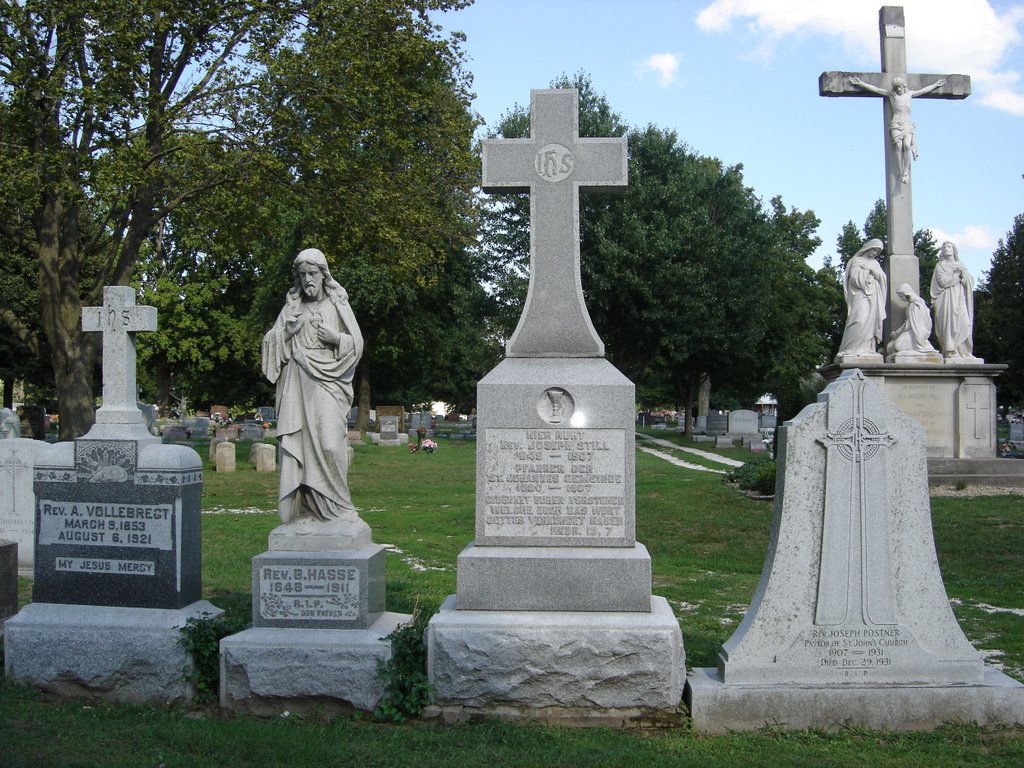
Here's a post simply for the curious. Below is a photograph of my final resting place in Calvary Cemetery in Quincy, Illinois. As I took the picture I was standing on the spot where I will be buried.

Strangely enough, I will be buried next to the founding pastor of my home parish of St. John the Baptist.

A sobering day


For many years now, the Commemoration of the Faithful Departed has been one of my beloved days in the liturgical life and prayer of the Church. While I always anticipate All Saints' Day with great joy, I anticipate All Souls' Day with a certain sadness.

On this day I naturally consider my own future death, whenever it may come (I'm hoping for death before knee replacement). But importantly, my thoughts and prayers turn always on this day to my parents, Bill and Pat. Dad has been dead now twenty years and Mom eighteen.

I look forward to the day when I will at long last see them again; and yet, I somehow know that they will embrace me and swiftly take my hands and lead me to the Lord Jesus. It will be a joyous occassion not so much because of them, but because of Jesus. This realization is for me a bitter-sweet one.

The prayers for the Mass say it all and so well:

Merciful Father,
hear our prayers and console us.
As we renew our faith in your Son,
whom you raised from the dead,
strengthen our hope that all our departed brothers and sisters
will share in his resurrection,
who lives and reigns with you and the Holy Spirit,
one God, for ever and ever.

Today is a day both of sorrow and of hope, a hope that somehow produces a joy. It is a day of one of those great paradoxes of the Christian life and faith and, as such, it is a beautiful and moving day.

Let us today recall the beautiful words of Sant Ambrose concerning the death of his brother:

Death was not part of nature; it became part of nature. God did not decree it from the beginning; he prescribed it as a remedy. Human life was condemned because of sin to unremitting labor and unbearable sorrow and so began to experience the burden of wretchedness. There had to be a limit to its evils; death had to restore what life had forfeited. Without the assistance of grace, immortality is more of a burden than a blessing. The soul has to turn away from the aimless paths of this life, from the defilement of an earthly body; it must reach out to those assemblies in heaven (thought it is given only to the saints to be admitted to them) to sing the praises of God.

Let us then raise our prayers to the Father for all of the dead remembering that "it is a holy and wholesome thought to pray for the dead that they may be loosed from their sins" (II Mac 12:46). In the words of Saint Ambrose: "We have loved [them] in life. Let us not forget [them] in death.

Eternal rest grant unto them, O Lord, and let perpetual light shine upon them. May they rest in peace. Amen.

A night at the theatre

A cast and crew from St. Anthony of Padua High School will perfom a non-musical version of The Wizard of Oz this weekend at 7:30 p.m. Friday and Saturday.

The high school producations are enjoyable and entertaining. I'm looking forward to seeing the young student thespians in action.

The Effingham Daily News has a brief article about the production here.

A royal wedding

In case you have not yet heard the news, Lord Nicholas Windsor, son of the Duke and Duchess of Kent, will wed Paola Frankopan, a British-born Croatian princess, by year's end in the church of Santo Stephano degli Abissini inside Vatican City State. Both have been received into the Roman Catholic Church from the Church of England.

With his entrance into the Church of Rome in 2001, Lord Windsor relinquished his claim, distant though it is, to the throne of England in accord with the 1701 Act of Settlement which barred any Catholic - or one married to a Catholic - from ascending the throne of England.

Her Majesty, the Queen, is said to be both "delighted" and "very pleased" about the coming marriage.

My congratulations and prayers to the couple.

More here and here.

29 October 2006

Where's the homily?

Just in case you've been looking for my homily for the weekend, you will not find it. Originally slated to be away from the parish for the weekend to attend a wedding in Quincy.

The wedding I did attend but stay away I did not. However, since I already had a priest lined up to celebrate my Masses I let him celebrate as scheduled while I am working on catching up on work.

Because I was not going to preach this weekend I did not compose a homily.

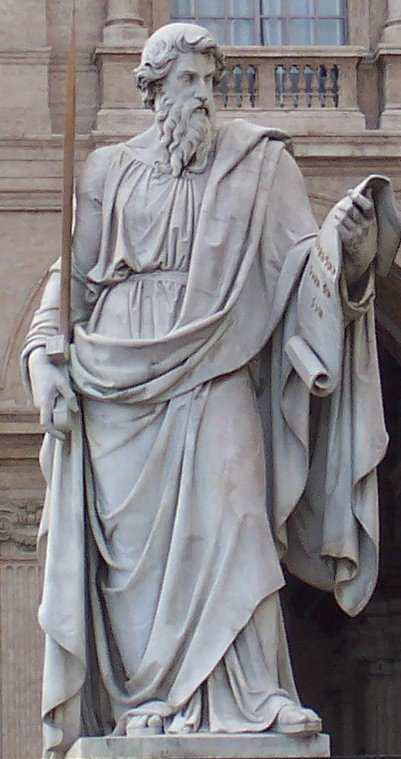
On the Apostle Paul

His Holiness reflected on the person of Saint Paul of Tarsus during his Wednesday General Audience October 25th.

Referring to Paul as "a star of first grandeur in the history of the Church," the Holy Father noted that Paul's conversion "was not the result of nice thoughts, of reflections, but the fruit of a divine intervention, of an unforeseen divine grace."

So very often we try to amend our lives and change our ways simply through our own initiative, giving all too little attention to the role of God in the change of hearts, both of our own and of others. Paul shows us, then, that we must yield to the power and love of Christ.

Indeed, "What matters", His Holiness remarked, "is to put Jesus Christ at the center of our lives, so that our identity is characterized essentially by the encounter, by communion with Christ and his Word. In his light, every other value must be recovered and purified of possible dross."

When one considers that Paul "dedicated himself to make this Gospel known," and that "difficulties were not lacking in Paul's apostolate, which he faced with courage for love of Christ," His Holiness asked, "How can such a man not be admired? How can we not thank the Lord for having given us an apostle of his stature?"

Pope Benedict XVI closed his reflections with a prayer asking the Lord to "help us to live the exhortation that the Apostle left us in his letters: 'Be imitators of me, as I am of Christ' (I Corinthians 11:1)."

24 October 2006

The agony of defeat

It is a curious thing, competition.

We spend so much time, effort and energy in preparing for various competitions, fully expecting to win and to taste the sweet glory of victory, all the while knowing that one side must win and the other must lose and suffer the agony of defeat.

Last night our soccer team played fantastically in their match against the Rochester Rockets in Raymond. They played an excellent game, far better than they played last Thursday night. Nevertheless, they lost the match after double overtime to penalty kicks.

All day Monday I was quite beside myself. I was excited about the game; me, the one who never has enjoyed sports at all. I wanted our Bulldogs to win maybe more than they did. I was even fully prepared to cancel my weekend plans to attend a wedding in Quincy to travel with them to the match(es) in Naperville and even to buy their meal on the way home (there are 20 some players on the team).

The boys kept me on the edge of my seat the entire game (I sat down after a while and wrapped myself in my cape because it was warmer than sitting). At one point I apparently let out a, "What the h__l," which quite surprised the team sitting next to me.

Still this evening I am sad at their loss. I cannot say that I am disappointed, though, because they played an exciting and awesome game. They should all be very proud of themselves; I know that I am.

Well done boys!

22 October 2006

Homily - 22 October 2006

His Holiness, Pope Benedict XVI, has declared today World Mission Sunday. He has given this day the theme, “Charity: Soul of the Mission,” a topic near and dear to his heart. In his message to mark this eightieth celebration of this World Mission Sunday, the Holy Father reminds us that,

Unless mission is animated by charity, that is, unless it flows from a profound act of divine love, it risks being reduced to a mere philanthropic and social action. The love which God has for each single person constitutes, in fact, the very core of living and preaching the Gospel, and all who hear it in turn, become witnesses (Message for World Mission Sunday, 2006, 1).
The message of the Gospel must be proclaimed to each and every person; no one can be refused the message of salvation in Christ Jesus. This is the very purpose of the Church; without this mission the Church would not exist.

The mandate to spread the message of love was entrusted to the apostles by Jesus after his resurrection, and the apostles, inwardly transformed on the day of Pentecost by the power of the Holy Spirit, began to bear witness to the Lord’s death and resurrection. From that time on the Church continues this same mission which constitutes for all believers an indispensable and permanent duty (MWMS, 1).
In all that she does, the Church seeks always and everywhere to make known that “we have a great high priest who has passed through the heavens, Jesus, the Son of God” (Hebrews 4:14).

Today Jesus warns us, “whoever wishes to be great among you will be your servant; whoever wishes to be first among you will be the slave of all” (Mark 10:43). “Every Christian community is called, then, to make God known, who is love” through service and charity (MWMS, 2). What greater act of service can there be than to make known Jesus Christ so that all people might “confidently approach the throne of grace to receive mercy and to find grace for timely help”? (Hebrews 4:16). What greater charitable gift can there be than to help ensure that every person hears the Gospel to proclaimed?

Here, we would do well to recall how salvation first came to us:

“In the beginning, man came from the Creator's hands as the fruit of an initiative of love. Later, sin obscured the impression of the divine within him.

“Deceived by the Evil One, Adam and Eve, our first parents, failed to live up to the relationship of trust with their Lord, succumbing to the temptation of the Evil One who instilled in them the suspicion that the Lord was a rival and wanted to limit their freedom.

“So it was that they preferred themselves to divine love freely given, convinced that in this way they were asserting their own free will. They consequently ended by losing their original happiness and they tasted the bitter sorrow of sin and death.

“However, God did not abandon them. He promised salvation to them and to their descendents, announcing in advance that he would send his Only-begotten Son, Jesus, who in the fullness of time was to reveal his love as Father, a love capable of redeeming every human creature from the slavery of evil and death.

“In Christ, therefore, immortal life was communicated to us, the very life of the Trinity. Thanks to Christ, the Good Shepherd who did not abandon the lost sheep, human beings of all time were granted the possibility of entering into communion with God, the Merciful Father who was prepared to welcome home the Prodigal Son” (MWMS, 2).
Precisely in the love of Jesus Christ – the love that went to the Cross and beyond - we see

love in its most radical form. It is there that this truth can be contemplated. It is from there that our definition of love must begin. In this contemplation the Christian discovers the path along which his life and love must move” (Pope Benedict XVI, Deus caritas est, 12).

“On the eve of his Passion, Jesus bequeathed as a testament to his disciples, who had gathered in the Upper Room to celebrate the Passover, the "new commandment of love - mandatum novum": "This I command you, to love one another" (Jn 15: 17). The brotherly love that the Lord asked of his "friends" originates in the fatherly love of God (MWMS, 3).

“The Apostle John noted: "He who loves is born of God and knows God" (I Jn 4: 7). Therefore, to love according to God it is necessary to live in him and of him: God is the first "home" of human beings, and only by dwelling in God do men and women burn with a flame of divine love that can set the world "on fire"” (MWMS, 3).
We are called to make our home in God so that we can announce to all people the wondrous truth that “God is love” (I John 4:16).

What then does it mean to be a missionary? What must one do to carry out the mission of the Church, a mission entrusted to each and every member of the baptized? It means simply this: “loving God with all one’s heart, even to the point, if necessary, of dying for him” (MWMS, 3).

Being missionaries means stooping down to the needs of all, like the Good Samaritan, especially those of the poorest and most destitute people, because those who love with Christ's Heart do not seek their own interests but the glory of the Father and the good of their neighbor alone. Here lies the secret of the apostolic fruitfulness of missionary action that crosses frontiers and cultures, reaches peoples and spreads to the extreme boundaries of the world (MWMS, 3).
Being a missionary means being “the slave of all” (Mark 10:).

Let us each, then, take up on the banner of the Cross and proclaim to everyone the truth of God’s love and salvation. If we truly know the Lord Jesus Christ, we will want everyone we know him, too, much in the same way we introduce one friend to another. Let us pray for the missions; let us contribute generously to the spread of the Gospel; let us not forget that we, too, are missionary persons. Let us make known the great love of God both to the far corners of the world, and to the corner of the nearest street. This is the “indispensable and permanent duty” of every Christian (MWMS, 1).

20 October 2006

An anonymous letter

Today I received what is, I believe, my first anonymous letter. The Feast of Saints Michael, Gabriel and Raphael coincided this year with what is known as “Dawg Days” at our high school. As part of the festivities, the students attend Mass and are given the afternoon free for games and contests.

This year, for one reason or another, it was not possible to celebrate Mass followed by lunch. I cannot now recall the reason, but circumstances necessitated that we eat first and then celebrate Mass, which was then followed by the games (which include a mud pit and tug-of-war match).

The anonymous letter I received reads as follows:

Dear Father Darren [sic],
I am writing this letter about Freshman and Senior day. It is my concern if these kids had a [sic] enough time between eating their lunch and recieving [sic] the Eucharist. Please check into this.

Let me first say that I do not appreciate the insinuation that I will not take their concern seriously, nor do I appreciate the author’s lack of trust. The anonymity of the letter seems to presume an ill intent on my part.

To answer the author’s concern, the Code of Canon Law states: “A person who is to receive the Most Holy Eucharist is to abstain for at least one hour before holy communion from any food and drink, except for only water and medicine” (canon 919 § 1). A further exception is given for “the elderly, the infirm, and those who care for them” (canon 919 § 3).

If this were the last word, I would indeed have acted inappropriately by offering the holy sacrifice of the Mass so soon after lunch. However, the law itself allows priests to dispense from the law in certain instances. Canon 89 states, “A pastor and other presbyters or deacons are not able to dispense from universal and particular law unless this power has been granted to them.”

Canon 919 itself does not grant me this permission, but the Diocesan Bishop has granted it. All priests in the Diocese of Springfield in Illinois have been granted the faculty “to dispense the faithful from the Eucharistic fast in individual cases and for a proportionate reason” (Faculties and Permissions for Priests, 6).

On the day in question, many of the students would have been able to observe the fast because some were able to receive their food more quickly than others. Mass also started later than expected because of a few technical difficulties. Those who did not have the required fast, I dispensed from the Eucharistic fast, as I believe I stated day.

An anonymous letter

Today I received what is, I believe, my first anonymous letter. The Feast of Saints Michael, Gabriel and Raphael coincided this year with what is known as “Dawg Days” at our high school. As part of the festivities, the students attend Mass and are given the afternoon free for games and contests.

This year, for one reason or another, it was not possible to celebrate Mass followed by lunch. I cannot now recall the reason, but circumstances necessitated that we eat first and then celebrate Mass, which was then followed by the games (which include a mud pit and tug-of-war match).

The anonymous letter I received reads as follows:

Dear Father Darren [sic],
I am writing this letter about Freshman and Senior day. It is my concern if these kids had a [sic] enough time between eating their lunch and recieving [sic] the Eucharist. Please check into this.

Let me first say that I do not appreciate the insinuation that I will not take their concern seriously, nor do I appreciate the author’s lack of trust. The anonymity of the letter seems to presume an ill intent on my part.

To answer the author’s concern, the Code of Canon Law states: “A person who is to receive the Most Holy Eucharist is to abstain for at least one hour before holy communion from any food and drink, except for only water and medicine” (canon 919 § 1). A further exception is given for “the elderly, the infirm, and those who care for them” (canon 919 § 3).

If this were the last word, I would indeed have acted inappropriately by offering the holy sacrifice of the Mass so soon after lunch. However, the law itself allows priests to dispense from the law in certain instances. Canon 89 states, “A pastor and other presbyters or deacons are not able to dispense from universal and particular law unless this power has been granted to them.”

Canon 919 itself does not grant me this permission, but the Diocesan Bishop has granted it. All priests in the Diocese of Springfield in Illinois have been granted the faculty “to dispense the faithful from the Eucharistic fast in individual cases and for a proportionate reason” (Faculties and Permissions for Priests, 6).

On the day in question, many of the students would have been able to observe the fast because some were able to receive their food more quickly than others. Mass also started later than expected because of a few technical difficulties. Those who did not have the required fast, I dispensed from the Eucharistic fast, as I believe I stated day.