Showing posts with label North American Martyrs. Show all posts

19 October 2015

Saint Jean de Brebeuf, S.J.: I felt myself drawn to Christ as to a magnet

Of the many writings of the North American Martyrs collected together in Jesuit Missionaries to North America: Spiritual Writings and Biographical Sketches, the most moving - for me - is taken from the diary Saint Jean de Brebeuf, S.J.

In the year that the Hurons turned against the Jesuit missionaries - 1637 - Father de Brebeuf offered himself to Jesus as a martyr:
...this vow, I repeat, my Lord Jesus, that if you most generously offer me the grace of martyrdom, me, your unworthy servant, I will never reject this favor. Never will I permit myself either to avoid the occasions of death that may present themselves (at least insofar as I judge these to be for the greater glory of God) or to withhold a joyful acceptance of the blow when it is struck. And so, my Lord Jesus, beginning with today, I joyfully offer you my body, my blood, my spirit, so that - if such be your holy will - I may die for you, who have deigned to die for me. Help me to live in such a way that you will allow me thus to die. Yes, Lord, I take the cup and will invoke your name: Jesus, Jesus, Jesus!
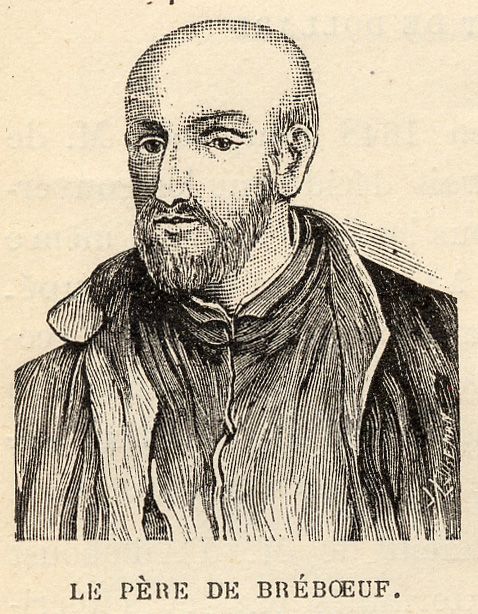
Three years after he wrote these words, Father de Brebeuf was making his annual retreat when he experienced a mystical vision on 14 February 1640. He describes it thus:
On the fourteenth, during the time of meditation, it seemed to me that I saw Christ our Lord hanging on the Cross and coming toward me as if to remove the burden from himself and place it on my shoulders. I willingly offered my body, but I do not know what happened. I know only that I saw, as it were, a corpse snatched from the Cross, but it no longer had the same appearance as before. It was completely covered with leprosy, "having neither beauty nor comeliness." Nevertheless, I know it was the body of Christ our Lord, because the wounds in the hands were quite evident. My thought then was that in our meditations Christ Crucified should not be considered as he is usually represented, but as a "leper; there is not beauty in him, nor comeliness" (Isaiah 53:4, 2).

Toward evening on that same day, when I was preparing to meditate on Christ's perfections and on the many different relationships that he had with me and that I, miserable wretch, had with him, the thought came to me that all the aspects of his extraordinary love for us should be referred to this charity as to a central point. At once I seemed to see an immense rose window, breathtaking not only for its size but also for its variety, yet even more because all its beauty seemed to emanate from the center.
Unlike Simon of Cyrene, whose body was forced to carry the cross for the Lord, Father de Brebeuf willingly offered his body for this task, so great was his love for Jesus.

We are often deeply touched by the desire of the Saints to ease the burden of the Lord and our hearts are warmed when we see an image of Saint Francis of Assisi receiving the body of the Lord from the cross. But how willing are we to receive the cross from the Lord, and even to be placed on it ourselves?
In a letter written to a confrere on 28 October 1637, Father de Brebeuf expressed his trust in the divine will:
If it is his holy will that at this hour we should die - oh, fortunate hour for us! And still, if it be his will to reserve us for other labors - may he also be blessed! If you should hear that God has crowned our insignificant labors, or rather, our desires, help us to bless him, for it is only for his sake that we desire to live and to die. It is only he who can give us the grace to accomplish this.
Let us ask Saint Jean de Brebeuf to intercede for us. May he teach us to love Jesus Crucified above all us and to resign ourselves to the divine will in joyful trust.

Saint Charles Garnier, S.J.: Protest to Jesus that you are his

In a letter written to his brother on 23 June 1641, Saint Charles Garnier, S.J., one of the North American Martyrs, wrote of the source of his strengthen in the mission field among the Hurons:
But the source of all sweetness and the whole support of our hearts is Jesus in the Blessed Sacrament. Do not say that you do not relish this Bread of Life; it is good to converse with God for some time after Holy Mass and to visit him in the Blessed Sacrament when your occupations permit you to do this. Let us adore and embrace him; let us protest to him that we are his in spite of ourselves, and let him do with us what he pleases.
Seven and a half years later, the Iroquois killed him with a shot from a musket.

Without daily attendance upon the Blessed Sacrament, without gathering daily in the presence of the Eucharistic King and gaining strength from him, the witness of the North American Martyrs would have been impossible.

Daily did Father Garnier protest to Jesus that he belonged to him, despite his weakness and sinfulness, and, in the end, he showed protestations to be true. Having tasted the sweetness of the Bread of Life, Father Garnier's heart was supported in the final moments of his life when he was indeed claimed by the Lord as his own. May Saint Charles intercede for us and teach us to savor the sweetness of the Bread of Life.

The sufferings of Saint Isaac Jogues

When I returned to Chicago last September for the conclusion of the diocesan investigation into the life of the Servant of God Father Augustus Tolton, I picked up a copy of Jesuit Missionaries to North America: Spiritual Writings and Biographical Sketches by Francois Roustang, S.J. and translated by M. Renelle, S.S.N.D. (San Francisco: Ignatius Press, 2006). I am glad I did and recommend it to you highly.

As I read through the biographical sketches of the eight martyrs of North America, I was struck by the boldness of their faith and by their love for those who abused them so severely. Their spiritual writings continue to provide inspiration and, as it were, much food for thought. This is an important part of the history of North America and of the Church that were too lightly of.

As we celebrate today the memorial of Saints John de Brebeuf, Isaac Jogues, and Companions - the North American Martyrs - it is good for us to consider just what these martyrs suffered and they did so.

In a lengthy letter written to his provincial on August 5, 1643, Saint Isaac Jogues described the tortures he and others suffered for the name of Christ at the hands of the Iroquois. The letter makes for rather difficult reading, but doing so is necessary to understand the faith not only of Jogues, but of his companions, as well.

What follows, then, are excerpts from this lettering pertaining directly to the wounds inflicted upon him:
Others [of the Iroquois] then fell upon me, tore off almost all my nails, and gnawed off my two index fingers with their teeth -- all of which caused me incredible pain. They did the same to Rene Goupil but left the Hurons unharmed....

But what seemed to me the cruelest of their torments was that, when we were exhausted after five or six days of traveling, they came up to us with no semblance of anger and in cold blood tore out our hair and our beards and scratched us deeply with their fingernails, which they keep sharply pointed, in the most tender and sensitive parts of our bodies. All these sufferings were external, however. My interior sufferings were much more intense when I saw that sad procession of Hurons, now slaves of the Iroquois. Among them were many Christians, five of them converts of long standing and pillars of the infant Huron Church....

First they gave thanks to the sun god, to whom they ascribe success in wars. Then they fired their muskets as a sign of good fortune. Each one then went into the nearby woods to cut clubs with which to beat us. They ordered us to get out of our canoes, and having arranged themselves in two parallel rows, they forced us to "run the gauntlet" between them, beating us ferociously with their cudgels....

Then they ordered me, scarcely breathing, to come down from the platform; and again heaping upon me insults and opprobrium, they covered me once more with innumerable blows on the head, the neck,  and the rest of my body. This letter would be too long if I were to try to enumerate in detail what we French had to bear. They burned one of my fingers and crushed another with their teeth. They twisted my other fingers - the ones they had already chewed on - and so strained the ligaments that even now, though healed, they are still frightfully deformed. But the lot of my companions was not any better....

But even more agonizing than my physical sufferings was the sight of my poor Hurons suffering like torments, especially Eustache, whom they tormented most cruelly. They had torn off both his thumbs and through the wound in his left hand had trust a pointed stick all the way up to his elbow....

The first ones told us, by way of greeting, that we were to be burned over a slow fire. The next group welcomed us with sticks, blows, and stones. And because they have an extreme aversion for a man whose hair is sparse and short, a veritable tempest exploded, particularly on my bald head. I still had two fingernails. These they now tore off with their teeth, and with their own sharp fingernails laid bare the bones of my poor fingers....

They beat us not only with sticks but with with whips having metal pieces at the end. They have a great number of these, having obtained them from the Europeans. In addition to the whip lashes, one of the chiefs had a lump of iron the size of his fist tied to the end of a rope. He gave me and my companions a blow with it that almost felled me to the ground. The only thing that kept me from fainting and that sustained my strength and courage was fear that he would strike me with it a second time....

One old man led a woman towards me and commanded her to cut off my [left] thumb....

They threw coals and live embers on our bare flesh. We could not throw them off because our hands were bound. this is the way the Iroquois apprentice their youth to cruelty and accustom them gradually to greater tortures....

As for me, they hung me in the middle of the cabin by the upper part of my arms, which they fastened to two stakes, one on each side, using as ropes some bark that they had taken from the trees.
In the end, the Iroquois killed Father Isaac Jogues, S.J. with a tomahawk.

Despite the tremendous and extended sufferings he endured in fidelity to the name of Jesus, Father Jogues was able to say, in the midst of his tribulations: "I thank you, Lord Jesus, that I have learned from this slight test how much you deigned to suffer for me on the Cross when the weight of your whole body was suspended not by ropes but by your hands and your feet cruelly pierced with nails."

Early on in his letter, Jogues acknowledged that he did not have to accept the assignment to the missions among the Iroquois, but he accepted it willingly out of love Jesus and for the salvation of the Iroquois. When the Cross was presented to him, he did not run away from it but instead embraced it. 

In another letter written just a few weeks before his martyrdom, he asked, "When shall I begin to give myself completely to him who has given himself to me without reserve?" The many sufferings he received culminated in his death; in the end, he gave himself to Jesus completely. May he intercede for us and teach us to do the same.