17 December 2006

Homily - 17 December 2006

Today Holy Mother Church says to us: guadete in Domino semper, “rejoice in the Lord always” (Introit; Philippians 4:4)! Today we put aside the violet vestments symbolizing our desire and need for sincere repentance and we take up the rose vestments of quiet rejoicing because “the Lord is near” (Introit; Philippians 4:5).

We know that the Lord is coming; his advent is near indeed. We have been – or at least we should have been – preparing ourselves these past two weeks to welcome him with great joy. From whence does this joy come? It comes from a life and faith lived in “festive seriousness.” We are to be festive, to be joyful, because, as Zephaniah reminds us, “The LORD, your God, is in your midst, a mighty savior” (Zephaniah 3:).

But how can we be festive if we know that, as John the Baptist warns us, the Lord holds his winnowing fan in his hand? How can we be festive if we know that the Lord is coming to separate the wheat from the weeds (cf. Matthew 13:24-30) and the sheep from the goats (cf. Matthew 25:31-46). How can we be festive knowing that not all of our fruit is good (cf. Matthew 7:16)?

We can rejoice in the Lord always, we can live in this festivity, if we have worthily prepared for his coming. If we have made the most of these days and truly examined our lives, comparing them to the teachings of Christ, if we have sought his mercy through the Sacrament of Penance, of Reconciliation, then we have prepared for his coming and we “have no further misfortune to fear.”

For this reason the prophet tells us: “Fear not, O Zion, be not discouraged! [The Lord himself] will rejoice over you with gladness, and renew you in his love, he will sing joyfully because of you, as one sings at festivals” (Zephaniah 3:16-17).

The Lord will rejoice over us in the same way that the widow rejoiced over the coin she lost and then found again (cf. Luke 15:9). He will rejoice over us in the same way that the shepherd rejoiced over the lost sheep he found (cf. Matthew 18:13). The Good Shepherd will place us upon his shoulders and take us home. This we know; this is the cause of our rejoicing, of our rejoicing. At the same time, however, we know that we do stray from the shepherd, that we do get lost.

To those who have not used these weeks to properly prepare for the Lord’s return John the Baptist tells us what to do in order to be found:

Whoever has two cloaks should share with the person who has none. And whoever has food should do likewise… Stop collecting more than what is prescribed… Do not practice extortion, do not falsely accuse anyone, and be satisfied with your wages (Luke 3:11-14).
Whoever follows the instructions of the Baptizer – of Elijah who is come – lives in justice and in righteousness. Whoever follows the words of John follows also the words of Christ: “Whatever you did for one of these least brothers of mine, you did for me” (Matthew 25:40).
In that crowd of common people who came to John the Baptist asking him, “What should we do?,” we hear the question of every person who has ever lived and who will live (Luke 3:10).

Do we not all ask the Lord, “Teacher, what should we do (Luke 3:12)?” We ask this question because we know that “one mightier than [John] is coming” (Luke 3:16). We know, too, that “his winnowing fan is in his hand to clear the threshing floor and to gather the wheat into his barn, but the chaff he will burn with unquenchable fire” (Luke 3:17). When he comes on the last day to judge the living and the dead we want to be prepared and ready to enter the heavenly kingdom with him. We want our fruit to be good, not bad; we want him to carry us home and so we must prepare.

To those who have used this holy season well, the Prophet Zephaniah exclaims:

Shout for joy, O daughter Zion! Sing joyfully, O Israel! Be glad and exult with all your heart, O daughter Jerusalem! The LORD has removed the judgment against you; he has turned away your enemies; the King of Israel, the LORD, is in your midst, you have no further misfortune to fear (Zephaniah 3:14-15).
What greater cause of rejoicing can there be?

By his grace and call we know and hear the voice of the Shepherd (cf. John 10:14) calling us to himself, saying, “I will come back again and take you to myself” (John 14:3). Because we hear his voice we know that he is near and we can listen well to the advice of Saint Paul: “Have no anxiety at all, but in everything, by prayer and petition, with thanksgiving, make your requests known to God” (Philippians 4:6). We have no anxiety at all when we live our lives with festive seriousness, rejoicing always in the merciful love of Jesus Christ and conscious always of our duty to faithfully follow after him.

If we follow faithfully after him we will abide in him and our hearts will know peace, then our hearts will know the true and lasting joy of Christ Jesus, rather than the fleeting happiness of this world.

By his mercy we have one more week to prepare for his coming, to uproot evil and tear down pride, to confess our sins and seek his forgiveness and love. Then we will be at peace with him who made us. Only then we can live in festive seriousness, eagerly awaiting his return in glory.

Let us, then, heed the words of Saint Paul: guadete in Domino semper! Rejoice in the Lord always! Amen!


15 December 2006

Fire damages church in Paris, IL

An Advent wreath candle began a fire that damaged St. Mary's church in Paris, Illinois.

The Paris Beacon has an article here.

The church building is a beautiful one. I wish I could provide pictures of the church for you but I cannot find any online. Please keep the parish of 375 families in your prayers.

14 December 2006

A pastor of great importance

The Holy Father used his Wednesday Audience yesterday to speak about the life of Saint Timothy, co-worker of Saint Paul and the first Bishop of Ephesus. Through his efforts to evangelize the world, "the figure of Timothy stands out as that of a pastor of great importance."

Reflecting also on the first Bishop of Crete, Saint Titus, Pope Benedict XVI noted that "we are aware of some significant facts" when we look at the lives of these two men:

The most important is that Paul used collaborators in the development of his missions. He is, of course, the Apostle par excellence, founder and pastor of many Churches. Nevertheless, it is clear that he did not do it all alone, but leaned on trustworthy persons, who shared the effort and responsibilities.
To be point out, moreover, is the willingness of his collaborators... [T]hey teach us to serve the Gospel with generosity, knowing that this also implies a service tot he Church herself.

12 December 2006

Exhaustible paper clips

I have had the same paper clip holder (whic looks like the one in the picture, only the clear part is a bit darker on mine) on my desk since high school. Much to my surprise my college and seminary years I never had to buy more paper clips than I first purchased in high school. The holder simply seemed inexhaustible - whenever I needed a paper clip, there were always plenty to be had.

About a month ago I realized my supply of paper clips seemed to be dwindling, for reasons that I do not fully understand. I can only surmise that I am using many more paper clips as a Parochial Vicar than I am receiving.

This morning, for the first time in at least ten years, my paper clip holder was empty. I used the last paper clip to . . . I can't remember now what I used it for (and it was only twenty minutes ago!).

At any rate, I now have one hundred paper clips in my holder. I wonder how long they will last?

Papal portrait

Sandro Magister has an excellent piece examining the papacy of Pope Benedict XVI. He is quite right in his assessment of the Holy Father. Have a read.

Is Christ coming or leaving?

After he dedicated a new church in Rome to Mary, Star of Evangelization, His Holiness spoke the following observation during his Angelus Address:

In these days the liturgy reminds us constantly that "God comes" to visit his people, to dwell in the midst of men and to form with them a communion of love and life, that is, a family. John's Gospel expresses thus the mystery of the Incarnation: "And the Word became flesh and dwelt among us"; literally, "he made his dwelling among us" (John 1:14). Does not the building of a church amid the hourses of a village or neighborhood of a city evoke perhaps this great gift and mystery?
The Holy Father is, of course, correct in this observation. But I wonder if the reverse is not also true? When we close churches - and worse, parishes - does it not seem that God is leaving his people, that is abandoning them?

In the past decade in my diocese we have been closing parish after parish; rather, we have been "merging" them together, which is, I think, more painful and less wise than a closing of one parish or another. As one who has experienced these "mergings" not once but twice, I can testify that the process is deeply painful and it does feel as though God is abandoning his people, or at least the Church.

"Does not the building of a church amid the houses of a village or neighborhood of a city evoke perhaps this great gift and mystery?" Absolutely!

10 December 2006

That's how I like it

Simply beautiful! Now if only there was a thurible around...

Homily - 10 December 2006

“Up, Jerusalem! stand upon the heights; look to the east and see … the light of his glory” (Baruch 5:5, 9). This is the Advent posture. We stand and look to the east, to the land of the rising sun. We stand in hope and look with joy for the coming of Christ our King who is the “salvation of God” (Luke 3:6).

From a spiritual point of view, the one who stands is one who is able to move swiftly and eagerly toward the Lord. The one who stands is able to survey the road lying open before him. The one who stands is able to move along the road removing, with the grace of God, whatever obstacles lie in the way. The one who stands and looks intently can heed the words of John the Baptist: “Prepare the way of the Lord; make straight his paths” (Luke 3:4; Isaiah 40:3).

To prepare the way for the Savior, the Baptizer issues this command:” Every valley shall be filled and every mountain and hill shall be made low. The winding roads shall be made straight, and the rough ways made smooth, and all flesh shall see the salvation of God” (Luke 3:5-6; Isaiah 40:4-5).

What potholes, then, lie before you on the way to Jesus Christ? What twists in the road need straightening? Where is the road crumbling and in need of repair? For each of us the answer to these questions will be different but no less important. We must cooperate with the grace of God to remove these stumbling blocks, these sins that keep us from beholding the vision of God. Whatever it is that keeps us from him must be uprooted and torn down, all done in a spirit of joyful hope for we know that he is coming indeed!

We know, though, that at the same time that we are preparing the way for him he has also given the command that his way may be prepared for us, for he calls us to himself. “For God has commanded that every lofty mountain be made low, and that the age-old depths and gorges be filled to level ground, that Israel may advance secure in the glory of God” (Baruch 5:7).

We are, then, in a certain sense preparing the way for and toward each other, man toward God and God toward man. This is the motion of the lover to the beloved and of the beloved to the lover.

Simply think back to the parable of the prodigal son. Recall with what eagerness the father anticipated his son’s return: “While he was still a long way off, his father caught sight of him, and was filled with compassion. He ran to his son, embraced him and kissed him” (Luke 15:20). Is this not how the Lord waits for us?

Imagine the preparations the father undertook as he waited each day for the return of his son. This is the wonder of love! That when we stray from him and forsake him, God never abandons us, never forgets us, never disregards us. Rather, he continually prepares the way for our return to him and for his coming to us.

“The forests and every fragrant kind of tree have overshadowed Israel at God’s command; for God is leading Israel in joy by the light of his glory, with his mercy and justice for company” (Baruch 5:8-9). As we, the new Israel, advance on our pilgrim way, the Lord orders these same trees to stretch out their branches over us, to shield us from the rays of the burning sun. He guards us from exhaustion and graces us with his strength so that we might prepare our hearts for his coming.

As we look for his coming, then, we must prepare ourselves and not simply wait. To simply await his arrival when the Lord himself helps to prepare the way would be very foolish and most unwise. Jesus himself told us to prepare our hearts for his coming so that he might find us watching and waiting, eager to welcome him with love. This is our task this Advent season, to prepare our hearts for his coming.

But this effort of preparation and repentance is not to be a dreary task, a great burden or drudgery. The Lord tells us: “Jerusalem, take off your robe of mourning and misery; put on the splendor of glory from God forever” (Baruch 5:1). Sadness and misery are not marks of the Christian life. For this reason, the Lord himself orders: “Quickly bring the finest robe and put it on him” (Luke 15:22). With this new robe we are “wrapped in a cloak of justice from God” for we have been clothed in Christ Jesus (Baruch 5:2).

Will we be ready when he comes? Will he find us waiting in joyful hope? When we examine our lives in honesty our eyes are opened to the many ways that we have not prepared the way for the Lord. We see the ways in which we create obstacles in his path and we can be tempted to despair and lose hope in the Lord’s return, but we must always remember that we are not without hope for the Lord will come. Of this hope,

In Advent, the liturgy often repeats and assures us, as though seeking to defeat our mistrust, that God ‘is coming.’ He comes to be with us, in each one of our situations; he comes to live among us, to live with and in us; he comes to the distances that divide and separate us; he comes to reconcile us with himself and with one another. He comes in the history of humanity to knock on the door of every man and woman of good will to offer individuals, families and peoples the gift of fraternity, concord and peace (Pope Benedict XVI, Angelus Address, 3 December 2006).
Up, Jerusalem! Stand upon the heights; look to the east and see the light of his glory!

07 December 2006

Homily - 8 December 2006

Today we celebrate one of the great mysteries of our redemption even as we celebrate Mary, our patroness, under her title of the Immaculate Conception. We pause today, as it were, from the Advent watch to gaze upon Mary. As we do so, we are attracted to “her beauty, [the] reflection of divine glory, so that 'the God that is coming' will find in each one of us a good and open heart, which he can fill with his gifts” (Pope Benedict XVI, Angelus Address, 3 December 2006).

In her Immaculate Conception, Mary was preserved from the stain of original sin. When he at long last defined the Church’s ancient – yet undeclared – understanding of Mary’s Immaculate Conception, Pope Pius IX said:

From the very beginning, and before time began, the eternal Father chose and prepared for his only-begotten Son a Mother in whom the Son of God would become incarnate and from whom, in the blessed fullness of time, he would be born into this world. Above all creatures did God so love her that truly in her was the Father well pleased with singular delight. Therefore, far above all the angels and all the saints so wondrously did God endow her with the abundance of all heavenly gifts poured from the treasury of his divinity that this mother, ever absolutely free of all stain of sin, all fair and perfect, would possess that fullness of holy innocence and sanctity than which, under God, one cannot even imagine anything greater, and which, outside of God, no mind can succeed in comprehending fully (Ineffabilis Deus).
Mary, as the perfect disciple of Christ and exemplar of the Church, was conceived and born in the state of grace, as God intended for his creation from the very beginning. “It was Mary’s privilege to receive this gift, not returned because never lost, but given in virtue of the redeeming blood of her Son, in order to prepare a place for him.”[1]

Only by being preserved free from the stain of sin could Mary truly be a fitting and worthy temple and vessel of the Lord. Precisely because of her Immaculate Conception Mary was the true Tabernacle, the Dwelling of the Lord Most High. This is Mary’s singular honor.

We know that the stain of original sin, which we inherited from the sin of Adam and Eve, excluded us from Paradise, from eternal life with the Father. “Each of us must once more find entry to the paradise lost from which Mary was never excluded, entry to the eternal company of God, presented, as St. Jude says, ‘spotless before the presence of His glory with exceeding joy.’”
[2] Mary, then, shows us the way by showing us her Son.

Because of her sin Eve was banished from Paradise, and we with her. Because of her absolute preservation from sin Mary was never excluded from Paradise. Death entered the world through the sin of Eve but through Mary “the way, the truth and the life” entered the world. Eve is the mother of all the living while Mary is the Mother of all of the redeemed. Just as Jesus Christ is the new Adam, so is Mary the new Eve.

Indeed, Mary is the woman of whom the LORD God said to the serpent: “I will put enmity between you and the woman, and between your offspring and hers; he will strike at your head, while you strike at his heel” (Genesis 3:20). While the devil strikes at Mary’s heel, Mary – and the Church with her – stomps at his head.

Through her acceptance of the will of the Lord Mary – and the Church – has triumphed over the serpent. Victory is ours through the precious blood of Christ, and yet our battle with the serpent in this life must still be fought. Together with Saint Bernard of Clairvoux and with Adam, we ought to cry out:

The woman, whom you gave me to be my companion, gave me of the tree, and I did eat. Make haste now, O Eve, and come to Mary; come O Mother, to your Daughter! Change those words from a miserable excuse to a song of thanksgiving: Lord, the woman, whom you gave me to be my companion, gave me to eat from the tree of life![3]
Mary takes us to her Son and says to us: “Eat of his Body, drink of his Blood. You will find life and he will make you spotless and immaculate.” “We are sure that, from on high, Mary follows our steps with gentle trepidation, gives us serenity in the hour or darkness and storm, and gives us security with her maternal hand” (Pope Benedict XVI, General Audience, 16 August 2006). Amen.

[1] Hugo Rahner, S.J. Our Lady and the Church. Sebastian Bullough, O.P., trans. (Bethesda, MD: Zaccheus Press, 2004), 20.
[2] Ibid.
[3] Homily 2 on “Missus est” (PL 183, 62).

Will it snow?

On the Solemnity of the Immaculate Conception last year school was dismissed here on account of a heavy snow fall we received. As the celebrant of the 12:15 p.m. Mass at which our high school students were in attendance, it was my distinct pleasure to make the announcement at the conclusion of the Mass.

As I was returning to the sanctuary, a number of students asked me to join them after school to go sledding at the park. I did join them and had a delightful time.

For the past week now, I have been asking Our Lady of the Snows to smile upon us and give us another snow fall tomorrow.

I woke up this morning to see that Mary grinned at me . . . there was a light dusting of snow covering everything, and much of it remains now. Will she change her grin into a full, beaming smile?

Our Lady of the Snows, pray for us!

More on Advent

His Holiness said Sunday of Advent:

In Advent, the liturgy often repeats and assures us, as though seeking to defeat our mistrust, that God "is coming"; He comes to be with us, in each one of our situations; he comes to live among us, to live with and in us; he comes to the distances that divide and separate us; he comes to reconcile us with himself and with one another. He comes in the history of humanity to knock on the door of every man and woman of good will to offer individuals, families and peoples the gift of fraternity, concord and peace.
Therefore, Advent is par excellence the time of hope, in which believers in Christ are invited to remain in vigilant and active expectation, nourished by prayer and by a concrete commitment of love. May Christ's approaching nativity fill the hearts of all Christians with joy, serenity and peace!

02 December 2006

Homily - 3 December 2006

Dear brothers and sisters, “your redemption is at hand” (Luke 21:28).

Today the watching and the waiting begin. Today we beg with the Psalmist: “Guide me in your truth and teach me, for you are God my Savior, and for you I wait all the day” (Psalm 25:5). We want to be taught how to love like him.

We watch, yes, and we wait, but we do not simply watch and wait: we prepare so that the day of his coming will not “catch [us] by surprise like a trap” (Luke 21:34-35). We prepare for that day when “the powers in the heavens will be shaken” and we see Christ our King “coming in a cloud with power and glory” (Luke 21:27).

Jesus told the Apostles, “I will come back again and take you to myself, so that where I am you also may be” (John 14:3) and “I am coming soon” (Revelation 22:20). Today he tells us through his Prophet: “The days are coming . . . when I will fulfill the promise I made” (Jeremiah 33:14). We know that when he does come at last he will “judge the living and the dead, and his kingdom will have no end” (Nicene Creed).

In these past several weeks we have seen that we will be judged according to our love, according to our acceptance of and imitation of the love of Christ Jesus. For this reason Saint Paul prays:

May the Lord make you increase and abound in love for one another and for all, just as we have for you, so as to strengthen your hearts, to be blameless in holiness before our God and Father at the coming of our Lord Jesus with all his holy ones (I Thessalonians 3:12-13).
Love, then, produces and deepens holiness, and those who are holy will recognize Christ, “the Lord our justice” (Jeremiah 33:16). If we desire to be holy, if we desire to be saints, we must love as God has first loved us (cf. I John 4:19).

Already there are many distractions that vie for our attention that keep us from growing in love. Rooms must be cleaned, presents must be purchased and wrapped, houses need decorating, cookies need to be baked and friends and family need to be visited. Already on top of work, school and family duties, all of this is enough to make one sick.

Jesus warns us of these distractions and he speaks against them, calling us to prepare, to watch and wait:

Beware that your hearts do not become drowsy from carousing and drunkenness and the anxieties of daily life, and that day catch you by surprise like a trap… Be vigilant at all times and pray that you have the strength to escape the tribulations that are imminent and to stand before the Son of Man (Luke 21:34-36).
It is all too easy for us to be caught up in the hustle and bustle of these weeks before Christmas. In doing so we lose sight of the primary focus of these days and we deprive ourselves of the grace of God. It is also tempting for us to decorate our homes as though Christmas has already come. Remember this season of Advent and join Holy Mother Church as she watches and waits for the coming of the Lord. If we bypass Advent altogether and skip right ahead to Christmas, we again deprive ourselves of the grace of God.

There are many good and necessary tasks to be completed, it is true, but we must remember also our Lord’s words to Martha: “you are worried and anxious about many things. There is need of only one thing. Mary has chosen the better part and it will not be taken from her” (Luke 10:41-42).

This holy season of Advent is given us as a time to prepare ourselves for the return of the King. If we take the time and the effort to clean our house for earthly guests and visitors, should we not also take the time and the effort to cleanse our soul for the coming of the great King of heaven and earth? This is the very goal of Advent: to cleanse the house of our soul to receive the Lord. We do not want to be caught off guard and unprepared when at last he comes. How, then, can we choose the better part? How are we to prepare ourselves for his coming?

We would do well to spend time with the Lord each day asking him to increase our faith, hope and love. Time spent with him is always time well spent, for “good and upright is the LORD; thus he shows sinners the way. He guides the humble to justice, and teaches the humble his way” (Psalm 25:8-9). He will teach us the way of love.

We cannot truly accept his love without being changed by his love. The experience of the wonder and power of his love must also lead us to a greater desire to turn from sin and to a true and sincere repentance. If we accept his love, grow in his love and share his love, we will be given “the strength to … stand before the Son of Man,” for the love of God is stronger than even death itself (Luke 21:36).


We grow in his love by remaining close to him. Advent invites to spend time quietly with the Lord, loving him and letting him love us. Such common practices as the Advent wreath and the Jesse Tree help us to do this, as does frequent attendance at Mass, frequent confession and acts of love. Let us focus this Advent season not on the giving and receiving of gifts or on the frantic busy-ness of these days, but on the love of the Lord Jesus who came to us at Christmas and will come to us again with power and glory.

01 December 2006

On Advent

Fr. Guy over at Shouts in the Piazza has an excellent post on the season of Advent.

Good news

From Amy at Open Book:

Here's the
korazym
account, translated: 20:30:

An encounter with Catholic youths - leaning out the winow of the Apostolic Nunciature, and remaining there for five long minutes as 500 Catholic youths, almost all from Istanbul, sang and prayed.

It was an event of great simplicity - with the Pope smiling and later giving them his blessing.

The young people had prepared this prayer rally with songs, psalms and prayers - and so they did, for at least three-quarters of an hour in the gardens of the Nunciature.

Jubilation when the Pope showed himself, leaning out the window to be able to see them better. Later he told them that he would carry them always in his heart and would remember them every day in his prayers.

When the youths sang "Stay with us" in Turkish, he answered, "But the Lord is always with us."

Later, a delegation of less than hundred met him personally. They presented him with an album of photographs showing their activities in the past year - a walk for Catholic youths, the last Palm Sunday celebration (whichs wa also World Youth Day everywhere), their pilgrimage to Ephesus last summer, their various meetings at local level.

The album was accompanied by a letter from them telling him of their readiness to be witnesses for the faith even in the difficult conditions they have in Turkey.

An unexpected joy

A bit late, perhaps, but what else is new?

Throughout my years in the seminary, the faculty continually told my fellow seminarians and I that we would find ourselves doing many things as priests that we never thought we ever would do. On the evening of 18 November, that warning proved true.

As many of you will know, that weekend was the beginning of - I believe - deer hunting season, with shotguns, that is. Or something like that. A hunter I am not, nor do I ever intend to be. However, as you can imagine, there are a great many hunters who are members of the parish. While I was on the Kairos retreat one of the students asked if I would come and celebrate Mass for the hunters at his family's "deer camp".

At the time I told him that I would have to first check with the pastor and that, if he gave his permission, it would be difficult to do because it was the same weekend as the Bishop's Pastoral Visitation. I did not at the time agree to come, although I did give two conditions for my possible visit:

1. Wherever I would celebrate Mass could not be freezing, and
2. I did not want to see any pieces of dead deer
These conditions were agreeable to the young man who flatly told me: "If you don't come to us for Mass, Father, we aren't going to Mass." (Or something very near that.)

He placed me in a bit of a quandry and so I seriously began to consider his request. My gut reaction was, "Not a chance," but the more I thought about it the better the idea seemed.

I recalled the Servant of God Pope John Paul II's words in his Ecclesia de eucharistia:

When I think of the Eucharist, and look at my life as a priest, as a Bishop and as the Successor of Peter, I naturally recall the many times and places in which I was able to celebrate it. I remember the parish church of Niegowić, where I had my first pastoral assignment, the collegiate church of Saint Florian in Krakow, Wawel Cathedral, Saint Peter's Basilica and so many basilicas and churches in Rome and throughout the world. I have been able to celebrate Holy Mass in chapels built along mountain paths, on lakeshores and seacoasts; I have celebrated it on altars built in stadiums and in city squares... This varied scenario of celebrations of the Eucharist has given me a powerful experience of its universal and, so to speak, cosmic character. Yes, cosmic! Because even when it is celebrated on the humble altar of a country church, the Eucharist is always in some way celebrated on the altar of the world. It unites heaven and earth. It embraces and permeates all creation. The Son of God became man in order to restore all creation, in one supreme act of praise, to the One who made it from nothing. He, the Eternal High Priest who by the blood of his Cross entered the eternal sanctuary, thus gives back to the Creator and Father all creation redeemed. He does so through the priestly ministry of the Church, to the glory of the Most Holy Trinity. Truly this is the mysterium fidei which is accomplished in the Eucharist: the world which came forth from the hands of God the Creator now returns to him redeemed by Christ.
I thought also of those many early missionary priests to North America who were "circuit riders," taking themselves to wherever the people were, rather than making the people come to them.

The more I considered these examples the more I knew that I simply must go. And so go I did.
I left the dinner and presentation with the Bishop a bit before it ended (I explained the situation to him earlier that day and he thanked me for my generous service) and arrived at the deer camp about 9:30 p.m. and celebrated the Eucharist for some fifty hunters. I visited with them for about an hour after the Mass and returned to the rectory for a short night of sleep. It was a marvelous experience!

Truth be told, it was a Mass that I was greatly looking forward to celebrating throughout the day. It was a great joy and blessing! The hunters told me that if I could have arrived earlier there may well have been over one hundred people for Mass. I certainly think I will try to make this an annual event!

27 November 2006

Papal prayer request

During his Angelus Address yesterday, the Holy Father, Pope Benedict XVI, asked all of the faithful "to accompany me with prayer so that this pilgrimage [to Turkey] may bring all the fruits willed by God."

The Knights of Columbus are sponsoring a spiritual pilgrimage beginning today, extending through the Pontiff's visit to Turkey. Here follows the prayer composed by Bishop William E. Lori, Supreme Chaplain of the Knights of Columbus:

Heavenly Father, from whom every family in heaven and on earth takes its name, we humbly ask that you sustain, inspire, and protect your servant, Pope Benedict XVI, as he goes on pilgrimage to Turkey – a land to which St. Paul brought the Gospel of your Son; a land where once the Mother of your Son, the Seat of Wisdom, dwelt; a land where faith in your Son’s true divinity was definitively professed. Bless our Holy Father, who comes as a messenger of truth and love to all people of faith and good will dwelling in this land so rich in history. In the power of the Holy Spirit, may this visit of the Holy Father bring about deeper ties of understanding, cooperation, and peace among Roman Catholics, the Orthodox, and those who profess Islam. May the prayers and events of these historic days greatly contribute both to greater accord among those who worship you, the living and true God, and also to peace in our world so often torn apart by war and sectarian violence.
We also ask, O Heavenly Father, that you watch over and protect Pope Benedict and entrust him to the loving care of Mary, under the title of Our Lady of Fatima, a title cherished both by Catholics and Muslims. Through her prayers and maternal love, may Pope Benedict be kept safe from all harm as he prays, bears witness to the Gospel, and invites all peoples to a dialogue of faith, reason, and love. We make our prayer through Christ, our Lord. Amen.

On Christ the King

Jesus Christ came as King of the Universe not "to dominate peoples and territories, but to free men from the slavery of sin and be reconciled with God," the Holy Father said during his Angelus Address yesterday.

Sitting on his "throne," the cross, Jesus has defeated the power of the "prince of this world."

Jesus told Pontius Pilate that he came to "testify to the truth" (John 18:37), the truth that Jesus "is Love and Truth, and love as well as truth never impose themselves," said the Pontiff. "They knock on the door of the mind and heart and, where they enter, bring peace and joy. This is the way God reigns."

26 November 2006

Stay in that rut!

Yesterday I received an advert for a certain Bible which, quite regretably, came from Catholic publisher.

This particular advert reads:

Grandma's couch - not Grandma's Bible!
and, even more striking - and worse -

The Gift they'll take with them through life!
Now, first of all, just what is wrong with Grandma's Bible? Nothing at all, I suspect. Language that is outdated? Maybe. Difficult to understand? No, that is, not if effort and genuine thought is put into the reading. (If you're curious, the couch on which the young man reclines is hardly Grandma's couch. It's one of those new "modern" styled - and colored - couches. It's ugly, if you ask me.)

Secondly, do we really want someone reading the same thing at age forty-five as at age fifteen? Hardly! Where is the encouragment for spiritual growth? For maturity? For deeper understanding and knowledge?

Why bother to learn more? Everything we need to know must be in this particular publication. Let's just stay in our rut!

This particular publishing house has received a previous letter from me - about their slogan "Make religion relevant" (it already is, I'm afraid; the trick is getting people to set it's relevancy) - and I expect they'll be receiving another letter from me.


For those of you remember the cartoon, Animaniacs, it's time for "Good Idea / Bad Idea".

Good idea: giving a Bible as a gift. Bad idea: giving a Bible for youth and expecting them to use it for the rest of their lives.

More on Saint Paul

Last Wednesday - I'll try to keep up with these in the future - His Holiness concluded his reflections on the life of Saint Paul, a figure he says was marked with a "spirited determination."

"History shows us that one reaches Christ normally through the Church!," said the Holy Father. The same is true for Paul, though in a roundabout way: he discovered Christ while persecuting the Church. "Paul converted then, at the same time, to Christ and the Church."

Pope Benedict XVI devoted most of his address to Saint Paul's understanding of the Church, most notably as the "body of Christ" (cf. I Corinthians 12:27; Ephesians 4:12; 5:30; Colossians 1:24).

The Holy Father noted:

With all this Paul leads us to understand that not only is there a belonging of the Church to Christ, but also a certain form of equivalence and identification of the Church with Christ himself. It is from here, therefore, that the greatness and nobility of the Church derives, that is, of all of us who are part of it: Our being members of Christ, is almost as an extension of his personal presence in the world. And from here follows, naturally, our duty to really live in conformity with Christ.
Think about that the next time you want to whop the shopper who places their cart right between you and the items you are clearly investigating!

25 November 2006

Homily - 26 November 2006

There is within each of us a deep longing. We somehow experience that we are not complete, individually, independently and on our own. There is a longing within us that reaches out to other people. This longing, this desire, is the basis of all friendship.

I recognize within myself that I cannot make myself happy, that something within me is missing or incomplete. I therefore look outside of myself for what seems to be missing and I find this person or that person, maybe even you. I am drawn to something within you that I do not find in myself and thus a friendship is born, for you are doing the same thing that I am. We both are looking for what seems to be lacking in ourselves.

If we allow this friendship to deepen it often becomes love, and often enough there are many levels, as it were, to love. We know this to be true with married couples. They are drawn to each other at first seeking their own completeness but as they grow in love they no longer seek their own good, but only the good of their spouse. They become servants of each other and thus grow in love together, following the example of Christ.

This longing, though, can never be satisfied with human friendship or love, but only with the friendship and love of God. Saint Augustine put this desire best when he wrote: “You made us for yourself and our hearts find no peace until they rest in you” (Confessions 1.1). Only when we serve Christ for no other reason than his own goodness will our hearts ever find peace. Only when we acknowledge Christ as King, and we as humble servants, will our hearts be at rest. Only when we serve Christ in each other will our souls find rest, for we are made for love and for service.

In Jesus Christ we find the epitome of service and kingship, the King whom we are to serve with all that we have and with all that we are. A king is set up to govern, to protect and care for his people. We know that few earthly kings have faithfully fulfilled the duties of their office but Christ has fulfilled his office and, because of this, he is “the King of kings and the Lord of lords” (I Timothy 6:15). As the Great King, Jesus Christ is also the Good Shepherd who lays down his life for his sheep (cf. John 10:14). He is the King who carries with him the shepherd’s crook and the shepherd who carries the King’s scepter (cf. Psalm 23:4). He is the just and merciful judge.

It is this Jesus, Crucified and Risen, whom John calls “the firstborn of the dead and ruler of the kings of the earth” (Revelation 1:5). Precisely on the Cross is his power manifested and revealed. His power is not military or political might, but love. The Roman poet, Virgil, said: Omnia vincit amor; et nos cedamus amori: Love conquers all; let us, too, yield to love (Bucolics, X, 69). The power of love has forever conquered the power of sin and death.

Our King is victorious and he calls us his friends if we do what he commands us (cf. John 15:14). The King invites us to follow the way of his glory – to take up the Cross of victory and triumph – to live with him and to experience his love.

His commands are simple, though not easy: “Whoever wishes to come after me must deny himself, take up his cross, and follow me” (Matthew 16:24); “Do not be afraid” (Matthew 17:7); “Love one another as I love you” (John 15:12).

We know that Christ the King “is coming amid the clouds, and every eye will see him, even those who pierced him” (Revelation 1:7). We know, too, that “when the Son of Man comes in his glory, and all the angels with him, he will sit upon his glorious throne, and all the nations will be assembled before him. And he will separate them one from another, as a shepherd separates the sheep from the goats” (Matthew 25:31-32). Then the Last Judgment will begin and “all the peoples of the earth will lament him” because they will see that their own love pales in comparison to his (Revelation 1:7).

There will be those who, like John Milton’s Satan, lived their lives thinking to themselves, “Better to reign in hell than to serve in heaven” (Paradise Lost, 1.261). They would not serve Christ and never found peace. Having refused both to be loved and to love, these will be lead away from the Great King into everlasting punishment.

There will also be those who, like Saint Anthony of Florence, lived their lives thinking to themselves, “To serve God is to reign.” They served Christ and found peace, and, having yielded to love and having loved in return, these will be escorted into everlasting joy. Why? As the King himself says, “Whatever you did for one of these least brothers of mine, you did for me” (Matthew 25:40).

We hear, at the end of the liturgical year, the echo of Jesus’ words: “For the Son of Man will come with his angels in his Father’s glory, and then he will repay everyone according to his conduct.” The King will come and we must be prepared. We must, then, stay clear of sin and close to Jesus Christ. We cannot remain close to him unless we open our hearts to his love and receive him with reverence and devotion, unless we yield to him and allow his love to conquer our heart.

This question remains: will you serve Christ the King and be at peace, or will you serve yourself and be restless? Will you make Jesus Christ the center of your life or will you focus on your own desires? Better yet: are you afraid of the love of Christ?


I tell you, “Do not be afraid of Christ! He takes nothing away, and he gives you everything. When we give ourselves to him, we receive a hundredfold in return. Yes, open, open wide the doors to Christ - and you will find true life” (Pope Benedict XVI, Inaugural Homily, 24 April 2005). Yield to the majestic splendor of his love and serve the Great King of heaven and earth, for love conquers all things.

Bishop Lucas on Christ the King

In his weekly column, "Grace and Mercy," the Most Reverend George J. Lucas reflects on the Solemnity of our Lord Jesus Christ the King. Here follows an excerpt:

The Feast of Christ the King tells us something about the life that is possible after death. The Christ whom we come to know and love in the Gospels is the same person who draws all people to himself through his death and resurrection. He came to serve, not to be served. He was obedient even to accepting enthronement on the cross. He invites us to prepare for life without end in his kingdom by learning obedience to the will of God and by serving the needs of others out of love for God. True obedience and true service are not coerced. Our willing participation in the life of Christ here and now deepens within us a desire for full life with him in the kingdom to come. This growing desire, strengthened by grace, shapes our choices according to the revealed plan of God.

Those who are already living in anticipation of the kingdom to come have no reason to fear death. It is normal to have some apprehension about what lies ahead. As we keep our focus on Jesus, our trust in him overcomes fear. Some of the fear has to do with the possibility of being excluded from the kingdom. Hell is really self-exclusion, freely refusing to love God, neighbor or self. Our culture would like us all to think that hell is an outdated concept. We know better because we understand what it means to be free, free to love God or to refuse to do so.


Each time we pray the Lord’s Prayer, we pray “thy kingdom come.” This week, in a reflective moment, picture yourself as part of God’s kingdom forever. Do you want what God wants for you, life everlasting? Pray for the wisdom to make the choices that lead there.

24 November 2006

The visit of the Excellent One

Another blog written during the useless meeting.

The Most Reverend George J. Lucas spent this past weekend with us for a pastoral visitation to St. Anthony of Padua parish.

His Excellency celebrated and preached all four of the weekend Masses and attended the meeting of the Dead Theologians Society.

After each of the Masses he visited with the parishioners, listening to their thoughts and concerns. He spoke to the DTS about the purpose of the Church as the place to encounter Jesus Christ.

It was a good visit and I hope he will be able to make such a visit on a more frequent basis.

Kairos to chronos

Here follows a post I wrote out Monday evening in the midst of the most useless meeting - truly! - I have ever attended.

Last week after returning from the conference on preaching Advent and Christmas at the Liturgical Institute - which yielded many good thoughts and inspirations - I left with our high school seniors for their Kairos retreat.

Kairos is the Greek notion of time where God interrupts, as it were, the usual course of time - chronos - and is encountered in a unique way.

Prior to the retreat, I told the boys who were leading the retreat that one of two things would happen before we returned: either I would kill them (to which they replied, "I think we can take you"), or they would kill me. Our two styles of working and preparing for the retreat were so different that I did not feel prepared for the retreat and we were driving each other crazy. Well, they were driving me crazy; I'm not sure they paid all too much attention to me. All the while, they kept saying to me, "Don't worry about it, Father. We have it all under control." This brought, of course, little comfort to me.

The advice of the boys, however, seems to have been well-founded. The retreat went very well and I am already looking forward to next year's retreat.

Now, some five days [actually nine now] after the retreat's conclusion, I am beginning to feel recovered, both in mind and body.

The energy and exhuberance of the youth is thrilling and even a bit contagious. I hope and pray that their enthusiasm continues to grow and spread. Thanks for your good efforts and work, guys!

21 November 2006

A Message from England

A friend sent the following to me. On the Interent, it is rumored to have been composed by Monty Python member John Cleese, a rumor that is, like most, quite false. Nevertheless, I did get a kick out of it and will pass it on to you.

In light of your failure to elect competent leaders of the USA and thus to govern yourselves, we hereby give notice of the revocation of your independence, effective immediately.


Her Sovereign Majesty Queen Elizabeth II will resume monarchical duties over all states, commonwealths, and territories (excepting Kansas, which she does not fancy).

Your new prime minister, Tony Blair, will appoint a governor for America without the need for further elections. Congress and the Senate will be disbanded. A questionnaire may be circulated next year to determine whether any of you noticed.

To aid in the transition to a British Crown Dependency, the following rules are introduced with immediate effect:

You should look up "revocation" in the Oxford English Dictionary.

1. Then look up "aluminum," and check the pronunciation guide. You will be amazed at just how wrongly you have been pronouncing it.

2. The letter 'U' will be reinstated in words such as "favour" and "neighbour." Likewise, you will learn to spell "doughnut" without skipping half the letters, and the suffix -ize will be replaced by the suffix -ise. Generally, you will be expected to raise your vocabulary to acceptable levels. (look up "vocabulary").

3. Using the same twenty-seven words interspersed with filler noises such as "like" and "you know" is an unacceptable and inefficient form of communication.There is no such thing as US English. We will let Microsoft know on your behalf. The Microsoft spell-checker will be adjusted to take account of the reinstated letter "u" and the elimination of -ize. You will relearn your original national anthem, God Save The Queen.

4. July 4th will no longer be celebrated as a holiday.

5. You will learn to resolve personal issues without using guns, lawyers, or therapists. The fact that you need so many lawyers and therapists shows that you're not adult enough to be independent. Guns should only be handled by adults. If you're not adult enough to sort things out without suing someone or speaking to a therapist, then you're not grown up enough to handle a gun.

6. Therefore, you will no longer be allowed to own or carry anything more dangerous than a vegetable peeler. A permit will be required if you wish to carry a vegetable peeler in public.

7. All American cars are hereby banned. They are crap and this is for your own good. When we show you German cars, you will understand what we mean.

8. All intersections will be replaced with roundabouts, and you will start driving on the left with immediate effect. At the same time, you will go metric with immediate effect and without the benefit of conversion tables. Both roundabouts and metrication will help you understand the British sense of humour.

9. The Former USA will adopt UK prices on petrol (which you have been calling "gasoline")-roughly $6/US gallon. Get used to it.

10. You will learn to make real chips. Those things you call French fries are not real chips, and those things you insist on calling potato chips are properly called crisps. Real chips are thick cut, fried in animal fat, and dressed not with catsup but with vinegar.

11. The cold tasteless stuff you insist on calling beer is not actually beer at all. Henceforth, only proper British Bitter will be referred to as beer, and European brews of known and accepted provenance will be referred to as Lager. American brands will be referred to as Near-Frozen Gnat's Urine, so that all can be sold without risk of further confusion.

12. Hollywood will be required occasionally to cast English actors as good guys. Hollywood will also be required to cast English actors to play English characters. Watching Andie MacDowell attempt English dialogue in Four Weddings and a Funeral was an experience akin to having one's ears removed with a cheese grater.

13. You will cease playing American football. There is only one kind of proper football; you call it soccer. Those of you brave enough will, in time, be allowed to play rugby (which has some similarities to American football, but does not involve stopping for a rest every twenty seconds or wearing full kevlar body armour like a bunch of nancies).

14. Further, you will stop playing baseball. It is not reasonable to host an event called the World Series for a game which is not played outside of America. Since only 21% of you are aware that there is a world beyond your borders, your error is understandable.

15. You must tell us who killed JFK. It's been driving us mad.

16. An internal revenue agent (i.e. tax collector) from Her Majesty's Government will be with you shortly to ensure the acquisition of all monies due (backdated to 1776).

17. Daily Tea Time begins promptly at 4 PM with proper cups, never mugs, with high quality biscuits (cookies) and cakes; strawberries in season.Thank you for your co-operation.

Antique holy cards

Looking for just the right holy card to include with your Christmas cards? Look here. They have great cards!

18 November 2006

The Bishop is coming

The Most Reverend George J. Lucas, Bishop of Springfield in Illinois, will be at St. Anthony of Padua parish this weekend for a Pastoral Visitation.

His Excellency will preach at all of the Masses this weekend (and celebrate most of them) and I will serve as the Master of Ceremonies, a role that I cherish and love very much. After the Masses he will visit with the parishioners. He will also attend the meeting of the
Dead Theologians Society.

Some weeks back, Bishop Lucas described his hopes for these pastoral visitations. You can read about them
here.

Here is the welcome that I will give the Bishop at the beginning of the Masses:

Your Excellency,

May the Lord give you peace!

As you know, the Reverend Monsignor Leo J. Enlow, Vicar Forane and Pastor of St. Anthony of Padua parish is, regrettably, unable to be with us this evening. It is, therefore, my happy duty and honor as the Parochial Vicar of this parish to receive you in his name and in the name of our parishioners. With great joy do I welcome you and I greet you with affection.

Most Reverend Father, in this, your first Pastoral Visitation to us, you come among us to exercise the tripartite ministry of governing, teaching and sanctifying which was entrusted to you by the great Pope John Paul II in the name of Jesus Christ, High Priest of the New and Eternal Covenant.

As the Successor to the Apostles, we, the faithful of your Diocese, look to your guidance and example as we seek to follow faithfully after Christ the Lord. We look to your crozier – to your shepherd’s staff – to gently prod us ever deeper into the mystery of Christ. We look, too, to the tails of your mitre – your hat that symbolizes the Ten Commandments – that fly behind you as you run the race and fight the good fight, leading us into the new and eternal Jerusalem (cf. I Corinthians 9:24-27). We run the race with you and, following after you, take courage and inspiration from your example. We look to you also as our father and listen with love and devotion to your words and your teaching.

We welcome you, dear Bishop, and thank you for your presence among us. Be assured of our constant prayers for you, that you may be formed ever more closely to the heart of the Good Shepherd that your ministry might bear fruit that will last (cf. John 15:16).

Spiritual Pilgrimage

The Knights of Columbus are sponsoring a spiritual pilgrimage with Pope Benedict XVI during the time of his upcoming visit to Turkey, November 28th - December 1st. His Excellency, the Most Revered William Lori, has composed a special prayer to be prayed each day of the pilgrimage:

Heavenly Father, from whom every family in heaven and on earth takes its name, we humbly ask that you sustain, inspire, and protect your servant, Pope Benedict XVI, as he goes on pilgrimage to Turkey – a land to which St. Paul brought the Gospel of your Son; a land where once the Mother of your Son, the Seat of Wisdom, dwelt; a land where faith in your Son’s true divinity was definitively professed. Bless our Holy Father, who comes as a messenger of truth and love to all people of faith and good will dwelling in this land so rich in history. In the power of the Holy Spirit, may this visit of the Holy Father bring about deeper ties of understanding, cooperation, and peace among Roman Catholics, the Orthodox, and those who profess Islam. May the prayers and events of these historic days greatly contribute both to greater accord among those who worship you, the living and true God, and also to peace in our world so often torn apart by war and sectarian violence.


We also ask, O Heavenly Father, that you watch over and protect Pope Benedict and entrust him to the loving care of Mary, under the title of Our Lady of Fatima, a title cherished both by Catholics and Muslims. Through her prayers and maternal love, may Pope Benedict be kept safe from all harm as he prays, bears witness to the Gospel, and invites all peoples to a dialogue of faith, reason, and love. We make our prayer through Christ, our Lord. Amen.
I encourage all of you to join with me and the Knights of Columbus in prayer for His Holiness.

Bishop Lucas on Thanksgiving

In his weekly column, "Grace and Mercy," the Most Reverend George J. Lucas gave consideration to the upcoming national holiday.

Noting that "prayer of thanksgiving is the type of prayer that most characterizes Catholic prayer," his Excellency said we give thanks "that all of creation is set free from sin and death by the death and resurrection of Christ." He continued:

This week we offer special thanks for the fruits of creation and for the truth that this world is being transformed by grace. We have our citizenship in heaven, as St. Paul tells us. Yet we live as fully as possible here, because this is where God has put us. To live fully in this world means to live in Christ, to be transformed by grace ourselves and to lead all of creation in a prayer of thanksgiving for the gifts of life and redemption. Each baptized person shares in the priesthood of Jesus Christ and is therefore able to speak a prayer of thanks to God in and through Christ, on behalf of all creation.

Any prayer of thanksgiving of ours will be shallow if we fail to take account of the burdens of our brothers and sisters, even as we count our own blessings. At a minimum, we must be aware that the peace and plenty which most of us enjoy this Thanksgiving are not the experience of so many. In particular, we must admit that peace and plenty are not ours by right, especially if they are had at the expense of others. A prayerful attitude of thanksgiving to God draws us out of ourselves and helps us see the world as God sees it.

On the State of the Parish Address

Two weeks ago I posted briefly about the State of the Parish address given by the pastor. In this week's issue of the Catholic Times is an article concerning the event.

An unexpected gift

Today in the mail I received the book Days of the Lord: The Liturgical Year: Volume I, Advent, Christmas, Epiphany. I have no idea why I received the book - it came with no note or letter - other than to assume that it is a gift from an anonymous friend (it seems to have come from someone's personal library by initials of WKR).

I have wanted this book - and the others in the series - for some time and so I say to you, my generous benefactor: Thank you!

17 November 2006

A little something to think about

His Holiness did it yet again by providing some rich food for thought at this past Wednesday Audience:

It is as if saying that the Holy Spirit, n amely, the Spirit of the Father and of the Son, becomes the soul of our soul, the most secret part of our being, from which rises incessantly to God a movement of prayer, of which we cannot even specify the terms. The Spirit, in fact, makes up for our deficiencies and offers the Father our adoration, along with our most profound aspirations. Obviously this calls for a level of great vital communion with the Spirit. It is an invitation to be ever more sensitive, more attentive to this presence of the Spirit in us, to transform it into prayer, to experience this presence and to learn in this way to pray, to speak with the Father as children in the Holy Spirit.

11 November 2006

Homily - 12 November 2006

Today Holy Mother Church presents for our consideration the story of two widows. Both women are quite poor and in dire circumstances. One we know has a young boy and neither has much money. Even so, the unexpected – and, in our estimation, the very foolish – was asked of these two women and in their responses we find for ourselves a very great challenge and the measuring rod of faith.

The first widow, and her son, clearly have eaten little or nothing for many days for she readily admits “we shall die” after they eat a small bite (I Kings 17:12). She has saved what little flour she had left as long as she could and when she can wait no longer the prophet Elijah requests her required hospitality. “Please bring me along a bit of bread,” he says to her, knowing full well, I expect, that she had none (I Kings 17:11). Nevertheless, the woman trusts in the generosity of the Lord who promised through his prophet: “The jar of flour shall not go empty, nor the jug of oil run dry” (I Kings 17:14). Through the Lord’s goodness, her flour and oil remain for an entire year, enough to feed her, the young boy, and the man of God; a remarkable feat by any standard. The widow gave everything she had to the Lord, through his prophet, and held nothing back and the Lord met all of her needs.

The second widow surely knew the story of the. When she entered the temple to offer alms for the poor and needy she gave no thought to herself but only to those worse off than she. Whereas the wealthy gave but a small portion of what was left -after they acquired everything they wanted - this beautiful widow “from her poverty, has contributed all she had, her whole livelihood” (Mark 12:44). Unlike the wealthy, the widow gave everything she had to the Lord and held nothing back and the Lord met all of her needs.

These two widows both knew that “the LORD keeps faith forever” (Psalm 146:7). Both could easily have withheld their offering and we would say they would be justified in doing so. We would commend them for being wise stewards of what little they had, but this Jesus does not do. He commends them and praises them not for their foolishness but rather for their great generosity and concern for others more than themselves.

In their poverty these two women depended upon the Lord for their sustenance and livelihood. They did not trust in their own ingenuity or cleverness, nor did they trust in what little wealth they had. In the midst of their difficulties they trusted not in themselves or in their own work, but in the Lord alone. Can the same be said of us?

There are many today who still try, as it were, to buy their way into heaven. They lack the love of the widows. You who are rich: do not trust in your wealth. The Lord will not be fooled.

If money could purchase such things, then the woman who deposited the two small copper coins would have received nothing very large. But since it was not money but rather her intention that prevailed, that woman received everything because she demonstrated firm conviction (Saint John Chrysostom, Homilies on Philippians).
The Lord Jesus did not praise the woman for her gift of money, but for her desire to give all that she had. In this way, she imitated Christ who gave himself completely to us, sparing not even his own life. In this way she is a model for us.

There are also many today who make no offering at all to the Lord, thinking their small gift will be of little or no account. Others think that the Lord will not provide all of their genuine needs if they foolishly give away their hard-earned money. They lack the faith of the widows. You who are poor: follow the example of these widows and remember the multiplication of the loaves and fish. The Lord can take a small gift freely given an make of it something truly great.

There are yet others today who consider their entrance into heaven assured simply because of themselves. They rightly make no great pretense about following Christ, but, wrongly, they make no great effort to follow Christ, either. They say to themselves,

I am a good person and have lived a good life. I haven’t killed anybody or committed adultery. I haven’t stolen a car or burned a house. I have nothing to worry about. I haven’t done anything really wrong. I don’t have any big sins.
All the while they say this they forget that they hate the person three pews away from them; they forget they are not open to God’s gift of life; they forget they live in sin with their boyfriend or girlfriend; they forget they do not meet the genuine needs of their employees or fulfill their duties at school or at work. All this they do and say, “I am a good person; what more does the Lord want?” The answer is simple: the Lord wants everything you have and everything you are.

What are you withholding from the Lord today, from him who gave everything for you? He desires your love. Will you give it to him? Your heart desires his love. Will you receive it today?

We might well ask: what enabled this widow to give away even her livelihood? I tell you, it was her love. She loved the Lord so very much and trusted so fully in him that she withheld not a thing from him but gave him everything. In this way she is a great challenge to us and a demonstration of what love truly is.


As the season of Advent draws ever closer, the season of giving also comes near. Solicitations in the stores and in the mail will increase in the coming weeks, as will our response to them. We have a tendency to throw in only a few coins here and a few coins there, all to avoid looking stingy by not dropping something in every kettle we see. Where is the love in this act? This is no act of love but of pride and arrogance. Let us then follow the example of this widow and offer to the Lord whatever he asks of us. Let us remember the words of Saint Paul: “If I give away all I have, and if I deliver my body to be burned, but have not love, I gain nothing” (I Corinthians 13:3).

07 November 2006

I've been promoted

This is a bit late, but I'll still post it.

I received an e-mail on October 10th from a dear friend in Quincy, of whose daughter, Rachel, I am the Godfather.

Rachel's Mom wrote this:

We went to our first First Reconciliation meeting last night. We talked about Baptism. Rachel said that it is neat to have the Pope be her Godfather.

State of the Parish Address

This past Sunday, 5 November 2006, marked a special day in the life of St. Anthony of Padua parish. The Rev. Msgr. Leo J. Enlow, Pastor, offered his State of the Parish Address before a gathering of some five hundred or more parishioners after the 11:00 a.m. Mass.

In his address, he focused mainly on stewardship, both the good and faithful stewardship of the past, and the need for a renewed sense of stewardship for the future.

At the conclusion of his address, he unveiled three new logos to be used within the parish: one for the parish, one for the high school, and one for the grade school.

I am having some difficulty loading these new logos, but when I figure it out I will post them.

A ministry fair followed the address, which was also very well attended.

At 3:00 p.m. a Bereavement Mass was celebrated in which we remembered our parishioners who died within the past year. At 7:00 p.m. the Dead Theologians Society met, which, all in all, made for a rather long day, though a good one.


04 November 2006

Homily - 5 November 2006

This month of November has long been given to the remembrance of the dead, and not simply to their memory but to the offering of prayers and sacrifices on their behalf. As we feel the temperatures fall and plummet, as the leaves turn their shades of colors and fall to the ground, as the grass turns brown and the darkness lengthens we see the slow death of nature and it is only fitting that we consider now our own death.

Saint John of the Cross pointedly reminds us: “At the evening of life, we shall be judged on our love” (Dichos, no. 64). Love is the measure of all things. This Jesus makes very clear today with his response to the question of the scribe:

You shall the love the Lord your God with all your heart, with all your soul, with all your mind, and with all your strength . . . You shall love your neighbor as yourself. There is no other commandment greater than these (Mark 12:29-32).
When, at long last, the dust from which we were made “returns to the earth as it once was, and the life breath returns to God who gave it,” we will indeed be judged on our love (Ecclesiastes 12:7). We will not be judged so much by what we have done or what we have failed to do, although these things will matter; what matters most is the depth of our love because love “is worth more than all burnt offerings and sacrifices.” (Mark 12:33). We will be judged according to our imitation of Christ Jesus.

When we stand before the throne of God and render to him an account of our life, “perfect love will make possible entrance into heaven, imperfect love will require purification, and a total lack of love will mean eternal separation from God” (United States Catholic Catechism for Adults, 153). The angels and saints will escort those who have loved with the perfect love of Christ into the glories of heaven. Those who have loved, although imperfectly, will enter Purgatory to be purged and cleansed of the effects of their sins. Those who have not loved will enter the gates of hell because they have rejected love itself.

Here we might well ask what it means to love. The Holy Father once said, “In the end, in fact, love alone enables us to live, and love is always also suffering: it matures in suffering and provides the strength to suffer for good without taking oneself into account at the actual moment” (Address to the Clergy of Aosta, 25 July 2005). Here Saint John reminds us: “In this is love: not that we have loved God, but that he loved us and sent his Son as expiation for our sins” (I John 4:10). Indeed, in Jesus Christ, “No longer is [love] self-seeking, a sinking in the intoxication of happiness; instead it seeks the good of the beloved: it becomes renunciation, and it is ready, and even willing, for sacrifice” (Pope Benedict XVI, Deus caritas est, 6).

How very easy – almost too easy - it is for us to say to Jesus with the scribe:

Well said, teacher. You are right in saying ‘He is One and there is no other than he.’ And ‘to love him with all your heart, with all your understanding, with all your strength, and to love your neighbor as yourself’ is worth more than all burnt offerings and sacrifices (Mark 12:32-33).
This man gives the correct answer and in so doing justifies himself; he knows he is to love God and his neighbor but he does not love either God or his neighbor fully. He will not let himself be vulnerable to love. If he were, he would have recognized Jesus not as a “teacher” but as the “high priest: holy, innocent, undefiled, separated from sinners, higher than the heavens” (Hebrews 7:26).

Jesus knows the scribe’s lack of love just as he knows our own and he says to him and to us, “You are not far from the kingdom of God” (Mark 12:34). A high compliment, maybe, but if it was, why, then, did “no one [dare] to ask him any more questions” (Mark 12:34)? The scribe felt a gentle rebuke in Jesus’ words, because “to say ‘you are not far from’ suggests that the scribe was still at some distance from the reign of God” (Psuedo-Jerome, Commentary on Mark).

Inasmuch as we fail to love, we are far from the kingdom of God. Love is the measure of distance to the Kingdom of God. How readily do we humble ourselves to accept the love of God that we do not deserve? How readily do we return his love? How readily do we show to others the love that Jesus lavishes upon us?

Sad to say, not all of us understand these spiritual values as well as we should, nor do we give them a proper place in our lives. Many of us, in fact, strongly attracted by sin, may look upon these values as of little moment, even something of a nuisance, or we ignore them altogether (Blessed Pope John XXIII, Homily at the Canonization of Saint Martin de Porres).
Now, then, we return to our initial thought from Saint John of the Cross: “At the evening of life, we shall be judged on our love.”

We know that we have not - and do not - always love perfectly as the Lord commands us. We grow jealous, we lie, steal and cheat; we grow angry and irritated at one another; we judge and condemn those who are one with us in Christ. In short, we fail to keep the supreme command of love and we fall into sin. And when we come to the end of our earthly life and suffer death we will stand before him who is Love itself.

We can be sure of this, that “all who die in God’s grace and friendship, but still imperfectly purified, are indeed assured of their eternal salvation; but after death they undergo purification, so as to achieve the holiness necessary to enter the joy of heaven” (Catechism of the Catholic Church, 1030).

We know, too, as we read in Sacred Scripture, that “it is a holy and wholesome thought to pray for the dead that they may be loosed from their sins” (II Maccabees 12:46). This is why we visit the graves of our loved ones in November. This is why Holy Mother Church celebrated only days ago the Commemoration of the Faithful Departed. This is why we continue to pray for the dead, confident in the power of intercessory prayer. The Church has always commended “almsgiving, indulgences, and works of penance undertaken on behalf of the dead” (CCC, 1032) because, as Saint John Chrysostom asks,

If Job’s sons were purified by their father’s sacrifice, why would we doubt that our offerings for the dead bring them some consolation? Let us not hesitate to help those who have died and to offer our prayers for them (Homily in I Corinthians 41:5).
Said Saint Ambrose so many centuries ago: “We have loved [them] in life. Let us not forget [them] in death.” Let us continue our love for our beloved dead – and for all the dead. Offering our sufferings out of love for them, asking the Lord to make them “perfect forever” (Hebrews 7:28) and welcome them swiftly into his Kingdom of “light, happiness, and peace” (Roman Canon). Then, together with them around the throne of God, we will cry out with the angels and all the saints: “I love you, Lord, my strength” (Psalm 18:2)!

03 November 2006

On the Saints

Below are a few quotes from the Holy Father's homily given during the Mass for the Solemnity of All Saints.

The saints are not a restricted caste of elect but a crowd without number toward which, today, the liturgy exhorts us to lift our eyes.

Many there are whose faces and names we do not know but with the eyes of faith we see them shine like stars full of glory in the divine firmament.

Gazing upon the luminious examples of the saints the great desire to be like the saints is awakened in us; happy to live near God, in his light, int he great family of the friends of God. Being a saint means living close to God, living in his family. And this is the vocation of all of us, vigorously reaffired by the Second Vatican Council, and on this day brought to our attention in a solemn way. But how can we become saints, friends of God? An initial response to this question is this: To be saints it is not necessary to perform extraordinary deeds and works, nor is it necessary to possess exceptional charisms. But this only tells us what sainthood is not. The positive answer it that to become a saint it is above all necessary to listen to Jesus and then to follow him and not lost heart in the face of difficulties.

The example of the saints encourages us to follow in their footsteps, to experience the joy of those who entrust themselves to God, because the only cause of sadness is to live far from him.

Holiness demands a constant effort but it is possible for all since it is not just the work of man but is above all a gift of God, who is thrice holy (cf. Isaiah 6:3).

In our life all is a gift of his love. How is it possible to remain indifferent before so great a mystery? How is it possible to not respond to the love of the heavenly Father by leading a life of grateful children?

Thus, the more we imitate Christ and remain united to him, the more we enter into the mystery of divine holiness.

In the measure that we accept his proposal and follow him - everyone according to his own circumstances - we too can participate in his beatitude.
And one quote from his Angelus Address:

"Eternal life," however, does not mean for us Christians simply a life that lasts forever, but rather a new quality of existence fully immersed in God's love, which frees us from evil and death and which puts us in everlasting communion with all the brothers and sisters who share in the same love.

02 November 2006

My future resting place

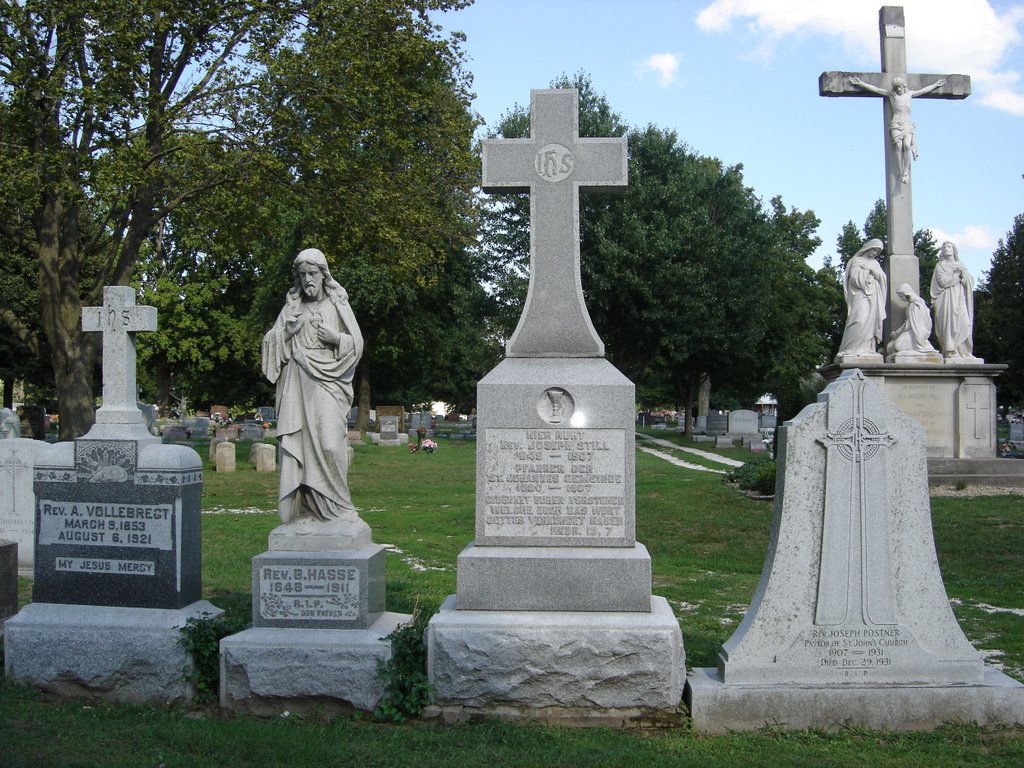
Here's a post simply for the curious. Below is a photograph of my final resting place in Calvary Cemetery in Quincy, Illinois. As I took the picture I was standing on the spot where I will be buried.

Strangely enough, I will be buried next to the founding pastor of my home parish of St. John the Baptist.

A sobering day


For many years now, the Commemoration of the Faithful Departed has been one of my beloved days in the liturgical life and prayer of the Church. While I always anticipate All Saints' Day with great joy, I anticipate All Souls' Day with a certain sadness.

On this day I naturally consider my own future death, whenever it may come (I'm hoping for death before knee replacement). But importantly, my thoughts and prayers turn always on this day to my parents, Bill and Pat. Dad has been dead now twenty years and Mom eighteen.

I look forward to the day when I will at long last see them again; and yet, I somehow know that they will embrace me and swiftly take my hands and lead me to the Lord Jesus. It will be a joyous occassion not so much because of them, but because of Jesus. This realization is for me a bitter-sweet one.

The prayers for the Mass say it all and so well:

Merciful Father,
hear our prayers and console us.
As we renew our faith in your Son,
whom you raised from the dead,
strengthen our hope that all our departed brothers and sisters
will share in his resurrection,
who lives and reigns with you and the Holy Spirit,
one God, for ever and ever.

Today is a day both of sorrow and of hope, a hope that somehow produces a joy. It is a day of one of those great paradoxes of the Christian life and faith and, as such, it is a beautiful and moving day.

Let us today recall the beautiful words of Sant Ambrose concerning the death of his brother:

Death was not part of nature; it became part of nature. God did not decree it from the beginning; he prescribed it as a remedy. Human life was condemned because of sin to unremitting labor and unbearable sorrow and so began to experience the burden of wretchedness. There had to be a limit to its evils; death had to restore what life had forfeited. Without the assistance of grace, immortality is more of a burden than a blessing. The soul has to turn away from the aimless paths of this life, from the defilement of an earthly body; it must reach out to those assemblies in heaven (thought it is given only to the saints to be admitted to them) to sing the praises of God.

Let us then raise our prayers to the Father for all of the dead remembering that "it is a holy and wholesome thought to pray for the dead that they may be loosed from their sins" (II Mac 12:46). In the words of Saint Ambrose: "We have loved [them] in life. Let us not forget [them] in death.

Eternal rest grant unto them, O Lord, and let perpetual light shine upon them. May they rest in peace. Amen.

A night at the theatre

A cast and crew from St. Anthony of Padua High School will perfom a non-musical version of The Wizard of Oz this weekend at 7:30 p.m. Friday and Saturday.

The high school producations are enjoyable and entertaining. I'm looking forward to seeing the young student thespians in action.

The Effingham Daily News has a brief article about the production here.

A royal wedding

In case you have not yet heard the news, Lord Nicholas Windsor, son of the Duke and Duchess of Kent, will wed Paola Frankopan, a British-born Croatian princess, by year's end in the church of Santo Stephano degli Abissini inside Vatican City State. Both have been received into the Roman Catholic Church from the Church of England.

With his entrance into the Church of Rome in 2001, Lord Windsor relinquished his claim, distant though it is, to the throne of England in accord with the 1701 Act of Settlement which barred any Catholic - or one married to a Catholic - from ascending the throne of England.

Her Majesty, the Queen, is said to be both "delighted" and "very pleased" about the coming marriage.

My congratulations and prayers to the couple.

More here and here.