24 May 2006

No Cross, No Christian

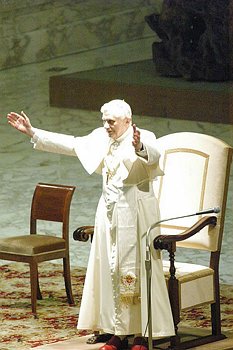
In a letter to Father Peter-Hans Kolvenbach, Superior General of the Society of Jesus, the Holy Father Pope Benedict XVI reiterated a centrul truth of the Christian faith, saying, "In fact, being Christian is only possible with our gaze fixed on the cross of our Redeemer."

So many who would call themselves "Christians" - largely in the Western world - are promoting a version of "Christianity" that seemingly seeks to avoid the cross of our salvation in everyday faith and living, but such a vision clearly is false and dangerous.

The letter, written on the occassion of the fiftieth anniversary of Pope Pius XII's Encyclical Letter Haurietis Aquas (On Devotion to the Sacred Heart), centered on the devotion to the Sacred Heart of Jesus. Praising this devotion, Pope Benedict XVI reminds us that "gazing at the side pierced by the lance, where shines God's boundless will for salvation, cannot then be considered as a passing form of veneration or devotion. The adoration of God's love, which found historical-devotional expression in the symbol of the pierced heart, remains irreplaceable for a living relationship with God."

In reflecting on the call of the Savior, Pope Benedict XVI recalled that "the experience of God's love is lived by man as a 'call' to which he must respond." Let us respond generously and with loving hearts to this invitation and so fulfill the Scripture, "They shall look on him whom they have pierced" (John 19:37).

Sweet Tackiness


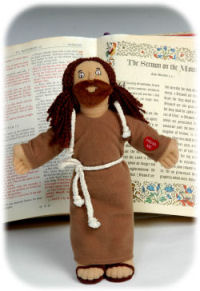
The other day a friend sent a link my way that I thought I would share with you: Talking Bible Dolls.

To my mind, they seem the epitome of tackiness and religious "fluff," but what do I know?

The three dolls are to represent Jesus, Moses, and - so as not to leave out little girls - Esther. I might have thought to make a doll out of Mary to go along with Moses and Jesus, but again, what do I know?

While Moses recites for us the Ten Commandments, Esther tells us about herself. Jesus, meanwhile, recites various passages from the Scriptures for us. You can make them talk by pressing their red hearts. How sweet.

23 May 2006

A Lovely Day

I must say that today has been quite a lovely and - for the most part anyway - refreshing day. Without having to teach class in the afternoons I now have a good chunk of free time in the day that I have not had in many months, which has resulted in the possibility to get to projects that have been waiting to be attended.

This morning as I was shopping about for various necessities, I found a bookcase that I liked and thought would work well in my library in the rectory. I have been searching for a bookcase for some weeks now, without success (obviously).

After purchasing the bookcase, loading it into my Toyot
a Matrix (which is excellent for hauling large objects around), and returning to the parish I lugged the bookcase into the rectory foyer with the help of our Administative Manager (summers are quieter for him, too).

I then spent the next two hours in the successful attempt to put the pieces together in the appropriate order (that part was a bit tricky as the directions were none too clear). However, I finally finished the project and ate some pizza.

After some delicious slices of pepperoni (left over from a meeting last night) I returned to my library and began the very peaceful and relaxing process of transferring books from one shelf to another, resorting books, and finally - after some three months - taking books from the ever-growing pile on the floor to place them properly on shelves, where, as everybody knows, all books belong.

I still have a bit more work to do in the library, including the hanging of various decorative pieces and some organzing to the workspace. When I finish this project I will take a picture of my library and post it - if I remember.

And don't forget, as Cicero once said: "A room without books is like a body without a soul."

21 May 2006

With the end comes the beginning

Although I have very much enjoyed teaching at the high school of my parish, I am quite happy to say that the school year is now officially over. Last evening, we graduated forty-five seniors and - as of this moment - we have enrolled sixty-one freshmen for the coming school year.

Even as classes at the high school drew to a close, my preparations were only beginning. This summer I will return to the Liturgical Institute of the University of St. Mary of the Lake to resume my studies toward the Licentiate in Sacred Theology.

What follows is the text of a letter that I sent to the parishioners on the Memorial of Saint Catherine of Sienna, 29 April 2006:

My dear parishioners,

The Lord give you peace! The Lord is risen from the dead! Alleluia, alleluia! The Lord is risen indeed! Alleluia!

During my final year of studies and preparation for the priesthood at Mundelein Seminary, I enrolled in the Liturgical Institute of the University of St. Mary of the Lake and began studies toward a Licentiate in Sacred Theology with an emphasis in sacramental theology (this degree is somewhat higher than a Masters degree). I completed the first year of studies during my final year in the seminary and I now have the second year yet to complete.

With the permission of Bishop Lucas, I have discussed with Msgr. Enlow the possibility of my returning to the Liturgical Institute this summer to resume these studies from June 12th through July 14th, with the aim of completing them in the summer of 2007. Msgr. Enlow has kindly granted me permission to resume these studies this coming June and July.

In my absence, Fr. Carl Schmidt and Fr. Ben Meyer have graciously offered their sacramental ministry to the parish until I return. Please know that my commitments in the parish – particularly weddings – I will keep. As such, I will be back in the parish about every other weekend. Fr. Schmidt and Fr. Meyer will celebrate Masses during the week and on many of the weekends.

I sincerely apologize for any inconvenience my absence may cause, but at the same time I know that these studies will only enhance my future ministry and teaching. I assure you that you will all remain in my prayers while I am away this summer and I ask your continued prayers for me.

As Saint Francis of Assisi encouraged his brothers so I encourage you: Praise and bless my Lord, and give thanks to him and serve him with great humility.
Peace and Joy,

The Rev. Daren J. Zehnle
Parochial Vicar

I am very much looking forward to my return to studies; I feel I am an academic at heart.

Homily - 21 May 2006

The Sixth Sunday of Easter (B)

It is this passage from the First Letter of Saint John that gave rise to Pope Benedict XVI’s first Encyclical Letter, Deus Caritas Est, God is Love. In this beautiful and moving reflection on the God who loves, the Holy Father reminds us that the foundational tenet of the Christian faith is this very passage, that “God is love” (I John 4:8). In fact, this belief and truth is expressly unique to Judaism and Christianity; in terms of the religions of the world, it is something entirely new and unheard of.

We learn from the Old Testament that the Lord God has created everything that is, that “all things came to be through him, and without him nothing came to be” (John 1:3). With this in mind, the Holy Father says we can learn two things: first, that

the whole world comes into existence by the power of his creative Word. Consequently, his creation is dear to him, for it was willed by him and “made” by him. The second important element now emerges: this God loves man (Deus Caritas Est, 9).
In the ancient world the notion that God would love humanity seemed absurd and bizarre at best. Today, too, many people are tempted to believe the same. How could it be that God loves mankind, they ask. Look at what people do to one another, look at how people even ignore their God. How could God possibly love man? Even worse, some people go so far as to ask, “How could God love me?” To this very question Jesus responds clearly, “As the Father loves me, so I also love you. Remain in my love” (John 15:9).

It is true to say that we do not deserve the love that the Lord has for us, but it is precisely here that the beauty and wonder of this love is made manifest. “In this is love: not that we have loved God, but that he loved us and sent his Son as expiation for our sins” (I John 4:10).

Just as the Old Testament teaches us something new about the God who loves, so, too, does the New Testament. The New Testament is, of course, primarily concerned with the life, death, and Resurrection of Jesus Christ, and of his continuing activity in the Church through the Holy Spirit. The Holy Father reminds us that

The real novelty of the New Testament lies not so much in new ideas as in the figure of Christ himself, who gives flesh and blood to those concepts – an unprecedented realism. In the Old Testament, the novelty of the Bible did not consist merely in abstract notions but in God’s unpredictable and in some sense unprecedented activity. This divine activity now takes on dramatic form when, in Jesus Christ, it is God himself who goes in search of the “stray sheep”, a suffering and lost humanity (Deus Caritas Est, 12).
Can there be any greater wonder than this? People often say to me that religion is boring, and by this they mean Christianity. Whenever they say this I have to wonder if they have been even the slightest bit of real attention throughout their entire lives. Can anything be more exciting than this?

Purely out of love God created us and fashioned us for himself. Purely out of pride we sinned against him and forfeited the graced relationship we had with him and were thereby condemned to death. Even so, God never stopped loving us. We might even say that his love even intensified as he continually lovingly called us back to himself, even as we continually turned away. But then, in the fullness of time, God did something seemingly unimaginable: he took on flesh and blood for us sinners, to redeem us and save us, and to restore our relationship with him. Such is the power and the depth of his love! Even when we did not love him he still loved us! So great is his love for us that, seeing us in the dark misery and pain of sin and death, forever separated from him, he sent his only Son, Jesus Christ, to atone for our sins. In Christ Jesus we learn firsthand that, as the only Son of God says to us, “no one has greater love than this, to lay down one’s life for one’s friends. You are my friends…” (John 15:13-14). In the Christ Jesus, “The Lord has revealed to the nations his saving power” (Antiphon, Psalm 98). Amen. Alleluia!

06 May 2006

Homily - 7 May 2006

Today we celebrate not only this fourth Sunday of Easter, this “Good Shepherd Sunday;” we also celebrate today the forty-third World Day of Prayer for Vocations because today Jesus says, “I am the good shepherd, and I know mine and mine know me, just as the Father knows me and I know the Father; and will lay down my life for the sheep” (John 10: 14-15). Through his prophet Jeremiah, the Lord also promises us, “I will give you shepherds after my own heart” (Jeremiah 3:15).
These are beautiful words the Savior says to us today and they are comforting words, for we cannot truly “know” another person unless we first love them. We may think that we know someone whom we do not love, but what we really mean is that we know about them; we do not – in reality – know them personally. We do not know their thoughts or true concerns, their worries, fears, and loves. Jesus says to us with confidence and with authority: “I know mine and mine know me.” He knows us through and through because he loves us and it is because he loves us that he reminds us, “[I] will lay down my life for my sheep.” This is the very reason he has come to us, to show us the depth of the Father’s love and to call us back to him. “[I]n Jesus Christ, it is God himself who goes in search of the ‘stray sheep’, a suffering and lost humanity” (Pope Benedict XVI, Deus caritas est, 12).
He comes among us and lives with us. He listens to us, he encourages us, he challenges us, he calls to repent and to turn from sin and he loves us. He loves us like no has ever loved before and he loves like no one will ever love again. He picks us up – wounded, broken, and in pain as we are – and places us upon his shoulders. He carries us all the way to the Cross, all because he loves us. And he invites certain men and women to join him in this act of love, in this act of service.
Jesus cannot know us any more deeply than he already does because he loves us perfectly and completely. We, on the other hand, can always know Jesus more deeply because we can always love him more profoundly. This side of heaven, our love for him will rarely be perfect. Nevertheless, he calls each of us to know him and to love him and so to become one with one.
As we grow in knowledge and love of God we come to know his will in our lives and we come to accept his will. So very often we consider our will for lives – what I want – and what God wants for my life as two very different things, almost as two forms of life set completely in opposition to each other. But this is not the case for the more we come to know and love the Lord

God’s will is no longer for me an alien will, something imposed on me from without by the commandments, but it is now my own will, based on the realization that God is in fact more deeply present to me than I am to myself. Then self-abandonment to God increases and God becomes our joy (cf. Psalm 73 [72]:23-28) (Deus caritas est, 17).

My will becomes one with God’s will for me because I have come to know and experience his marvelous love, a love which knows no limits. In knowing his love I come to learn that he desires my happiness and joy – this is his will for my life and only in him will any of us ever be truly happy and joyous.
This, then, brings us to the heart of the prayer of the Church today. Pope Benedict XVI reminds us today that

it should never be doubted that Christ continues to raise up men who, like the Apostles, leaving behind all other work, dedicate themselves completely to the celebration of the sacred mysteries, to the preaching of the Gospel and to pastoral ministry” (Message for the 43rd World Day of Prayer for Vocations).

Still today the Lord calls men in this very parish to serve him as priests and deacons, just as he calls men to serve him as consecrated brothers and as he calls women to serve him as consecrated sisters.
This is a faithful parish and a vibrant parish. The faith is alive here, and yet there has been no priestly vocation to come from this parish in quite some time. And so the question must be asked, “Are we doing enough? Are we doing what the Lord truly asks of us? Are we living the faith as we should? Is there more the Lord asks of us?” Fifteen years – twenty years – since the last ordination from this parish is simply too long.
I can say with great certainty that I would not be standing before you today, I would not be a priest of Jesus Christ, if it were not for the parishioners of my home parish in Quincy. These faithful men and women have a great love of the Church and of priests, as do you. These men and women saw something in me when I was in high school and they thought the Lord was calling me to the priesthood and so they told me; in fact, they repeatedly told me. Little did they know that at this very same time I, too, believed the Lord was calling me to the priesthood. Even so, without their invitation, without their support, without their enthusiastic encouragement, I would not have had the courage to pursue the priesthood, feeling myself unworthy of such a sacred calling. And indeed I am unworthy of the priesthood – as is every priest; but as the Holy Father reminds us, “Weaknesses and human limitations do not present an obstacle, as long as they help make us more aware of the fact that we are in need of the redeeming grace of Christ” (Message for the 43rd World Day of Prayer for Vocations).
With this in mind, then, I challenge you to ask the Lord to let you know which young men in this very parish he is calling to serve him as priests and deacons. Ask him, too, to tell you whom is calling to serve him as consecrated men and women. I am watching several young men and women – and have been for some time – whom I believe the Lord is calling at this very moment. Many of them know who they are and so do you.
These are the young men and women with whom you live, work, study, and play. You know their qualities and characteristics and you have a sense whether or not the Lord is calling them. When was the last time you extended the invitation to a young man to consider the priesthood or to a young woman to consider the consecrated life?
Vocations are nourished, supported, and sustained through the parish; vocations do not simply fall out of heaven. The Lord raises up men and women to serve him and his Church through the communities of faith we call parishes and families. Vocations must be supported, they must be talked about, they must be encouraged if those whom the Lord calls are to hear his call and to respond to his call with generosity and with love.
The Holy Father reminds us that the Lord invites all people to know him love him. He says,

Already on the shores of the Sea of Galilee, many allowed themselves to be won by Jesus: they were in search of healing in body or spirit, and they were touched by the power of his grace. Others were chosen personally by Him and became his apostles. We also find some, like Mary Magdalene and others, who followed him on their own initiative, simply out of love. Like the disciple John, they too found a special place in his heart (Message for the 43rd World Day of Prayer for Vocations).

Let us then always encourage and invite young men and women to offer their lives to the Lord as priests, deacons, and consecrated men and women. Lord, give us shepherds to lead us!

23 April 2006

Homily - 23 April 2006

In the sacrificial death of Jesus on the Cross we find the ultimate expression of love, for “no one has greater love than this, than to lay down one’s life for one’s friends” (John 15:13). “God, the Father of Mercies,” (Rite of Penance) through the power of the Holy Spirit, raised his only Son from the dead and in so doing displayed for us the ultimate power of love, a love that is stronger than death. Love has conquered. “We know that Christ, raised from the dead, dies no more; death no longer has any power over him,” (Romans 6:9). Even so, the expression of love and the power of love does not stop here, but with Divine Mercy.

After Christ Jesus was raised from the dead and appeared to his disciples and to the Apostles, he did not reprimand or condemn them for fleeing from his side when he needed them most. He did not vent anger against Peter who thrice denied him. He did not raise his voice against Thomas for his doubt and neither does he do to us when we doubt him and when we sin against him. Through his great mercy, he continually calls each of us – as he did the Apostles - individually and by name and he extends to each of us the fullness of his great love. To each of us he says, “I have called you by name; you are mine” (Isaiah 43:1).

To Saint Faustina Kowalska, Christ the Lord revealed that at the moment of death he offers to each soul the grace of conversion; he extends one final time the opportunity to receive his love, to receive his redemption, to receive his salvation. But, of course, this grace, this love, the soul can either accept or reject, for true love never forces itself upon another.

The Lord Jesus says to Dismas, the repentant thief, “today you will be with me in paradise” (Luke 23:43). For God wishes “everyone to be saved and to come to the knowledge of the truth “(I Timothy 2:4). For this reason Jesus says to Thomas, “Put your finger here and see my hands, and bring your hand and put it into my side, and do not be unbelieving but believe” (John 20:27). “Believe in the truth,” he says to us. “Believe in me, for ‘I am the Way, the Truth, and the Life’” (John 14:6). “Come to me,” and know the fullness of my mercy (Matthew 11:28).

Sometimes we have a tendency not to believe in the mercy of the Lord. We think, maybe, that he is too kind, too generous, too loving to us sinners. We know that we do not deserve his love and so we have a difficult time bringing ourselves to believe he can possibly love us as he says he does. We think, perhaps, that he is tricking us, that there is some clause we have not heard, some small print we have not yet read. But, my friends, he is himself Truth itself. He will never lie to us; he will never deceive us; he will never disappoint us!

His love and his mercy he offers to us, without any strings attached. He only calls us to carry our cross each day with him (cf. Luke 9:23). Do not doubt his love! Out of love for us sinners, the sinless one, Jesus, the only Son of God, seeing us in the wretched state of sin, leaps to his feet and abandons the glory of heaven, in order to go in search of the sheep and pursue it, all the way to the Cross (Pope Benedict XVI, Inaugural Homily, 24 April 2005). Jesus says to us, “Come, feel my wounds for my mercy is tangible. Come, see the wound in my side from where my love flowed out for you, for my mercy is visible. Come, take shelter within my wounds and let my love and mercy wash over you and surround you and give you peace.”

Some might take this Divine Mercy as an opportunity to “eat, drink, and be merry, for tomorrow you may die” approach to life. But if we reject the love of the Lord in this life, why would we accept it in the life to come?

The Truth stood before Pontius Pilate and he did not recognize the Truth nor did he accept the Truth; instead, Pilate demanded, “What is truth?” (John 18:38). The testimony Pilate heard about Jesus seemed absurd, bizarre, and unbelievable. Rather than believe the Truth about Love, Pilate chose to believe the lies of the Evil One, he chose to believe the falsehoods of this world that promise power, wealth, happiness, and liberty. Pilate failed to see that all of these things only enslave us and make us miserable. Only the Truth, only Love, can free us! And this he has done through his Death and Resurrection; he has made us free!

It seems too good to be true, and yet it is true. Do not doubt his love and his mercy, my friends, for he has written it in his own blood using the nails upon his hands. Stretch out your hands to his. Feel his wounds. See his love. Open yourself to his mercy. St. Anthony of Padua reminds us that

Christ has inscribed us in his hands … for three reasons: (1) to show the scars of the wounds he bore for us to the Father, thus inviting the Father to show us mercy. (2) In order not to forget us. For this reason he says in Isaiah: ‘Can a woman forget her infant, and not have pity on the son of her womb? And if she should forget, yet I will not forget you. Behold, I have written you in my hands’ (Isaiah 49:15-16). (3) He has written in his hands what kind of people we should be and in whom we should believe. ‘Do not be unbelieving,’ O Thomas, O Christian, ‘but believe’ (The First Sunday After Easter).

Let us then, with the father of the possessed boy whom Jesus freed, let us cry out to him, “I do believe, help my unbelief!” (Mark 9:24).

“Let us ask, therefore, dearest brothers [and sisters], and humbly entreat the mercy of Jesus Christ, so that he might come and stand in our midst. May he grant us peace, absolve us from our sins, and take away all doubt from our hearts. And may he imprint in our minds faith in his passion and resurrection, so that with the apostles and the faithful of the Church we might merit to receive eternal life. May he grant this, he who is blessed, [praised], and glorious through all ages. Let every faithful soul say: Amen. Alleluia” (St. Anthony of Padua, The First Sunday After Easter).

15 April 2006

Homily - 16 April 2006

The Resurrection of the Lord (B)
Based on the Easter Sermon of St. John Chrysostom

Is anyone here a great lover of God? Let the lovers of God enjoy this beautiful and bright festival, for their love is returned by their Lord!
Is there anyone here who is a grateful servant? Let the grateful servants rejoice and enter into the joy of their Lord, for their service is accepted and honored and returned!
Are there any here who are weary from fasting? Let those who have fasted now receive their wages for their hunger is now satisfied.
If any here have worked from the first hour of the day in the vineyard of the Lord, let them receive their due reward; if any here have come after the third hour to work in his vineyard, let him with gratitude join in the Feast! Anybody, who arrived after the sixth hour to work and serve the Lord, do not doubt your payment and reward; for you, too, shall receive your pay. And if any delayed until the ninth hour and have only recently come to know and love the Lord, let the latecomers not hesitate; but let them come, too. And you who arrived only at the eleventh hour and have not yet fully begun to work or serve the Lord, do not be afraid because of your delay, for the Lord is gracious and he receives the last in the same way that he receives the first. He gives rest to those who come upon their deathbed as well as to those who faithfully loved and served from the moment of their Baptism. The Lord Jesus accepts our works in the same way that he greets our endeavor. He honors our deeds and he commends the intention of those who come to him.
Let us all enter into the joy of the Lord! Those who have come first and those who have come last alike – you who worship every week and you who worship only infrequently - receive your reward; rich and poor, rejoice together! Sober and lazy, celebrate the day!
You who have kept the Easter fast, and you that have eaten all in sight, rejoice today for the table of the Lord is richly prepared! Feast royally on it for the calf is a fattened one. Let no one go away hungry. Let everyone drink from the cup of faith. Enjoy all the riches of his goodness!
Let no one grieve his poverty, for the universal kingdom has been revealed. Let no one grieve that he has sinned time and again because forgiveness has risen from the grave. Let no one fear death, for the Death of our Savior has forever set us free.
He has destroyed death by enduring it. He destroyed the power of Hell when he descended into it. He put Hell into an uproar even as it tasted his flesh. Isaiah foretold this when he said, “You, O Hell, have been troubled by encountering him below” ().
Hell was in an uproar because it was done away with. It was in an uproar because it was mocked. It was in an uproar, for Christ the Lord has destroyed it.
It is in an uproar, for it is annihilated. It is in an uproar, for it is now made captive. Hell claimed a human body, and discovered God. It took earth, and encountered Heaven. It took what it saw, and was overcome by what it did not see. “O death, where is thy sting? O death, where is thy victory?” ().
Christ is Risen, and you, O death, are annihilated! Christ is Risen, and the evil ones are cast down! Christ is Risen, and the angels rejoice! Christ is Risen, and life is liberated! Christ is Risen, and the tomb is emptied of the dead; for Christ having risen from the dead, has become the first-fruits of those who have fallen asleep.
To him be glory and power forever and ever. Amen! Alleluia!

Homily - 15 April 2006

At the Easter Vigil in the Holy Night of Easter
Based on an Ancient Homily for Holy Saturday

“Something strange is happening – there is a great silence on earth today, a great silence and stillness. The whole earth keeps silence because the King is asleep. The earth trembled and is still because God has fallen asleep in the flesh and he has raised up all who have slept ever since the world began. God has died in the flesh and hell trembles with fear.”
The tomb of Jesus is empty. We are told, “He has been raised; he is not here” (Mark 16:). “He has gone to search for our first parent, as for a lost sheep. Greatly desiring to visit those who live in darkness and in the shadow of death, he has gone to free from sorrow the captives Adam and Eve. The Lord approached them bearing the Cross, the weapon that had won him the victory . . . He took him by the hand and raised him up, saying, ‘Awake, O sleeper, and rise from the dead, and Christ will give you light.’
Jesus says to Adam, “I am your God, who for your sake have become your son. Out of love for you and your descendants I now by my own authority command all who are held in bondage to come forth, all who are in darkness to be enlightened, all who are sleeping to arise. I order you, O sleeper, to awake. I did not create you to be held a prisoner in hell. Rise from the dead, for I am the life of the dead. Rise up, work of my hands, you who were created in my image. Rise, let us leave this place, for you are in me and I in you; together we form one person and cannot be separated.” So he says to each of us! He has not created us for slavery but for freedom! He has not created us for death but for life! He has not created us to be servants but friends! Through Baptism and the Holy Eucharist he makes us one with himself and he gives to us a share in his divine life.
To Adam he says, “For your sake I, your God, became your son; I, the Lord, took the form of a slave; I, whose home is above the heavens, descended to the earth and beneath the earth. For your sake, for the sake of man, I became like a man without help, free among the dead. For the sake of you, who left a garden, I was betrayed to the Jews in a garden, and I was crucified in a garden.
“See on my face the spittle I received in order to restore to you the life I once breathed into you. See there the marks of the blows I received in order to refashion your warped nature in my image. On my back see the marks of the scourging I endured to remove the burden of sin that weighs upon your back. See my hands, firmly nailed to a tree, for you who once wickedly stretched your hand out to a tree.
“I slept on the cross and a sword pierced my side for you who slept in paradise and brought forth Eve from your side. My side has healed the pain in yours. My sleep will rouse you from your sleep in hell. The sword that pierced me has sheathed the sword that was turned against you.
“Rise. Let us leave this place. The enemy led you out of the earthly paradise. I will not restore you to that paradise, but will enthrone you in heaven. I forbade you the tree that was only a symbol of life, but see, I who am life itself am now one with you. I appointed cherubim to guard you as slaves are guarded, but now I make them worship you as God. The throne formed by the cherubim awaits you, its bearers swift and eager. The bridal chamber is adorned, the banquet is ready, the eternal dwelling places are prepared, the treasure houses of all good things lie open. The kingdom of heaven has been prepared for you from all eternity.”
As he says to Adam so he says to each of us, especially to you, Greg, Michael, and Crystal, who are to become one with us and one with the Lord Jesus Christ this most holy and blessed of all nights. Tonight, through the saving waters of Baptism new life is to be given to you.
You, Jared, Mark, Cordell, and Jami, who are already one with us in Baptism, you are soon to be received into the Church of Rome founded by the Savior himself upon the Apostle Peter through your profession of faith. And Charity, your initiation into the Catholic Church will soon be completed as you are sealed with the gift of the Holy Spirit.
Let us cease now this vigil and this waiting; we have waited long enough; let us begin, for the tomb is empty and the Lord is risen from the dead! Alleluia!

Homily - 14 April 2006

Good Friday of the Lord’s Passion

Today the world is forever changed; nothing shall ever be the same again. Today God has given his life for man, the sinless for the sinners. Today “he was pierced for our offenses” (Isaiah 52:5). Today we experience the ultimate power and mystery of love.

His death on the Cross is the culmination of that turning of God against himself in which he gives himself in order to raise man up and save him. This is love in its most radical form. By contemplating the pierced side of Christ, we can understand … [that] ‘God is love’ (I John 4:8) (Benedict XVI, Deus caritas est, 12).

What can anyone do before such love? What can anyone say upon seeing the depth of such love? Who would have thought a love of this magnitude could ever be experienced? Love has come to us and today Love died in our place. “Because of him kings shall stand speechless” (Isaiah 52:15). Such is the power of this love.
What adequate response can be given in response to so powerful a love? There are two fundamental reactions and responses to this love: we can either accept this love in all humility, or we can reject this love in all of our pride. The choice is ours but the choice must be made.
Last night Judas willingly took those cursed coins and handed the Savior over to death. It was Judas who went to the chief priests and asked them, “What are you willing to give me if I hand him over to you?” (Matthew 26:15). Indeed, the chief priests “were pleased and promised to pay him money” (Mark 14:11). It was his own idea to betray the Messiah; he freely sold his Teacher and Master for a few pieces of silver. He saw the power of Jesus’ love as he followed him for three years. He saw how dearly Jesus loved his disciples. At the same time, Judas knew that Jesus loved him as well, but Judas would not return any love at all. He refused to accept the love of the Lord; he completely rejected Love himself. Judas represents the ultimate rejection of the Lord.
To accept this love of the Savior we can follow the example of the three Marys, of Joseph of Arimathea, of Nicodemus. These followers of the Lord did not leave his side. They accompanied Jesus on this most difficult of journeys as he gave his life for us. They opened themselves to experience his love and his love they returned as best they could, even after his death. In love, they served him who died for us, and so should we. The Holy Father encourages us in this love, saying,

We offer him our service only to the extent that we can, and for as long as he grants us the strength. To do all we can with what strength we have, however, is the task which keeps the good servant of Jesus Christ always at work: “The love of Christ urges us on” (II Corinthians 5:14) (Benedict XVI, Deus caritas est, 35).

We know, also, that although many of us truly do love the Lord Jesus, we do not always follow him and serve him faithfully. We forsake him, we abandon him, and we sin against him. We sinners then can follow the example of Saint Peter who three times denied the Lord and sinned against him. Even so, he powerfully experienced the merciful love of Jesus when “the Lord turned and looked at Peter” and Peter “went out and began to weep bitterly” (Luke 22:61, 62).

As tears fill our eyes as we acknowledge that we, too, have sinned against the Lord, let us gaze upon the crucified Lord who was pierced for us. Let us look up into his face lowered down to look upon us and see there the very face of love. Let us run into his arms so lovingly and gently extended and held out to embrace us. Let us take refuge within his holy and glorious wounds and allow our hearts to be filled with his mercy and love.

Let us look upon the one whose heart was pierced for us and know the fullness of the truth that “God is love.” “Behold the man!” (John 19:6).

Homily - 13 April 2006

The Mass of the Lord’s Supper

Tonight we gather here in the upper room with the Lord Jesus and his disciples as we prepare to celebrate the great Passover feast. On this night we will be marked with the Blood of the Lamb and his household, the Church, will be saved from death because of his Blood. Tonight, “types and shadows have their ending, for the newer rite is here,” newer rites given us by the Savior himself (St. Thomas Aquinas, Tantum ergo). Christ gives the definitive meaning and power to the celebration of the Passover and never will it need to be repeated again, for with his own Blood he destroys death forever.
When the Lord gathered his disciples together in the Upper Room he knew well what he intended to do. As St. Paul relates to us, Jesus, the Master and Teacher,

took bread, and, after he had given thanks, broke it and said, ‘This is my body that is for you. Do this in remembrance of me.’ In the same way also the cup, after supper, saying, ‘This cup is the new covenant in my blood. Do this, as often as you drink it, in remembrance of me’” (I Corinthians 11:23-25).

In this way his own Body replaces the flesh of the Paschal Lamb and his own Blood replaces the blood of the Paschal Lamb spread on the posts and lintels of the houses. It is precisely through his death on the Cross that he gives his Body and Blood for us to eat and to drink; through his death he atones for our sins and washing us clean in his own Blood, making us “whiter than snow” (Psalm 51:9). He who is without sin willingly gives his life for us that we, too, might live. “This is love in its most radical form” (Pope Benedict XVI, Deus caritas est, 12).
This night Jesus knows that one of his own will betray him and for this reason he says to the Apostles, “Not all of you are clean” (John 13:11). “Jesus knew that his hour had come to pass from this world to the Father” (John 13:1). The time has come for him to fulfill his mission, to give his life for our redemption and salvation.
In giving us the Eucharist, his very Body and Blood, Soul and Divinity, before he gives up his life for us, he “loved his own in the world and he loved them to the end” (John 13:2). Through the Holy Eucharist Jesus desires to remain present with us always, but to do so his sacrificial death needs to be perpetuated and made present in every age and in every place “until he comes” again (I Corinthians 11:26). To achieve this end he established the Apostles and some of his disciples as his priests of the New Covenant sealed in his own Blood.
To these, his priests, he says, “I have given you a model to follow, so that as I have done for you, you should also do” (John 13:15). As Jesus changed the bread and wine of the Passover meal into his very own Body and Blood given for us, so he will do through the ministry of his priests. He commands his priests to perpetuate his sacrifice and to bring his love to every corner of world – to a world mortally wounded by sin - through the sacramental life of the Church.
On this night the Lord Jesus institutes the sacrament of the Eucharist and he institutes his Church to carry out his work of salvation always and everywhere. We know that the Eucharist unites each of us with Christ and that the Eucharist gives us the grace we need to daily follow faithfully in the footsteps of the Lord. In this sense, we can say that the Eucharist makes the Church for it strengthens us, cleanses us of venial sin, and unites us with the Lamb of God.
But at the same time, the Eucharist does not simply fall from heaven as the manna did in the desert. No, the Eucharist is given us through the sacramental ministry of the Church through her priests and bishops. We know that without the sacred ministers, without priests and bishops, we cannot have the Eucharist. In this way we can say that the Church makes the Eucharist.
Here, then, we can combine the two into a truly magnificent marvel of God’s love for us: “The Eucharist makes the Church and the Church makes the Eucharist.” This is why the Fathers of the Second Vatican Council call the Eucharist the “source and summit” of the Christian life. The Eucharist gives us life and sends us forth, yet at the same time it calls us back to be refreshed and rejuvenated again. We must always return to this great fountain of life. The Eucharist and the priesthood and the life of the Church and of every individual Christian are intimately and inseparably bound together through the power and mystery of Christ’s love displayed for us in the Eucharist.
Here, then, we can begin to understand the power of Jesus’ humility when he washes the feet of his disciples and commands them to do likewise. Remembering this particular aspect of the Last Supper of the Lord calls to mind the centrality of service in the Christian life.
Various elements of service today are often emphasized but rarely are they ever connected with the Eucharist as Jesus clearly does. The Eucharist is, in fact, a call to service and at the same time it is a call that also enables such service. It is a call that ennobles such service. Without the Eucharist, true Christian service - which must always take the form of love of God and love of neighbor - simply is not possible. The Eucharist demands that we love God and our neighbor while at the same the Eucharist gives us the strength and the grace to love as Christ has first loved us.
In his Encyclical Letter, Pope Benedict reflects on this connection between the Eucharist and service. He writes,

in sacramental communion I become one with the Lord, like all the other communicants. As Saint Paul says, “Because there is one bread, we who are many are one body, for we all partake of the one bread” (I Corinthians 10:17). Union with Christ is also union with all those to whom he gives himself. I cannot possess Christ just for myself; I can belong to him only in union with all those who have become, or who will become, his own. Communion draws me out of myself towards him, and thus also towards unity with all Christianity. We become “one body”, completely joined in a single existence. Love of God and love of neighbor are now truly united: God incarnate draws us all to himself…Love of God and love of neighbor have become one: in the least of the brethren we find Jesus himself, and in Jesus we find God” (Deus caritas est, 14-15).

On this night when we celebrate the institution of the Eucharist and of the priesthood, let us beg the Lord to fill each of us with his love, that we might then love others as he has first loved us and so come to love him fully. Through the Eucharist and through the Christian service of love may we come a greater unity with one another and the Lord Jesus Christ. Amen.

03 April 2006

Homily - 2 April 2006 (B)

Today the author of the Epistle to the Hebrews presents for us two necessities
of the Christian life that we all too often seek to avoid: obedience and
suffering, saying, “Son though he was, [Jesus] learned obedience from what he
suffered; and when he was made perfect, he became the source of eternal
salvation for all who obey him” (Hebrews 5:8-9). Through suffering, then, we
learn obedience and from obedience to the Lord Jesus Christ we receive
eternal salvation and everlasting life.

We see this reality in what Jesus says to us in the Gospel. Referring to
himself – and to each of us – he says, “unless a grain of wheat falls to the
ground and dies, it remains just a grain of wheat; but if it dies, it produces
much fruit” (John 12:24). In order to die the grain of wheat must suffer. Its
shell must be broken and it must break free and struggle through the earth to
reach the light of day. In much the same way, whenever we suffer there is a
certain dying that takes place as we come to accept the reality that our will,
that our desires, are not in control of our lives. There is a greater will than
ours to which we must submit, to which we must be obedient for the Lord
says to us, “Whoever serves me must follow me, and where I am, there also
will my servant be” (John 12:26).

We see this dual necessity – that of suffering and obedience – in the
words of Jeremiah as well. The Lord God announces through his prophet,
“The days are coming … when I will make a new covenant with the house of
Israel … I will place my will law within them and write it upon their hearts; I
will be their God and they will be my people” (Jeremiah 31:31; 33). Here
again we see that obedience to the will of God, to his Law – which always
involves a certain suffering – leads to eternal salvation, for as the Lord says, “I
will forgive their evildoing and remember their sin no more” (Jeremiah 31:34).

There is an ancient Greek maxim, a proverb, if you will, that says, paqein
maqein, “to suffer is to learn.” But what do we learn in suffering? We learn
to be obedient and in becoming obedient we grow in union for the Crucified
and Risen Lord.

Very few people today like being obedient. Very often obedience is given
a quite negative connotation, almost to the point that some have difficulty
finding any good whatsoever in obedience. It is almost as though all forms of
obedience are likened to nothing more than a “blind obedience,” which in all
actuality is not obedience at all. It is simply a case of “the blind leading the
blind,” of ignorant following.

What, then, is obedience? The English word comes from the Latin
obidere meaning, “to listen, to hear.” Obedience does not so much consist in
following orders and commands simply because they are given as it does in
being attentive and attuned to the will and desires of the Master. For
Christians, obedience means listening so intently to the voice of Christ that we
know his will for us and we see the good that he has in store for us and so we
do desire his will as our own. When one is truly obedient, one does not
question commands because the good in store is evident; there are no
questions to ask because there is no sense of being oppressed or used. We no
longer need to question the purpose of suffering because we come to know
that obedience in suffering leads to salvation, to a sharing in the Paschal
Mystery of Christ the Redeemer.

In the life of Jesus we find the perfect model of obedience to the will of
the Father. In all things he freely followed the divine will, even in suffering.
We know that Christ Jesus,

emptied himself, taking the form of a slave, coming in human likeness; and
found human in appearance, he humbled himself, becoming obedient to death,
even death on a cross (Philippians 2:6-8).

Jesus knows the great difficulty of uniting our will to that of the Father; he
knows how very hard it is to accept suffering and to embrace it. But it is
precisely “because he himself was tested through what he suffered, [that] he is
able to help those who are being tested” (Hebrews 2:18). He knows the
difficulty we face and he has come to alleviate it, to give us “a model to
follow, so that as [he has] done for [us], [we] should also do” (John 13:15).
Indeed, Jesus says to us, “I give you a new commandment: love one another.
As I have loved you, so you also should love one another” (John 13:34).

In his Encyclical Letter, Pope Benedict XVI speaks of the will of God and
he reminds us:

The love-story between God and man consists in the very fact that this
communion of will increases in a communion of thought and sentiment, and
thus our will and God’s will increasingly coincide: God’s will is no longer for
me an alien will, something imposed on me from without by the
commandments, but it is now my own will, based on the realization that God
is in fact more deeply present to me than I am to myself. Then self-
abandonment to God increases and God becomes our joy” [Deus caritas est,
17).

The more that we yield to the will of God, the more that we yield to our
suffering and seek to unite it with the Passion of Christ, the greater our joy
becomes. It is one of the great paradoxes of the Christian faith.

But when we directly face our suffering we say with Jesus, “I am troubled
now. Yet what should I say? ‘Father, save me from this hour?’) John 12:27).
More often than not we ask the Lord to take our suffering away from us,
forgetting that the Son of God accepted his suffering and invites us to do the
same, saying, “If anyone wishes to come after me, he must deny himself and
take up his cross daily and follow me” (Luke 9:23).

In these final days of Lent, then, let us not run from suffering and from
obedience. Let us, rather, take confidence that in obedient suffering new
growth and life will be given us, for as the Lord said to St. Paul, “My grace is
sufficient for you, for power is made perfect in weakness” (II Corinthians 12:
9).

“Sir, we would like to see Jesus,” the Greeks said to Philip (John ). Jesus then
responds to the Apostles, as if telling them to convey this message to the
Greeks, “The hour has come for the Son of Man to be glorified” (John ). The
hour has come for love to triumph over death; the hour has come for the
Cross.

We do not know if the Greeks ever saw Jesus. I suspect they did see him if
they could accept his message of the grain of wheat and of the Cross; but if
they could not accept it then I suspect they did not see Jesus. It is much the
same with us. May we ask to see the Lord and so accept his message.

Let us follow the example of the Lord and carry our cross together with him
on the road to Calvary. Let us always remember that when we carry our
cross with the Lord Jesus, the name of the Father will be glorified and we will
find our joy.

Homily - 2 April 2006 (A)

Death touches us all. For some, life seems to be a constant encounter with
death; for others, death comes rather infrequently, but either way death never
is easy, nor is it the end.

To experience it changes everything and nothing is ever the same again,
nor should it be, for the experience of death calls to mind our love and that of
others. In the midst of death we very often feel completely alone, isolated,
abandoned and yet surrounded by family and friends. Death leaves us quite
vulnerable and utterly helpless.

A tragic or a sudden death – especially the death of a parent for a young
child and the death of a young child for a parent – is the single greatest misery
and pain that a person can endure. I say this with some authority: the
experience forever changes a person, sometimes for the better and sometimes
for the worse.

The Lord Jesus himself has experienced the agony of death; he knows
well the emotions and the thoughts that we experience in death, because he
himself suffered all of these at the death of his friend, Lazarus.

When at last he arrived at Bethany, Martha and Mary both cried out to
him, “Lord, if you had been my brother would not have died” (John 11:21,
32). Martha seems to address him with a sense of deep faith in his power,
for she then says to him, “[But] even now I know that whatever you ask of
God, God will give you” (John 11:22). Martha has not lost all hope; Mary has.
Seeing the mournful tears of Mary Jesus then “became perturbed and deeply
troubled” (John 11:33).

At this point in the Gospel we find one of those unfortunate instances
where language becomes a difficulty. In Greek, the word we translate as
“perturbed” actually says that Jesus “snorted in spirit.” Jesus is not simply
irritated or frustrated at what death has done to his friends, he is moved to
anger because of what sin has done to his people. He feels our agony and he
sees our powerlessness in the face of death and so, with a certain authority in
his voice, he calmly demands, “Where have you laid him?” (John 11:34). Here
in the midst of suffering and of death - standing near the tomb - Jesus
acknowledges the very purpose for his coming among us: “I am the
resurrection and the life; whoever believes in me, even if he dies, will live,
and everyone who lives and believes in me will never die” (John 11:25-26).

In his anger over the power of sin and its grip upon the human race Jesus
exclaims

O my people, I will open your graves and have you rise from them, and bring
you back to the land of Israel. Then you shall know that I am the LORD,
when I open your graves and have you rise from them, O my people! I will
put my spirit in you that you may live, and I will settle you upon your land;
thus you shall know that I am the LORD. I have promised, and I will do it
(Ezekiel 37:12-14).

As Jesus looks upon us in his love and as he sees our desperate plight, he is
moved with pity and moved again to anger until at last he calls for his
beloved: “Lazarus, come out!” (John 11:43).

Yet Jesus does not stop here, for Lazarus has only been restored to life –
he has not shared in the glory of the Resurrection and Lazarus must die
again. Jesus cannot leave us in such a deplorable condition. The anger that he
feels when he looks upon our grief and shares in the agony of death impels
him to turn his gaze anew to Jerusalem. Jesus sees each of us and he knows
that we will suffer a physical death as a consequence of sin. Yet he still says,
“Let us go back to Judea (John 11:7); “Let us go to him” (John 11:15); “Let us
go to Jerusalem.”

The Apostles know the danger of returning to Jerusalem and Thomas
senses something of Jesus’ mission when he says to the others, “Let us also go
to die with him” (John 11:16). Having shared fully in our human experience
Jesus longs to save us and free us from the power of death, but this he must
do on the Cross. Before he heard of Lazarus’ illness, Jesus said, ”This is why
the Father loves me, because I lay down my life in order to take it up again.
No one takes it from me, but I lay it down on my own” (John 10:17-18). Jesus
becomes resolute in his desire to save us and seven days later Jesus enters
Jerusalem to lay down his life so that we might live (see John 12:1, 12).

Before the power of Christ the Lord death has no power. Humanity was
bound to death – was made subject to death – because of sin. When our first
parents sinned against the Lord and chose their own wills over his own, the
Lord God said to them, “By the sweat of your face shall you get bread to eat,
until you return to the ground, from which you were taken; for you are dirt,
and to dirt you shall return” (Genesis 3:19). Confident in the power of the
love of Christ Jesus, St. Paul mocks death, saying, “Death is swallowed up in
victory. Where, O death, is your victory? Where, O death, is your sting?” (I
Corinthians 15:54-55). The love of Christ has conquered death because it has
destroyed the power of sin and broken its hold on us.

By raising Lazarus from the dead Jesus foreshadows the greatness of his
power that will be revealed when on the Last Day he raises all of our mortal
bodies to the glory of the Resurrection. We can be confident that the Lord
will reunite our bodies with our souls and we shall be like him in glory, for “If
the Spirit of the One who raised Jesus from the dead dwells in you, the One
who raised Christ from the dead will give life to your mortal bodies also,
through his Spirit dwelling in you” (Romans 8:11). The Spirit of God certainly
dwells within us through the grace and power of the Sacrament of Baptism; he
has promised and he will do it.

My dear Elect, you have listened to the words of the Redeemer and you
have heard him call to you, “Come out of your sin and live!” You have, with
him, come to detest sin and you long to share in the life that he promises to
those who believe in him. With great joy we look forward to the day when
you will be one with us. But before we bestow upon you the gift of the Spirit
of God and the promise of eternal life, you must first go through this last
scrutiny.

25 March 2006

Homily - 26 March 2006

Laetare, Ierusalem! Rejoice, Jerusalem! Rejoice, all who belong to Lord our God! “This is the day the LORD has made, let us rejoice in it and be glad!” (Psalm 118:24).

We may think it odd to hear such words in the midst of the season of Lent, a season which we typically associate with weeping and with sorrow. Certainly these emotions and mindsets are a part of the Lenten observance, but if we stop here then we miss the very meaning of this season of grace and of mercy. Lent always looks to Baptism, to freedom from sin, to life, to joy, to glory. Can there be any greater cause for rejoicing than this? Can anything bring us greater joy than knowing that “God so loved the world that he gave his only Son, so that everyone who believes in him might not perish but might have eternal life”? (John 3:16).

We know full well that through our pride and selfishness and sin we lost the blessed state in which we were created and we were cast out from the presence of God. It is a pain that we feel even today. We sometimes feel abandoned by God; at other times we feel that have utterly failed him, but we are not without hope because in Christ Jesus “God has visited his people” (Luke 7:16). For “God, who is rich in mercy, because of the great love he had for us, even when we were dead in our transgressions, brought us to life with Christ,” all because of his love (Ephesians 2:4-5).

Because of our sin we, like the Israelites, had been taken captive by the Enemy and made subject to sin and death. No longer were we free but we were slaves to sin with no possible means of escape; we could do nothing to regain our freedom. But then, “in the blink of an eye” (I Corinthians 15:52) the tables were turned when the Father, because of his love, sent the archangel Gabriel to the Blessed Virgin Mary with this announcement:

Behold, you will conceive and bear a son, and you shall name him Jesus. He will be great and will be called Son of the Most High, and the Lord God will give him the throne of his father David, and he will rule over the house of Jacob forever, and of his kingdom there will be no end (Luke 1:31-33).

At the very moment Gabriel stood before Mary our freedom and salvation was close at hand. For Jesus Christ, to whom “all power in heaven and on earth has been given” (Matthew 28:18), has come to us to save us from the power of sin and death and to free us from our captivity, to restore us to the “glorious freedom of the children of God” (Romans 8:21).

From his glorious position on the throne of the Cross, lifted up for all to see, Jesus proclaims to the world:

All the kingdoms of the earth the LORD, the God of heaven, has given to me, and he has also charged me to build him a house in Jerusalem, which is in Judah. Whoever, therefore, among you belongs to any part of [my] people, let him go up, [knowing that I am] with him! (II Chronicles 36:23).

We were doomed to death, but now, through the self-giving love of Christ, the sentence has been lifted, “For God did not send his Son into the world to condemn the world, but that the world might be saved through him” (John 3:17). Through the power of his love he brings us now into his house, and not as slaves but as friends (cf. John 15:15).

We know that we belong to Christ, we know that he has saved us, and yet we grow complacent in our faith; we openly rebel against him choosing our own will over his; we sin and we fall short of the glory he has given us. So Holy Mother Church gives us this “joyful season when we prepare to celebrate the paschal mystery with mind and heart renewed (Preface, Lent I). It is a blessed time to return to the Lord, to dedicate ourselves again to living as his faithful servants, those who truly belong to his household. It is a time for us to cease our evil thoughts and deeds, to stop walking in the darkness and to begin walking anew in the light of the Lord. It is a time for us to embrace the power of the Paschal Mystery in each of our lives. How, then, do we do this?

Jesus says to us today, “Whoever lives the truth comes to the light, so that his works may be clearly seen as done in God” (John 3:21). Jesus also tells us, “I am the way, the truth, and the life” (John 14:6). To live the truth, then, means to live in Jesus Christ, to recognize that in Baptism we have been made one with Christ and have become a “new creation” (II Corinthians 5:17). Living in Christ Jesus we journey within into heaven where the brilliant light of God is so beautiful and bright that even the angels shield their faces. How then do we always remember that we are new creations in Christ Jesus? How do we always live as true and faithful members of his house? Let us follow the advise of St. Clare of Assisi:

O dearest one, look up to heaven, which calls us on, and take up the cross and follow Christ who has gone on before us: for through him we shall enter into his glory after many and diverse tribulations. Love God from the depths of your heart and Jesus, his Son, who was crucified for us sinners. Never let the thought of him leave your mind but meditate constantly on the mysteries of the cross (Letter to Blessed Ermuntrude of Bruges, 9-12).

We must always focus on the “Son of Man [who was] lifted up, so that everyone who believes in him may have eternal life” (John 3:14-15). The Cross is the source of our joy and it is to the Cross that the season of Lent leads us, and for this reason it is a joyful season.

Pausing today should fill us with the joy of the Risen Lord for today we are reminded that the final victory is already won because of the power of his love, a love that is stronger than death (cf. Song of Songs 8:6). We know that Christ has forever conquered sin and death and that his love is with us always. Let this be our consolation and our hope as together we journey toward Easter. God loves us. Let us rejoice and be glad.

18 March 2006

Homily - 19 March 2006

Are you thirsty? Have you found a means to quench your thirst? Is there a longing or a yearning in your heart that you cannot satisfy? We can rightly say that if we are not fully satisfied that we search for something or, perhaps better, that we thirst for somebody.

Today the Israelites grumble against Moses, demanding, “Why did you ever make us leave Egypt? Was it just to have us die here of thirst with our children and our livestock?” (Exodus 17:3). They thirst for water, certainly; but they thrist for something more than the water they demand, even though they do not yet realize it. We are much the same.

Like the woman at the well, the Israelites thirst for the Messiah. With her, they know “that the Messiah is coming, the one called the Christ; when he comes, he will tell us everything” (John 4:25). This woman has many unanswered questions. Her life has not been easy, nor has it been pleasant. For many years she has tried to quench her thirst. She has looked for ways to ease her troubled heart. She looked for ways to suppress her disturbing questions about life. In short, she looked for her happiness in the things of this world, yet never did she find it here.

Many of us look to food, or alcohol, or drugs, or money, or food, or sports, or cars, or clothing, or computers, or books – it could be anything – to satisfy our longings. We at least look to these sorts of things to forget about our questions, but this forgetting is only temporary and so we find ourselves in some sort of viscious circle of forgetfulness and remembrance and we grow more weary because the questions never go away. The more we try to avoid them the more insistent they grow and the more we try to satisfy our longings with things.

The Samaritan woman at the well sought her escape from her suffering and pain in the company and pleasure of men. Jesus pointedly reminds her of the uselessness of her quest for happiness when he says to her, “You have had five husbands, and the one you have now is not your husband” (John 4:18). In searching for her happiness she wandered farther and farther from the Lord her God, the only true source of happiness, fulfillment, and peace. Now her Lord comes to her, saying, “Give me a drink,” or rather, “Take a drink of me” (John 4:7).

With the Psalmist, the woman can sing, “As the deer longs for streams of water, so my soul longs for you, O God. My being thirsts for God, the living God. When can I go and see the face of God” (Psalm 42:2-3). Through her searching in vain for something to satisfy her deepest desires the woman came to realize that she sought the Lord himself. She is left with no where else to turn. All that she thought would bring her happiness has failed; she has been lied to and is lost. Now she knows that she was really searching for the Lord all along, but she does not know where or how to find him.

Her situation seems desperate and almost without hope. All of her life has led her to this point, but for what purpose? It has been a life of “emptiness and pain” (Psalm ). Have not each of us felt ourselves in this same predicament before? The singer and songwriter Rich Mullins sings this: “I can’t see how you’re leading me unless you’ve led me here / Where I’m lost enough to let myself be led / And so, you’ve been here all along I guess / It’s just you’re ways and you are just plain hard to get” (Rich Mullins, “Hard to Get”). Her difficult journey has led her here, to the very place where she is broken enough to recognize her need for the Savior. Today the Savior comes to her and says, “All you who are thirsty, come to the water!” (Isaiah 55:1). He calls, too, to us in our brokenness, “All you who are thirsty, come to the water!”

Jesus offers himself to her – and to us as well - as the only lasting satisfaction to her yearnings and as the only one who can tell her everything she has done (cf. John 4:39). As Jesus said to her so he says to each of us today: “whoever drinks the water I shall give will become in him a water welling up to eternal life” (John 4:14).

But where do we find this water? When Jesus died upon the Cross for our salvation, “one soldier thrust his lance into his side, and immediately blood and water flowed out” (John 19:34). By gazing upon the pierced side of the Crucified and Risen Lord we will find this living water, and the more we gaze upon him in love the more we, too, we will come to say, “For you my body yearns; for you my soul thirsts, like a land parched, lifeless, and without water” (Psalm 63:2). We will come to realize that without the Lord Jesus we are empty and lost, but that with him all of our thirst will be quenched.

It is precisely at the Cross that we will find this living water and it is here where all of our deepest yearnings and desires and longings will at long last be fulfilled and satisfied. Beneath the shadow of the Cross we will find our happiness, our fulfillment, and our peace. This will only happen at the Cross because it is from the pierced side of the Savior that the Church and all of the Sacraments poured forth. The Fathers of the Church always saw the blood and water which flowed from his side as the symbol of the Sacraments – especially of Baptism and the Eucharist – and of the Church.

There are in our community a number of individuals who, like the Samaritan woman, have searched in vain for happiness until the Lord came to them and said, “Give me a drink; take a drink of me.” They [You] have found in Jesus Christ their happiness, their fulfillment, and their peace, and they [you] wish to share in full communion with us the riches and graces of the Sacraments of the Church, entrusted to the Church by the Savior. All of the joys and sorrows of their [your] lives have led them [you] to this moment and we are happy to welcome these [you] Elect and look forward to the day when they [you] will be one with us.

But before we can welcome them [you] fully into our community, we must first examine their [your] lives and their [your] commitment to Christ and to his Church. We must scrutinize their [your] motives and their [your] faith. We must ask the Lord to protect them [you] from and strengthen them [you] against the power of Satan and his ways. They [You] come to us now, in humility and in faith, to be received into our community. As these Elect and candidates come to us to ask for the Sacraments they say to us, “[We] have seen the Lord!” (John 20:18).

Let us follow their example of complete faith and trust in the Lord Jesus and in his Church. Let us examine and scrutinize our own lives, so that we may cooperate with the grace of God to remove whatever it is that keeps us from following perfectly after him. Let us seek to become like him and so share fully in the glory of his Resurrection.

11 March 2006

Homily - 12 March 2006

Today, in the reading from the book of Genesis, we see a foreshadowing of the Messiah in Abraham’s willingness to sacrifice his only son Isaac. The Lord called Abraham while he was still in the land of the Chaldeans and said to him: “Go forth from the land of your kinsfolk and from your father’s house to a land that I will show you. I will make of you a great nation, and I will bless you” (Genesis 12:1-2).

There was nothing particular about Abraham that gave the Lord a specific reason to call him. He had previously never known the Lord nor had Abraham performed any especially significant deeds. The Lord chose Abraham simply because he wanted to; the Lord chose Abraham simply because he loved him, and so he chooses us as well.

After Abraham followed the way of the Lord to the land of Canaan, the Lord clarified his promise to him that he would make of him a great nation:

Look about you, and from where you are, gaze to the north and south, east and west; all the land that you see I will give to you and your descendants forever. I will make your descendants like the dust of the earth; if anyone could count the dust of the earth, your descendants too might be counted. Set forth and walk about in the land, through its length and breadth, for to you I will give it (Genesis 13:14-17).

Here, then, we come to the particular dilemma Abraham faced when God said to him, “Take your son Isaac, your only one, whom you love, and go to the land of Moriah. There you shall offer him up as a holocaust [as a burnt offering] on a height that I will show you” (Genesis 22:2). The difficulty here for Abraham is not so much in the offering of his son as it is in the Lord’s former promise to him. This is not to say that Abraham did not love Isaac – he certainly did – but this command of the Lord seems to contradict his promise to make of him a great nation.

When Abraham’s wife Sarah gave birth to her son she called him “Isaac” – a name that means “laughter” – because, as she said, “God has given me cause to laugh, and all who hear of it will laugh with me” (Genesis 21:6). When Isaac was born Abraham was one hundred years old, and Sarah was close to this age. The Lord then told Abraham that “it is through Isaac that descendants shall bear your name” (Genesis 21:12). All of God’s promises to Abraham rested upon his only son and now the Lord asked Abraham to give him Isaac. Without Isaac, how could the promise possibly be fulfilled? Nevertheless, Abraham followed the command of the Lord.

When they reached the top of the height, Isaac – thinking they had gone to offer a sheep - looked around and asked his father, “Here are the fire and the wood, but where is the sheep for the holocaust?” (Genesis 22:7). The father answered his son, “God himself will provide the sheep;” surely there were tears in his eyes as his heart pounded within his chest (Genesis 22:8).

When all was ready and Abraham was about to sacrifice his only son, the angel of the Lord commanded him, “Do not lay your hand on the boy. Do not do the least thing to him. I know now how devoted you are to God, since you did not withhold from me your own beloved son” (Genesis 22:12).

Now we come before the Lord fully aware of our sins and with the full knowledge that the “wages of sin is death” (Romans 6:23). What are we to do? We, too, look around and ask, “where is the sheep for the holocaust?” We are told, “God himself will provide the sheep,” and the John the Baptist announces to us, “Behold the lamb of God, who takes away the sin of the world” (John 1:29).

God indeed provided the lamb to atone for our sins; he sent his only Son whom he loved. “He … did not spare his own Son but handed him over for us all” (Romans 8:32) because “without the shedding of blood there is no forgiveness” (Hebrews 9:22). At the time of the Passover, the Lord commanded the descendants of Abraham, “Go and procure lambs for your families, and slaughter them as Passover victims” (Exodus 12:21). “The lamb must be a year-old male and without blemish” (Exodus 12:5).

But when Christ came as high priest of the good things that have come to be . . . he entered once for all into the sanctuary, not with the blood of goats and calves but with his own blood, thus obtaining eternal redemption. For if the blood of goats and bulls . . . can sanctify those who are defiled . . . how much more will the blood of Christ? (Hebrews 9:11-14).

Jesus Christ, “like a lamb was led to the slaughter or a sheep to the shearers, he was silent and opened not his mouth” (Isaiah 53:7). “But he was pierced for our offenses, crushed for our sins, upon him was the chastisement that makes us whole, by his stripes we were healed” (Isaiah 53:5). Of Jesus’ death on the Cross, the Father has said, “Through his suffering my servant shall justify many, and their guilt he shall bear” (Isaiah 53:11b). “He shall take away the sins of many, and win pardon for their offenses” (Isaiah 53:12c).

Through his death Jesus has taken away our sins and redeemed us, restoring our relationship with the Father and giving us the promise of eternal life and glory with him. This is certainly cause for great rejoicing in “this joyful season when we prepare to celebrate the paschal mystery with mind and heart renewed” (Preface, Lent I). The Church presents to us today the reading from Genesis to remind us of the very reason for this penitential season. Through these forty days of Lent we are to renew our love and trust in the Lord who has saved us.

At the same, Holy Mother Church presents us with the reading from the Gospel of Matthew concerning the Transfiguration of the Lord to remind us of the joys of Easter which we will experience after these forty days. In her wisdom, the Church recognizes that the beginning of any sort of discipline is difficult. Ask someone who has quit smoking, or drinking, or gambling, or who has lost a significant amount of weight. The first week or so are always very difficult, but once that hurdle is cleared it becomes at least a bit easier.

So it is with Lent. I do not know about you, but a double bacon cheeseburger never sounded so delectable as it did on Friday. The Lenten disciplines are difficult if we truly seek to honor them. As we continue our Lenten observance may we always remember the Father’s offering of his only Son for the forgiveness of our sins. At the same time, let us keep in mind the great joys of the Resurrection that await us if we remain faithful when the Lord at last comes again.

09 March 2006

Homily - 5 March 2006

The sacred season of Lent “has a double character, namely, to prepare both catechumens [those who learn the Christian faith and are preparing for baptism] and the baptized faithful to celebrate the paschal mystery” (Ceremoniale Episcoporum, 249). The Paschal Mystery is nothing less than the Passion, Death, and Resurrection of Jesus Christ. The focus of this Lenten season is, then, to prepare each of us to share fully in the Death and Resurrection of Christ the Lord.

We who have been baptized first shared in the Paschal Mystery of Christ the very moment we were baptized into the Church, the Body of Christ. St. Paul asks of us:

… are you unaware that we who were baptized into Christ Jesus were baptized into his death? We were indeed buried with him through baptism into death, so that, just as Christ was raised from the dead by the glory of the Father, we too might live in newness of life. For if we have grown into union with him through a death like his, we shall also be united with him in the resurrection. (Romans 6:3-5).

Indeed, as we entered into the waters of baptism – or as the water was poured over our head – we entered into the tomb of Christ having shared in his death. When we arose from the waters – or when the water ceased to be poured over us – we came forth as from a womb, sharing in the new life of Christ Jesus. In Baptism, we have shared fully in the Death and Resurrection of Christ, in the Paschal Mystery. Those who are to be baptized at the sacred Vigil of Easter are also called by him to share in this Mystery; they, too, are called to die and to rise with Christ. Together we journey and prepare for this great day, even if there are no catechumens physically present among us.

With Jesus, then, who, after his baptism by John in the River Jordan, entered into the desert, we, too, enter into the desert of Lent. Indeed, even as “the Spirit drove Jesus out into the desert, and he remained in the desert for forty days,” so, too, are we driven out into the desert by the same Spirit where we will remain for forty days so that we might “return to the Lord” as we were called to do on Ash Wednesday (Mark 1:12; Joel 2:13).

Jesus is led into the desert, into the land of death where he lived “among wild beasts,” (Mark 1:13). But just what are these wild beasts? Scorpions and cobras and other creatures of the desert? Perhaps, but I suggest that these beasts are more than things of the earth, for why would the angels minister to Jesus simply for living among the animals?

Rather, these beasts are the various temptations that each of us face each day of our lives. We know that “we do not have a great high priest who is unable to sympathize with our weaknesses, but one who has similarly been tested in every way, yet without sin” (Hebrews 4:15). These wild beasts are the same beasts with which we contend in the desert of Lent. They are the same sins we face each day and now combat with increased prayer, with fasting, and with almsgiving, whether they be pride, greed, envy, gluttony, lust, laziness, or any other sin which we commit. Jesus wrestled with each of these beasts in the desert and he conquered each one of them and gave rise to the life-giving water of which he said, “the water I shall give will become in him a spring of water welling up to eternal life“ (John 4:14). “So let us confidently approach the throne of grace to receive mercy and to find grace for timely help” (Hebrews 4:16). Let us beg of the Lord the grace to valiantly fight against our sins to throw off the yoke of Satan which keeps us from fully following after the Lord.

As Jesus conquered each of our sins he demonstrated his great willingness and desire to share fully in our humanity. When he took on flesh and was born of the Virgin Mary, he did not abandon his divinity but fully accepted our human frailties. Jesus not only unites himself with us in the desert as he did at his baptism, but he undergoes the very same aspects of human life which we seek to avoid here in the desert. He came to us as we are to call us to himself and to reform our lives. As Peter reminds us today, “For Christ also suffered for sins once, the righteous for the unrighteous, that he might lead you to God” (I Peter 3:18).

As the angels ministered to him in the desert – just as they had ministered to the people of Israel in the desert and to Elijah – Jesus prepared for what he knew would come from his time in the desert. He knew that the desert prepared him for his mission, for when he emerged from the land of death, he boldly proclaimed, “This is the time of fulfillment. The reign of God is at hand! Reform your lives and believe in the Good News!” (Mark 1:15).

This same message was preached to the people of Noah’s day and none but Noah and his family heeded the message. The waters of the flood destroyed all that was, all except for that which was on the ark. Through the waters of the flood the earth was re-created, even as we were re-created in the waters of baptism. We know well what Peter reminds us of today, that the waters of the flood “prefigured baptism, which saves [us] now” (I Peter 3:21).

When Noah and his family emerged from the ark, the Lord God placed the rainbow “in the clouds to serve as a sign of the covenant between [the Lord] and the earth” (Genesis 9:). Even as he set his bow in the heavens as a sign of his mercy given to Noah, so the Lord now sets before us the Cross of Christ as the sign of his grace and mercy to us and to all. Through the Cross, the Lord Jesus “shows sinners the way. He guides the humble to justice, and he teaches the humble his way” (Psalm 25:9).

Before we enter into the great joy of Easter, we know that we must pass first through the pain and sorrow of Good Friday; we must first embrace the Cross of our salvation. Today, let us embrace the Cross of our Lord! Let us take up the wood of the Cross and beat back the demons and with it’s power conquer our sins and be united with Christ the Lord. Let us again renounce the Evil One and seek to follow Christ in all things, that we might share in the glory of his Resurrection, for “this is the time of fulfillment. The kingdom of God is at hand. Repent, and believe in the Gospel!”

07 March 2006

Deus caritas est

Last evening I gave the first of a two-part presentation on Pope Benedict XVI's encynclical, Deus caritas est. I was given a very pleasant - and encouraging - sign when twice as many people (26) came to the presentation as had registered (13). I had anticipated a few more people attending than registered, but not quite this many and so did not have enough materials for everyone.

The presentation went very well and the feedback was positive. I very much enjoyed offering the presentation. It has been so long since I have done something like this that I think I forgot how very much I enjoy it.

I will offer the second presentation on the encyclical next Monday night and I am very much looking forward to it.

18 February 2006

Homily - 19 February 2006

The Seventh Sunday of Ordinary Time (B)

“See, I am doing something new!” says the Lord God to us; “I am doing something new!” (Isaiah 41:19).

Israel rejected her God, she had turned to false idols and openly broken the commands of the Lord. Rather than to turn to her Creator for help, Israel turned to the false gods of her enemies. As Israel sought her independence, she neglected the poor, the widows, and the orphans. To call Israel back to himself the Lord sent the prophets to speak on his behalf. Through these prophets, in his love and desperation for “the people [he] formed for [himself]” (Isaiah 43:21), the Lord lamented, saying, “Yet you did not call upon me, O Jacob, for you grew weary of me, O Israel” (Isaiah 43:22). Have we not done the same?

We reject the Lord many times each day. We hear him gently calling to us,
Come to me, all you who labor and are burdened, and I will give you rest. Take my yoke and learn from me, for I am meek and humble of heart; and you will find rest for yourselves. For my yoke is easy, and my burden light (Matthew 11:28).

And even though we know in the depths of our hearts that his word ring true, still we do not come to him; instead, we run from him and look to everything else to satisfy our longings. We, like Israel, all too often have not called upon him and truly trusted him in our need. We, like Israel, have perhaps grown weary of what we perceive as the Lord’s unreasonable commands and rules.

Seeing us in such a deplorable condition, having called us back to himself time and time again and we having ignored his call, the Lord announces to us, “See, I am doing something new!”

He does not refuse us as we have refused him but instead, in his grace and mercy, he says to, “Yes,” for as St. Paul says to us,

For the Son of God, Jesus Christ, who was proclaimed to you by us, Silvanus and Timothy and me, was not “yes” and “no,” but “yes” has been in him. For however many are the promises of God, their Yes is in him (II Corinthians 1:19-20).

Jesus Christ is the ultimate answer of God; he is the great exclamation, “Yes!” to humanity. He is the final word of the Father, as it were; the great affirmation of life and of love. By his “Yes” God has claimed humanity for himself and has saved us; “he has also put his seal upon us and given the Spirit in our hearts as a first installment” (II Corinthians 1:22).

In the life-giving waters of death – in the waters of Baptism – the Lord has done something drastically new: he has re-created us. Just before we rose from the waters created anew, the priest and our parents and godparents traced the cross of Christ on our forehead, saying, “The Christian community welcomes you with great joy. In its name I claim you for Christ our Savior by the sign of his cross” (Rite of Baptism, 79). No longer do we belong to ourselves “for [we] have been purchased at a price” (I Corinthians 6:20).

As we were clothed in the baptismal garment, the priest told us,

You have become a new creation, and have clothed yourself in Christ. See in this white garment the outward sign of your Christian dignity. With your family and friends to help you by word and example, bring that dignity unstained into the everlasting life of heaven (Rite of Baptism, 99).

As we died with Christ and rose with him in the waters of baptism, the Father said to us,

Remember not the events of your past, the things of long ago consider not; see, I am doing something new! It is I, I who wipe out, for my own sake, your offenses; your sins I remember no more” (Isaiah 43:18; 25).

Through our baptism, Christ the Lord placed his very own seal on our soul – the indelible mark – that can never be taken away, marking us for ever as his very own. We belong to him and all of our actions are to be done for him so that, as St. Paul encourages us, “whether you eat or drink, or whatever you do, do everything for the glory of God” (I Corinthians 10:31).

But of course we know that we do not do everything for the glory of God. We still, even after we have been given new life through Baptism and have been configured to Christ, we still ignore him and we still do not call upon him. We still try to be self-sufficient and independent. We still sin against the Lord and we grow paralyzed by sin. The Psalmist today gives us the answer to the plight that we are in; it is the same answer given us through Isaiah: the Yes of the Father in Jesus Christ.

When we feel the weight of our sin there is one who is waiting to lift this burden from our shoulders, for he has already borne the weight when he carried the wood of the cross on his upon his back. From the wound in his side the blood and the water – and symbolically with it, the Church and the Sacraments - flowed out. His very body became the fountain of eternal life. Even today Isaiah asks us, “Now it springs forth, do you not perceive it?” (Isaiah 43:19).

Are you burdened by your sin? Do your offenses weigh heavy upon you? Do you grow weary and tired as you run from him who is love itself? My dear friends, you need run no more, for he is doing something new! If you turn now to him in humility and integrity and say to him, “O LORD, have pity on me; heal me, though I have sinned against you,” he will wipe away your sins again and renew his Spirit within you (Psalm 41:5). Turn to him and live!

Just as he said to the paralytic in the Gospel today, so he desires to say us, but first we must come to him. When we do, we will hear him say to us, “Child, your sins are forgiven” (Mark 2:5). “Your sins I remember no more” (Isaiah 43:25). I say to you, rise, pick up your mat, and go home” (Mark 2:11). As we return home, cleansed and renewed, let us announce his praise.

“Blessed by the LORD, the God of Israel, from all eternity. Amen. Amen” (Psalm 41:14).

11 February 2006

Homily - 12 February 2006

The Sixth Sunday of Ordinary Time (B)

“Be imitators of me, as I am of Christ,” says St. Paul to each of us today (I Corinthians 11:1). Paul is only able to imitate Christ because he knows Christ, because he has a friendship with Christ, a friendship that he nurtures and values above all else. If we are to imitate Paul and follow his counsel, we, too, must be friends of Jesus Christ and treasure this friendship above all else.
In order to be friends of Christ, we must spend time with him. Pope Benedict has spoken a great deal about friendship with Christ and recently to the young Catholics in the Netherlands he said, “Jesus is your true friend and Lord; enter into a relationship of true friendship with him! He is expecting you and in him alone will you find happiness” [Message for the First National Day of Young Catholics of the Netherlands, 21 November 2005].
If we know, then, that we will only find lasting and authentic happiness in Jesus Christ as the lives of so many saints clearly demonstrate for us, why are we so hesitant to spend time with Christ? Why are the Scriptures so very often at the bottom of our reading pile? Why do we not turn off the television and pray? Could it be that we are afraid of Christ?
St. Francis of Assisi often said, “What a man is in God’s eyes, that he is and nothing more” [Minor Legend, 6.1]. When we spend time with our friends we often encourage each other and look past each other’s faults. We tell each other that we are not as bad as some might think and we also tell each other that we are better and more skilled than really we are. We inflate each other’s ego, all in the name of self-esteem, but is this truly beneficial? Does it not do us more harm than good?
“What a man is in God’s eyes, that he is and nothing more.” To realize this is true humility because humility is not so much debasing ourselves as it is seeing ourselves as God himself sees us; St. Bernard of Clairvoux taught us this. When we spend time with the Lord he sees us just as we are – nothing more and nothing less. At they very same time that he sees our good works, all of the kindnesses that we have shown, all of the ways that we have faithfully followed him, he sees all of the times that we have failed, he sees our sins and our mistakes and our flaws. He sees the beautiful at the same time he sees the ugly. He sees what we portray to others at the same time he sees what we hide. He looks past nothing and ignores nothing. His is the greatest friendship for nothing is hidden. There is no reason for fear.
In friendship with Jesus there is no flattery, no puffing up. There are no undeserved compliments or praises. There is no ignoring of sins and faults. All is laid bare. There is nothing but faithful love. Is this, perhaps, why we are afraid to spend time with Jesus? Do we not know that he will show us – quite clearly – our sins and demand something from us?
If we are to be friends of Christ, we must be honest with him and not attempt to keep anything hidden from him. It is a vain attempt to do so for he knows all things and from him nothing is hidden. The longer we are in his company and the more honest we are with him, the more he reveals our faults, failings, and sins to us and at one and the same time he calls to be like him. As all friends do, Jesus challenges us to grow in holiness and he shows us the way to grow in holiness, but we must first seek his mercy and confess our sins.
Within this friendship with Jesus, each of us has been declared unclean because of our sins. We have all sinned against the Lord; we have all sinned against each other. To be friends of the Lord Jesus – to be honest with him – requires that we confess our sins to him and acknowledge our wrongdoing. We can say then with King David, “Then I acknowledged my sin to you, my guilt I covered not” (Psalm 32:5). After our confession we can echo David’s words, “Blessed is he whose fault is taken away, whose sin is covered” in the Blood of the Lamb (Psalm 32:1).
The leper who approached Jesus begging him, “If you wish, you can make me clean” through his words acknowledged his faults and sought the mercy of the Lord (Mark 1:40). Through faith and humility the leper sought friendship with the Lord and this the Lord granted him. “I do will it,” he said, “be made clean” (Mark 1:41).
Jesus sent him away saying, “but go, show yourself to the priest and offer for your cleansing what Moses prescribed” (Mark 1:44). This is what Moses prescribed for the cleansing of a leper:

If the priest finds that the sore of leprosy has healed in the leper, he shall order the man who is to purified, to get two live, clean birds, as well as some cedar wood, scarlet yarn, and hyssop. The priest shall then order him to slay one of the birds over an earthen vessel with spring water in it. Taking the living bird with the cedar wood, the scarlet yarn and the hyssop, the priest shall dip them all in the blood of the bird that was slain over the spring water, and then sprinkle seven times the man to be purified from his leprosy. When he has thus purified him, he shall let the living bird fly away over the countryside (Leviticus 14:3-7).

Whereas the leper was cleansed and healed through the priest’s sprinkling him with the blood of the bird, we are cleansed and healed through the priest’s absolution and the Blood of the Lamb of God.
To his friends, to those who allow him to know them through and through, who allow Jesus to challenge them to grow in holiness each day, he still says, “but go, show yourself to the priest.” Let us not be afraid to be with Jesus, to renew and strengthen our friendship with him. When he shows us our sins and tells us to seek his mercy, it is only because he wants us to be whole and clean. He wants to save us from the disease of sin, but if we do not recognize and accept the symptoms of our sin he cannot give us his medicine to save us.
The true friends of Jesus come before saying, “Lord, ‘if you wish, you can make me clean.’” In this way we truly can, as St. Paul urges us, “do everything for the glory of God” (I Corinthians 10:31). Having heard the depth of our faith and the strength of our love for him who first loved us, Jesus will say to us, “I do will it. Be made clean,” and we, too, will depart in joy and in peace.